Development of technology for extracting non-ferrous and precious metals from flotation tailings
УДК 622.7+669.21+669.22
Abstract
This article addresses the lack of comprehensive technologies in Uzbekistan for processing industrial mineral processing waste to recover valuable components. The study focuses on flotation tailings from the copper processing plant (CPP-2) processing plant, which contain 0.4 g/t gold, 2.1 g/t silver, and up to 0.4 % copper. Based on an analysis of the particle-size distribution of the samples and the distribution of metals across different size fractions, the author proposes a combined approach—integrating mineral processing with hydrometallurgy—to produce a gravity concentrate. This involves a two-stage centrifugal-gravity separation process, followed by the selective treatment of the resulting concentrate using an environmentally friendly ammonia-thiosulfate solution. Optimal process parameters were established: a grind size of 80 % passing 0.074 mm, and ammonia-thiosulfate leaching conditions of 125 g/L Na2S2O3, 17 g/L NH3, 25 g/L CuSO4 •5H2O, a pH of 12.0, a solid-to-liquid ratio of 1:10, a temperature of 25°C, a duration of 2 hours, and a stirring speed of 350 rpm. Activated carbon sorption is proposed for the recovery of precious metals from the resulting solutions. The developed technology achieves an overall recovery rate of up to 70 % for gold, 60 % for silver, and 60 % for copper. It is a cyanide-free, economically efficient process that also helps improve the environmental conditions in regions where such waste has accumulated. Based on these parameters, a combined technological flowsheet for the recovery of gold, silver, and copper has been developed.
Аннотация
В статье рассмотрена проблема отсутствия в Узбекистане комплексных технологий переработки техногенных отходов обогащения для извлечения ценных компонентов. В качестве объекта исследования выбраны хвосты флотации меднообогатительной фабрики (МОФ-2), содержащие 0,4 г/т золота, 2,1 г/т серебра и до 0,4 % меди. Учитывая результаты анализа гранулометрических характеристик полученных автором образцов и распределение металлов по классам размеров, он предлагает сочетание обогащения и гидрометаллургической технологии для получения гравитационного концентрата с использованием двухстадийного центробежно-гравитационного обогащения с последующей селективной переработкой последнего с использованием экологически чистого аммиачно-тиосульфатного раствора. Установлены оптимальные параметры процессов: крупность измельчения – 80 % класса –0,074 мм, и параметры аммиачно-тиосульфатного растворения гравитационного концентрата Na2S2O3 125 g/L, NH3 17 g/L, CuSO4·5H2O 25 g/L, pH=12,0, Т:Ж=1:10, 25°C, 2 часа, 350 об/мин). Для извлечения благородных металлов из растворов предложена сорбция активированным углём. Разработанная технология обеспечивает сквозное извлечение золота до 70 %, серебра – до 60 % и меди – до 60 %, является бесцианидной, экономически эффективной и позволяет улучшить экологическую обстановку в регионах накопления отходов. На основе определенных параметров также создана комбинированная технологическая схема обогащения золота, серебра и меди.
Keywords: Technogenic waste; flotation tailings; gravity enrichment; centrifugal concentration; ammonium thiosulfate leaching; noble metals; gold; silver; sorption; activated carbon.
Ключевые слова: Техногенные отходы; хвосты флотации; гравитационное обогащение; центробежная концентрация; аммиачно-тиосульфатное выщелачивание; благородные металлы; золото; серебро; сорбция; активированный уголь.
Introduction
Currently, Uzbekistan lacks a comprehensive technology for processing man-made waste and recovering rare and precious metals. This article examines the potential for developing a technology to extract non-ferrous and precious metals from flotation tailings. The study evaluates the effectiveness of beneficiation methods for finely disseminated gold associated with magnetite, quartz, and litharge. Additionally, the selective dissolution of precious metals from the resulting gravity concentrates using an ammonium thiosulfate process—followed by the sorptive separation of the metals—was investigated. A comprehensive integrated processing technology has been developed, combining precious metal recovery with multi-stage separation processes.
Materials and methods
The material selected for study consisted of flotation tailings generated during the processing of copper slags at Copper Concentrator No. 2 in Almalyk. During the research, conducted in collaboration with specialists from the mining and metallurgical complex and adhering to sampling protocols, a total of 60 representative samples were collected from specific horizons at Tailings Dump No. 2 (associated with Concentrator No. 2); with an average of 30 kg of technogenic waste per bag, the total sample mass amounted to 1,800 kg.
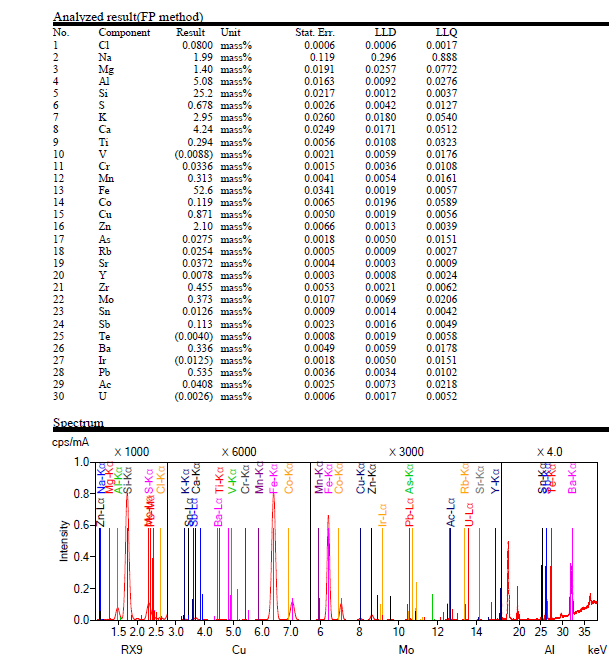
Chemical, mineralogical, and phase analyses of samples derived from flotation tailings were conducted at the Central Analytical Laboratory (CAL) and the laboratory of the Uzbekistan-Japan Youth Center. Samples from the CPP-2 tailings storage facility were collected at various depths; following initial assaying, quartering, and blending, ten separate composite samples were prepared for chemical and mineralogical analysis. The prepared samples were analyzed using a Rigaku NEX CG energy-dispersive X-ray fluorescence spectrometer. Figure 1 shows the spectrum of a pre-blended sample, indicating that the copper content in the technogenic waste is 0.871 wt% [4; 3].
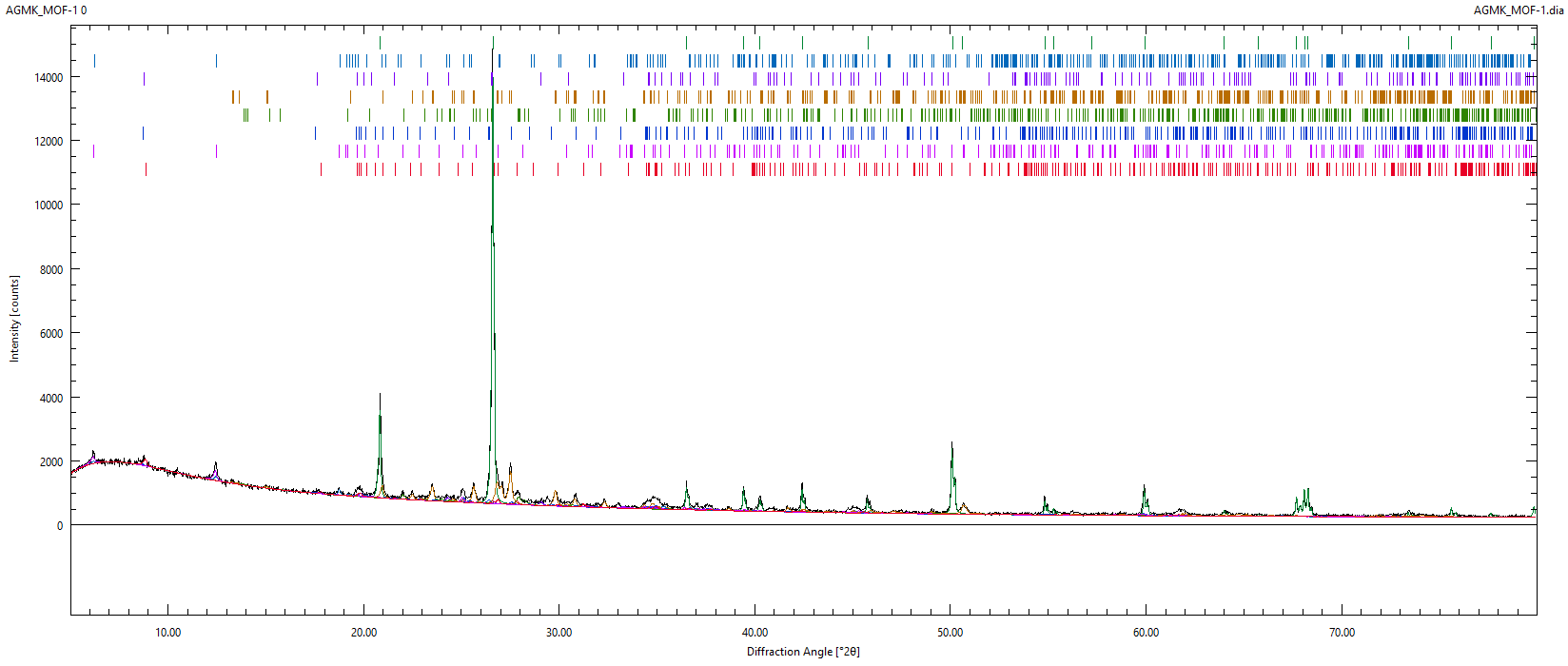
A synthesis of the X-ray phase analysis results reveals that oxide mineralization is closely associated with iron sulfide minerals and remains in the tailings phase rather than partitioning into the concentrate during copper flotation. At the same time, valuable elements such as copper, lead, tungsten, gold, and silver are retained within their composition..
The results of the aforementioned analysis serve as the basis for experiments on the gravity concentration of precious metals using centrifugal concentrators (Knelson KC-MD3, Knelson GX9), leading to the determination of an optimal particle size for the -0.074 mm fraction in the range of 80–85 % [9]..
Extensive research, comprising a series of tests and experiments, led to the development of a new process flowsheet for the two-stage centrifugal concentration of the bulk of the gold, silver, and copper from flotation tailings. The results of the centrifugal beneficiation are presented in Table 1; tests were conducted using identical feed samples while varying the product yield, rotational speed, and water flow rate, thereby establishing a basis for determining the optimal centrifugal beneficiation parameters.
Table 1.
Results of centrifugal beneficiation of CPP-2 tailings (Stage II: Knelson, G=120, water flow rate 5 l/min, particle size -0.074 mm 80 %)
| Products | Mass, g | Yield, % | Content, % | Recovery, % | ||||||
|---|---|---|---|---|---|---|---|---|---|---|
| Au, g/t | Ag, g/t | Cu | Ss | Au | Ag | Cu | Ss | |||
| Results of gravity separation of sample No.5 | ||||||||||
| Concentrate 1 | 220 | 2,2 | 10,63 | 26,96 | 1,72 | 1,46 | 58,44 | 28,24 | 12,22 | 3,37 |
| Concentrate 2 | 210 | 2,1 | 2,77 | 40,22 | 3,63 | 3,37 | 14,54 | 40,22 | 24,56 | 7,45 |
| Lunch concentrate | 430 | 4,3 | 6,79 | 33,43 | 2,65 | 2,39 | 72,98 | 68,46 | 36,78 | 10,82 |
| Tails | 9570 | 95,7 | 0,11 | 0,69 | 0,20 | 0,89 | 27,02 | 31,54 | 63,22 | 89,18 |
| Tailings СС-2 | 10000 | 100 | 0,4 | 2,1 | 0,31 | 0,95 | 100 | 100 | 100 | 100 |
| Results of gravity separation of sample No.6 | ||||||||||
| Concentrate 1 | 198 | 1,98 | 11,47 | 29,93 | 2,46 | 2,51 | 56,78 | 28,22 | 15,71 | 5,24 |
| Concentrate 2 | 242 | 2,42 | 3,18 | 38,28 | 3,62 | 3,55 | 19,25 | 44,11 | 28,27 | 9,04 |
| Lunch concentrate | 440 | 4,4 | 6,91 | 34,52 | 3,10 | 3,08 | 76,03 | 72,33 | 43,98 | 14,28 |
| Tails | 9560 | 95,6 | 0,10 | 0,61 | 0,18 | 0,85 | 23,97 | 27,67 | 56,02 | 85,72 |
| Tailings СС-2 | 10000 | 100 | 0,4 | 2,1 | 0,31 | 0,95 | 100 | 100 | 100 | 100 |
| Results of gravity separation of sample No.7 | ||||||||||
| Concentrate 1 | 200 | 2 | 10,63 | 19,45 | 2,87 | 3,32 | 53,14 | 21,56 | 18,52 | 6,98 |
| Concentrate 2 | 220 | 2,2 | 4,10 | 44,60 | 4,14 | 7,14 | 22,56 | 46,72 | 29,36 | 16,54 |
| Lunch concentrate | 420 | 4,2 | 7,21 | 34,14 | 3,53 | 5,32 | 75,7 | 68,28 | 47,88 | 23,52 |
| Tails | 9580 | 95,8 | 0,10 | 0,70 | 0,17 | 0,76 | 24,3 | 31,72 | 52,12 | 76,48 |
| Tailings СС-2 | 10000 | 100 | 0,4 | 2,1 | 0,31 | 0,95 | 100 | 100 | 100 | 100 |
| Results of gravity separation of sample No.8 | ||||||||||
| Concentrate 1 | 245 | 2,45 | 9,57 | 25,62 | 2,68 | 3,87 | 58,62 | 29,89 | 21,22 | 9,99 |
| Concentrate 2 | 260 | 2,6 | 3,45 | 36,29 | 4,10 | 7,72 | 22,42 | 44,93 | 34,36 | 21,12 |
| Lunch concentrate | 505 | 5,05 | 6,42 | 31,11 | 3,41 | 5,85 | 81,04 | 74,82 | 55,58 | 31,11 |
| Tails | 9495 | 94,95 | 0,08 | 0,56 | 0,15 | 0,69 | 18,96 | 25,18 | 44,42 | 68,89 |
| Tailings СС-2 | 10000 | 100 | 0,4 | 2,1 | 0,31 | 0,95 | 100 | 100 | 100 | 100 |
| Results of gravity separation of sample No.9 | ||||||||||
| Concentrate 1 | 233 | 2,33 | 9,75 | 25,72 | 3,28 | 3,90 | 56,82 | 28,54 | 24,66 | 9,56 |
| Concentrate 2 | 220 | 2,2 | 4,48 | 46,72 | 5,20 | 7,20 | 24,62 | 48,94 | 36,88 | 16,67 |
| Lunch concentrate | 453 | 4,53 | 7,19 | 35,92 | 4,21 | 5,50 | 81,44 | 77,48 | 61,54 | 26,23 |
| Tails | 9547 | 95,47 | 0,08 | 0,50 | 0,12 | 0,73 | 18,56 | 22,52 | 38,46 | 73,77 |
| Tailings СС-2 | 10000 | 100 | 0,4 | 2,1 | 0,31 | 0,95 | 100 | 100 | 100 | 100 |
Gravity separation results for flotation tailings indicate that increasing the water flow rate during the second stage of centrifugal concentration facilitates the effective recovery of silver and copper—owing to their low densities—thereby enhancing the overall recovery rates of these metals. These findings led to the determination of optimal operating parameters for the second gravity separation stage, specifically regarding the adjustment of Knelson concentrator rotor speeds [1].
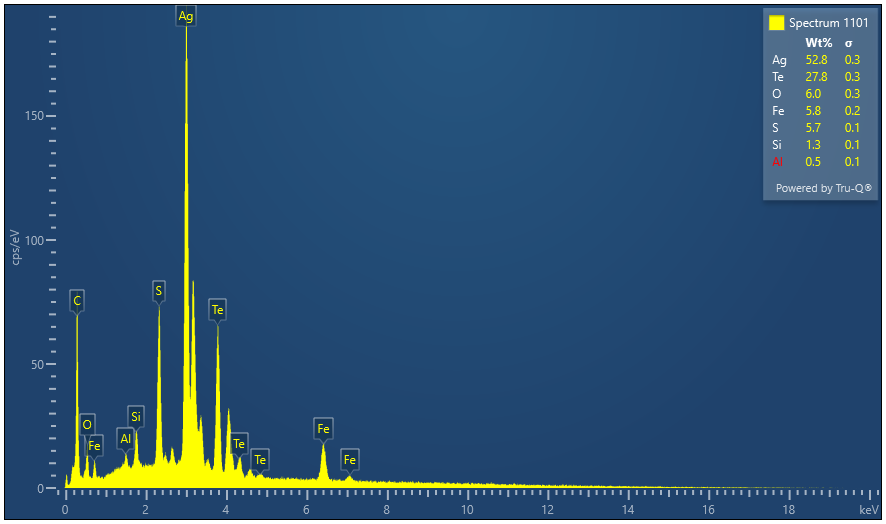
Energy-dispersive analysis and the determination of the mode of occurrence of gold, silver, and copper via SEM and EDS provide a basis for selecting the appropriate method for processing the concentrates. Since, in both cases, gold and silver are present in fine fractions as compounds with tellurium and iron minerals, processing a gravity concentrate of this composition—followed by smelting in converter furnaces—is not viable; this is because such a process results in the loss of precious metals to the slag—the very same pathway by which these metals originally entered the feed material from the CPP-2 tailings..
Results and discussion
In the traditional cyanidation of gravity concentrates derived from copper processing plant tailings, the presence of sulfide minerals (such as pyrite and chalcopyrite) leads to the formation of thiocyanates and increases cyanide consumption. To address this, a new hydrometallurgical processing approach—ammonia-thiosulfate leaching (Cu–NH3–S2O3²-)—was investigated; this method serves as an environmentally safe alternative that exhibits selectivity for gold in the presence of copper. The process mechanism relies on the formation of the stable [Au(S2O3)2]³- complex, with Cu²+ ions acting as an oxidizing catalyst [5]..
Preliminary experiments were conducted using a sodium thiosulfate (Na2S2O3) solution concentration of 0.2–2 M, a solid-to-liquid (S:L) ratio of 1:5, a dissolution time of 1 h, a temperature of 25°C, a stirring speed of 400 rpm, and a pH of 10. The gold content in the initial concentrate was 7.19 g/t, and the silver content was 35.92 g/t..
Our studies on the duration of the leaching process showed that during the first hour of dissolution, the bulk (70–80 %) of the readily soluble gold passes into solution; subsequently, extending the process to 12 hours increases total dissolution by only up to 15 %. Prolonging the process entails additional costs and leads to increased copper dissolution..
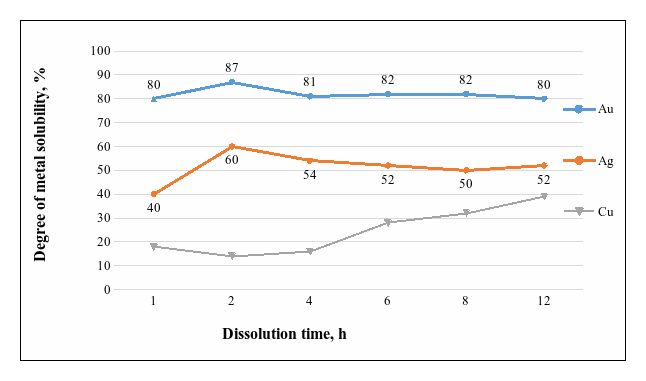
Based on the relationship shown in Figure 4, a duration of 2 hours was selected as the optimal time interval. Applying the identified parameters to the specified experimental conditions yielded the following settings: thiosulfate concentration of 125 g/L S2O3²- and 17 g/L NH3; Cu²+ ion concentration of 25 g/L; stirring speed of 350 rpm; pH 12; pulp density of 10 % (solid-to-liquid ratio 1:10); temperature of 25°C; and dissolution time of 2 hours. The experiments demonstrated that, under these optimized conditions, metal recovery rates into the solution were 87 % for gold, 60 % for silver, and 14 % for copper. In the thiosulfate-ammonia system, gold and silver form anionic complexes ([Au(S2O3)2]³- and [Ag(S2O3)2]³-).
The next task involved the recovery of noble metals from a thiosulfate solution; we selected a sorption method using activated carbon as the sorbent. The sorption capacity of activated carbon is determined by its porous structure and the functional groups (carboxyl, hydroxyl, and carbonyl) present on its surface.
The thiosulfate solutions were obtained after a settling stage; since the pH level significantly influences the sorption process, determining the optimal alkaline environment is a critical factor. Given that the initial solution pH reached 12.0—and in some cases 12.5—our experiments were conducted within the pH range of 9 to 12.5. A 10 g/L sulfuric acid solution was used to lower the pH, while an aqueous NH3 solution was used to raise it..
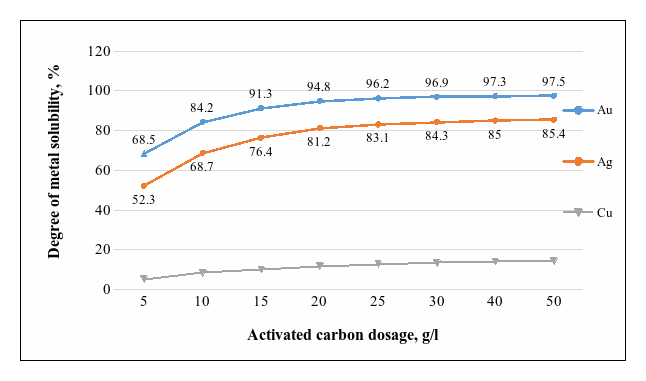
When determining the solution pH, it was necessary to assess the impact on the stability of thiosulfate complexes and, primarily, on the degree of ionization of functional groups on the activated carbon surface. This is because high pH values reduce the extent of sorption by blocking the activated carbon surface, whereas excessively low pH levels lead to the additional decomposition of gold compounds and reduced sorption efficiency due to the destabilization of the thiosulfate solution system.
We investigated a method for the sorption of gold and silver onto activated carbon. This approach relies on the globally established practice of desorbing gold and silver from loaded activated carbon in a highly alkaline medium at elevated temperatures (60–80°C). Using this technology, gold can be transferred into solution as a marketable regenerate (eluate), and an anodic precipitate can be recovered by precipitating the gold and silver from the solution. The resulting high-purity anodic precipitates are melted into an alloy, which serves as the feedstock for producing 99.99 % pure gold and silver ingots via electrolysis [2].
Conclusion
Comprehensive studies have established that the technogenic waste from MOF-2 contains 0.40–0.41 g/t gold, 1.84–2.35 g/t silver, and 0.24–0.4 % copper. The primary processing challenge stems from the distribution of gold and silver—occurring mainly as free particles (10–80 µm) and as fine particles (<20 µm) associated with oxide and sulfide minerals—and the coexistence of copper in both oxide (CuO, Cu2O) and sulfide (chalcopyrite, bornite) forms [7].
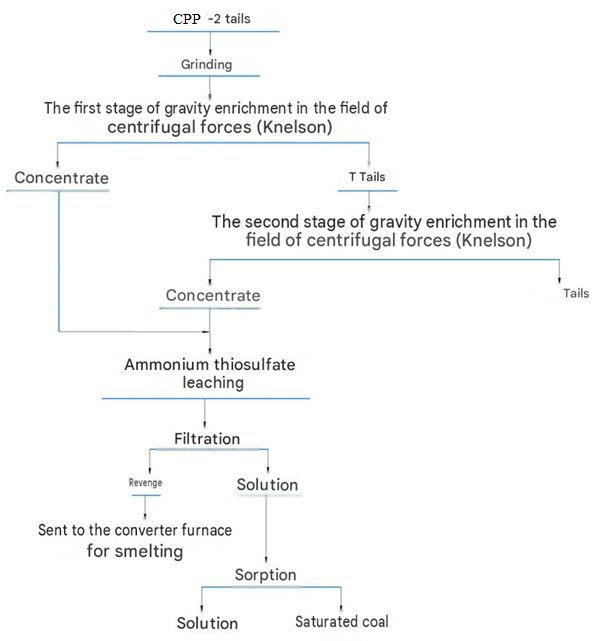
The proposed combined process flow scheme (see Fig. 6) is based on the following fundamental principles:
• primary concentration of gold and silver via gravity separation of tailings;
• selective hydrometallurgical processing of gravity concentrate via ammonia-thiosulfate dissolution;
• sorption of gold and silver from solution using activated carbon;
• recovery of copper from the solution after sorption and regeneration of reagents.
The proposed combined technology (Stage II gravity separation + selective ammonia-thiosulfate leaching) enables the recovery of gold from CPP-2 technogenic waste with an overall recovery rate of 70 %, and up to 60 % for copper.
This technology is cyanide-free, environmentally safe, and cost-effective; it is a scientifically grounded method for the comprehensive processing of man-made waste [4]. Implementing this technology will yield undeniable economic benefits through the additional recovery of valuable components and will improve the environmental situation at sites where man-made waste has accumulated.
References