Adhesion strength of coatings based on hydrolyzed polyacrylonitrile modified with glycerin, dimethylol urea and dibutyl phthalate on a steel substrate
УДК 667.6+620.197
Abstract
The aim of the work was to establish the effect of the synthesis temperature and the content of polyfunctional modifiers on the adhesion strength of protective coatings based on hydrolyzed polyacrylonitrile (HPAN). Compositions containing 50 mL of HPAN, 2–14 mL of glycerin and 1–7 wt.% each of dimethylol urea and dibutyl phthalate were synthesized at 30, 40 and 50 °C, applied by dipping onto St3 carbon steel plates and cured for 48 h at 25 °C. Adhesion was determined by the pull-off method according to GOST 32299-2013 (ISO 4624:2002) and ASTM D4541. At all synthesis temperatures the adhesion strength increases with the modifier content and reaches 588 N/cm2 (5.88 MPa). Raising the synthesis temperature from 30 to 50 °C increases the adhesion of coatings of equal composition only slightly (by 0.7–2.0 %), but narrows the range of compositions that form coatings suitable for testing: at 30 °C such coatings are obtained with up to 10 mL of glycerin, at 40 and 50 °C – only up to 8 mL. Synthesis at 30 °C with an HPAN: glycerin volume ratio of 5: 1 (5 wt.% of dimethylol urea and dibutyl phthalate) is therefore recommended as optimal: it provides the maximum adhesion at the lowest synthesis temperature. The concentration dependences of adhesion are adequately described by polynomial approximations. The results can be used in the development of anti-corrosion coatings for steel structures.
Аннотация
Цель работы – установить влияние температуры синтеза и содержания полифункциональных модификаторов на адгезионную прочность защитных покрытий на основе гидролизованного полиакрилонитрила (ГИПАН). Композиции, содержащие 50 мл ГИПАН, 2–14 мл глицерина и по 1–7 мас.% диметилолмочевины и дибутилфталата, синтезировали при 30, 40 и 50 °C, наносили методом окунания на пластины из углеродистой стали Ст3 и отверждали 48 ч при 25 °C. Адгезию определяли методом отрыва по ГОСТ 32299-2013 (ISO 4624:2002) и ASTM D4541. При всех температурах синтеза адгезионная прочность возрастает с увеличением содержания модификаторов и достигает 588 Н/см2 (5,88 МПа). Повышение температуры синтеза с 30 до 50 °C незначительно увеличивает адгезию покрытий одинакового состава (на 0,7–2,0 %), но сужает область составов, образующих покрытия, пригодные для испытаний: при 30 °C такие покрытия получены при содержании глицерина до 10 мл, при 40 и 50 °C – лишь до 8 мл. Оптимальным признан синтез при 30 °C при объёмном соотношении ГИПАН: глицерин = 5: 1 (по 5 мас.% диметилолмочевины и дибутилфталата), обеспечивающий максимальную адгезию при наименьшей температуре синтеза. Концентрационные зависимости адгезии адекватно описываются полиномиальными аппроксимациями. Результаты могут быть использованы при разработке противокоррозионных покрытий для стальных конструкций.
Keywords: hydrolyzed polyacrylonitrile; adhesion strength; pull-off test; protective coatings; dimethylol urea; synthesis temperature; steel substrate.
Ключевые слова: гидролизованный полиакрилонитрил; адгезионная прочность; метод отрыва; защитные покрытия; диметилолмочевина; температура синтеза; стальная подложка.
Introduction
Corrosion of metal structures causes considerable economic and environmental damage, and polymer coatings remain one of the most widely used means of protection [1-3]. The service life of such coatings is determined primarily by their adhesion strength to the metal substrate, which depends on the chemical nature of the film former, the presence of polar functional groups capable of interacting with the oxidized metal surface, and the level of internal stresses arising during film formation [4-7].
Earlier, our research group developed hydrophobizing, heat-insulating and organosilicon polymer compositions [8-11], as well as multifunctional organomineral coatings and corrosion inhibitors [12]. Hydrolyzed polyacrylonitrile (HPAN), widely used as a reagent in oil production and in gel-forming compositions [13-15], is of particular interest as a film former: alkaline hydrolysis of polyacrylonitrile converts nitrile groups into carboxylate and amide groups [16], which are able both to interact with the metal surface and to take part in cross-linking reactions. In our previous works, film-forming corrosion inhibitors based on HPAN were obtained and the physical and mechanical properties of their films were studied [17-19].
The adhesion of HPAN-based coatings, however, depends strongly on the structure of the polymer matrix formed at the synthesis stage. It can be assumed that the synthesis temperature governs the rate of cross-linking reactions between HPAN, glycerin and dimethylol urea and hence the density of the three-dimensional network, while dibutyl phthalate, acting as a plasticizer, reduces internal stresses in the film. The relationship between the synthesis temperature, the modifier content and the adhesion strength of such coatings has not been studied systematically [20-22].
The aim of this work was to determine the effect of the synthesis temperature (30–50 °C) and of the content of glycerin, dimethylol urea and dibutyl phthalate on the adhesion strength of HPAN-based coatings on carbon steel.
Materials and methods
Hydrolyzed polyacrylonitrile (HPAN) was used as the film-forming base; glycerin, dimethylol urea (DMU) and dibutyl phthalate (DBP) were used as modifiers. The compositions were prepared from 50 mL of HPAN, 2–14 mL of glycerin and DMU and DBP in amounts of 1–7 wt.% each relative to the total mass of the composition (Tables 1–3). Synthesis was carried out at 30, 40 and 50 °C; the temperature was kept constant in order to control the rate of the cross-linking reactions.
Plates of St3 carbon steel served as substrates; before coating they were mechanically cleaned and degreased. The compositions were applied by dipping. To exclude the influence of curing conditions, all coated samples were cured under identical conditions (25 °C, 48 h), so that the differences in adhesion reflect the structure formed during synthesis.
Adhesion strength was determined by the pull-off method in accordance with GOST 32299-2013 (ISO 4624:2002) [13] and ASTM D4541 [1]: aluminum dollies were bonded to the coating, and the maximum tensile force required for detachment was recorded. The results are expressed in N/cm2 (1 N/cm2 = 0.01 MPa). Compositions that did not form a coating suitable for testing are marked «not measurable» in the tables. The experimental dependences were approximated by polynomial regression, and the quality of approximation was assessed by the coefficient of determination R2.
Results and discussion
The adhesion strength of the compositions synthesized at 30 °C is presented in Table 1 and Fig. 1.
Table 1.
Adhesion strength of HPAN-based compositions synthesized at 30 °C as a function of modifier content
| № | HPAN, mL | Modifier content | Adhesion strength, N/cm2 | ||
|---|---|---|---|---|---|
| glycerin, mL | DMU, wt.% | DBP, wt.% | |||
| 1 | 50 | 2 | 1 | 1 | 560 |
| 2 | 50 | 4 | 2 | 2 | 576 |
| 3 | 50 | 6 | 3 | 3 | 579 |
| 4 | 50 | 8 | 4 | 4 | 581 |
| 5 | 50 | 10 | 5 | 5 | 588 |
| 6 | 50 | 12 | 6 | 6 | not measurable |
| 7 | 50 | 14 | 7 | 7 | not measurable |
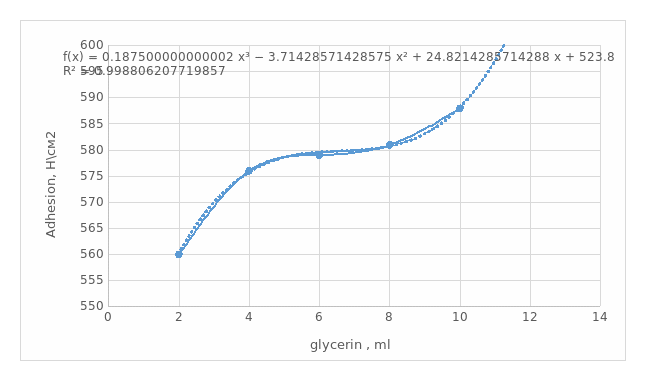
As follows from Table 1, an increase in the glycerin content from 2 to 10 mL (with a simultaneous increase in the DMU and DBP content from 1 to 5 wt.%) raises the adhesion strength from 560 to 588 N/cm2 (5.60–5.88 MPa), i.e. by 5.0 %. The largest gain (16 N/cm2) is observed between the first and second compositions, after which the growth slows down. Compositions containing 12 and 14 mL of glycerin did not form coatings suitable for measurement.
The results obtained for the compositions synthesized at 40 °C are presented in Table 2 and Fig. 2.
Table 2.
Adhesion strength of HPAN-based compositions synthesized at 40 °C as a function of modifier content
| № | HPAN, mL | Modifier content | Adhesion strength, N/cm2 | ||
|---|---|---|---|---|---|
| glycerin, mL | DMU, wt.% | DBP, wt.% | |||
| 1 | 50 | 2 | 1 | 1 | 568 |
| 2 | 50 | 4 | 2 | 2 | 579 |
| 3 | 50 | 6 | 3 | 3 | 581 |
| 4 | 50 | 8 | 4 | 4 | 583 |
| 5 | 50 | 10 | 5 | 5 | not measurable |
| 6 | 50 | 12 | 6 | 6 | not measurable |
| 7 | 50 | 14 | 7 | 7 | not measurable |
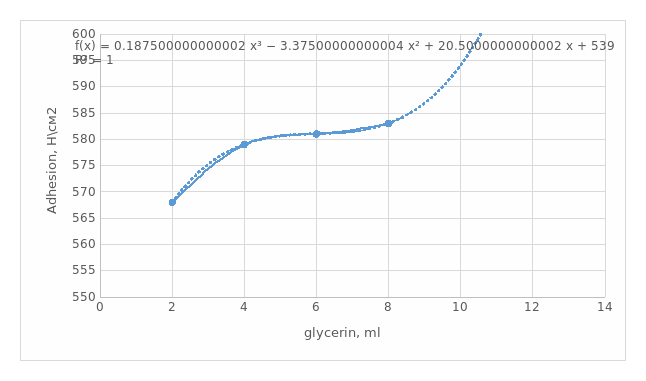
At 40 °C the adhesion increases from 568 to 583 N/cm2 (by 2.6 %) as the glycerin content rises from 2 to 8 mL; for compositions containing 10 mL of glycerin or more the adhesion could not be measured.
The results for the compositions synthesized at 50 °C are presented in Table 3 and Fig. 3.
Table 3.
Adhesion strength of HPAN-based compositions synthesized at 50 °C as a function of modifier content
| № | HPAN, mL | Modifier content | Adhesion strength, N/cm2 | ||
|---|---|---|---|---|---|
| glycerin, mL | DMU, wt.% | DBP, wt.% | |||
| 1 | 50 | 2 | 1 | 1 | 571 |
| 2 | 50 | 4 | 2 | 2 | 580 |
| 3 | 50 | 6 | 3 | 3 | 583 |
| 4 | 50 | 8 | 4 | 4 | 588 |
| 5 | 50 | 10 | 5 | 5 | not measurable |
| 6 | 50 | 12 | 6 | 6 | not measurable |
| 7 | 50 | 14 | 7 | 7 | not measurable |
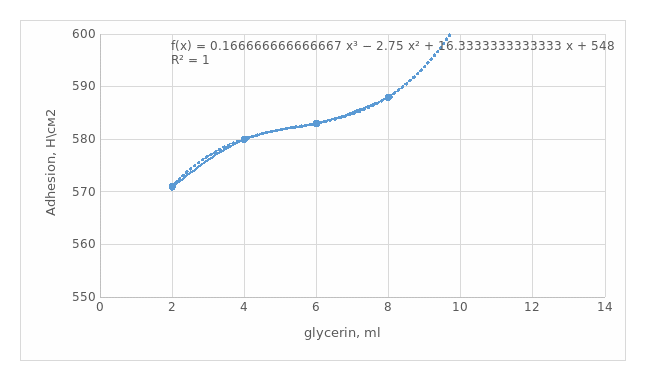
At 50 °C the adhesion grows from 571 to 588 N/cm2 (by 3.0 %) in the range of 2–8 mL of glycerin; compositions with 10 mL of glycerin or more were not measurable.
Comparison of Tables 1–3 reveals two opposite effects of the synthesis temperature. At equal composition, increasing the temperature from 30 to 50 °C slightly increases adhesion (by 0.7–2.0 %; e.g., from 560 to 571 N/cm2 for the composition with 2 mL of glycerin). At the same time, the range of compositions that form measurable coatings becomes narrower: at 30 °C coatings are obtained with up to 10 mL of glycerin, whereas at 40 and 50 °C – only up to 8 mL. The maximum adhesion (588 N/cm2) is achieved both at 30 °C with 10 mL of glycerin and at 50 °C with 8 mL of glycerin.
These regularities can be explained by cross-linking of the HPAN macromolecules. DMU, as a polyfunctional cross-linking agent, reacts with the carboxyl and amide groups of HPAN and with the hydroxyl groups of glycerin to form a three-dimensional network; a moderate increase in the network density raises the cohesive strength of the film and, consequently, the measured pull-off strength [3; 18]. DBP plasticizes the network and reduces internal stresses at the polymer–metal interface. A higher synthesis temperature accelerates cross-linking, so that at a high modifier content the composition presumably reaches the gel state before application, which prevents the formation of a continuous coating. This is consistent with the results of our earlier studies of HPAN-based films [4; 7]. Confirmation of this mechanism requires additional structural studies (IR spectroscopy, determination of the gel fraction).
The concentration dependences of adhesion are approximated by polynomials (Fig. 1–3). For 30 °C (five experimental points) the third-order polynomial gives R2 = 0.999. For 40 and 50 °C only four experimental points are available, so a third-order polynomial passes through all of them exactly; a second-order polynomial gives R2 = 0.970 and 0.979, respectively, which confirms the regular character of the dependences.
Taking into account both the adhesion value and the width of the working range of compositions, synthesis at 30 °C with an HPAN: glycerin volume ratio of 5: 1 is optimal: it provides the maximum adhesion (588 N/cm2) at the lowest synthesis temperature.
Conclusion
1. The adhesion strength of coatings based on HPAN modified with glycerin, dimethylol urea and dibutyl phthalate on St3 steel was determined by the pull-off method according to GOST 32299-2013 (ISO 4624:2002). At all synthesis temperatures (30–50 °C) the adhesion increases with the modifier content and reaches 588 N/cm2 (5.88 MPa).
2. Raising the synthesis temperature from 30 to 50 °C increases the adhesion of coatings of equal composition by 0.7–2.0 %, but narrows the range of compositions forming measurable coatings from 10 to 8 mL of glycerin per 50 mL of HPAN.
3. The optimal conditions are synthesis at 30 °C and the composition 50 mL of HPAN, 10 mL of glycerin, 5 wt.% of DMU and 5 wt.% of DBP (HPAN: glycerin = 5: 1), which provide an adhesion strength of 588 N/cm2.
4. The compositions obtained are promising as film-forming anti-corrosion coatings for steel; further work should be aimed at studying their corrosion resistance and network structure.
References