Chemical and microbiological aspects of water retting for fiber extraction from industrial Cannabis stems
УДК 633.522+579.64+677.021.16
Abstract
The objective of this study was to establish a suitable duration of water retting for fiber extraction from industrial Cannabis stems, taking into account pectin removal and changes in cellulose content. Stems were immersed in water and examined after 3, 5, and 7 days. Pectin determination involved extraction with ammonium oxalate and oxalic acid, ethanol precipitation, and gravimetric measurement. Cellulose content was assessed separately. Chemical analyses were complemented by measurements of dissolved oxygen and pH and microbiological examination of the retting water. Between days 3 and 5, pectin content decreased from 8.5 % to 3.1 %, equivalent to a relative reduction of 63.5 %; the corresponding decrease in cellulose content was 8.2 %, from 49 % to 45 %. Further retting produced a different pattern. By day 7, pectin content had declined only to 2.7 %, whereas the cellulose fraction had fallen to 37 %. Bacillus, Pseudomonas, and Paenibacillus were detected on days 3 and 5. The detection of Cellulomonas and Aspergillus on day 7 coincided with the greater decline in cellulose content. Dissolved oxygen decreased from 8.2 to 1.5 mg/L over the observation period, accompanied by a pH decrease from 7.5 to 4.5. Five days was selected as the appropriate duration under the experimental conditions: fiber bundles could be separated mechanically from the woody core, while extending treatment yielded limited additional pectin removal and a larger decrease in cellulose content.
Аннотация
В работе изучались, изменение химического состава стеблей технической конопли и микробиологическая среда при водной мацерации. Задачей процесса являлось установление рациональной продолжительности обработки, при которой волокно отделяется без лишних потерь. Контролирование процессом проводилось систематическим измерением количества пектина, целлюлозы, растворенного кислорода, pH, а также слежением за тем, какие бактерии и грибы появляются в воде.
На третьи-пятые сутки наблюдались снижение пектина с 8,5 до 3,1 %, то есть на 63,5 % и целлюлозы с 49 до 45 %, то есть на 8,2 %. Повышение продолжительности замачивания до семи суток приводило к снижению пектина еще на 12,9 %, но целлюлоза при этом разрушалась заметно больше, уже на 17,8 %. На третьи и пятые сутки в воде обнаружены Bacillus, Pseudomonas и Paenibacillus. На седьмые сутки к ним добавились Cellulomonas и Aspergillus. Также, за этот период наблюдалось снижение кислорода с 8,2 до 1,5 мг/л, pH - с 7,5 до 4,5. Вышеуказанные результаты наблюдений привели к выводу, что пять суток обработки являются достаточными. К этому моменту пектиновые связи ослаблены настолько, что волокно отделяется от древесины механически. Установлено, что продолжение процесса дольше смысла не имеет, т.к. целлюлоза начинает разрушаться слишком быстро. Полученные данные дают экспериментальную основу для выбора режима мацерации при переработке конопляного волокна.
Keywords: Industrial cannabis; maceration; water retting; pectin content; cellulose content.
Ключевые слова: Техническая конопля; мацерация; мочка; содержание пектина; содержание целлюлозы.
Introduction
The global development of the textile industry is driving the need to expand sources of fibrous raw materials and create a diverse product assortment. According to the «Materials Market Report 2025» by Textile Exchange, global fiber production reached 125 million tonnes in 2023 and rose to 132 million tonnes in 2024. This expansion in production scale highlights the urgency of securing textile raw material supplies not only through existing sources but also by developing alternative fiber resources. At the same time, the dominance of synthetic materials derived from fossil fuels in the fiber market underscores the importance of research focused on utilizing renewable sources [1].
In the current context, developing new product assortments involves not merely replacing existing fibers entirely, but rather complementing their properties with other fibrous components and expanding their range of applications. Extracting fibers from alternative plant sources for use in yarn and fabric production allows for the diversification of raw material composition while simultaneously enabling control over the structure and performance characteristics of the finished products. The practical value of the raw material in these processes depends on the efficiency of fiber extraction, purification, and preparation for subsequent processing. Consequently, alongside creating new fiber assortments derived from industrial cannabis, it is crucial to refine the processing technologies involved [2].
Industrial Cannabis is an annual plant characterized by cellulose-rich bast fibers located in the outer layer of its stalk. These fibers do not exist in isolation within the stalk but rather occur as bundles integrated with the plant's tissues. Pectin-based intercellular layers and other non-cellulosic components facilitate the bonding of these fibers. Therefore, obtaining fiber suitable for textile applications requires separating the bundles from the woody core of the stalk, followed by purification and refinement (thinning) to the necessary degree. The maceration process facilitates the initial task of separating the fiber bundles from the woody part of the stem, while subsequent mechanical and necessary chemical or enzymatic treatments shape the fiber properties to meet product requirements [3].
Biological maceration is based on the breakdown of connective tissues surrounding fiber bundles through the action of microbial enzymes. Typically, the process is carried out in the field, where the harvested plants are spread out; moisture, temperature, and the activity of microorganisms colonizing the stem surface play crucial roles in this process. During maceration, the degradation of pectic substances weakens the adhesion between tissues. The efficiency of the process depends not merely on the overall extent of degradation, but rather on which structural components are targeted. Specifically, the degradation must be selective: the pectin acting as the binding element should be broken down without damaging the cellulose structure or negatively affecting fiber quality [4].
In recent years, water-based retting processes have also been extensively studied. Notably, a significant approach to controlling water-based maceration was demonstrated in a study by Di Candilo et al. The authors showed that the natural retting process could be accelerated and the quality of the resulting fiber improved through the combined use of selected aerobic and anaerobic pectinolytic bacteria. The scientific significance of the work lies not only in the reduction of processing time but also in the evaluation of the biological treatment results in relation to the condition of the fiber during subsequent mechanical processing. Fibers treated with selected strains were better preserved during the carding process. This result indicates that sufficiently weakening pectin bonds can reduce damage occurring during subsequent mechanical processing [5].
Zhang et al. investigated the dependence of maceration on the aqueous medium and experimentally evaluated the feasibility of using seawater. In the study, a reduction in pectin and hemicellulose content was observed alongside the cleaning of the fiber surface and the separation of fiber bundles. The complementary nature of the results from chemical analysis, infrared spectroscopy, and electron microscopy allowed the process to be explained through structural and morphological evidence, rather than relying solely on changes in external appearance. The authors also isolated bacteria exhibiting pectinolytic activity; however, the use of a single pure culture failed to achieve complete maceration. This result demonstrates that replicating the overall technological efficiency of a complex microbial community is not equivalent to identifying a single enzyme-producing microorganism. While the study by Di Candilo et al. demonstrated the practical efficacy of a selected strain combination, the experiments conducted by Zhang et al. highlighted the combined importance of microbial community composition and environmental characteristics [5, 6].
The approach to maceration at the microbial community level-extending beyond the scope of individual strains-was further developed in the study by Ribeiro et al. By characterizing the bacteria and fungi on Cannabis stalks undergoing field retting using molecular methods, the authors determined that while similar microorganisms are present in various samples, their relative proportions differ depending on soil type, harvest time, and the duration of maceration [7].
The shift from analyzing microorganism composition to examining their functional impact is clearly demonstrated in the study by Liu et al. The authors compared traditional field retting with a controlled treatment using the fungus Phlebia radiata Cel 26, which possesses low cellulose-degrading capability. The study jointly evaluated enzymatic activity, fiber chemical composition, and the mechanical properties of fiber-based composites. It was shown that controlled fungal treatment achieved pectin removal and preservation of the cellulosic component more rapidly than field retting. This research indicates that high biological activity alone is insufficient for retting; the selectivity of enzymatic action is of decisive importance [4]. While Di Candilo et al. improved suitability for mechanical processing through bacterial control, Liu et al. deepened the understanding of the enzymatic basis for such control [5,6].
The study by Placet, Day, and Beaugrand provided significant insight into the impact of retting on fiber quality. Following uncontrolled field retting, a deterioration in mechanical properties was observed, alongside a shortening of fiber elements and a reduction in pectinaceous substances. A significant decrease in the total cellulose content was observed, and the authors attributed the decline in mechanical properties to the degradation of hemicelluloses and a reduction in the crystalline cellulose fraction. This result challenges the simplistic interpretation that fiber purification based on pectin degradation inevitably leads to increased strength. Relative enrichment in chemical composition, bundle thinning, and structural integrity are not equivalent parameters. While the study by Liu et al. demonstrated the benefits of selective biological treatment, Placet et al. found that uncontrolled processing can lead to simultaneous external purification and internal structural damage [8].
Subsequent research by Ventorino et al. showed that the prior processing history of the stalk also influences the results of water retting. The authors compared stalks that had undergone preliminary field retting with those subjected to a laboratory water-retting process. Samples that had not undergone preliminary field retting developed a relatively homogeneous microbial community characterized by higher pectinolytic activity. These findings indicate that the sequential application of two biological stages-field retting and water retting-does not automatically enhance their beneficial effects. The scientific contribution of the work lies in demonstrating the importance of the artificial selection of microorganisms during both the initial field-based soaking and the subsequent soaking in an aqueous medium. However, since the addition of nutrient components for these microorganisms was carried out under laboratory conditions, directly transferring this technology to the industrial-scale water-based process presents several challenges. Nevertheless, the research substantiates the view that treating water-based maceration as a stage independent of the stalk's prior condition is incomplete [9].
The present study aimed to determine a suitable duration of water retting for the mechanical separation of fiber bundles from industrial Cannabis stems while limiting the decline in cellulose content. Three treatment periods were compared: 3, 5, and 7 days. Changes in pectin and cellulose contents were examined alongside the occurrence of bacteria and fungi in the retting water, with dissolved oxygen and pH measurements providing additional information on the processing medium. The choice of treatment duration was based on the extent of pectin removal, changes in the cellulose fraction, and the observed separability of fiber bundles from the woody core.
Materials and methods
Stems of freshly harvested industrial Cannabis plants were selected as the research material. A water maceration method was employed to evaluate the degradation of pectic compounds and changes in cellulose content within the stems.
Retting to separate the fibrous component from the industrial Cannabis stem.
Technical Cannabis stalks, after harvesting, are trimmed into sizes of 20 to 80 cm and go through the process of retting. This process takes place in an open container within the temperature range of 18°C to 40°C in a duration of 2 to 7 days. The processing medium is monitored once daily at a fixed time.
Extraction of extractive substances.
To determine the content of extractive substances, samples prepared from air-dried technical Cannabis raw material were extracted in a Soxhlet-type extractor using acetone as the solvent.
The sample, pre-dried to a constant mass, was placed in an extraction thimble, and a sufficient volume of acetone was added. The extraction process was conducted for 6 hours. The heating rate was adjusted to ensure a solvent cycle frequency of six times per hour.
After the process of extraction had been completed, the solvent was then removed, and the left-over solid material was dried in an oven at 60oC until a constant weight was attained. The percentage of extractives was then determined by comparing the initial and final weights of the samples.
The content of extractives was determined using the following formula:
where:
m1 - is the mass of the sample before extraction, g;
m2 - is the mass of the dried sample after extraction, g.
Measurement of the pectin content.
For the selective extraction of pectins from the biomass and fibers of the technical Cannabis plant, an extractant on the basis of the ammonium oxalate-oxalic acid system was used, which allows converting insoluble salts of calcium pectates into the soluble form.
In the course of the experiment, a sample of 50 g of air-dried and powdered biomass was measured and put into a flask that withstands heating. The reagent consisting of 0.5 % ammonium oxalate and 0.5 % oxalic acid in equal volumes was added to the biomass (solid-to-liquid ratio 1:10). Extraction took place in a water bath at 70-75°C within 2 hours with stirring. To completely extract pectic substances, this procedure was performed twice.
The liquid phase thus obtained was separated from the solid by filtration. The resulting solution underwent dialysis through a semipermeable membrane for the removal of salts and reagents of low molecular weight. The dialysis went on till neutralization of pH was attained, with replacement of dialysis water three times a day. The concentrate was obtained from the dialyzate under conditions of reduced pressure with the help of the rotary evaporator. The extraction solution was treated with 85 % ethyl alcohol at a ratio of 1:3 (solution to alcohol) to precipitate the pectin. The precipitate was isolated by centrifuging, washed with 96 % alcohol, and dried in a drying chamber to a constant weight. The mass fraction of the pectin substance was determined according to the following formula:
where:
m0 – initial sample mass, g;
mp – mass of the dried pectin fraction, g.
Results and discussion
In the bast fibers of industrial hemp stems, cellulose microfibrils within the cell wall form a complex structure in which they are bound with hemicellulose, lignin, and pectic substances (Figure 1). While cellulose microfibrils provide the fiber's primary structural support, non-cellulosic components contribute to maintaining the integrity of this structure and ensuring intercellular bonding.
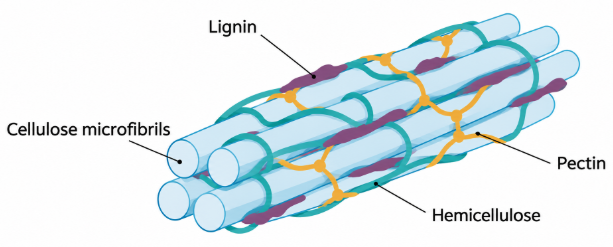
Despite the relatively low pectin content in the plant stem, it encapsulates the primary layer of the cell wall. Therefore, a water-retting process was investigated to break down the pectin and separate the fibers from each other and from the woody core. This process was carried out by fully immersing the plant stems in water.
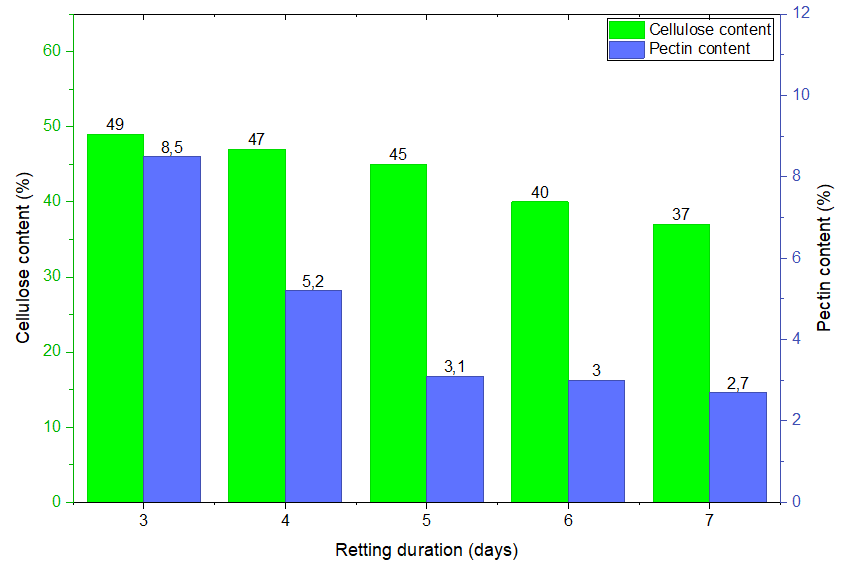
Figure 2 presents the effect of water maceration duration on the pectin and cellulose content of industrial Cannabis stems; it was observed that between the 3rd and 5th days of the process, the pectin content decreased from 8.5 % to 3.1 %, representing a 63.5 % reduction relative to the value on the third day. During this period, the cellulose content decreased from 49 % to 45 % - a reduction of 8.2 %. This indicates that the decrease in the pectin fraction proceeded more rapidly than that of the cellulose at this stage.
Transition to seven days of maceration caused the decrease of pectin content from 3.1 percent to 2.7 percent, which is equal to a decrease of 12.9 percent in comparison to the pectin content on the fifth day. At the same time, there was a decrease in the percentage of cellulose from 45 % to 37 %, which equals 17.8 percent in comparison to the value registered on the fifth day. From these data it became clear that the changes in the composition of stems do not occur at the same pace in the first and later phases of maceration. In order to study the connection between these changes and microbiological factors, researches were performed aimed at the identification of bacteria and fungi present during maceration and determination of their composition; these results are presented in Table 1.
Table 1.
Types of bacteria and fungi identified at various stages of the maceration process
| Microorganisms | Identified microorganisms | ||
|---|---|---|---|
| Day 3 | Day 5 | Day 7 | |
| Identified bacteria | |||
| Bacillus | + | + | |
| Clostridium | + | + | |
| Pseudomonas | + | + | |
| Cellulomonas | + | ||
| Paenibacillus | + | + | |
| Identified fungi | |||
| Stemphylium | + | + | |
| Cladosporium | + | + | |
| Alternaria | + | ||
| Aspergillus | + | ||
Microbiological analysis results revealed changes in the composition of microorganisms identified during the water maceration process. Bacteria belonging to the genera Bacillus, Pseudomonas, and Paenibacillus were detected on the 3rd and 5th days of the process. Literature indicates that representatives of these genera produce pectinase, xylanase, and other hydrolytic enzymes [10-12]. The emergence of microorganisms at this stage is associated with the rapid reduction in the amount of pectin from the 3rd to 5th days, which indicates their possible role in the decomposition of pectic substances.
Microorganisms of the genus Clostridium appeared on the 5th and 7th days, whereas microorganisms of the genus Cellulomonas were detected on the 7th day. The representatives of these genera are distinguished by pectinolytic activity and cellulolytic activity, respectively. It is important to note that the appearance of the bacteria of the genus Cellulomonas during the later stage of the process was accompanied by a decrease in cellulose, which suggests the participation of cellulose enzymatic destruction [13].
There were differences in the fungi depending on the time of the soaking period; namely, the fungi Stemphylium and Cladosporium were found on the 3rd and 5th days, respectively, Alternaria was found on the 5th day, and Aspergillus was found on the 7th day. It has been found from literature sources that the fungi of the first three generations secrete pectinases and hemicellulases, whereas Aspergillus secretes pectinases, hemicellulases, and cellulases [14-17].
To investigate the dynamics of microorganism development during this process, the dissolved oxygen content and pH of the water containing plant stems were analyzed; the results are presented in Table 3.6.
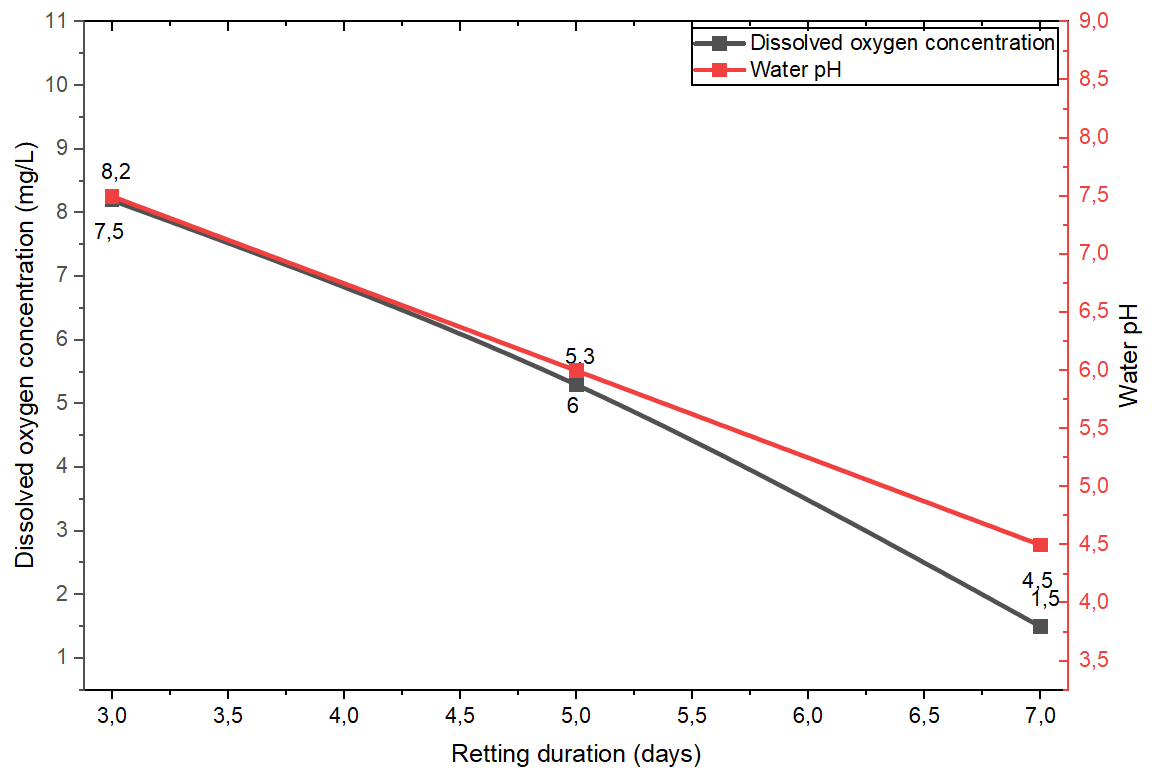
From the information, it is evident that the time taken for the process has a significant impact on the physical and chemical characteristics of the water such as the oxygen concentration and pH. Between days 3 – 5, there was a drop in the dissolved oxygen concentration from 8.2 mg/L to 5.3 mg/L (35.4 %) and the pH value changed from 7.5 to 6.0. In this experiment, the occurrence of pectinolytic bacteria is related to the drop in the pectin concentration.
By the seventh day, the oxygen concentration had fallen to 1.5 mg/L and the pH to 4.5; according to the microbiological analysis data, this stage saw the appearance of Cellulomonas and Aspergillus microorganisms. Their presence was observed concurrently with a decrease in the cellulose fraction from 45 % to 37 % between days 5 and 7, indicating the activity of cellulolytic microorganisms at this stage of the process.
Acetic acid (CH3COOH) and other organic acids are produced during the enzymatic breakdown of polymers by microorganisms associated with the plant material. In this process, polysaccharides undergo enzymatic degradation, first converting into ethanol, which is subsequently oxidized into acetic acid:
The resulting acetic acid dissociates in water, increasing the concentration of hydrogen ions (H+) in the medium:
Such conditions provide an ideal ground for the bacterial activities. A slightly acid environment is the physiological environment for bacteria where there is a good process of ions transfer through the cell membranes as well as the stabilization of the enzymatic systems. At such pH, all the bacterial hydrolytic enzymes including pectinase, polygalacturonase, xylanase, and ligninase exhibit maximal activity since the ionization of their active sites takes place under acidic conditions. This results in the increasing rate of the polymer hydrolysis and, therefore, fiber disintegration. The H+ ions produced in the slightly acidic environment create the proton gradient across the cell membrane and, hence, increase the ATP production in bacteria. Therefore, a slightly acidic environment is the main environmental determinant of the efficiency of the retting process.
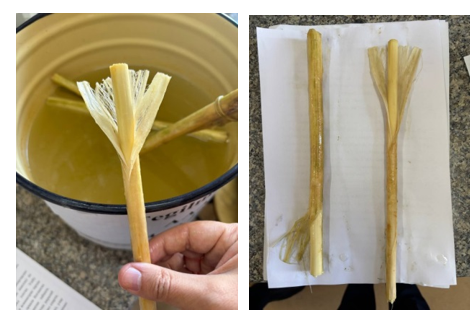
Based on the obtained results, a duration of 5 days was selected for the water maceration of industrial Cannabis stalks. At this stage, there was a reduction in the pectin content to 3.1 %, weakening of the bond between the fiber bundles and the wood component of the stalk, and easy separation mechanically. The termination of the process at the fifth day enabled us to minimize the sharp decrease in the cellulose content that occurred at the later stages.
Conclusion
The study results revealed that the duration of water maceration for industrial Cannabis stalks has varying effects on pectin and cellulose content. From the 3rd to the 5th day of maceration, pectin content was reduced from 8.5 % to 3.1 %, which is a decrease of 63.5 %, and the cellulose content dropped by 8.2 %. Extending maceration duration from 5 to 7 days was followed by the additional decrease in pectin content by 12.9 % and cellulose content by 17.8 %.
As follows from the data obtained from the microbiological investigation, during maceration there was the presence of microorganisms which destroy pectin at the initial stages, and microorganisms which destroy cellulose on the 7th day of maceration from the groups of Bacillus, Pseudomonas, Paenibacillus, Cellulomonas, and Aspergillus. This process was accompanied by the decrease in the concentration of dissolved oxygen from 8.2 to 1.5 mg/L and pH from 7.5 to 4.5. Based on changes in chemical composition and the degree of fiber separation, a maceration duration of five days was selected. Within this timeframe, the weakening of pectin bonds facilitated the mechanical separation of fiber bundles from the woody part of the stem. Concluding the process on the fifth day made it possible to avoid the sharp decline in cellulose content observed with longer processing times and to prepare the fibrous raw material for subsequent processing.
References