Doctor of Technical Sciences, Professor Namangan State Technical University Islam Kаrimоv Street, Republic of Uzbekistan, Namangan
E-mail: sobirjonrsj@gmail.com

УДК 666.3+553.6
The study investigates the effect of bentonite clay addition on the compressive strength of ceramic bricks produced from locally available clay raw materials. Bentonite was incorporated into the ceramic mixture at contents ranging from 3 to 30 % with an increment of 3 %. Experimental brick specimens were prepared and tested to evaluate the influence of bentonite content on their compressive strength. The results demonstrated that the addition of bentonite up to 12 % significantly improved the strength characteristics of the ceramic bricks. At a bentonite content of 12 %, the compressive strength reached 84.0 kg/cm², compared with 67.2 kg/cm² for the control specimen, corresponding to an increase of approximately 25 %. Further increasing the bentonite content resulted in a gradual reduction in compressive strength. At 30 % bentonite, the compressive strength decreased to 58.2 kg/cm², which was 13.4 % lower than the control value. The observed increase in strength at moderate bentonite contents can be attributed to the fine and highly dispersed structure of bentonite, which contributes to filling interparticle voids and improving the density of the ceramic mass during firing. At higher contents, increased water absorption, drying shrinkage, and the formation of internal microcracks may adversely affect the mechanical properties. Based on the experimental results, 12 % bentonite was identified as the optimal content. The findings demonstrate the potential of bentonite as an effective mineral additive for improving the compressive strength and optimizing the composition of ceramic bricks produced from locally available clay raw materials.
В статье исследовано влияние добавки бентонитовой глины на прочность при сжатии керамического кирпича, изготовленного на основе местного глинистого сырья. Бентонит вводился в состав керамической массы в количестве от 3 до 30 % с шагом 3 %. Были изготовлены и испытаны экспериментальные образцы кирпича для оценки влияния содержания бентонита на их прочность при сжатии. Результаты исследований показали, что увеличение содержания бентонита до 12 % способствует значительному повышению прочностных характеристик керамического кирпича. При содержании бентонита 12 % прочность при сжатии достигла 84,0 кг/см² по сравнению с 67,2 кг/см² у контрольного образца, что соответствует увеличению примерно на 25 %. Дальнейшее повышение содержания бентонита приводило к постепенному снижению прочности. При содержании бентонита 30 % прочность при сжатии снизилась до 58,2 кг/см², что на 13,4 % ниже контрольного значения. Повышение прочности при умеренном содержании бентонита может быть связано с его тонкодисперсной структурой, способствующей заполнению межчастичных пустот и уплотнению керамической массы в процессе обжига. При повышенном содержании бентонита увеличение водопотребности, усадка при сушке и образование внутренних микротрещин могут отрицательно влиять на механические свойства кирпича. На основании экспериментальных результатов оптимальным содержанием бентонита определено 12 %. Полученные результаты подтверждают перспективность применения бентонита в качестве эффективной минеральной добавки для повышения прочности при сжатии и оптимизации состава керамического кирпича на основе местного глинистого сырья.
Keywords: ceramic brick; clay raw material; bentonite; clay raw material compressive strength; clay.
Ключевые слова: керамический кирпич; глинистое сырье; бентонит; плотность глинистого сырья; прочность при сжатии; глина.
Ceramic brick is one of the most widely used wall-building materials in construction due to its relatively low cost and the possibility of producing it from locally available raw materials. The long-term reliability of buildings and structures largely depends on the mechanical strength, deformation characteristics, water resistance, and durability of bricks under environmental influences [1, 2]. Therefore, improving the physical and mechanical properties of ceramic bricks, efficiently utilizing local raw materials, and determining optimal compositions are important scientific and practical tasks [2, 3, 5]. In the production of ceramic bricks, the technological and performance properties of the material can be controlled by incorporating various mineral additives into the raw material composition [3, 4, 10]. Bentonite clay, in particular, is characterized by a high content of montmorillonite minerals, high dispersity, and binding properties. These characteristics of bentonite may positively influence the interaction between particles in the ceramic mixture, improve the molding process, and contribute to the formation of a dense and strong structure during firing [6, 8].
However, when the amount of bentonite additive is excessively increased, the optimal ratio of mineral components in the ceramic mixture may be disturbed, leading to increased volumetric changes during drying and firing and, consequently, a reduction in the mechanical properties of the bricks [7, 8, 10]. Therefore, not only the presence of bentonite but also the determination of its optimal content is of considerable importance [6, 10]. Establishing the optimal content can make it possible to produce ceramic bricks with higher strength from locally available raw materials while improving production efficiency [3, 6]. Uzbekistan has considerable potential for using locally available soils and clay raw materials in the production of construction materials. At the same time, the mineralogical and chemical composition of local raw materials varies depending on the region [5, 9]. Therefore, it is necessary to experimentally determine the optimal amount of mineral additives incorporated into such raw materials. In particular, evaluating the effect of different amounts of bentonite clay added to a ceramic mixture based on local soil on the compressive strength of bricks is of practical significance [6].
The main objective of this study is to determine the effect of incorporating different amounts of bentonite clay into ceramic bricks produced from local soil on their physical and mechanical properties and to establish the optimal bentonite content that ensures adequate compressive strength. Within the framework of the study, specimens containing different amounts of bentonite were prepared, and their strength characteristics were compared with those of a control specimen. The results of this study can provide a scientific and practical basis for optimizing the composition of ceramic bricks produced from locally available raw materials with bentonite additives, improving their mechanical strength, and enhancing the technology for manufacturing construction materials. The novelty of this research is the establishment of the optimum amount of bentonite in the production of ceramic bricks from local loess clay soil of the Kosonsoy region (Uzbekistan). The present study is a new research that sets the bentonite dosage which gives the highest compressive strength with this local raw material in industrial production conditions, unlike the previous ones carried out on other clay deposits and raw materials
During the experimental study, local clay soil was used as the main raw material, while bentonite was used as additional components. The material consumption required for the production of 1,000 conventional ceramic bricks is presented in Table 1.
Table 1.
Material consumption for the production of 1,000 bricks
| Material/Parameter | Unit | Value |
|---|---|---|
| Soil | m³ | 2.7 |
| Soil density | kg/m³ | 1640 |
| Soil mass | kg | 4428 |
| Ordinary water | L | 886 |
A comprehensive study was conducted to evaluate the effect of partially replacing the local clay soil with bentonite at contents of 3, 6, 9, 12, 15, 18, 21, 24, 27, and 30 % on the physical and mechanical properties of the bricks, particularly their compressive strength. During the study, changes in brick density, porosity, and strength characteristics with increasing bentonite content were evaluated, with the aim of determining the optimal bentonite content. The specimens were prepared in accordance with ГОСТ 530 – 2012, “Ceramic Bricks and Stones,” based on the applicable international standard [11]. The raw material compositions used for the brick specimens are presented in Table 2.
Table 2.
Raw material composition of the brick specimens
| Series | Bentonite (%) | Bentonite (kg) | Soil (kg) | Total dry mass (kg) | Ordinary water (L) | Number of specimens |
|---|---|---|---|---|---|---|
| T | - | - | 4.428 | 4.428 | 0.886 | 15 |
| T-B-3 | 3 | 0.133 | 4.295 | 4.428 | 0.886 | 15 |
| T-B-6 | 6 | 0.266 | 4.162 | 4.428 | 0.886 | 15 |
| T-B-9 | 9 | 0.399 | 4.029 | 4.428 | 0.886 | 15 |
| T-B-12 | 12 | 0.531 | 3.897 | 4.428 | 0.886 | 15 |
| T-B-15 | 15 | 0.664 | 3.764 | 4.428 | 0.886 | 15 |
| T-B-18 | 18 | 0.797 | 3.631 | 4.428 | 0.886 | 15 |
| T-B-21 | 21 | 0.930 | 3.498 | 4.428 | 0.886 | 15 |
| T-B-24 | 24 | 1.063 | 3.365 | 4.428 | 0.886 | 15 |
| T-B-27 | 27 | 1.196 | 3.232 | 4.428 | 0.886 | 15 |
| T-B-30 | 30 | 1.328 | 3.100 | 4.428 | 0.886 | 15 |
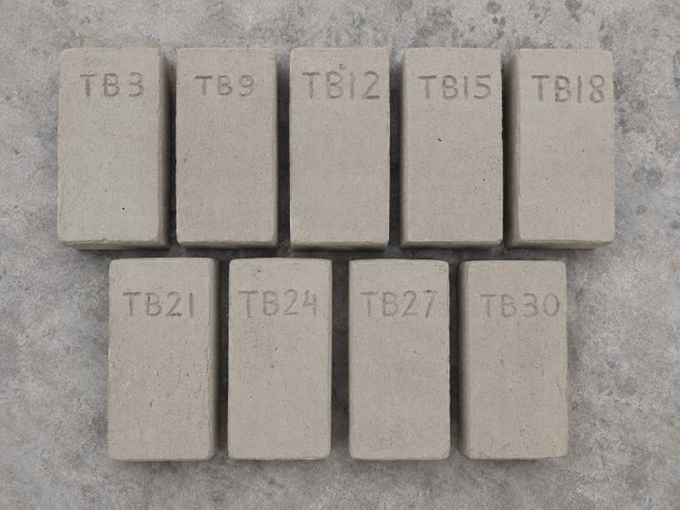
The preparation and firing of the specimens were carried out mainly at the “Komiljon Muminov” private enterprise, located in Kosonsoy District, which specializes in the production of bricks. The experimental brick specimens were prepared in accordance with the applicable standards using molds with standard dimensions of 250 × 120 × 65 mm. A total of 11 series of experimental specimens were produced to determine the compressive strength characteristics of conventional ceramic bricks. The specimens were dried under natural conditions. Natural drying was carried out indoors for 7 days. During the drying period, the air temperature was maintained at 20–30 °C, with a relative humidity of 60–75 %. The bricks were stored under conditions protected from direct sunlight. The general appearance of the specimens dried under natural conditions is shown in Figure 1.
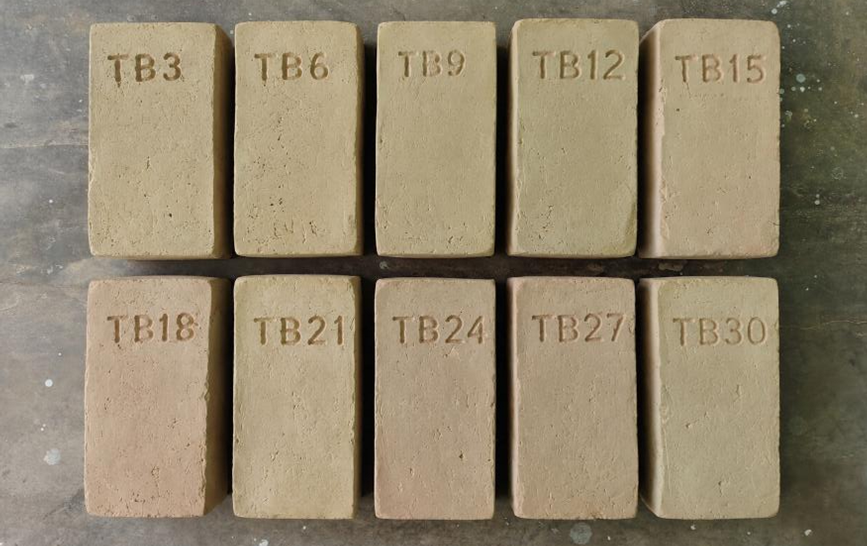
After the raw bricks had been naturally dried, they were placed in a kiln for the firing process. The kiln-firing process was aimed at ensuring the final strength and quality of the bricks and was carried out in several stages. The general appearance of the fired brick specimens is shown in Figure 2.
First, the kiln was heated gradually. This initial stage typically lasted 8 hours, during which the remaining moisture inside the bricks evaporated. The temperature was controlled within the range of 200-300 °C to prevent the formation of cracks. In the subsequent stage, the temperature was gradually increased to 900-1050 °C, and this stage typically lasted 16 hours. At the end of the firing process, the kiln was gradually cooled, with the cooling process lasting approximately 14 hours. The experimental testing was carried out in the testing laboratory of “Techno Standard Test” LLC.
Before testing, the dimensions of all specimens were measured with an accuracy of 1 mm, and each geometric dimension was determined as the average value of measurements taken on opposite surfaces. During the test, each specimen was positioned at the center of the testing machine platen, with the geometric axes of the specimen and the platen carefully aligned. The specimen was then securely placed between the upper and lower platens of the testing machine. The load was applied to the specimens continuously and uniformly increased throughout the test. The loading rate was selected so that failure of the specimen occurred within 20-60 seconds after the beginning of the test.
The experimental results indicated that the compressive strength of the ceramic bricks changed in a non-linear way due to the addition of bentonite. With bentonite content increased from 0 to 12 %, the compressive strength was increased gradually and then decreased slightly. The mean compressive strength value of the control specimens was 67.20 kg/cm², while the highest mean compressive strength value obtained was 84.00 kg/cm² at a bentonite content of 12 %, which showed a 25.0 % increase when compared with the control composition. The results from the 15 individual measurements taken for each mixture were analyzed statistically to assess the variability and repeatability of the experimental results. For each bentonite content, the mean value, the standard deviation (SD), the 95 % confidence interval (CI), and the coefficient of variation (CV) were determined. Table 3 shows the results of the statistical analysis.
Table 3.
Statistical characteristics of compressive strength of ceramic brick specimens at different bentonite contents
| Bentonite content, % | n | Mean, kg/cm² | SD, kg/cm² | 95% CI, kg/cm² | CV, % |
|---|---|---|---|---|---|
| 0 | 15 | 67.20 | 3.47 | 65.28-69.12 | 5.16 |
| 3 | 15 | 72.58 | 4.44 | 70.12-75.04 | 6.12 |
| 6 | 15 | 77.95 | 4.89 | 75.24-80.66 | 6.27 |
| 9 | 15 | 81.98 | 4.65 | 79.40-84.56 | 5.67 |
| 12 | 15 | 84.00 | 4.48 | 81.52-86.48 | 5.33 |
| 15 | 15 | 81.66 | 4.92 | 78.94-84.38 | 6.02 |
| 18 | 15 | 75.30 | 4.63 | 72.74-77.86 | 6.15 |
| 21 | 15 | 71.26 | 4.31 | 68.87-73.65 | 6.05 |
| 24 | 15 | 66.56 | 3.91 | 64.39-68.73 | 5.87 |
| 27 | 15 | 63.84 | 3.64 | 61.82-65.86 | 5.70 |
| 30 | 15 | 58.20 | 3.68 | 56.16-60.24 | 6.32 |
The coefficient of variation values were between 5.16 % and 6.32 %, which shows the dispersion of the measured compressive strength values of the replicate specimens was relatively low. The 95 % confidence intervals also illustrate the variability that exists for each mean value. This gives the maximum mean compressive strength for the bentonite content of 12 % bentonite, 81.98 kg/cm² and 81.66 kg/cm², respectively, for the bentonite content of 9 % and 15 %. The experimental results are graphically shown in Figure 3. Error bars show the 95 % confidence interval for each of the 15 replicate measurements for each mixture.
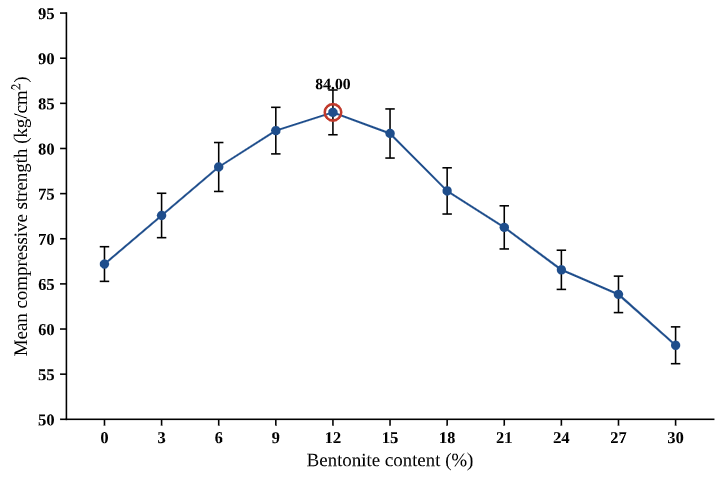
This was due to the increase in compressive strength after adding bentonite to the control composition, which recorded 67.20 kg/cm², while it recorded 72.58, 77.95, 81.98, and 84.00 kg/cm² at bentonite levels of 3, 6, 9, and 12 %, respectively. These values are 8.01 %, 16.00 %, 21.99 %, and 25.00 % greater than that of the control specimen. At higher bentonite contents, the compressive strength decreased, reaching 81.66, 75.30, 71.26, 66.56, 63.84, and 58.20 kg/cm² at 15, 18, 21, 24, 27, and 30 % bentonite, respectively. The strength of the specimen with bentonite content of 30 % was 13.39 % lower than that of the control specimen.
The observed strength improvement at medium bentonite content may be correlated with the fine and highly dispersed bentonite particles, which could fill interparticle voids in the clay matrix and create a denser ceramic structure after firing. This interpretation should be used in conjunction with the experimental conditions, as the present study did not carry out any direct microstructural or mineralogical analysis. Increased bentonite concentration could lead to a greater amount of swelling clay minerals and higher water requirements of the mixture and enhance drying shrinkage at higher bentonite concentrations. These changes can contribute to the formation of internal defects and microcracks that can negatively influence the compressive strength of the fired ceramic material. Thus, the compressive strength results from the experiments show that the optimum bentonite proportion of 12 % gives the maximum measured strength.
1. The experimental findings indicated that the ceramic bricks made from local clay soil were affected by the addition of bentonite. The compressive strength also rose as bentonite content increased, with peaks at 12 % at the value of 84.0 kg/cm², which is an increase of 25.0 % over the control composition of 67.2 kg/cm². The strength had a tendency to decrease with an increase in bentonite content up to 30 % bentonite, where it reduced to 58.2 kg/cm², which is 13.4 % lower than the control strength.
2. The enhancement of the compressive strength at intermediate bentonite levels might be related to better packing and densification of the ceramic mass during firing. With higher bentonite percentages, the internal defects and the microcracks can be formed due to the increased water demand and shrinkage and may be responsible for the decrease in compressive strength.
3. The main practical value of this work is the determination of the bentonite content, which gives the maximum compressive strength to ceramic bricks manufactured from local loess clay soil of the Kosonsoy region of Uzbekistan. The results obtained in this study show that the optimum bentonite content of the composition is 12 %, which yielded the highest mean compressive strength of 84.0 kg/cm² when compared with the control composition.

Doctor of Technical Sciences, Professor Namangan State Technical University Islam Kаrimоv Street, Republic of Uzbekistan, Namangan
E-mail: sobirjonrsj@gmail.com
д-р техн. наук, проф. Наманганский государственный технический университет, Республика Узбекистан, г. Наманган