
Results of research on the application of laser methods for detecting wear particles in oil
УДК . 621.829
Abstract
This paper presents the results of an experimental study on the application of Laser-Induced Breakdown Spectroscopy (LIBS) for determining the concentration of wear products in used gas engine oil. It is shown that the main metallic components of wear particles are iron, copper, aluminum, chromium, and silicon. The LIBS method allows elemental analysis of wear products directly in the oil sample without complex sample preparation. It was found that at 100–200 engine operating hours, the particle size remains small and the content of wear products in the oil is relatively stable. With an increase in operating time to 300–400 hours, an increase in both the concentration of wear products and the size of metal particles is observed. A comparison of LIBS with traditional analytical methods (ICP-OES, atomic absorption spectrometry) was performed in terms of sample preparation, limit of detection, analysis speed, multi-element capability, and particle size analysis. The advantages of LIBS are demonstrated: minimal sample preparation, high analysis speed (less than 1 second), simultaneous multi-element determination, and the ability to analyze large particles (up to 100 µm). The results of the study can be used for non-disassembly diagnostics of gas and tractor engines based on the concentration of wear products in the oil.
Аннотация
В работе представлены результаты экспериментального исследования применения метода лазерно-искровой эмиссионной спектрометрии (LIBS) для определения концентрации продуктов износа в отработанном масле газовых двигателей. Показано, что основными металлическими компонентами частиц износа являются железо, медь, алюминий, хром и кремний. Метод LIBS позволяет проводить элементный анализ продуктов износа непосредственно в пробе масла без сложной пробоподготовки. Установлено, что при наработке 100–200 мото-часов размер частиц невелик, а содержание продуктов износа в масле относительно стабильно. При увеличении наработки до 300–400 мото-часов наблюдается рост как концентрации продуктов износа, так и размеров металлических частиц. Проведено сравнение LIBS с традиционными методами анализа (ICP-OES, атомно-абсорбционная спектрометрия) по таким параметрам, как подготовка проб, предел обнаружения, скорость анализа, возможность многоэлементного определения и размер анализируемых частиц. Показаны преимущества LIBS: минимальная пробоподготовка, высокая скорость анализа (менее 1 секунды), возможность определения всех элементов одновременно и анализа крупных частиц (до 100 мкм). Результаты исследования могут быть использованы для диагностики газовых и тракторных двигателей без их разборки по концентрации продуктов износа в масле.
Keywords: aluminum; non-disassembly monitoring; wear products; laser; engine oil; spectrum; emission.
Ключевые слова: алюминий; неразборочный мониторинг; продукты износа; лазер; моторное масло; спектр; эмиссия.
Introduction
During the operation of gas engines, cylinder liners are subjected to high temperatures and pressures, leading to the formation of micro-irregularities on their working surfaces due to tribomechanical and tribological factors [1]. The cylinder-piston assembly is the main source of mechanical losses in an internal combustion engine and, according to literature data, accounts for up to 70 % of all friction losses [2]. Under the influence of high radial pressure from the piston rings, the oil film on the cylinder walls ruptures, which is accompanied by a significant increase in friction and accelerated wear of the cylinders and piston rings [3].
The method for determining the degree of wear based on the content of wear products in the oil relies on laboratory analysis of used oil. A sample taken from the engine crankcase after shutdown is thoroughly mixed and allowed to settle. Laboratory analysis allows the determination of the content of wear products, as well as organic and inorganic substances. This method does not require engine disassembly [3]. Laser methods enable the study of static, dynamic, vibrational, and other deformation processes, offering key advantages such as non-contact operation and simultaneous data acquisition [4, 5].
The aim of this work is an experimental study of the possibility of using Laser-Induced Breakdown Spectroscopy (LIBS) for the quantitative determination of wear product concentrations in used gas engine oils, as well as a comparative assessment of the effectiveness of this method with traditional analytical techniques (ICP-OES, atomic absorption spectrometry).
Materials and Methods
The research is based on existing analytical methods; theoretical approaches, standard techniques for determining wear products in oil, and mathematical statistical methods were employed.
Laser spectroscopy performs more effectively and accurately with gas-diesel oils compared to conventional diesel oils. Oil transparency decreases much more slowly due to lower soot content, allowing the laser beam to easily penetrate the sample and accurately measure the size of mechanical impurities and wear particles [6].
Modern reliability assurance is based on condition-based diagnostics; in particular, oil analysis — including wear debris, viscosity changes, and Total Base Number (TBN) — makes it possible to estimate the engine's remaining service life [7]. The probability of failure-free operation of engine oil is a measure of its ability to perform its intended functions without losing operational properties over a specific period of service [8].
To process the measurement results, mathematical statistical methods were used. The standard deviation and confidence interval were calculated for a pooled sample of 10 sequential measurements at a confidence level of P = 95 %. The results of the statistical processing are presented in the tables and in the graph.
Comparative characteristics of methods. The comparison of Laser-Induced Breakdown Spectroscopy (LIBS) with reference methods (ICP-OES, atomic absorption spectrometry) was performed according to the following parameters: sample preparation, limit of detection, analysis speed, multi-element capability, and particle size analysis [6, 9]. The comparison results are presented in Table 1.
Table 1.
Comparative characteristics of methods for analyzing wear products in oil
| Characteristic | LIBS | ICP-OES | Atomic Absorption Spectrometry |
|---|---|---|---|
| Sample preparation | Absent or minimal. Direct drop analysis | Requires dilution with a solvent | Acid digestion, extraction, emulsion formation |
| Limit of detection | 1–50 ppm (depends on element and matrix) | 0.001–0.1 ppm | 0.01–0.5 ppm |
| Analysis time | Less than 1 second | 1–3 minutes per sample | 1–2 minutes (one element at a time) |
| Multi-element capability | All elements simultaneously | Up to 40–70 elements simultaneously | Sequential analysis |
| Wear particle size | Dissolved and large particles up to 100 µm | >3–5 µm | Only fine/dissolved ones |
Experimental setup and measurement conditions. Analysis of oil samples for wear product content was performed using Laser-Induced Breakdown Spectroscopy (LIBS) with a solid-state pulsed Nd:YAG laser. Laser parameters: wavelength λ = 1064 nm, pulse duration 5–10 ns, pulse energy 50–150 mJ, pulse repetition rate 1–10 Hz, focal spot diameter 50–200 µm [6, 9].
To ensure accurate determination of iron, aluminum, copper, chromium, and silicon particles in the oil, a double-pulse mode was used [10]. Measurement parameters: wavelength 1064 nm, pulse frequency 5 Hz, signal acquisition delay 1.0–2.5 µs, focal spot diameter 150 µm. Calibration was performed using a method simulating actual wear. The reliability of the results meets calibration quality assessment criteria with R² = 0.999 for dispersed particles of at least 0.095 µm.
To prevent wear particles from settling to the bottom, ultrasonic homogenization was used. Immediately before analysis, the sample was treated in an ultrasonic bath for 7 minutes to bring any sediment into suspension. To reduce viscosity, the engine oil sample was diluted with a solvent and applied in a thin layer onto a metal substrate. A series of 100 pulses was summed and averaged; based on the data obtained, the automated system generated a report containing the total elemental concentration in ppm (mg/kg) [9].
Sampling. Oil samples were collected after shutting down the operating gas engine. Measurements were performed in 5–10 replicates in accordance with ASTM D5185 and ASTM D6595 standards [9].
Results
Wear product content. During operational tests using the developed method, oil samples were collected in the required quantities. The content of wear products in used oil was determined under laboratory conditions. With increasing operating time, the amount of mechanical impurities and insoluble products increased (Table 2) [7, 8].
Table 2.
Results of oil analysis for wear product content using laser spectroscopy
| Operating time, engine hours | Large particle size, µm | Small particle size, µm |
|---|---|---|
| 100 | 29 | 16 |
| 200 | 52 | 30 |
| 300 | 68 | 42 |
| 400 | 79 | 56 |
| 500 | 82 | 62 |
Note: mean values from 10 measurements are presented. Measurement error (confidence interval at P = 95%) is ±15.8 µm.
Average particle size. Based on a pooled sample of 10 sequential measurements, the average particle size was x̄ = 51.6 µm. The confidence interval at a confidence level of P = 95% is ±15.8 µm.
Dependence of wear product concentration on operating time. The concentration of wear products depends on the oil service life (Fig. 1). Wear metals (failure indicators): iron (Fe) indicates cylinder liner and camshaft wear; aluminum (Al) indicates piston wear; chromium (Cr) indicates piston ring wear [7, 8].
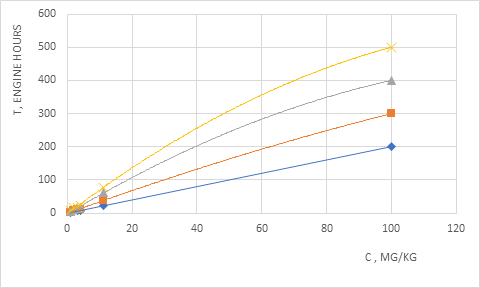

Elemental composition of wear products. Analysis results indicate that the majority of particles consist of metals such as iron, copper, aluminum, chromium, and silicon [10]. In addition to these elements, metallic particles derived from oil additives were detected in the used gas engine oil. Iron constitutes the bulk of the wear products, contributing to the increase in total mass (Table 3) [7, 8].
Table 3.
Laser-induced breakdown spectroscopy analysis results
| Element | Wavelength, λ, nm | Relative intensity, Iₗ/I | Concentration (mean), mg/kg | Absolute error, Δx |
|---|---|---|---|---|
| Iron, Fe | 259.94 | 0.3050 | 42.2 | ±3.0 |
| Aluminum, Al | 396.15 | 0.0721 | 8.0 | ±0.60 |
| Chromium, Cr | 425.43 | 0.0252 | 3.6 | ±0.27 |
| Silicon, Si | 288.16 | 0.0917 | 12.8 | ±0.98 |
Interpretation of element concentrations. An increase in iron (Fe) concentration results from wear of cylinder liners, the camshaft, the crankshaft, and valve train gears [7]. An increase in aluminum (Al) concentration indicates wear of the piston and plain bearing shells (aluminum-tin). Chromium (Cr) content indicates wear of top compression piston rings (chrome plating) and valve stems. Copper (Cu) indicates wear of bearing shells (connecting rod, main), thrust washers, bronze bushings, and oil cooler. Silicon (Si) indicates ingress of dust through the air filter [8].
Discussion
The high relative standard deviation (RSD = 30.7 %) obtained during the study does not preclude the use of this method, as this result is due to physical factors and serves as an informative indicator of the presence of large particles [9]. The study results demonstrate the advantages of the LIBS method over traditional laboratory methods such as ICP-OES, RDE-AES, and XRF [6, 10].
When analyzing oil for wear products, it is necessary to consider both viscosity and chemical composition [6]. The standard viscosity for M10G2 oil is 11 mm²/s; during operation, the viscosity of gas engine oil does not change significantly, typically remaining within the range of 9.5–10.2 mm²/s. At a measurement temperature of 20°C, the viscosity of such oil is approximately 110–140 mm²/s. Oils with a lower base viscosity (10 mm²/s) are more prone to spreading and hydrodynamic effects [9].
The chemical composition of the oil also influences the determination of wear products [10]. The heavy hydrocarbon matrix of mineral oil is prone to extensive thermal degradation (pyrolysis), and high concentrations of free radicals and molecular carbon compounds can form instantaneously in the plasma. Intense molecular emission bands appear in the LIBS spectrum, which can overlap with the analytical lines of wear metals, degrading the limit of detection, especially for iron (Fe) [6].
During operation, M-10G2 oil degrades and its initially transparent appearance darkens. The resulting opaque black matrix drastically increases the optical absorption coefficient at the laser wavelength (1064 nm). As a result, the laser beam is not scattered within the droplet volume but is fully absorbed by the surface micro-film of the used oil. Due to this matrix change, the signal intensity for wear products (Fe, Cr) in darkened used oil will be 1.5–2 times higher than in fresh oil, even at the same actual concentration (in ppm) [9].
It should be noted that the LIBS method is insensitive to sample «age» provided that wear metals remain uniformly distributed throughout the oil volume [10]. However, over time, processes critical to metrology occur in the mineral oil sample: gravitational settling of large particles (>5–10 µm) within 48–72 hours; coagulation of soot during long-term storage (more than one month), trapping metal ions and increasing RSD to 25 % [7].
Recommended storage period: LIBS analysis should be performed within 7–10 days of sample collection [9]. Sample storage temperature affects oil viscosity and the rate of oxidative processes, thereby indirectly altering the quality of the laser plume. Low temperatures (–20…0°C) are considered ideal for long-term storage: freezing stops additive degradation and base oil oxidation, while metals become immobilized within the structure of the «solidified» oil. Prior to LIBS analysis, the sample must be fully warmed to +40°C and thoroughly mixed to restore homogeneity [8].
Conclusions
- The study determined the effectiveness of Laser-Induced Breakdown Spectroscopy (LIBS) for analyzing the elemental composition of wear products in gas engine oils [6, 9]. The elemental concentrations in used oil were (mg/kg): iron (Fe) — 42.2, aluminum (Al) — 8.0, chromium (Cr) — 3.6, silicon (Si) — 12.8. The high iron concentration indicates wear of cylinder liners, camshaft, crankshaft, and valve train gears [7, 8].
- Compared to traditional analysis methods (ICP-OES and atomic absorption spectrometry), the use of LIBS for analyzing wear products in gas engine oils provides high accuracy and comprehensive assessment of iron, copper, aluminum, chromium, silicon, and additive metals, while also delivering rapid results [6, 10].
- Large wear particles (>5–10 µm) settle to the bottom of the container within 48–72 hours. If the oil sample is not ultrasonically agitated before being applied to the LIBS substrate, the instrument will report concentrations of Fe, Cr, and Cu that are 2–5 times lower than actual values [9].
- Recommended storage period: LIBS analysis should be performed within 7–10 days of sample collection [9].
- Sample storage temperature affects oil viscosity and the rate of oxidative processes, indirectly altering the quality of the laser plume. Low temperatures (–20…0°C) are considered ideal for long-term storage [8].
References
