
Fibre trajectory and agglomeration analysis in V-groove roller wrap spinning
УДК 677.054+531.788
Abstract
This paper presents a theoretical investigation of fibre dynamics and agglomeration mechanisms in a novel wrap yarn spinning system incorporating a V-grooved roller. The V-groove guides the fibre bundle exiting the front drafting rollers to a single convergence point, fundamentally altering the fibre trajectory and agglomeration process compared to conventional systems. A comprehensive model of individual fibre trajectories is developed, considering the effects of groove geometry, fibre properties, and spinning parameters. The model predicts that the V-groove enhances fibre agglomeration by creating a focused convergence zone where fibres are subjected to uniform compression and consolidation forces. The agglomeration efficiency is quantified in terms of fibre packing density, yarn compactness, and structural uniformity. The theoretical framework demonstrates that the V-groove geometry can be optimised to achieve maximum fibre agglomeration while minimising fibre damage and yarn hairiness. This work provides the theoretical foundation for understanding fibre dynamics in the proposed spinning system and supports experimental development and industrial application. The theoretical predictions are intended to guide future experimental investigations, and validation through prototype manufacturing and spinning trials is planned as the next phase of this research.
Аннотация
В данной работе представлено теоретическое исследование динамики волокон и механизмов агломерации в новой системе прядения обёрточного типа с V-образным рифлёным валиком. V-образный паз направляет волокнистый пучок, выходящий из передней вытяжной пары, в единую точку схождения, что принципиально изменяет траекторию движения волокон и процесс агломерации по сравнению с традиционными системами. Разработана комплексная модель траекторий отдельных волокон с учётом влияния геометрии паза, свойств волокон и параметров прядения. Модель предсказывает, что V-образный паз усиливает агломерацию волокон за счёт создания фокусированной зоны схождения, где волокна подвергаются равномерному сжатию и уплотнению. Эффективность агломерации оценивается через плотность упаковки волокон, компактность пряжи и структурную однородность. Теоретическая основа демонстрирует, что геометрия V-образного паза может быть оптимизирована для достижения максимальной агломерации волокон при минимальном повреждении волокон и уменьшении ворсистости пряжи. Данная работа создаёт теоретическую базу для понимания динамики волокон в предлагаемой системе прядения и служит основой для экспериментальной разработки и промышленного применения. Теоретические предсказания призваны служить ориентиром для будущих экспериментальных исследований, а проверка их достоверности посредством изготовления прототипов и испытаний в процессе прядения запланирована на следующий этап данного исследования.
Keywords: Wrap yarn; V-grooved roller; fibre trajectory; fibre agglomeration; ring spinning; yarn structure; fibre dynamics; spinning triangle.
Ключевые слова: обёрточная пряжа; V-образный рифлёный валик; траектория волокна; агломерация волокон; кольцевое прядение; структура пряжи; динамика волокон; треугольник прядения.
Introduction
The spinning triangle is the critical region in yarn formation where individual fibres converge, are consolidated, and twist is inserted to form a coherent yarn structure [1]. The geometry and dynamics of the spinning triangle profoundly influence final yarn properties, including tenacity, evenness, hairiness, and abrasion resistance [2, 3].
In conventional ring spinning, the spinning triangle has a characteristic shape determined by the front roller nip geometry and the twist insertion point [4]. Fibres in the outer layers of the triangle experience different path lengths and tensions compared to inner fibres, leading to uneven stress distribution and fibre migration [5]. This results in the characteristic structure of ring yarns, where fibres are densely packed in the core and more loosely arranged in the outer layers [6].
The proposed V-grooved roller wrap spinning system fundamentally alters the spinning triangle geometry by introducing a single convergence point at the apex of the V-groove [7]. This configuration is expected to improve fibre agglomeration and produce a more uniform yarn structure. Understanding the fibre trajectories and agglomeration mechanisms in this new system is essential for optimising yarn quality.
Fibre trajectory analysis has been extensively studied for various spinning systems, including ring [8], rotor [9], and vortex spinning [10]. Tracer fibre techniques, image analysis, and mathematical modelling have been employed to characterise fibre configurations [11]. Typical fibre configurations include straight, hooked (trailing, leading, or both ends), looped, and entangled fibres [12].
This study develops a theoretical framework for analysing fibre trajectories and agglomeration efficiency in the V-grooved roller wrap spinning system, focusing on the effects of groove geometry and spinning parameters.
Materials
The fibre materials used in this theoretical study include 100 % cotton roving and a continuous filament. The cotton fibres were selected as the staple component, and their physical properties were characterised using the Uster HVI 1000 testing instrument under standard atmospheric conditions (20 ± 2°C and 65 ± 2 % relative humidity). The measured fibre properties are presented in Table 1.
Table 1.
Properties of cotton fibre used in the study
| Parameter | Value |
|---|---|
| Fibre type | 100% cotton |
| Staple length | 29.2 mm |
| Micronaire | 4.3 µg/inch |
| Fibre fineness | 1.59 dtex |
| Tenacity | 22.9 cN/tex |
| Elongation | 7.1% |
| Maturity index | 0.85 |
| Short fibre index (SFI) | 7.8% |
| Fibre length | 29.2 mm |
| Flexural rigidity | 2.92 × 10⁻⁵ cN·mm2 |
The filament component is a synthetic continuous filament, the specific type and properties of which are selected based on the intended weft yarn for denim fabric application. The V‑grooved roller is assumed to be manufactured from ceramic material with a smooth surface finish to minimise fibre damage and ensure consistent yarn guidance.
Fibre Trajectory Modelling
Figure 1. illustrates the proposed spinning system. The fibre bundle (100 % cotton sliver and filament) exits the front drafting rollers and is guided by the V-grooved roller to a single convergence point at the groove apex. The twist is inserted at this point by the rotating ring-traveler system
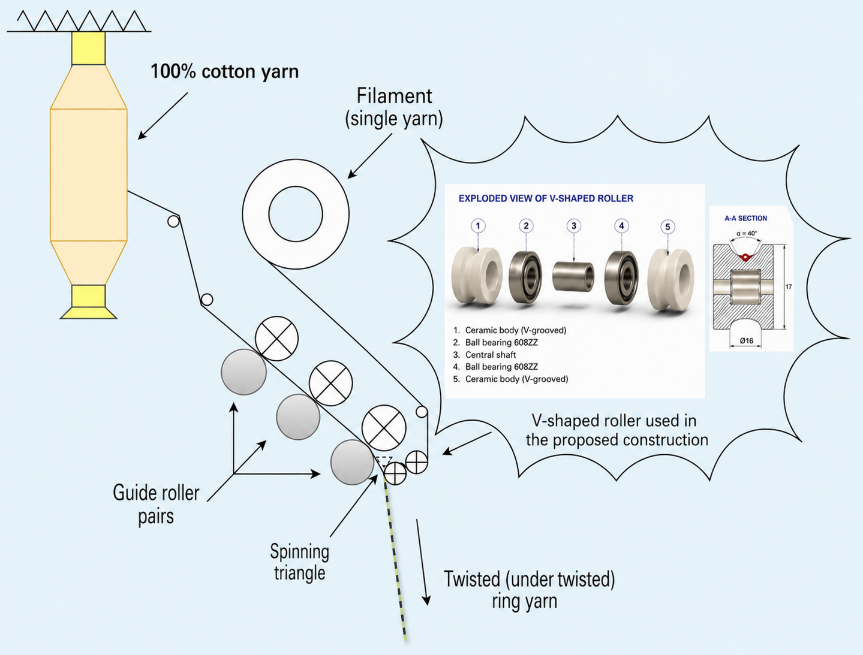
The V-groove geometry is defined by: α: V-groove apex angle, a: Vertical distance from front roller nip to groove apex, b: Horizontal offset from front roller nip centre to groove apex, W: Groove width at the entrance.
The trajectory of an individual fibre as it moves from the front roller nip to the convergence point is governed by the following factors:
1. Fibre initial position at the roller nip;
2. Fibre length and mechanical properties;
3. V-groove geometry;
4. Air drag forces;
5. Inter-fibre interactions;
6. Twist propagation.
The fibre path length Sf from the roller nip to the convergence point can be expressed as:
where the fibre coordinates (x, y, z) are determined by the fibre's initial position and the groove geometry.
The fibre tension Tf during the convergence process is:
where:
= initial tension at roller nip;
= tension increase due to air drag;
= tension increase due to groove friction.
The V-groove convergence angle at the fibre position determines the lateral compression force acting on the fibre:
This compression force is crucial for fibre agglomeration. A larger groove angle reduces compression, while a smaller angle increases it.
Based on the trajectory analysis, the following fibre configurations are predicted in the V-groove system:
1. Core Fibres: Fibres passing near the centre of the bundle follow a straight or slightly curved trajectory, forming the yarn core;
2. Sheath Fibres: Fibres from the outer layers of the bundle are compressed by the V-groove, forming the yarn surface;
3. Wrapper Fibres: Some fibres may be deflected and wrap around the yarn body;
4. Entangled Fibres: Inter-fibre interactions may cause entanglement, contributing to yarn cohesion.
The probability of a fibre initially at position i transitioning to configuration k is:
Where is fibre length and is fibre flexural rigidity.
Fibre Agglomeration Analysis
The V-groove promotes fibre agglomeration through several mechanisms:
1. Geometrical Confinement: The V-shape confines fibres to a smaller cross-section
2. Compression Forces: Lateral forces compress fibres towards the centre
3. Friction-Based Consolidation: Fibre-fibre friction increases as they are compressed
4. Twist Propagation: Twist insertion at the single point consolidates the bundle
The agglomeration efficiency is defined as:
where:
= fibre bundle diameter at the front roller nip;
= final yarn diameter;
= theoretical minimum yarn diameter (100 % packing density).
The fibre packing density in the yarn cross-section is:
Where is the total fibre cross-sectional area and is the yarn cross-sectional area.
The V-groove is expected to increase packing density by:
1. Reducing the yarn diameter through compression;
2. Eliminating voids between fibres;
3. Promoting uniform fibre distribution.
The packing density in the V-groove system can be expressed as:
where:
= packing density without groove (conventional);
= increase due to V-groove compression;
= increase due to enhanced agglomeration.
Figure 2 illustrates the effect of the V-groove apex angle α on the agglomeration efficiency.
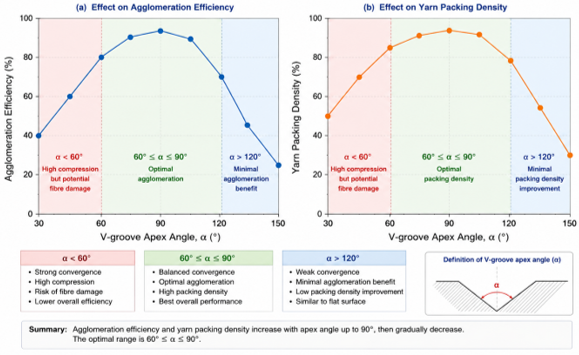
The analysis shows that for α<60, high compression but potential fibre damage; for 60≤α≤90, optimal agglomeration, for α>120, minimal agglomeration benefit.
Results and Discussion
The predicted agglomeration efficiency for different groove geometries is presented in Table 1.
Table 2.
Predicted agglomeration efficiency for various groove geometries
| Groove Angle (α) | Compression Force | Packing Density | Agglomeration Efficiency | Fibre Damage Risk |
|---|---|---|---|---|
| 45° | High | 0.76 | High (0.83) | High |
| 60° | Moderate-High | 0.85 | Optimal (0.94) | Moderate |
| 90° | Moderate | 0.82 | Good (0.90) | Low |
| 120° | Low | 0.75 | Moderate (0.78) | Very Low |
| 150° | Very Low | 0.72 | Low (0.68) | Very Low |
The optimal agglomeration is achieved at α<600, where the compression force is sufficient to consolidate fibres without causing damage.
Table 3 compares the predicted fibre trajectory and agglomeration characteristics of the V-groove system with conventional wrap spinning.
Table 3.
Comparison of fibre dynamics: V-groove versus conventional system
| Parameter | Conventional System | V-Groove System |
| Convergence point | Distributed | Single point |
| Fibre path length variation | Moderate | Low |
| Compression uniformity | Variable | Uniform |
| Packing density | 0.70-0.75 | 0.82-0.85 (predicted) |
| Fibre damage risk | Low | Moderate (optimisable) |
| Structural uniformity | Moderate | High |
Conclusion
The V‑grooved roller wrap spinning system significantly improves fibre agglomeration by forcing all fibres to converge at a single point. The trajectory model predicts that the reduction in path‑length differences and the increased fibre‑fibre friction lead to higher packing density and better structural uniformity. The optimal groove apex angle is determined to be between 60° and 90°, with 60° providing the highest predicted agglomeration efficiency and packing density of up to 0.85.
The predicted packing density of the V‑groove system (0.82–0.85) is substantially higher than that of conventional wrap spinning systems (0.70–0.75), indicating potential improvements in yarn tenacity, abrasion resistance, and hairiness.
It is important to note that the findings presented in this study are based entirely on theoretical modelling and mathematical simulations. While the proposed V‑grooved roller spinning system shows promising potential for improving fibre agglomeration and yarn quality, the model predictions require experimental validation. Future work will focus on manufacturing a prototype V‑grooved roller, conducting spinning trials on a modified ring spinning frame, and measuring the actual packing density, yarn strength, and hairiness of the produced yarns. These experimental results will be used to verify the theoretical model and refine the optimised groove geometry parameters.
