
Enhancing performance of mining piston compressors by optimizing cooling and lubrication systems
УДК 622.002.5
Abstract
Objective: The objective of this study is to enhance the performance, efficiency, and reliability of mining reciprocating compressors by developing and optimizing advanced cooling descaling methods and improved lubrication filtration systems In practice, during the operation of reciprocating compressors, various problems arise related to the formation of scale and deposit layers on the heat exchange surfaces of air coolers, valve failures characterized by a low mean time between failures (MTBF), and the severe wear of moving parts such as the crosshead, shaft, and bearings, which ultimately leads to an increased number of emergency downtimes.
Methodology: SolidWorks Flow Simulation was utilized to evaluate the impact of scale thickness on cooling efficiency. Experimental setups were designed to test an ultrasonic acoustic device for descaling internal tube surfaces and to evaluate a novel porous magnetic oil filter.
Results: Simulation results demonstrated that each 1 mm increase in scale layer thickness decreases cooling effectiveness by 9 °C. Testing of the acoustic descaling device identified optimal parameters (15–20 kHz frequency, 1.5–2 ms pulse duration) for effective scale removal along long tubes. The proposed magnetic oil filter (70 % porosity, 10 mm thickness) achieved a 40–50 % higher oil purification efficiency compared to standard filters.
Conclusions: Implementing the optimized cooling and magnetic lubrication filtration systems drastically reduces emergency downtime, lowers energy consumption, and extends the operational lifespan of critical compressor mechanisms.
Аннотация
Цель: Целью данной работы является повышение производительности и надежности поршневых компрессоров горнодобывающей промышленности за счет оптимизации систем охлаждения и смазки. На практике в процессе эксплуатации поршневых компрессоров, возникают различные проблемы, связанные с образованием накипи и слоёв отложений на теплообменных поверхностях воздухоохладителей, поломки клапанов, которые имеют низкую наработку на отказ и интенсивный износ механизмов движения таких как крейцкопф, вал и подшипники, в результате которого увеличивается число аварийных простоев.
Методы: Для оценки влияния накипи на эффективность охлаждения применялось программное обеспечение SolidWorks Flow Simulation. Кроме того, были проведены экспериментальные исследования для определения оптимальных параметров ультразвукового акустического устройства для очистки от накипи и оценки новой конструкции магнитного масляного фильтра.
Результаты: Моделирование показало, что каждый 1 мм накипи снижает эффективность охлаждения на 9 °C. Экспериментальные испытания акустического устройства выявили оптимальные параметры (частота 15–20 кГц, длительность импульса 1,5–2 мс), обеспечивающие эффективное удаление отложений. Предложенный магнитный фильтр (пористость 70 %, толщина 10 мм) повысил эффективность очистки масла на 40–50 % по сравнению с базовыми фильтрами.
Выводы: Оптимизация систем охлаждения и смазки значительно снижает энергопотребление и увеличивает срок службы узлов компрессора.
Keywords: compressor; piston; cylinder; cooling system; air cooler; temperature; compressed air; reliability; lubrication system; oil filter; oil contamination.
Ключевые слова: компрессор; поршень; цилиндр; система охлаждения; воздухоохладитель; температура; сжатый воздух; надежность; система смазки; масляной фильтр; загрязненность масла.
1. Introduction
The operation of mining compressors is one of the most energy-intensive processes in the mining industry, necessitating effective resource conservation. In the overall energy balance of mining enterprises in Uzbekistan, the proportion of compressor equipment generating compressed air for pneumatic energy accounts for 20–25 %. Therefore, its further improvement significantly impacts the performance indicators of subsequent technological processes. The widespread application of compressed air dictates the need to reduce operating costs through the development of efficient technical solutions for industrial compressed air production, as well as the enhancement of the overall energy efficiency of compressor unit operations [1].
The cooling system has the most significant impact on the reduction of productivity and the increase in specific energy consumption of mining compressor units. Consequently, the efficiency of reciprocating compressor units can be improved by upgrading the cooling system, as energy losses due to insufficient cooling (undercooling) in reciprocating compressor units reach up to 20 %.
Furthermore, the failure-free and reliable operation of reciprocating compressors heavily depends on the lubrication system of the compressor's drive mechanisms. Special attention must be paid to the lubricating oil parameters and its purity, as the degradation of the initial oil characteristics and its contamination lead to the wear of moving friction components, thereby increasing the frequency of emergency shutdowns. Oil contamination causes wear on the shaft journal and its sections connected to the crank webs, leading to shaft deflection and premature failure. The operational performance of the crosshead, piston rod, and sliding blocks, which transmit the motion from the shaft to the piston, also depends on the purity and viscosity of the oil. The presence of abrasive particles in the lubricating oil leads to the wear of the crosshead, its slider surfaces, and the crosshead pin, resulting in a reduction of their dimensional tolerances and a decrease in their overall service life.
Currently, one of the primary challenges identified in the cooling systems of multi-stage reciprocating compressors is the inadequate cooling of air within the intercoolers and aftercoolers. The discharge pressure of the compressed air exiting the first stage of a reciprocating compressor typically ranges from 0.3 to 0.4 MPa, with temperatures reaching approximately 110–130 °C. It is necessary to reduce the temperature of the air being transferred from the first-stage cylinder to the second stage by roughly 70 °C. If the air temperature is not cooled to the specified requirement before entering the second stage, it may lead to emergency conditions. Moreover, a degradation in intercooler performance—where the air temperature remains 6–8 °C above the target—results in an increase in compression energy consumption of approximately 1 % [4].
The existing cooling systems for compressor machinery operated in the Kyzylkum region possess significant drawbacks due to their specific operational conditions. The cooling water contains high concentrations of salts and impurities. Typically, the total water hardness in the circulating cooling system exceeds 20 mg-eq/L, which is several times higher than permissible limits. Consequently, rapid fouling of the heat exchanger surfaces occurs. The accumulation of scale deposits reduces the intensity of heat transfer processes, compromising both the safety and economic efficiency of mining compressor operations.
The objective of this work is to enhance the performance and reliability of mining piston compressors by analyzing the factors reducing their efficiency and subsequently developing optimized cooling descaling techniques and advanced lubrication filtration systems.
2. Methodology
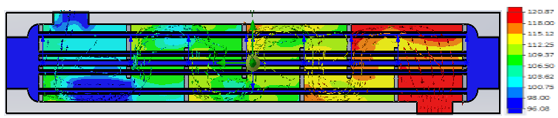
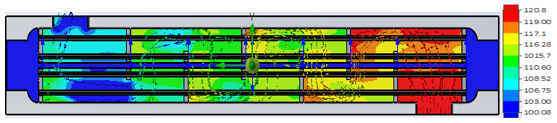
To determine the impact of scale thickness on air-cooling efficiency in the intercooler of a reciprocating compressor, a study was conducted using the advanced SolidWorks Flow Simulation software. The research analyzed compressed air discharge tcomp.air temperatures of 100°C, 110°C, 120°C, 130°C, and 140°C. The cooling water inlet temperature was set at 15°C, 20°C, and 25°C, while the scale layer σScale thickness was incrementally increased from 1 to 5 mm with a 1 mm step. The simulation was repeated for each air discharge tcomp.air temperature across the various cooling water t1cool wat temperatures and scale layer thicknesses.
To eliminate carbon deposits and scale on the heat exchange surfaces of air coolers during compressor operation—without requiring disassembly or additional labor—the application of an ultrasonic acoustic device is proposed.
The ultrasonic descaling device is applicable to various types of heat exchangers and operates as follows: special waveguide sensors (transducers) are mounted onto the acoustic wave generator, with the quantity determined by the total heat exchange surface area. The impulses generated by the ultrasonic device are transmitted through these sensors to the processed tube or heat exchanger. High-speed amplitude oscillations, with an average frequency of 12–25 kHz, are transferred to the walls of the heat exchanger, leading to the disintegration of the scale layer forming on the surfaces.
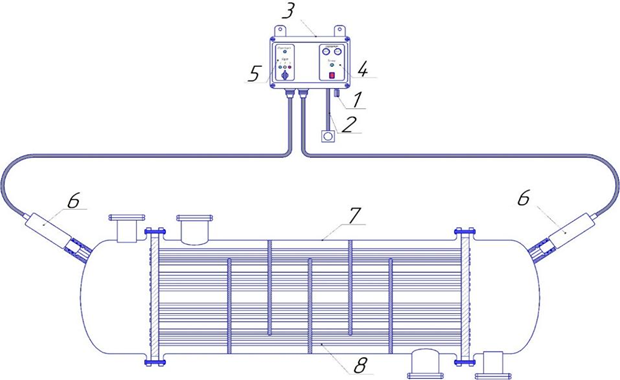
(1 – grounding; 2 – power supply unit; 3 – housing; 4 – fuses and indicator; 5 – control panel; 6 – pulse transmission sensors; 7 – intercooler shell; 8 – pipelines)
The acoustic device developed in this study features adjustable pulse duration and oscillation frequency. Its technical specifications are summarized in the table below.
Table 1.
Technical specifications of the acoustic device
| Power consumption, W | Acoustic power, W | Oscillation frequency, kHz | Pulse duration, ms | Impact area, m² | Number of sensors, pcs. |
|---|---|---|---|---|---|
| 300 | 120 | 5-30 | 0.5-3 | 150 | 2-4 |
To ensure the effective descaling of the intercooler, experimental trials were conducted to determine the optimal oscillation frequency and pulse duration for the acoustic device. During the initial stage of the experiments, the scale delamination time from the test surface was measured across various pulse durations and amplitude-frequency characteristics. Acoustic treatment was applied to metal specimens with a uniform scale layer thickness. Within the ultrasonic device, the oscillation frequency was incrementally increased from 5 kHz to 30 kHz in 5 kHz steps, while the pulse duration was varied at levels of 1, 1.5, and 2 ms
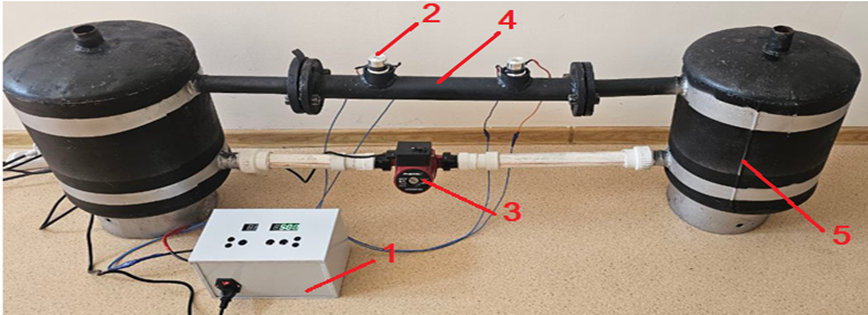
1 – ultrasonic device; 2 – ultrasonic transmitting sensors (transducers);
3 – pump; 4 – pipe; 5 – water tank.
To enhance oil filtration efficiency, a new oil filter design has been developed based on a porous filter media. This design allows for the high-quality purification of the circulating oil by capturing abrasive metallic particles as small as 0.5 mcm, while also allowing for the regeneration of the filter media. The distinctive feature of this design compared to other similar porous filters is its cylindrical configuration with a magnetic rod installed at the center. The filter media itself is dual-layered: the pore size of the layer adjacent to the magnetic rod is 0.5–1.0 mcm, while the pore size of the second (outer) layer is 3–5 mcm
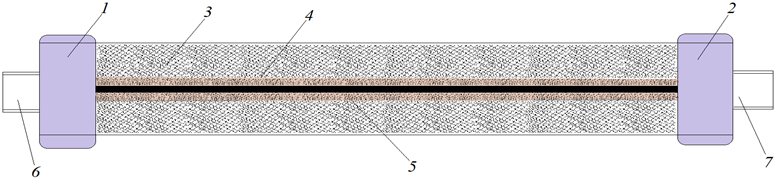
1, 2 – removable covers; 3 – filter media with a pore size of 3–5 μm;
4 – filter media with a pore size of 0.5–1.0 μm; 5 – permanent magnet;
6, 7 – connecting parts.
Two-stage experimental trials were conducted to evaluate the efficiency of the developed magnetic oil filter. In the first stage, 5 liters of KS-19 compressor oil, which had been in operation for 2,500 operating hours, were filtered. The oil contained metallic particles ranging from 880 to 900 mg/kg with particle sizes between 0.5 and 25 mm. Filtration was performed using a standard porous filter with porosities of 40 %, 50 %, 60 %, and 70 % under a pressure of 4 bar. In the second stage, the proposed magnetic oil filter was tested. These experiments involved varying the thickness of the filter media surrounding the magnet (5, 10, and 15 mm) across the same porosity levels (40 %, 50 %, 60 %, and 70 %).
3. Results and Discussion
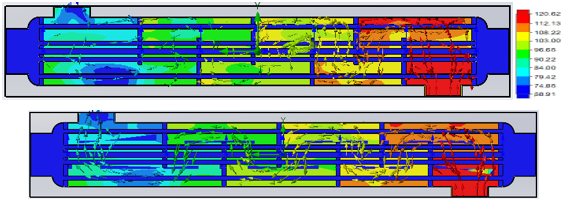
a) ; ℃; .
b) ; ℃; .

с) ; ℃;
d) ; ℃;
e) ; ℃; .
The research results indicate that for every 1 mm increase in scale layer σScale thickness on the inner walls of the cooler tubes, the compressed air cooling effectiveness decreases by 9 °C. This trend remains consistent until the scale thickness reaches 4 mm. Once the scale layer thickness reaches 4 mm or more, each subsequent 1 mm increase in scale results in a further reduction in cooling effectiveness by 2–4 °C
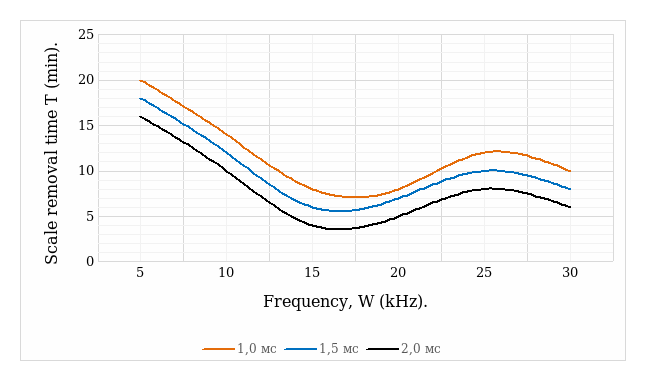
The experimental results established that when using the proposed ultrasonic acoustic descaling device, the most efficient and rapid removal of scale from metallic surfaces is achieved at an oscillation frequency of 15–20 kHz and a pulse duration of 2 ms
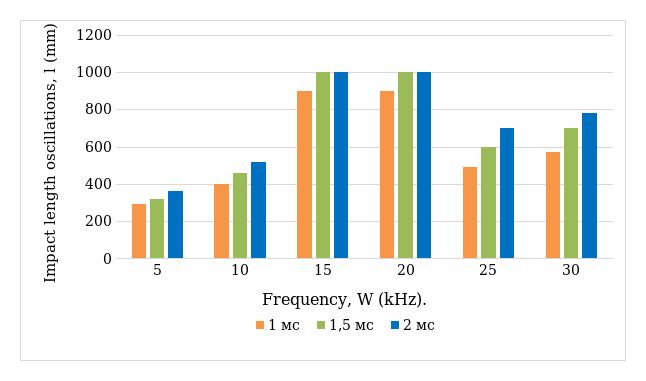
An analysis of the experimental results regarding the effective application of the acoustic descaling device for internal tube surfaces leads to the conclusion that for tubes with a length of 1000 mm or more, an oscillation frequency within 15–20 kHz and a pulse duration of 1.5–2 ms must be maintained to achieve high efficiency. The practical implementation of this device has resulted in improved cooling efficiency of the compressed air within the intercoolers of the reciprocating compressor [16, p. 38].
Regarding the lubrication system, the experimental results indicated that the integration of a magnetic rod into the porous filter media reduces the oil flow velocity. For instance, the oil flow velocity through a standard filter with 70 % porosity is 75 mm/s, whereas the velocity through the magnetic filter with the same porosity and a 5 mm media thickness is 50 mm/s. The flow velocity is further influenced by the thickness and porosity of the magnetic surface filter. However, the reduction in oil flow velocity within the magnetic filter is compensated by its significantly enhanced cleaning capacity (filtration efficiency).
The optimal parameters for the proposed magnetic filter were determined to be a 70 % porosity and a 10 mm thickness. These parameters ensure maximum oil purity and the highest achievable flow velocity while maintaining the ability to capture sub-micron particles (less than 1 mm) contained within the oil
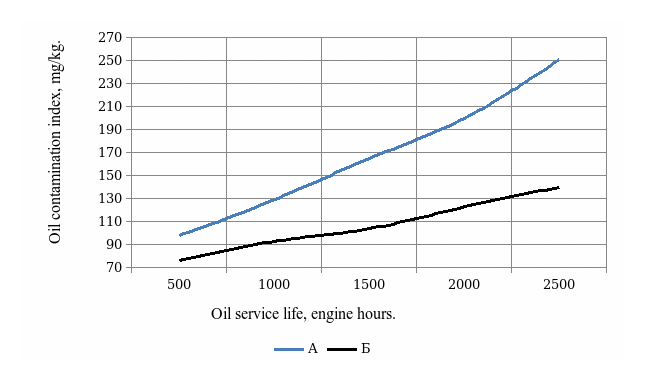
A comparison between the baseline and magnetic filters established that the proposed magnetic filtration system is approximately 40–50 % more effective at purifying the oil.
4. Conclusion
Based on the research conducted, the following conclusions of theoretical and practical significance have been drawn:
1. Each 1 mm increase in scale thickness on the heat exchange surfaces of the intercoolers in multi-stage reciprocating compressors leads to an average 5 % increase in the temperature of the air delivered to the next stage cylinder.
2. An ultrasonic acoustic device has been developed, enabling the effective descaling of the intercooler heat exchange surfaces in multi-stage reciprocating compressors. The practical application of this device has resulted in a 95 % reduction in scale formation within the air coolers and a 2 % reduction in energy consumption for air compression.
3. The optimal values for oscillation amplitude, frequency, and pulse duration generated by the ultrasonic acoustic device have been determined (frequency 15–20 kHz, pulse duration 1.5–2 ms), ensuring effective descaling of the internal surfaces of metallic tubes.
4. The optimal parameters for the improved design of the compressor lubrication system filter have been established. A porosity of 70 % and a filter media thickness of 10 mm over the magnet ensure maximum oil purity and the highest flow velocity, while achieving the capability to capture sub-micron particles (less than 1 mcm) contained in the oil.
5. The implementation of the improved filter design in the compressor lubrication system allows for an increase in the service life of the crosshead by 20 %, the oil pump by 30 %, the connecting rod by 20 %, and both the oil filter and the lubricant itself by 60 %.
References
