
Influence of the physical-mechanical properties of substances included in the composition of oil emulsion on the quality of the obtained product
УДК 66.066.3
Abstract
This study investigated the influence of various surfactants and filler additives in oil emulsion compositions on the emulsion's physical-mechanical properties, comparing samples prepared from local raw materials with imported analogues, and developed a technology for producing oil emulsion with quality indicators superior to imported products. The effects of these substances on temperature resistance, color, adhesion, and consumption during wire drawing were studied, and several locally-based samples were compared with imported oil emulsions (Russia, China). Results showed that samples containing iron oxide and sodium fluoride were considerably more resistant to high temperatures (170–240 °C) than imported products. Furthermore, the sample obtained through a newly developed two-stage technology — heating followed by stepwise addition of calcium stearate — barely melted at 170 °C, with a melting point above 250 °C. This new technology yields a granular, non-monolithic product that is easier to crush, produces less dust, and consumes less electricity. The findings confirm that oil emulsions produced from local raw materials can achieve quality indicators superior to imported products, making them viable import substitutes.
Аннотация
Данное исследование посвящено изучению влияния различных поверхностно-активных веществ и наполнителей, входящих в состав масляной эмульсии, на её физико-механические свойства; проведено сравнение образцов, приготовленных на основе местного сырья, с импортными аналогами, и разработана технология получения масляной эмульсии с показателями качества, превосходящими импортные продукты. Было изучено влияние данных веществ на теплостойкость, цвет, адгезию и расход в процессе волочения проволоки, а также сопоставлены образцы на основе местного сырья с импортными масляными эмульсиями (Россия, Китай). Результаты показали, что образцы с оксидом железа и фторидом натрия значительно более устойчивы к высоким температурам (170–240 °C), чем импортные продукты. Кроме того, образец, полученный по новой двухстадийной технологии — нагрев с последующим поэтапным добавлением стеарата кальция — практически не плавился при 170 °C, а его температура плавления превышала 250 °C. Новая технология даёт гранулированный, немонолитный продукт, который легче измельчается, меньше пылит и требует меньше электроэнергии. Полученные результаты подтверждают, что масляные эмульсии на основе местного сырья могут достигать показателей качества, превосходящих импортные продукты, и служить полноценной заменой импорту.
Keywords: oil emulsion; surfactant; calcium stearate; sodium stearate; temperature resistance; adhesion; wire drawing; drawing die; local raw materials.
Ключевые слова: масляная эмульсия; поверхностно-активное вещество; стеарат кальция; стеарат натрия; теплостойкость; адгезия; волочение проволоки; волочильная фильера; местное сырьё.
Introduction
Every substance possesses its own distinct nature and properties, and the purpose of combining them into a single composition is to obtain a specific emulsion in which substances from a group with differing characteristics complement one another. In the present work, the soap contained in the composition of the oil emulsions for which a production technology is proposed is, by nature, a surfactant.
The aim of this study is to investigate the effect of various surfactants and filler additives constituting the oil emulsion on the physical-mechanical properties of the emulsion, including temperature resistance, color, adhesion, and consumption during the wire drawing process; to conduct a comparative analysis of samples prepared on the basis of local raw materials with imported oil emulsions (Russia, China); and to develop a new, efficient technology for producing an oil emulsion possessing high temperature resistance and quality indicators superior to those of imported products, capable of substituting imports.
The chemical composition of the obtained and imported emulsions shows that stearates ensure the smooth passage of the metal through the drawing die. Talc and borax, in addition to imparting a distinctive color to the metal surface, also affect its anticorrosive properties.
A comparison of the chemical composition of the obtained samples with that of the imported products shows that 90 % of the raw materials required for the samples are available within the Republic, are inexpensive, and at the same time consist of substances that assist the functions of the emulsion. These filler additives — lime, potassium fluoride, iron oxide, and sodium sulfates — provide the temperature resistance of the emulsion (Figure 1), consistent with earlier findings on oil compositions and emulsions obtained from local raw materials. Borax, talc, and sodium phosphate (Na3PO4) likewise increase both temperature resistance and adhesion.
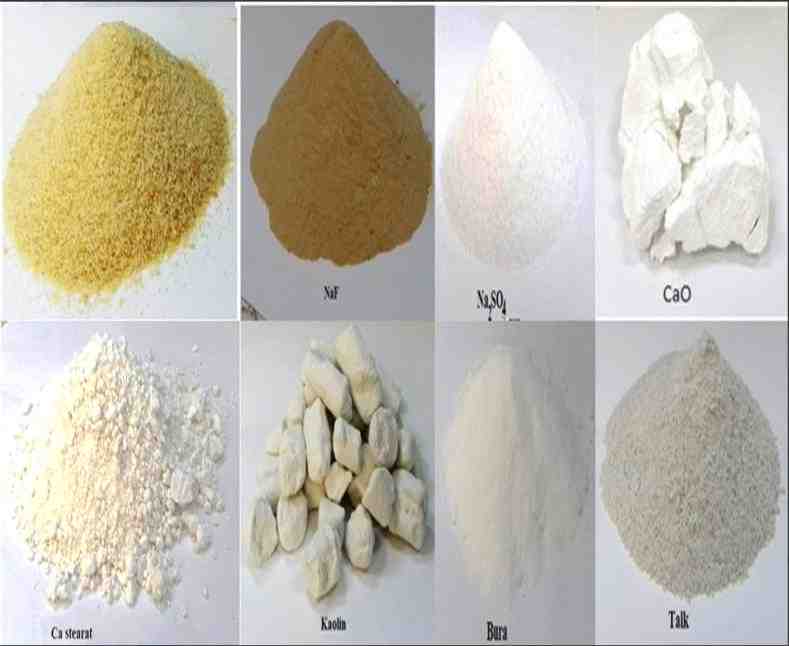
Based on Table 1, the color and temperature resistance of the samples were compared, presenting the melting behavior of the imported products and the samples as the temperature increased.
Table 1.
Physical properties of the oil emulsions.
| No. | Product | Melting degree (%) | Color | ||
|---|---|---|---|---|---|
| 170 °C | 200 °C | 240 °C | |||
| 1 | Imported product (Russia) | 15 | 60 | 100 | Gray |
| 2 | Imported product (China) | 20 | 67 | 100 | Light gray |
| 3 | Sample 1 | 17 | 46 | 72 | Gray |
| 4 | Sample 4 | 15 | 44 | 65 | Pink |
| 5 | Sample 5 | 5 | 20 | 60 | Light red |
At 170 °C, mainly due to the heat generated in the drawing die, the Chinese oil emulsion was observed to melt by 20 %. The melting temperature of the emulsions was found to be 240 °C; only in sample 4, owing to the low mass fraction of calcium and sodium stearate salts, was 65 % melting observed at 240 °C, forming a solid alloy. The iron oxide contained in sample 5, prepared on the basis of local raw materials, ensures the high temperature resistance of the oil emulsion. The sodium fluoride contained in sample 4, besides increasing the temperature resistance of the oil emulsion, also reduces the flammability of the emulsion. For this reason, samples 4 and 5 are more resistant to high temperatures than the other samples and the imported product, which is consistent with findings on the temperature-dependent behavior of stearate-based soap lubricants reported elsewhere.
Materials and Methods
The oil emulsion obtained under laboratory conditions was divided into three groups according to the degree of fineness. Sample 3, with a particle size of up to 0.2 mm, was used for drawing hard non-ferrous metals. Sample 4, with a relatively larger particle size, was used for drawing soft non-ferrous metals, since drawing soft wires does not require high pressure; it was used to reduce the consumption of the oil emulsion. For single-stage wire drawing, samples 2 and 3 were found to be effective (Table 2).
The fat content and melting temperature of the oil emulsion are selected according to the grade of the non-ferrous metal, since an increase in the carbon content of copper also increases the temperature in the drawing die.
Table 2.
Emulsion consumption depending on wire-drawing speed.
| No. | Product | 0.5 (m/s) | 1 (m/s) | 5 (m/s) | 9 (m/s) | 12 (m/s) |
|---|---|---|---|---|---|---|
| 1 | China | 0.30 | 0.52 | 0.65 | 0.73 | 0.83 |
| 2 | Russia | 0.26 | 0.51 | 0.73 | 0.74 | 0.82 |
| 3 | Sample 1 | 0.30 | 0.61 | 0.70 | 0.75 | 0.82 |
| 4 | Sample 2 | 0.26 | 0.57 | 0.73 | 0.77 | 0.86 |
| 5 | Sample 3 | 0.28 | 0.57 | 0.69 | 0.73 | 0.80 |
| 6 | Sample 4 | 0.30 | 0.61 | 0.69 | 0.75 | 0.80 |
Unlike the first method, in the new method of obtaining oil emulsion the filler products of the emulsion are charged into the reactor once the equipment temperature reaches 160–165 °C. Stirring is then continued for 35 minutes. Calcium stearate is added in 1-gram increments at 3-minute intervals. The resulting granular mixture is cooled and fed to a ball mill. The differences between this new technology and the previous technologies are as follows:
– the resulting product forms a granular, non-monolithic mass that is convenient for crushing;
– no paste (slurry) is formed during mixing;
– less time is required to obtain the finished product;
– since the filler products are heated together with the emulsion before the calcium stearate is added, dust formation from the equipment is reduced;
– it is distinguished by higher electricity efficiency.
Results and Discussion
Obtaining the product on the basis of the new technology in the production of oil emulsion requires less time and energy than traditional technologies. These factors reduce the cost price of the product.
Table 3.
Chemical composition of the newly obtained emulsion.
| No. | 1 | 2 | 3 | 4 | 5 | 6 | 7 |
|---|---|---|---|---|---|---|---|
| New Sample | Ca stearate | Na stearate | sodium sulfate | Borax | sodium phosphate | Na2SO4 | Water |
| Mass fraction (%) | 15 | 15 | 5 | 25 | 10 | 10 | 10 |
The physical and chemical properties of the substances constituting the new sample obtained by the second method, as well as the functions of the emulsion, were taken into account (Table 3). Unlike the previous samples, this sample takes into account the diversity of filler products and the conditions for optimizing the concentration of calcium stearate and sodium stearate salts in the oil-emulsion composition.
The temperature resistance of this new emulsion was found to be higher than that of the previous samples and of the imported emulsions. As can be seen from Table 4, the emulsion barely melts at 170 °C. During passage through the drawing die, when the heat reaches 150–180 °C, the adhesion and friction properties of the emulsions decrease. In this case, a low melting heat of the emulsion has a negative effect on wire drawing.
Table 4.
Physical properties of the newly obtained emulsion compared with imported products.
| No. | Product | Melting degree (%) | Color | ||
|---|---|---|---|---|---|
| 170 °C | 200 °C | 240 °C | |||
| 1 | Imported product (Russia) | 15 | 60 | 100 | Gray |
| 2 | Imported product (China) | 20 | 67 | 100 | Light gray |
| 3 | New sample | 3 | 12 | 40 | Light brown |
The fact that the melting temperature of the newly obtained sample exceeds 250 °C makes it possible to resolve this problem. In the die box, the portion of emulsions with a low melting temperature — up to 20 % — forms unnecessary waste. The distinguishing feature of the newly obtained sample compared with the previous samples is that the emulsion obtained by the second method does not form a monolithic, solid, alloy, and consequently the emulsion granules are easily crushable. This property makes the oil emulsions obtained by this method suitable for recommending them for drawing non-ferrous metals and non-ferrous metals with a low carbon content. Since its melting temperature is higher than that of the previously obtained samples, it can also be used for wire drawing at higher speeds.
Conclusion
The experiments conducted established that the substances constituting the oil emulsion have a significant effect on the physical-mechanical properties of the emulsion. The samples prepared on the basis of local raw materials stand out for their higher temperature resistance compared with imported products, owing to the iron oxide and sodium fluoride in their composition. The newly developed technology — adding the filler substances at a temperature of 160–165 °C and introducing calcium stearate in stages — yields an emulsion sample with a melting temperature above 250 °C and high adhesion and friction properties, requiring less time and energy than the traditional technology, reducing dust formation, and lowering the cost price of the product.
Thus, the oil emulsions developed on the basis of local raw materials are superior to, or equal to, their imported analogues in terms of physical-mechanical properties, and are recommended for production as import-substituting products.
References
