
Effective technologies for strengthening the foundation of low-head hydraulic structures under complex engineering-geological conditions
УДК 626/627+624.138
Abstract
This article analyzes and evaluates technologies for strengthening small-structure foundations and improving soil properties in challenging conditions. The research aim is to select the most effective and economically viable method for stabilizing weak, multi-layered base layers in the Amudarya River delta, which are characterized by highly deformable, water-saturated dusty sands exhibiting pronounced quicksand properties under dynamic impacts. The methodology involves a comprehensive engineering comparative analysis of current techniques used in hydraulic engineering, including chemical silicatization, microcement grouting, jet grouting, deep foundations, and Deep Soil Mixing (DSM). As a primary result, soil column construction via Deep Soil Mixing (DSM) was selected as the preferred approach. This technology offers high reliability and structural profitability while minimizing geotechnical risks in challenging ground environments. In conclusion, the paper outlines a specialized testing workflow, including laboratory core evaluation and field pilot stabilization, to fully optimize future hydraulic designs.
Аннотация
В данной статье анализируются и оцениваются технологии укрепления оснований малых сооружений и улучшения свойств грунтов в сложных условиях. Целью исследования является выбор наиболее эффективного и экономически обоснованного метода стабилизации слабых многослойных оснований в дельте реки Амударьи, характеризующейся сильнодеформируемыми, водонасыщенными пылеватыми песками, проявляющими свойства плывуна при динамических воздействиях. Методология включает комплексный сравнительный инженерный анализ современных методов, применяемых в гидротехническом строительстве, таких как химическая силикатизация, цементация, струйная цементация, свайные фундаменты и глубокое смешивание грунтов (DSM). В качестве основного результата устройство грунтоцементных колонн по технологии DSM определено как наиболее предпочтительный подход. Эта технология обеспечивает высокую надежность и рентабельность, минимизируя геотехнические риски в сложных грунтовых условиях. В заключении сформулирован алгоритм проведения опытно-промышленных испытаний и лабораторных тестов кернов для оптимизации проектирования будущих гидротехнических сооружений.
Keywords: small structures; events; technology; foundation; strengthening; soil improvement; safety; deformation; quicksand; Deep Soil Mixing.
Ключевые слова: малые сооружения; мероприятия; технология; основание; укрепление; улучшение свойств грунтов; безопасность; деформация; плывун; Deep Soil Mixing.
Introduction
In recent years, increasing water scarcity has led to greater emphasis on designing, constructing, and rationally using small structures in challenging engineering-geological contexts. According to the Ministry of Water Resources, small structures now outnumber large ones in the republic. Ensuring the long-term safe operation of these small structures is a pressing concern. To meet this challenge, stakeholders should systematically review both positive and negative global experiences in hydraulic engineering and implement best practices accordingly [1,2].
It is essential to recognize factors that inevitably cause the condition of structures to deteriorate, even when used correctly. These include aging materials, weakened foundations, and changes over time in strength, water resistance, and other properties. When needed, engineers must plan for major repairs, reinforcement, or replacement of outdated structures with modern materials.
Soils that quickly lose their properties under the influence of external factors capable of deformation are widespread in the Amudarya River delta. The depth of these soils ranges from several centimeters to tens of meters and even more meters. In such cases, insufficient assessment of the properties of deformable soils leads to the loss of strength and stability of the foundations of small structures, which can subsequently lead to catastrophic consequences. Such cases were very common in the practice of hydraulic construction and caused significant damage to socio-economic sectors [3 – 5]. The reliability of the foundations of small structures and the reduction in the cost of their construction work largely depend on the correct assessment of the properties of the soils in the foundation, the effectiveness of the chosen technological methods and dimensions, and the quality of these works.
Research Objectives: This paper aims to mathematically and logistically analyze geotechnical options to overcome the floating sand layer underneath minor concrete water management channels, identifying a method that maximizes foundation bearing capacity while ensuring project profitability under aggressive aquatic conditions.
Materials and Methods
A complex multi-layered soil layer was identified at the base of the small structure
Layer 1: Sandy loam extending from the surface with a thickness of 3.8 m, characterized by a critically low deformation modulus (E = 5 MPa).
Layer 2: Loamy loam with a thickness of 5.8 m, exhibiting an equally poor load-bearing capacity (E = 4 MPa).
Layer 3: Dusty sands representing a highly critical layer with a thickness of 4.5 m. It lies at a depth of 9.6 m from the surface. This layer exhibits severe floating (quicksand) properties, creating a substantial hurdle for standard engineering setups.
Layer 4: Semi-solid clay with a thickness of 1.0 m. While it behaves as a relatively strong layer, its small thickness does not allow it to be considered a reliable structural load-distribution layer.
The detailed stratigraphic profile and spatial layout of the hydraulic installation are illustrated below (Figure 1).
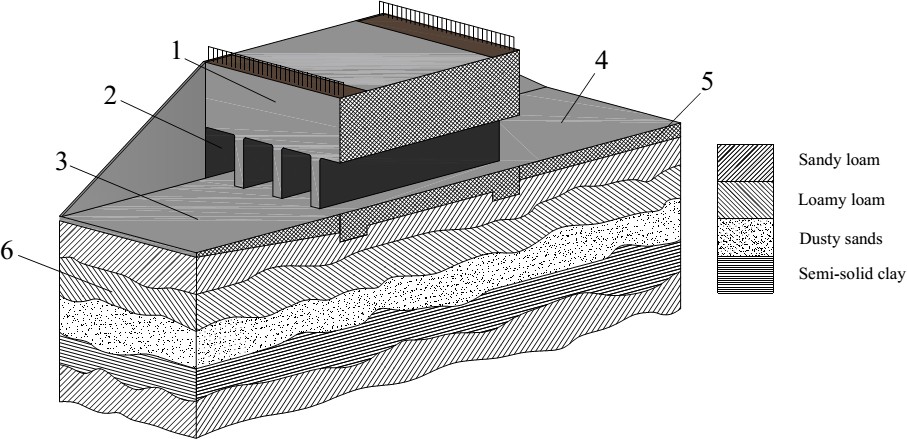
Note on Figure 1: The diagram establishes the geological positioning of the critical quicksand layer (Layer 3) relative to the concrete hydraulic body. It highlights how proximity to hydraulic pool boundaries induces a volatile stress state inside weak subgrades.
The groundwater level is documented in the range of 4.5 – 6.4 m, which directly saturates the soil profile. This indicates that while the upper portion of the third layer (approximately 0 – 1.9 m) lies above the water table, its main body ( ~ 2.6 – 4.5 m) is deeply submerged, activating acute fluidic behavioral features under dynamic shifts. After construction, constant operational water filling completely saturates all adjacent layers, maximizing quicksand mobility across the system. Compounding this issue, both the soil matrix and groundwater exhibit chemical aggressiveness toward standard concrete compounds, demanding sulfate-resistant cement components and specialized structural barriers [7 – 10].
A quicksand mass consists of water-saturated fine-grained (dusty) sands that shift into a flowing state upon dynamic impact or pit opening. This phenomenon yields:
1. A sharp loss of soil load-bearing capacity.
2. Large and highly uneven settlement patterns across the structure.
3. Rapid flooding and collapse of the excavation pit during early development phases.
4. Severe difficulties in successfully boring piles or embedding foundational units.
Results and Discussion. For the site's unique geotechnical conditions, engineering methods capable of stabilizing the quicksand layer without requiring its physical extraction were systematically evaluated [11,12].
1. Silicatization (Chemical Fixation)
Principle: Pumping chemical mixtures (e.g., sodium silicate «liquid glass» and calcium chloride) through pressure injectors directly into the quicksand matrix. The reaction precipitates a waterproof silicic acid gel that bonds fine sand particles together.
Technology: Well drilling spaced at 0.8 – 1.2 m intervals down to the quicksand base, followed by sequential solution injection to construct a continuous solid block.
Assessment: It offers excellent localized strength, water resistance, and silent, vibration-free execution suited for tight spaces. However, the extreme cost of chemical reagents, uneven solution migration radius, and potential environmental contamination restrict its broad utility. It remains economically justifiable only to avoid massive, risky open earthworks.
2. Cementation (Smolization)
Principle & Technology: Utilizes ultra-fine microcements or synthetic resins capable of passing through the tiny pores of dusty sands. The operational steps mimic silicatization under stringently controlled pressures.
Assessment: Yields phenomenal structural strength and demonstrates good compatibility with surrounding slurry walls or sheet pile frameworks. However, its financial cost is extremely high. Microcements require specialized procurement, and the solution must rely on premium sulfate-resistant compositions to survive the aggressive local groundwater, rendering it the least profitable option for large volumes. It is recommended only for localized reinforcement of critical joints.
3. Jet Grouting
Principle & Technology: A specialized hydraulic cutter on a rotating drill string introduces a cement solution under ultra-high pressure (300 – 600 atm), simultaneously tearing apart the soil matrix and blending it with the binder to create stable clay-cement blocks.
Assessment: Completely replaces weak quicksand with predictable, high-strength soil cement. It allows the construction of seamless underground structural walls and uses sulfate-resistant cement. However, equipment mobilization costs are remarkably high, it demands substantial workspace, and it produces an extensive volume ofground-cement pulp byproduct (slag) requiring disposal. Despite this, it remains technically justified due to its absolute elimination of geotechnical risks.
4. Deep Supports (Bored or Screw Piles)
Principle & Technology: Bypasses the quicksand layer entirely by sinking cast-in-place bored piles or screw piles through the unstable strata until they rest firmly on the deep semi-solid clay layer. Casing pipes prevent soil collapse during concreting.
Assessment: A mature, structurally sound method that effectively relocates structural loads to deeper, stable layers. Screw piles facilitate fast installation with minimal soil vibration. Nevertheless, passing through active quicksand frequently causes casing jams, wellbore wall collapse, or significant drilling fluid loss. Metal screw piles also demand intensive anti-corrosion codings in aggressive waters. Financially, it stands as a highly profitable alternative since establishing a focused pile field is often cheaper than mass soil cementation.
5. Deep Soil Mixing (DSM) Technology
Principle & Technology: Mechanical mixing blades are lowered into the subgrade, mechanically blending the in-situ soil with a customized cement mortar slurry to forge high-density, uniform structural columns.
Assessment: This method ensures superb column homogeneity and structural quality while generating zero construction vibrations or disruptive noise. It supports the direct introduction of sulfate-resistant binding agents. While it demands specialized mixing machinery, its overall economic profitability is moderate and highly competitive compared to Jet Grouting due to superior speed and minimized waste material generation.
6. Full or Partial Soil Replacement
Principle & Technology: Physical excavation of the weak quicksand and layer-by-layer replacement with compacted coarse sand, gravel, or sand-gravel mixtures.
Assessment: Technically unfeasible for this site. Because the quicksand layer occurs at a massive depth of 9.6 m in a water-saturated floodplain environment, keeping the excavation pit stable would require heavy sheet pile barriers and intense continuous pumping. This creates a high risk of trench collapse and undermines adjacent infrastructure due to fine particle migration. Furthermore, disposing of 675 m3 of saline, muddy soil is highly inefficient and expensive.
Following this analytical review, the evaluated geotechnical methods were synthesized into a standard engineering matrix outlined below (Table 1).
Table 1.
Comparative Engineering Matrix of Geotechnical Methods for Subgrade Stabilization
| Technology Category | Evaluated Engineering Methods | Technical Advantages | Main Constraints / Risks |
|---|---|---|---|
| Group 1: Recommended | Deep Soil Mixing (DSM), Jet Grouting | High column homogeneity; minimal waste pulp; completely replaces weak zones. | Demands specialized equipment; high initial mobilization budgets. |
| Group 2: Conditional | Deep Supports (Bored/Screw Piles) | Effectively relocates loads down to deep stable clay layers. | High risk of casing jams and wall collapse in active quicksand. |
| Group 3: Not Recommended | Silicatization, Cementation, Mass Soil Replacement | Silence and vibration-free execution in tight spaces. | Extreme chemical costs; unfeasible trench cave-ins under high water tables. |
Conclusions
Based on structural performance metrics, operational logistics, and cost balances, Deep Soil Mixing (DSM) technology is officially selected as the primary methodology for reinforcing the quicksand foundation zone under the small hydraulic structure. To guarantee seamless implementation, the following subsequent technical actions are mandatory:
1. Clarifying Surveys: Execute detailed geotechnical investigations focusing exclusively on the Layer 3 quicksand band to map its exact granulometric distribution and filtration coefficients.
2. Test Strengthening: Install 2–3 pilot soil-cement test columns on-site, away from the core footprint, using the selected DSM gear.
3. Laboratory Verification: Extract core samples from the test columns to evaluate compressive strength and evaluate chemical resistance against local aggressive groundwater parameters. This ensures accurate selection of cement grades and slurry configurations.
4. Final Engineering Design: Utilize empirical data to perform final structural calculations mapping precise column diameters, optimal spatial pitching, immersion depths, and required binder concentrations.
Adopting this systematic approach to Deep Soil Mixing guarantees structural longevity and maximizes project profitability while fully mitigating risks induced by volatile ground environments.
