
The role of mass media in the professional and personal development of a teacher
УДК 371.8
Аннотация
В данном исследовании изучалась медиаграмотность преподавателей дистанционного обучения и использование ими средств массовой информации. С помощью онлайн-опроса были выявлены психологические барьеры, проблемы с управлением временем и недостатки в фильтрации информации в дистанционном обучении. Результаты показали значительные различия между учителями мужского и женского пола: доля тех, кто использует технические средства для организации уроков, составила 60 % среди мужчин и 40 % среди женщин. На долю учителей-мужчин приходилось 35 % активного обмена опытом в Telegram и социальных сетях, а на долю учителей-женщин — 65 %. Также были исследованы возрастные различия в решении проблем. Были выявлены четкие различия в отношении использования средств массовой информации. 95 % учителей утверждают, что средства массовой информации не могут заменить учителя, однако это подрывает престиж их цифровой деятельности. Результаты визуализированы, показывая, что более 80 % респондентов регулярно используют мультимедийные ресурсы. Это связано с профессиональной мотивацией учителей и качеством подготовки уроков. Учителя, которые интегрировали мультимедийные инструменты в свои уроки, оценили свое профессиональное развитие выше, чем те, кто использовал традиционные методы.
Abstract
This study examined the media literacy of OTM educators and their use of mass media. Using an online survey, psychological barriers, time management issues, and shortcomings in information filtering were identified in OTM education. The results revealed significant differences between male and female teachers: the proportion of those using technical tools to organize lessons was 60 % among men and 40 % among women. Male teachers accounted for 35 % of active experience sharing on Telegram and social networks, and female teachers accounted for 65 %. Age-related differences in problem-solving were also investigated. Clear distinctions have been identified regarding relation to the use of media. Ninety-five percent of teachers assert that the media cannot replace the teacher, yet this undermines the prestige of their digital activities. The results are visualized, showing that over 80 % of respondents use multimedia resources regularly. This is linked to teachers’ professional motivation and the quality of their lesson preparation. Teachers who integrated multimedia tools into their lessons rated their professional development higher than those using traditional methods.
Ключевые слова: СМИ; мультимедиа; педагогические вопросы; цифровые технологии; форум Google.
Keywords: Media; multimedia; pedagogical issues; digital technology; Google forum.
Introduction
Today, it is about ensuring the professional and personal development of educators. A modern educator must not only have an excellent command of their subject but also be able to make independent decisions in a fast-flowing information environment, critical thinking and the ability to analyse information presented by the mass media (MM), as well as the capacity to apply their knowledge in practice, are essential. For this reason, the role and importance of the mass media in a teacher’s professional and personal development is currently emerging as a distinct scientific and pedagogical issue.
Within the scope of this research, experimental work was carried out to determine the effectiveness of using mass media (MSM) and digital resources in the professional and personal development of educators in the contemporary information space. In today’s era of intense information exchange, a teacher’s media competence is becoming one of the key factors determining their professional expertise. The experimental work allows for the integration of theoretical knowledge with practical pedagogical activity and the application of new digital methods in the teaching process.
Methodology
Accordingly, the extent to which mass media play a role in teachers’ daily lives was practically analysed. The study was conducted online under invigilated conditions. Tests were created on Google Forms, and the following general overview of teachers’ media literacy and their level of use of mass media was formed, with sample test items provided. The psychological barriers to teachers’ use of media resources, time management issues, and shortcomings in information filtering were identified.
Results and Discussion
Significant behavioural differences were observed between male and female teachers in their use of technical tools during lesson preparation. The research findings were carefully analysed, and the test results for male and female teachers revealed significant differences.
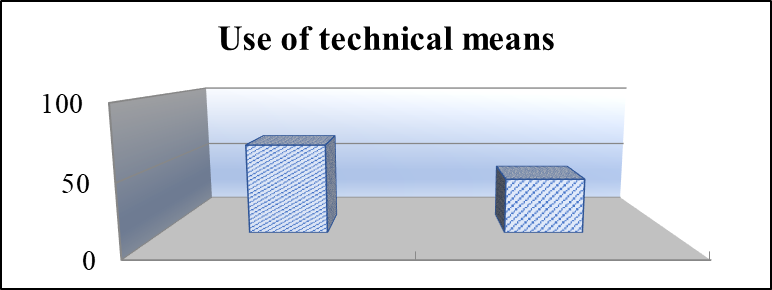
Accordingly, the main results are shown in Figure 1. Accordingly, you can see that among male teachers it accounted for 60 %, whereas among female teachers it accounted for 40 %. The survey is compared with a total of 100 %.
Age-related differences. In the second part of the questionnaire developed for this process emphasis was placed on the aspects primarily concerned with age-related differences in media use.
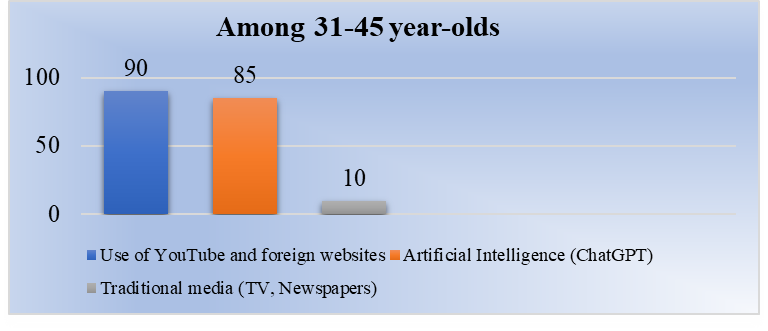
Based on this, the level of adaptation to digital technologies was distributed by age as follows. You can see these results in Diagram 2.
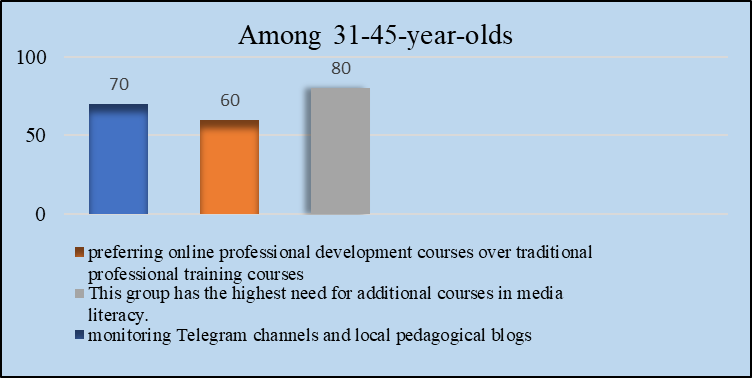
Nearly 70 % of 31-45-year-olds (Experienced users) follow Telegram channels and local educational blogs. 60 % prefer online professional development courses to traditional ones. This group has the greatest need for additional media literacy courses, at 80 %. This is shown in Diagram 3.
III. General Conclusion and Issues
According to the survey results, the main platform for teachers, according to Chart 4, is Telegram (80 %) for Uzbek teachers.
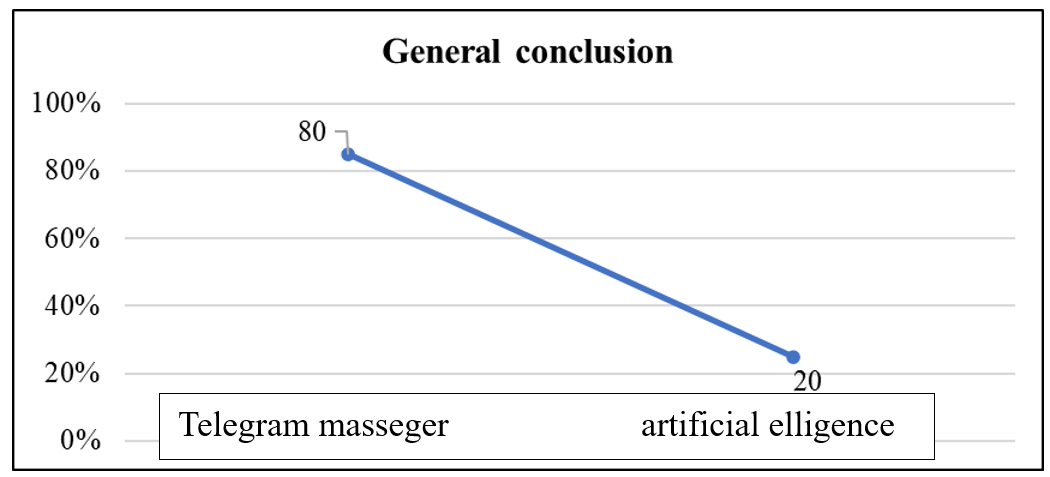
Next in line are Facebook, YouTube and the latest generation of artificial intelligences. Artificial Intelligence: Only 20 % of teachers use artificial intelligence during lessons.
Barriers
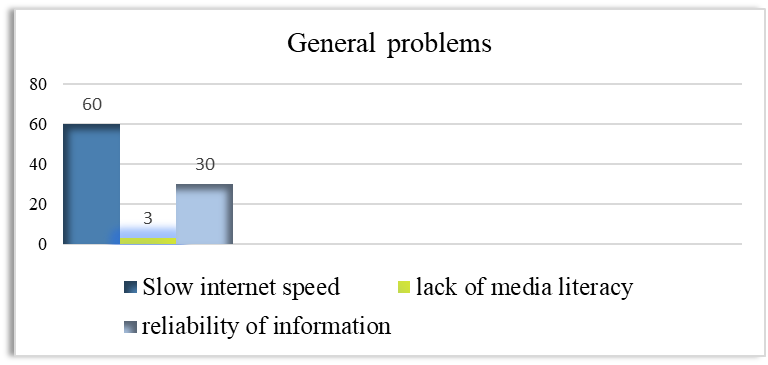
Slow internet speeds in schools (60 % of complaints). Reliability of information (only 30 % of teachers verify sources). Lack of media literacy.
Conclusion
Media cannot replace the teacher (95 % of teachers believe this), but a teacher’s reputation is increasingly linked to how active they are in the digital world. The results of the survey conducted showed that over 80 % of teachers regularly use multimedia resources during lessons. This indicator directly affects teachers’ professional motivation and the quality of their lesson preparation. OTM educators rated the media as significantly higher in promoting teachers’ professional development compared with traditional methods.
References
