Development of technology for obtaining anticorrosion coatings on gas pipelines
УДК 621.643+620.197+667.6
Abstract
This study is aimed at developing a bitumen–alkyd anticorrosion coating for steel gas pipelines using locally available raw materials. BND 60/90 bitumen, PF-060 alkyd varnish, hydrocarbon liquids, microcalcite, and zinc oxide were used to prepare five coating formulations. The effect of formulation composition on bitumen dissolution, drying behavior, adhesion, water uptake, and corrosion resistance was evaluated. Pyrolysis distillate showed the highest bitumen dissolution at 25–45 °C and was selected as the preferred processing liquid. Among the tested compositions, F5, containing 25 wt.% bitumen, 30 wt.% alkyd varnish, 30 wt.% pyrolysis distillate, 10 wt.% microcalcite, and 5 wt.% ZnO, showed the shortest drying time and the highest reported adhesion index. Salt-spray and NaCl exposure tests indicated delayed visible corrosion of coated steel compared with uncoated specimens. The obtained results confirm the practical potential of the developed coating for further pipeline protection studies.
Аннотация
Данное исследование посвящено разработке битумно-алкидного антикоррозионного покрытия для стальных газопроводов с использованием доступного местного сырья. Для приготовления пяти вариантов состава покрытия применялись битум марки БНД 60/90, алкидный лак ПФ-060, углеводородные жидкости, микрокальцит и оксид цинка. Оценивалось влияние состава на растворимость битума, скорость высыхания, адгезию, водопоглощение и коррозионную стойкость. Пиролизный дистиллят обеспечил наилучшую растворимость битума в диапазоне температур 25–45 °C и был выбран в качестве предпочтительного растворителя. Среди испытанных составов вариант F5, содержащий 25 мас. % битума, 30 мас. % алкидного лака, 30 мас. % пиролизного дистиллята, 10 мас. % микрокальцита и 5 мас. % ZnO, продемонстрировал наименьшее время высыхания и наиболее высокий показатель адгезии. Испытания в камере соляного тумана и в среде NaCl показали, что появление видимых признаков коррозии на стали с покрытием задерживается по сравнению с образцами без покрытия. Полученные результаты подтверждают практический потенциал разработанного покрытия для дальнейших исследований в области защиты трубопроводов.
Keywords: bitumen–alkyd coating; gas pipeline; anticorrosion protection; zinc oxide; microcalcite; pyrolysis distillate; adhesion; corrosion resistance.
Ключевые слова: битумно-алкидное покрытие; газопровод; антикоррозионная защита; оксид цинка; микрокальцит; пиролизный дистиллят; адгезия; коррозионная стойкость.
Introduction
The problem of efficient protection of steel gas pipelines from corrosion becomes increasingly important for materials engineering due to the possibility of failure caused by coatings degradation, which will lead to higher maintenance needs and shorter lifetime. Bituminous and alkyd coatings are promising materials because of their relative simplicity of preparation along with barrier properties, which can be adjusted through mineral or functional fillers. The recent research has revealed that the corrosion resistance of these systems depends not only on the chemistry of binder, but also on the coating thickness, filler dispersion, adhesion properties and the conditions of exposure. Thus, the cerium-doped zinc-rich bitumen, MOFs-modified polyester coatings, and polyaniline-containing alkyd systems have shown enhanced barrier properties under the investigation using electrochemical, immersion, and accelerated corrosion tests. Recent studies have demonstrated that the performance of protective organic coatings is governed by both formulation chemistry and electrochemical behavior. EIS analysis has been successfully used to assess corrosion protection in organic coating systems [1], while surfactant-based modification studies illustrate the broader role of functional additives in controlling interfacial processes in complex material systems [2]. For alkyd coatings, incorporation of polyaniline has been shown to improve corrosion protection of mild steel [3]. In addition, bitumen-based anticorrosion coatings have been specifically developed for gas-pipeline applications, confirming the practical relevance of combining bituminous binders with functional components for steel protection [4]. Recently carried out researches prove that the effectiveness of protective action of alkyd and bituminous coatings largely depends on the type of filler, amount of pigment, its distribution in the coating matrix, and electrochemical behavior. The use of nanoclays in the composition of alkyd coatings increased their anticorrosive action with regard to carbon steel, as well as pigment composition and zinc-rich coatings [5,7,8]. In addition, composite mastic coatings made of bitumen for gas pipeline protection confirm the applicability of bituminous coatings [9]. In general, the performance of anticorrosive coatings depends on the combined properties of barrier action, adhesion, and stability [10].
In that case, the current study deals with the evaluation of a five-formulation series of bitumen-alkyd coating intended for the protection of gas pipelines by means of locally obtained materials. In this context, the study investigates the link between formulation composition, processing procedure, temperature-based drying process, properties connected with adhesion, exposure to water and resistance to corrosion, while taking into account the possibility of preparation of larger batches. Special emphasis is placed on the formulation based on ZnO and mineral filler along with the reasons for its efficiency in relation to the other formulations. Instead of taking for granted the mechanism common for all coating systems studied before, the study intends to establish which structure-process-property links are evidenced by the available data. Aluminum oxide-based granular materials and composite organic coatings have been investigated as functional components for improving material performance and corrosion protection [11–13]. In particular, waterborne and organic composite coatings have demonstrated the importance of formulation design and barrier properties in protecting steel substrates from corrosive environments [12,13].
Materials and methods
Five coating formulations were made using BND 60/90 bitumen, PF-060 alkyd varnish, hydrocarbon processing liquids and mineral fillers. Main formulations included 25 wt.% of bitumen, 30 wt.% of alkyd varnish, 30 wt.% of liquid phase and 15 wt.% of filler phase. White spirit, kerosene or pyrolysis distillate were used as liquid phase, while aluminium containing powder, kaolin, microcalcite and ZnO were used as fillers. Chosen formulation F5 included 25 wt.% of bitumen, 30 wt.% of varnish, 30 wt.% of pyrolysis distillate, 10 wt.% of microcalcite and 5 wt.% of ZnO. Purities of microcalcite and ZnO are indicated as 97.8 and 99.2 %, correspondingly. Coatings preparation was performed by heating the bitumen up to 60–80 °C, mixing the bitumen with liquid phase, then gradually mixing alkyd varnish and finally gradual addition of the mineral ingredients. Also, ZnO was pre-wetted with varnish before addition to coating mixture. The coating formulations were prepared following a defined sequence of bitumen heating, incorporation of the liquid phase, addition of alkyd varnish, and dispersion of mineral fillers. The preparation procedure was evaluated in relation to the physicochemical and protective properties of the resulting coatings.
The physicochemical, mechanical, and corrosion-protection properties of the prepared coating formulations were investigated experimentally using the testing procedures described below. Drying kinetics were studied at 10, 20 and 30 °C, as well as independently in a degree-3 drying curve measured at 20 ± 2 °C. Adhesion was tested by the cross-cut technique according to GOST 15140-78, and impact strength was determined according to GOST 4765 – 73 by a U-1A tester as the average of three independent measurements. Absorption rate in water was measured after a 24 h immersion at 23 ± 2 °C, and corrosion resistance was estimated visually in 3 % NaCl solution and additionally by a salt spray test on St3 steel substrates having approximately 100 µm thick two-layer coating. Infrared spectra were registered within the region of 4000 – 400 cm-¹. The experimental results were evaluated through comparative analysis of the physicochemical, mechanical, and corrosion-protection properties of the prepared coatings. The impact resistance was determined from three independent measurements. For the remaining tests, the available experimental data were analyzed descriptively, and differences between the formulations were interpreted within the investigated conditions without assigning statistical significance.
The experimental results were analyzed to compare the physicochemical, mechanical, and corrosion-protection characteristics of the investigated coating formulations. Impact resistance was evaluated using three independent measurements (n = 3) in accordance with GOST 4765 – 73. The remaining experimental results are presented descriptively because the corresponding replicate measurements and estimates of variability are not available in the current dataset. Therefore, no statistical significance is attributed to differences between formulations, and the reported trends are interpreted within the investigated experimental conditions.
Results and discussion
The initial screening study determined the dissolution of bitumen at 10 and 20 wt.% in different solvents at temperatures of 25–70 °C. The pyrolysis distillate had the best dissolution of 65–85 % at 25 and 45 °C, for 10 and 20 wt.% bitumen, correspondingly, while for alkyd varnish the dissolution was 60–80 % and 55–75 %, correspondingly. At 70 °C, full dissolution (100 %) was obtained.
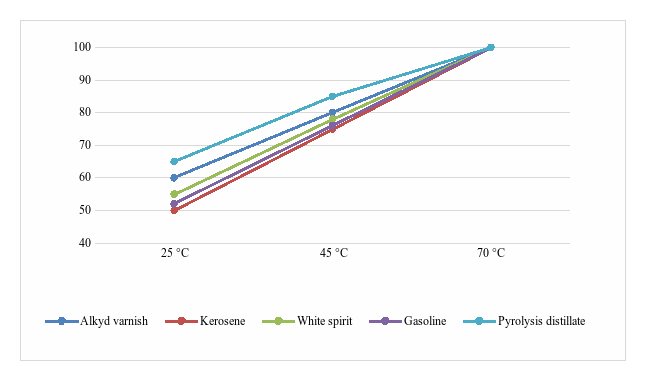
Increase in bitumen content from 10 to 20 wt.% slightly reduced the rate of dissolution at 25 and 45 °C, but the pyrolysis distillate still had the best effect.
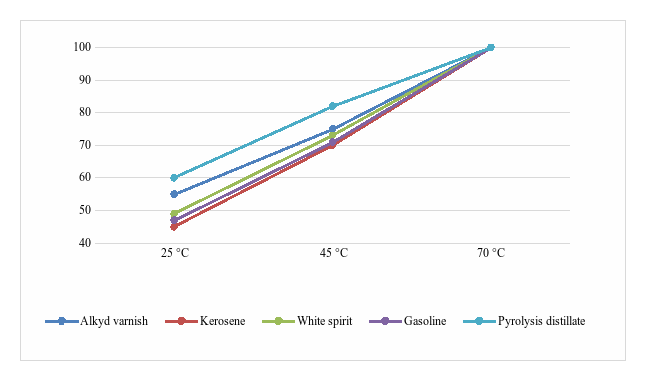
This allows for the assumption that some moderate heating can be used during mixing, but due to the lack of contact-time, agitation, endpoint, replicates and uncertainty values it is impossible to analyze the results according to equilibrium solubility.
The selected ALBM composition includes 55 wt.% bitumen-varnish binder, 30 wt.% distillate and 15 wt.% mineral filler. F5 differs from F2 in replacing microcalcite by ZnO with the same total filler content. Therefore, any differences between F5 and other formulations should be considered as the result of filler properties, dispersion and interfacial effects.
F5 also demonstrated the fastest drying time at all the tested temperatures (9, 7 and 6 h at 10, 20 and 30 °C correspondingly). As compared to F2, the drying time was reduced by 14.3–25.0 %, and as compared to F4 – by 30.8–36.4 %. Again, these values should be considered as descriptive only since replicates were not analyzed.
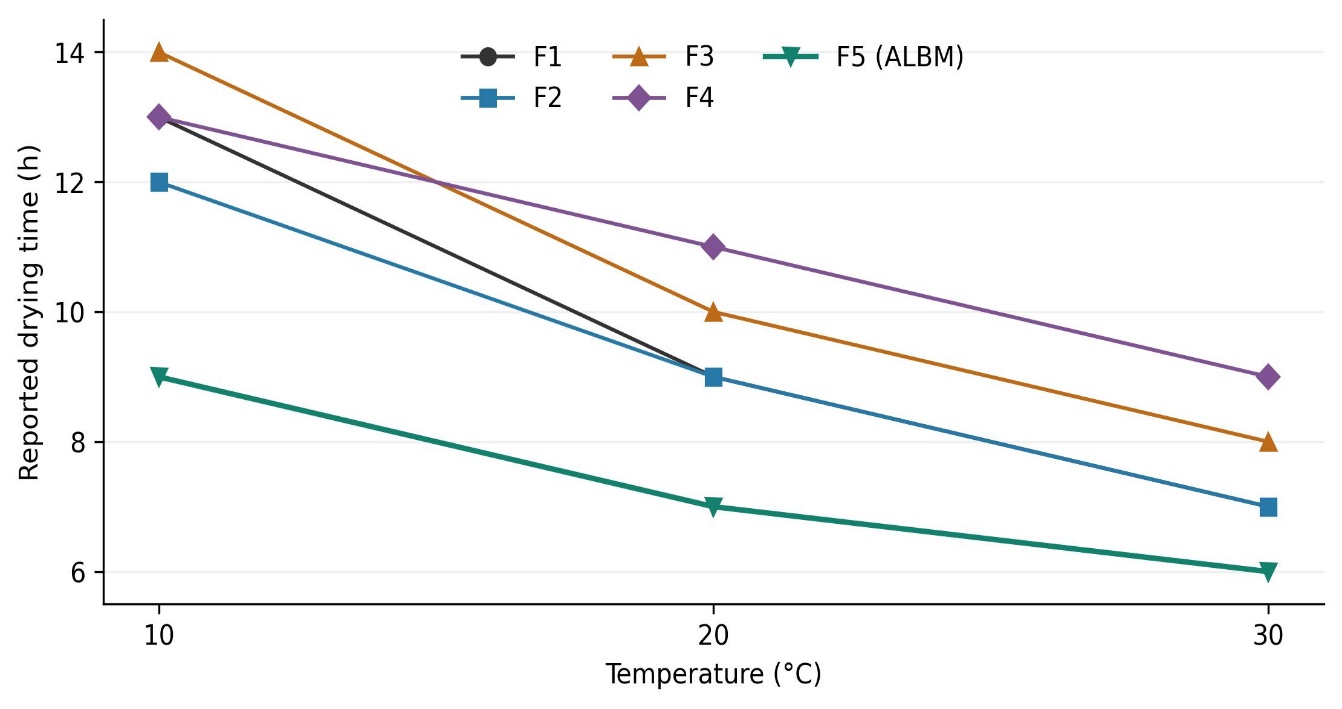
All systems showed decreased drying times with increased temperature. F5 exhibited the shortest drying time in absolute terms, while its relative decrease from 10 to 30°C (33.3 %) was smaller than that of F1-F3. This information proves the existence of a temperature-dependent drying pattern but is not enough for distinguishing between the proposed mechanisms of evaporation, oxidation and through-film curing as well as for kinetic modeling. The difference between F2 and F5 is also not enough for establishing a ZnO-catalyzed curing mechanism without controlled cure data and standardized film thickness.
In the temperature-dependent drying experiments, formulation F5 exhibited drying times of 9, 7, and 6 h at 10, 20, and 30 °C, respectively (Figure 3). A separate determination of drying to degree 3 at 20 ± 2 °C yielded a value of 6 h. Since the equivalence of the experimental endpoints and testing conditions has not been established, these measurements were treated as separate datasets and were not directly compared. The temperature-dependent results consistently demonstrate a reduction in drying time with increasing temperature.. Since there is no information about the experimental conditions for obtaining this data, only the order of drying time for the temperature-resolved series is certain. Consequently, initial drying cannot be identified with mechanical curing or commissioning time.
Water absorption was 0.5 %, 1.5 % and 0.8 % for neat bitumen, unfilled bitumen-alkyd and filled coatings respectively. The addition of mineral filler to bitumen-alkyd resulted in an average reduction of 46.7 % in water absorption compared to the unfilled bitumen-alkyd but the figure was higher than neat bitumen. It means therefore that the performance regarding moisture resistance is better than the modified unfilled bitumen.
The filled category being unspecified, F5, the 0.8 % could not be attributed to ALBM alone. In addition, 24 hours of water absorption represents total mass gain under the exposure condition and cannot be used to assess diffusion resistance or interfacial corrosion protection.
Table 1.
Reported ALBM properties and their interpretation
| Property | Reported value | Interpretive boundary |
|---|---|---|
| Density | 0.97 g cm⁻³ | Reported material density |
| Nominal dry-film thickness | 90 µm | Not uniform across all tests |
| Efflux time at 20 ± 2 °C | 125 s | Cup and orifice unspecified |
| Drying to degree 3 at 20 ± 2 °C | 6 h | Different from 7 h in the temperature series |
| Adhesion index | 95–98% | Not reconciled with categorical cross-cut scoring |
| Impact-test drop height | ≥50 cm | Load and replicate readings unavailable |
| Bending parameter | 1.5–2 mm | Detailed geometry not reported |
The indicated density (0.97 g cm-³), efflux time (125 s) and dry film thickness (90 µm) pertain to the basic coating properties. Still, the efflux time cannot be considered dynamic viscosity as the cup geometry and its orifice diameter are not specified. Furthermore, the film thickness differs from about 100 µm two-layer salt spray test specimen; hence, these datasets cannot be considered as measurements of the same coating setup.
The increase in adhesion index from 80 – 92 % in F1-F4 to 98 % in F5 notwithstanding another source table indicates an inconsistent F3 value; the percentages demonstrate good performance but cannot be considered adhesion strength, as the measured quantity is not force. As well, the advantage of 20 – 25 % due to mechanical activation lacks sufficient support through baseline pairings.
All samples were unchanged in the described 3 % NaCl test, whereas a separate report of salt spray test found localized deterioration of the paint coating of St3 steel at 240 hours, in contrast to serious corrosion of plain steel after 48 hours. Such findings reveal delayed visible deterioration, but without equal times of testing, corrosion rates and inspection criteria, calculation of the efficiency of protection cannot be performed. The reported 80 %, 90 %, and 95 – 98 % values seem to come from different tests, and hence they should not be combined to produce an ALBM corrosion protection value.
There have been several scale up operations, such as 5 L preparation and 100 L batch processing with application on 2 m lengths of 325 mm and 220 mm pipes. Yet, such experiments fail to show batch-to-batch reproducibility, evenness of coating application, or service life in the field. Assuming that a nominal 1000 kg batch would be used, the chosen formulation includes 250 kg of bitumen, 300 kg of alkyd varnish, 300 kg of pyrolysis distillate, 100 kg of microcalcite and 50 kg of ZnO. It is only an approximate material balance, which has not yet been verified in the 3 m³ reactor.
Table 2.
Calculated ingredient requirement and source-price cost for a 1000 kg charge
| Ingredient | Charge kg | Source price UZS kg⁻¹ | Calculated cost UZS |
|---|---|---|---|
| BND 60/90 bitumen | 250 | 2,700 | 675,000 |
| Alkyd varnish | 300 | 10,000 | 3,000,000 |
| Pyrolysis distillate | 300 | 1,800 | 540,000 |
| Microcalcite | 100 | 800 | 80,000 |
| ZnO | 50 | 43,000 | 2,150,000 |
| Total ingredients | 1,000 | — | 6,445,000 |
The calculated raw-material cost of the developed formulation was 6,445,000 UZS per tonne of prepared coating mixture. Including an assumed additional processing allowance of 50 %, the estimated production cost was 9,667,500 UZS per tonne. These estimates refer to the nominal wet formulation. The composition contains 25 wt.% bitumen and 15 wt.% mineral fillers, corresponding to a combined 40 wt.% of these components before accounting for the non-volatile fraction of the alkyd varnish. Therefore, the previously indicated non-volatile content of 25–28 wt.% was excluded from quantitative interpretation pending verification by gravimetric analysis. The calculation does not represent the cost per tonne of dry coating solids. Despite the promising performance of the developed bitumen–alkyd anticorrosion coating, several limitations of the present study should be acknowledged. The experimental evaluation was primarily based on laboratory-scale physicochemical, mechanical, and corrosion-resistance tests. Although the results demonstrated favorable drying behavior, adhesion characteristics, and delayed visible corrosion of coated steel, the limited availability of replicate measurements and quantitative electrochemical data restricts the statistical assessment of coating performance. Furthermore, differences in drying-test conditions, variations in coating thickness, and uncertainties regarding the non-volatile content require additional experimental verification. Future research will focus on improving the reproducibility and reliability of the experimental results through standardized testing procedures and at least three independent measurements for each investigated property. Particular attention will be given to electrochemical impedance spectroscopy (EIS), quantitative corrosion-rate measurements, and extended salt-spray exposure tests to evaluate the protective efficiency of the coatings. Additional FTIR and morphological analyses will be performed to investigate the interactions between the bitumen–alkyd matrix, ZnO, and microcalcite. Furthermore, optimization of filler dispersion, coating thickness, and processing conditions will be undertaken to improve the mechanical durability and long-term corrosion resistance of the developed formulation. The practical applicability of the coating will be assessed through larger-scale production trials and long-term exposure studies under representative gas-pipeline operating conditions.
Conclusion
From the investigation, F5, with its combination of bitumen, alkyd varnish, pyrolysis distillate, microcalcite and ZnO, was found to be the best formula among those tested. F5 exhibited short drying time, high adhesion index and delay in corrosion damage, which is reported under the stated conditions of exposure, and scale-up tests confirmed that it can be produced at larger scales than the laboratory scale. However, irregularities in the drying, adhesion, non-volatile content and corrosion data, in addition to insufficient replicates, preclude the calculation of a definite protection efficiency or performance of the formulation.
References