Quantum-chemical evaluation of stability and chemical reactivity descriptors of 3d-transition metal complexes based on quinazolin-4(3H)-one derivatives
УДК 544.183:546.562:546.732:546.711
Abstract
This work presents a comparative quantum-chemical investigation of the electronic structure and chemical reactivity descriptors of the free heterocyclic carbonyl ligand X-4-one and its complexes with the transition-metal ions Cu(II), Co(II), and Mn(II). The systems considered are [CuCl4(X-4-one)2], [CoCl4·(2,3M-X-4-one)2], and [MnCl4·(2,3dM-X-4-one)2]. Density functional theory (DFT) calculations were used to examine the relationship between the identity of the central metal ion, electron-density distribution, frontier molecular-orbital energies, and the predicted reactivity of the compounds.
The comparison involved the HOMO and LUMO energies, the HOMO–LUMO energy gap (ΔE), ionization potential, electron affinity, electronegativity, chemical hardness and softness, chemical potential, and electrophilicity index. The calculated ΔE values are 1.39 eV for the Cu(II) complex, 3.05 eV for the Co(II) complex, 3.07 eV for the Mn(II) complex, and 4.38 eV for the free X-4-one ligand.
The copper complex has the smallest energy gap, suggesting, within the framework of the descriptors applied, a greater ease of electronic excitation and comparatively higher chemical reactivity. The cobalt and manganese complexes exhibit wider energy gaps and higher chemical-hardness values, consistent with comparatively lower electronic softness. Among the investigated complexes, the Cu(II) system also displays the highest electron affinity, softness, and electrophilicity index.
Overall, the results indicate that the identity of the central metal ion substantially affects the electronic properties of these complexes. The calculated descriptors provide a theoretical basis for further investigation and may help guide experimental assessment of their potential biological, antibacterial, and antiseptic properties. These biological effects are considered potential research directions and require independent experimental validation.
Аннотация
В работе проведено сравнительное квантово-химическое исследование электронной структуры и характеристик химической реакционной способности свободного гетероциклического карбонильного лиганда X-4-one и его комплексов с ионами переходных металлов Cu(II), Co(II) и Mn(II). В качестве исследуемых систем рассмотрены комплексы [CuCl4(X-4-one)2], [CoCl4·(2,3M-X-4-one)2] и [MnCl4·(2,3dM-X-4-one)2]. Расчётный анализ выполнен в рамках теории функционала плотности (DFT) и направлен на выявление взаимосвязи между природой центрального иона, распределением электронной плотности, энергетическими характеристиками граничных молекулярных орбиталей и предполагаемой реакционной способностью соединений.
Для сопоставления систем использованы энергии HOMO и LUMO, энергетический зазор HOMO–LUMO (ΔE), потенциал ионизации, сродство к электрону, электроотрицательность, химическая жёсткость и мягкость, химический потенциал и индекс электрофильности. Согласно полученным данным, величина ΔE составляет 1,39 эВ для комплекса Cu(II), 3,05 эВ для комплекса Co(II), 3,07 эВ для комплекса Mn(II) и 4,38 эВ для свободного лиганда X-4-one.
Наименьший энергетический зазор обнаружен у комплекса меди, что в рамках используемых дескрипторов указывает на более лёгкое электронное возбуждение и сравнительно высокую химическую реакционную способность. Комплексы кобальта и марганца характеризуются более широкими энергетическими зазорами и более высокими значениями химической жёсткости, что согласуется с их сравнительно меньшей электронной податливостью. Наибольшие значения сродства к электрону, мягкости и индекса электрофильности среди рассмотренных комплексов получены для системы Cu(II).
В целом результаты показывают, что замена центрального металлического иона заметно изменяет электронные характеристики комплексов. Эти расчётные данные могут служить теоретической основой для дальнейшего изучения соединений, в том числе для планирования экспериментальной оценки их биологической, антибактериальной и антисептической активности. При этом биологические эффекты в настоящей работе рассматриваются как потенциальное направление дальнейших исследований и требуют отдельного экспериментального подтверждения.
Keywords: Density functional theory (DFT); HOMO–LUMO energy gap; heterocyclic carbonyl ligands; global chemical reactivity descriptors; electronic stability; antibacterial activity; antiseptic activity.
Ключевые слова: теория функционала плотности (DFT); энергетический зазор HOMO–LUMO; гетероциклические карбонильные лиганды; глобальные дескрипторы химической реакционной способности; электронная устойчивость; антибактериальная активность; антисептическая активность.
Introduction
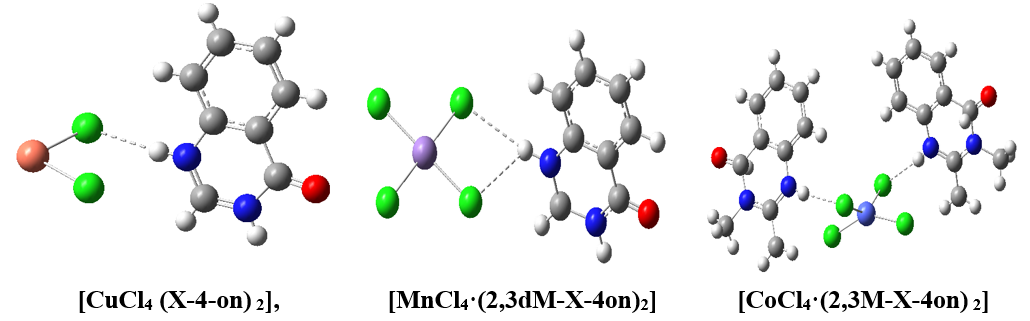
In modern chemistry and pharmaceutical science, quantum chemical calculations, especially density functional theory (DFT), are widely used worldwide as an important tool that allows the electronic structure, stability, and reactivity of molecules to be predicted with high accuracy before synthesis. When HOMO–LUMO frontier orbitals and global reactivity descriptors are used together with molecular docking and in silico ADME screening, they significantly save time and resources in selecting candidate compounds and evaluating their biological activity. For this reason, complexes of biogenic 3d metals – copper(II), cobalt(II), and manganese(II) – with heterocyclic carbonyl (-4-one) ligands are of great interest, since chelation alters lipophilicity and charge distribution and enhances the antibacterial, antifungal, antioxidant, and antiseptic activity of the free ligand. This is usually explained by Tweedy's chelation theory, the binding of the metal center to enzymes and nucleic acids, and the generation of reactive oxygen species. Under conditions of increasing pathogen resistance to traditional antiseptics, such metal-based agents are considered a promising alternative. This work presents a DFT study of the complexes [CuCl4(X-4-on)2], [CoCl4·(2,3M-X-4-on)2], and [MnCl4·(2,3dM-X-4-on)2], with the aim of comparing their stability and chemical activity with the free ligand and evaluating their potential biological and antiseptic activity.
Materials and Methods
The HOMO (highest occupied molecular orbital) and LUMO (lowest unoccupied molecular orbital), determined by DFT calculation methods, provide important information about the electronic structure and chemical properties of a molecule. The HOMO is the highest-energy orbital in the molecule that is filled with electrons; it indicates the molecule's ability to donate electrons, i.e., its tendency toward oxidation. The higher the HOMO energy, the more easily the molecule donates an electron and the higher its reactivity. The LUMO is the lowest-energy empty orbital and expresses the molecule's ability to accept electrons, i.e., its reduction property; likewise, the lower the LUMO energy, the more easily the molecule accepts an electron (Fig. 2).
Results and Discussion
The calculated molecular orbital (HOMO–LUMO) energies of the three complexes – [CuCl4(X-4-on)2], [CoCl4·(2,3M-X-4-on)2] and [MnCl4·(2,3dM-X-4-on)2] – and the key reactivity parameters derived from them provided important information about the electronic structure and chemical properties of the molecules (Fig. 1).
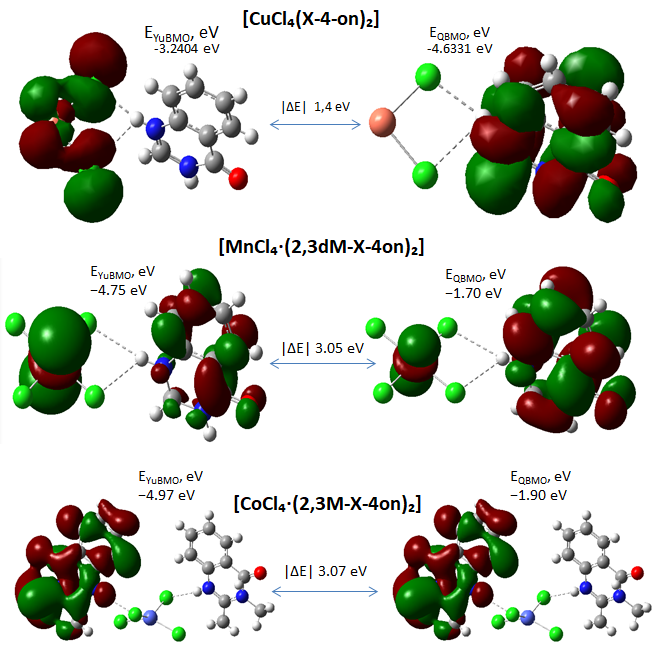
First of all, the HOMO–LUMO energy gap (ΔE) is the main indicator for assessing the kinetic stability and chemical activity of the complexes. According to the calculation results, the ΔE value is 1.4 eV for the Cu complex, 3.05 eV for the Co complex, and 3.07 eV for the Mn complex. A small ΔE indicates a high probability of electron excitation and that the substance is chemically more active.
Accordingly, the [CuCl4 (X-4-on)2] complex has the smallest energy gap and exhibits relatively high activity and lower kinetic stability. In contrast, in the Co and Mn complexes the energy gap is almost twice as large, which indicated the stability of their electronic structure. The ionization potential values are 4.63, 4.75 and 4.97 eV for the Cu, Co and Mn complexes, respectively.
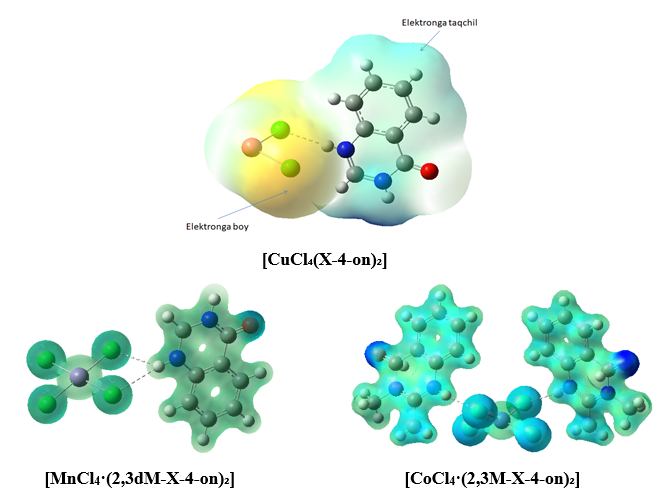
An increase in the ionization potential means that it becomes more difficult to remove an electron from the molecule. Thus, the Mn complex loses an electron with the greatest difficulty and, in this respect, has a relatively stable electronic configuration. The electron affinity of the Cu complex is 3.24 eV, which is significantly higher than those of the Co (1.70 eV) and Mn (1.90 eV) complexes. This shows that the Cu complex has a high tendency to accept an additional electron (Fig. 3).
The electronegativity value is also the largest for the Cu complex (3.94 eV), which reflects its stronger ability to attract electron density. The chemical hardness of the Cu complex is 0.70 eV, whereas it is considerably higher in the Co and Mn complexes (1.53–1.54 eV). A small hardness value means that the system is highly sensitive to external influences and that its electron cloud is highly deformable. For this reason, the Cu complex is characterized as a chemically “unstable” system. For the Cu complex, σ = 0.718 eV-1, which is almost twice as large as for the Co and Mn complexes.
Table 1.
Quantum-chemical parameters of the complex compounds [CuCl4(X-4-on)2], [CoCl4·(2,3M-X-4-on)2] and [MnCl4·(2,3dM-X-4-on)2]
| Quantum-chemical parameters | [CuCl4 (X-4-on)₂] |
[CoCl4‧ (2,3M-X-4on)2] |
[MnCl4⋅ (2,3dM-X-4on)2] |
X-4on |
|---|---|---|---|---|
| EHOMO, eV | -3.2404 eV | −4.75 eV | −4.97 eV | –6.8489 eV |
| ELUMO, eV | -4.6331 eV | −1.70 eV | −1.90 eV | –2.4657 eV |
| |ΔE| = EHOMO – ELUMO, (eV) | 1,3927 eV | 3.05 eV | 3.07 eV | 4.3832 eV |
Ionization potential, |
I=4.6331 eV | 4.75 eV | 4.97 eV | 6.8489 eV |
Electron affinity, |
A=3.2404 eV | 1.70 eV | 1.90 eV | 2.4657 eV |
Electronegativity, |
χ=3.9368 eV | 3.23 eV | 3.44 eV | 4.6573 eV |
Chemical hardness, |
η=0.6963 eV | 1.53 eV | 1.54 eV | 2.1916 eV |
Chemical potential, |
μ=−3.9368 eV | −3.23 eV | −3.44 eV | –4.6573 eV |
| Chemical softness, σ = 1/(2η) (eV)-1 | σ=0.718 eV−1 | 0.33 eV−1 | 0.325 eV−1 | 0.2281 (eV)⁻¹ |
| Electrophilicity index, ω = μp2/2η (eV) | ω=11.14 eV | 3.42 eV | 3.84 eV | 4.95 eV |
The electrophilicity index (ω) of the Cu complex is 11.14 eV, which is considerably higher than those of the Co (3.42 eV) and Mn (3.84 eV) complexes. This shows that the Cu complex has strong electrophilic properties, i.e., a high probability of interacting with nucleophilic reagents. The Co and Mn complexes, in turn, show moderate values of the electrophilicity index (Table 1).
As a result of the quantum-chemical analysis, the nature of the metal center has a significant effect on the outer orbital energies and on the indicators of high activity. The Cu(II)-based complex has the smallest HOMO–LUMO gap and the highest softness and electrophilicity index, and is characterized as the chemically most active system. The Co(II) and Mn(II) complexes, on the other hand, are distinguished by a large energy gap and high hardness values, which indicates that they are relatively stable and less active.
Conclusion
[MnCl4·(2,3dM-X-4-on)2] (3.05 eV) ≈ [MnCl2These results were explained by the electronic structure of the complexes, the influence of the ligand field, and the d-orbital configuration of the metal center, and are important for predicting their potential chemical and biological activity in advance. According to the obtained quantum-chemical analysis results, the values of the HOMO–LUMO energy gap (ΔE) increase in the following order: [CuCl4(X-4-on)2] (1.39 eV) < [CoCl4·(2,3M-X-4-on)2] / [MnCl4·(2,3dM-X-4-on)2] (3.07 eV) < ligand X-4-on (4.38 eV).
References