Carbohydrate profile and phenolic markers of Phlomoides isochila determined by HIGH-performance liquid chromatography
УДК 547.9+543.544.5.068.7
Abstract
This study aimed to characterize soluble carbohydrates and selected phenolic markers in the aerial parts of Phlomoides isochila (Pazij & Vved.) Salmaki (Lamiaceae) using high-performance liquid chromatography. Plant material was collected during flowering in the Pap district of Namangan Region. Carbohydrates were analyzed by HPLC with refractive-index detection on an amino-bonded column using acetonitrile and water (82:18). The ethanolic extract was examined by reversed-phase HPLC with diode-array detection at 254 nm. Sucrose was the dominant quantified carbohydrate (4.944 mg/g), followed by fructose (0.810 mg/g) and glucose (0.173 mg/g). The total concentration of these three compounds, for which chromatographic parameters were available, was 5.927 mg/g. The phenolic profile contained a peak consistent with gallic acid by retention time, giving a calculated concentration of 5.68 mg/g. The tentative ellagic-acid assignment showed a substantial difference in retention time between the sample and the reference standard and therefore requires additional confirmation before quantitative interpretation. These findings provide preliminary analytical information on the phytochemical composition of this species and identify priorities for method validation, compound identification, and further phytochemical investigation.
Аннотация
Целью настоящего исследования являлась характеристика профиля растворимых углеводов и отдельных фенольных маркеров в надземной части растения Phlomoides isochila (Pazij & Vved.) Salmaki (семейство Lamiaceae) методом высокоэффективной жидкостной хроматографии. Растительное сырьё собирали в период цветения на территории Папского района Наманганской области Республики Узбекистан. Анализ углеводов проводили методом высокоэффективной жидкостной хроматографии с рефрактометрическим детектированием на колонке с привитой аминогруппой с использованием подвижной фазы ацетонитрил–вода в объёмном соотношении 82:18. Этанольный экстракт исследовали методом обращённо-фазовой высокоэффективной жидкостной хроматографии с диодно-матричным детектированием при длине волны 254 нм.
Установлено, что среди количественно определённых углеводов преобладала сахароза, содержание которой составило 4,944 мг/г. Содержание фруктозы и глюкозы составило 0,810 и 0,173 мг/г соответственно. Суммарное содержание трёх указанных углеводов, для которых имелись хроматографические параметры, составило 5,927 мг/г.
При исследовании фенольного профиля обнаружен хроматографический пик, время удерживания которого соответствовало времени удерживания стандартного образца галловой кислоты. Расчётное содержание данного соединения составило 5,68 мг/г. Предварительная идентификация эллаговой кислоты выявила существенное расхождение между временем удерживания соответствующего пика в исследуемом образце и временем удерживания стандартного вещества. В связи с этим для достоверного количественного определения эллаговой кислоты необходимо дополнительное подтверждение её идентичности.
Полученные результаты представляют предварительные аналитические сведения о фитохимическом составе исследуемого вида и позволяют определить приоритетные направления дальнейших исследований, включая валидацию аналитических методик, подтверждение идентичности отдельных соединений и углублённое изучение фитохимического состава растения.
Keywords: Phlomoides isochila; Lamiaceae; HPLC; carbohydrates; sucrose; gallic acid; ellagic acid.
Ключевые слова: Phlomoides isochila; Lamiaceae; высокоэффективная жидкостная хроматография; углеводы; сахароза; галловая кислота; эллаговая кислота.
Introduction
Following the phylogenetic revision of the tribe Phlomideae, the genus Phlomoides Moench (Lamiaceae) includes species previously assigned to Eremostachys. Thus, Phlomoides isochila (Pazij & Vved.) Salmaki is the accepted combination for Eremostachys isochila Pazij & Vved. [12]. Species of the related genera Phlomis and Eremostachys have been used in traditional medicine for diabetes, gastric ulcers, inflammation, and wound healing [10]. Phytochemical investigations of these plants have focused mainly on iridoids, phenylethanoid glycosides, flavonoids, and essential oils [5, 10]. Phenolic acids (including chlorogenic and ferulic acids), vitamins B3, C, and E, α-glucosidase inhibitory activity, and hepatoprotective effects have been described for the related species Phlomoides tuberosa (syn. Phlomis tuberosa) [3, 7, 9]. Information on soluble carbohydrates and tannin-related constituents of P. isochila remains limited.
Plant tannins are generally classified as hydrolysable tannins (gallotannins and ellagitannins) and condensed tannins (proanthocyanidins) [11]. These compounds can bind proteins and metal ions and exhibit reducing properties [12]. Ellagic acid is the dilactone of hexahydroxydiphenic acid and may form during ellagitannin hydrolysis [6, 13], whereas gallic acid is widely studied for its antioxidant properties [4]. Pharmacopoeial titrimetric and spectrophotometric approaches frequently estimate total tannin content [1, 2], whereas high-performance liquid chromatography permits more selective examination of individual marker compounds.
Sucrose plays a central role in the long-distance transport of carbon in plants [11]. Soluble sugars can be separated by high-performance liquid chromatography with refractive-index detection using amino-bonded stationary phases [8]. The objective of this investigation was to characterize soluble carbohydrates and selected phenolic markers, particularly gallic acid and a tentatively assigned ellagic-acid peak, in the aerial parts of P. isochila.
Materials and methods
The aerial parts of Phlomoides isochila were collected during flowering in April 2024 in the Pap district of Namangan Region, Uzbekistan. Plant material was dried and ground to a particle size of approximately 3–10 mm. Reference standards of fructose, glucose, sucrose, maltose monohydrate, gallic acid, and ellagic acid, high-performance liquid chromatography-grade acetonitrile (Sigma-Aldrich, USA), and deionized water (Millipore Simplicity, France) were used.
Carbohydrate analysis. Carbohydrates were extracted from the plant material, and the extract was passed through a 0.45 μm nylon filter. Analyses were performed using an Agilent 1100 chromatograph equipped with a G1362A refractive-index detector (ChemStation Rev. B.01.03) and a Supelcosil LC-NH2 column (5 μm, 4.6 × 250 mm; Supelco, USA). Isocratic elution was performed with acetonitrile–water (82:18, v/v) at a flow rate of 1.0 mL/min, a column temperature of 35 °C, and an injection volume of 5 μL. Compounds were assigned by comparison with reference standards and the expected elution sequence on the amino-bonded column (fructose < glucose < sucrose < maltose).
Phenolic acid analysis. A 10 g sample of plant material was treated with 50 mL of 70 % ethanol and heated under reflux with stirring for 1 h at 70–80 °C, followed by stirring for 2 h at ambient temperature. The mixture was filtered, and the residue was extracted twice with 25 mL portions of 70 % ethanol. Combined filtrates were brought to 100 mL with 70 % ethanol and centrifuged at 6000–8000 rpm for 20–30 min. The supernatant was analyzed on an Agilent 1200 chromatograph equipped with an autosampler and diode-array detector. An Eclipse XDB-C18 column (5 μm, 4.6 × 250 mm), a flow rate of 0.8 mL/min, a column temperature of 30 °C, a 10 μL injection volume, and detection at 254 nm were used. The mobile phase consisted of phosphate buffer (A) and acetonitrile (B), with the following A:B gradient: 0–5 min, 95:5; 6–12 min, 70:30; 12–13 min, 50:50; and 13–15 min, 95:5. Quantities were estimated by external-standard peak-area calibration and expressed as mg/g of plant material.
Results and discussion
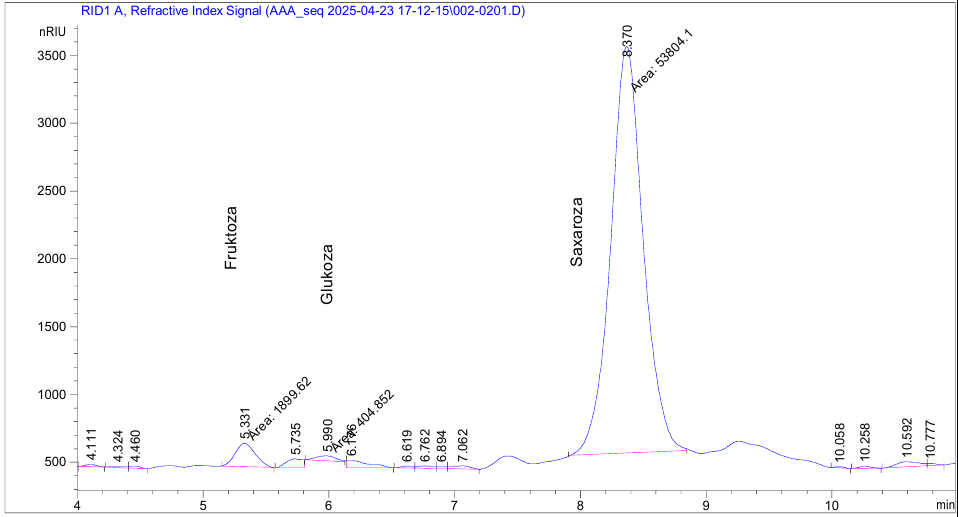
Carbohydrates. The chromatogram (Figure 1) showed a dominant sucrose peak (retention time, 8.370 min; integrated area, 53,804 units). Fructose and glucose peaks appeared at 5.331 and 5.990 min, respectively. The measured concentrations were 4.944 mg/g for sucrose, 0.810 mg/g for fructose, and 0.173 mg/g for glucose. The combined concentration of these three compounds with reported chromatographic parameters was 5.927 mg/g (Table 1). Because the retention time and peak area for maltose were not available, its previously reported value of 0.040 mg/g was not included in the analytically supported sum. The predominance of sucrose is consistent with its recognized role in carbon transport in plants [11].
Table 1.
Carbohydrate composition of P. isochila (percentages calculated for three chromatographically characterized components)
| Compound | Retention time, min | Peak area, nRIU·s | Content, mg/g | Fraction, % |
|---|---|---|---|---|
| Fructose | 5,331 | 1899,6 | 0,810 | 13,7 |
| Glucose | 5,990 | 404,9 | 0,173 | 2,9 |
| Sucrose | 8,370 | 53 804 | 4,944 | 83,4 |
| Maltose | — | — | Not confirmed | — |
| Total | 5,927 | 100,0 |
Phenolic compounds. A peak with a retention time of 6.789 min was observed in the ethanolic extract, close to that of the gallic acid reference (6.708 min). The calculated concentration was 5.68 mg/g (Table 2). The peak tentatively assigned to ellagic acid occurred at 9.389 min, which differed appreciably from the reference standard at 10.163 min; another signal was observed in the sample at 10.215 min. Therefore, the identity and concentration of ellagic acid cannot be regarded as confirmed on the basis of these observations alone. Additional comparison of ultraviolet spectra, standard addition, and/or liquid chromatography–mass spectrometry is required.
Table 2.
Chromatographic comparison of gallic and tentatively assigned ellagic acid in P. isochila at 254 nm
| Compound | Reference retention time, min | Sample retention time, min | Sample peak area, mAU·s | Content, mg/g |
|---|---|---|---|---|
| Gallic acid | 6,708 | 6,789 | 101,9 | 5,68 |
| Ellagic acid (tentative) | 10,163 | 9,389 | 17,0 | Not confirmed |
| Total | — |
Note. Identification of ellagic acid from retention time has not been confirmed; its quantitative estimate was excluded from the overall interpretation.
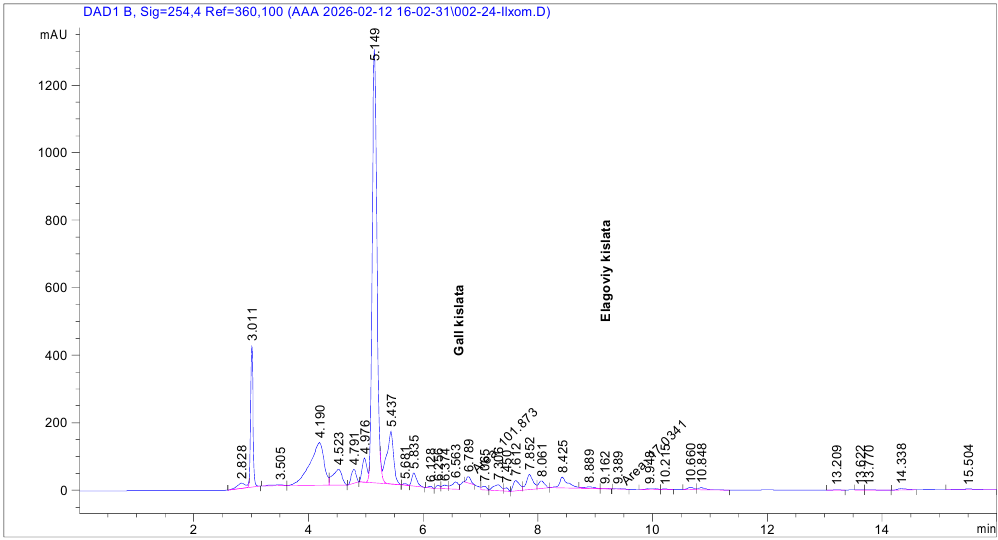
The chromatographic profile (Figure 2) also contained several unidentified peaks. Accordingly, the identification of individual compounds in the phenolic fraction should be considered preliminary. Further method validation should assess calibration linearity, limits of detection and quantification, repeatability, and recovery during sample preparation.
Conclusion
High-performance liquid chromatography was used to characterize the soluble-carbohydrate profile of aerial parts of Phlomoides isochila. Sucrose was the predominant quantified compound (4.944 mg/g), while fructose and glucose were present at 0.810 and 0.173 mg/g, respectively; the sum of these three analytes was 5.927 mg/g. In the ethanolic extract, a chromatographic signal consistent with gallic acid was observed, corresponding to a calculated concentration of 5.68 mg/g. Unambiguous identification of ellagic acid and quantification of maltose require additional analytical evidence. These findings provide a basis for further phytochemical characterization and the development of a validated analytical approach for this plant material.
References