Production of a polymer composite using phosphogypsum as a filler
УДК 678.5+628.3
Abstract
This article describes the processing of phosphogypsum, a large-scale by-product of the chemical fertilizer industry, for the production of a polymer composite material. The study aimed to obtain a composite based on phosphogypsum and to examine its structural characteristics using physicochemical analytical methods. Phosphogypsum was washed with distilled water at 60–70 °C at a solid-to-liquid ratio of 1:3, dried at 105 °C for 4 h to constant mass, ground, and fractionated to obtain a 100–200 μm filler fraction. Sand, phosphogypsum, sodium carboxymethylcellulose (Na-CMC), and urea-formaldehyde resin (KFS) were combined at a mass ratio of 2:1:1:1 and heat-treated at 105–110 °C. The obtained material was characterized by infrared spectroscopy (IR), scanning electron microscopy (SEM), and energy-dispersive X-ray spectroscopy (EDS). The IR spectrum showed absorption bands associated with hydroxyl, amine, carboxylate, C–O–C, and C–H groups. SEM observations at ×160 magnification revealed an aggregate porous structure with particles and agglomerates in the micrometre range. EDS identified C, N, O, Na, Al, Si, P, S, K, Ca, and Fe, with calcium and oxygen among the major detected elements. The results demonstrate the formation of a heterogeneous polymer–mineral composite structure containing phosphogypsum as the principal mineral component.
In the course of the work, optimal conditions for the synthesis of the composite material were selected, and the structural structure of the obtained samples was comprehensively studied using modern physicochemical analysis methods—IR spectroscopy and SEM-EDS (scanning electron microscopy and energy-dispersive X-ray spectroscopy). IR spectroscopy analysis reveals the nature of the base, crystalline hydrate, and formal bonds within the material.
Аннотация
В статье рассматривается переработка фосфогипса — крупнотоннажного побочного продукта химической промышленности — для получения полимерного композиционного материала. Целью работы являлось получение композиции на основе фосфогипса и изучение её структурных характеристик с применением современных физико-химических методов анализа. Исходный фосфогипс промывали дистиллированной водой при температуре 60–70 °C при массовом соотношении твёрдой и жидкой фаз 1:3, затем сушили при 105 °C в течение 4 ч до постоянной массы, измельчали и разделяли по фракциям. В качестве целевой фракции использовали частицы размером 100–200 мкм. Песок, фосфогипс, натрий-карбоксиметилцеллюлозу (Na-КМЦ) и карбамидоформальдегидную смолу (КФС) смешивали в массовом соотношении 2:1:1:1 и подвергали термообработке при 105–110 °C. Полученный композит исследовали методами ИК-спектроскопии, сканирующей электронной микроскопии (СЭМ) и энергодисперсионной рентгеновской спектроскопии (ЭДС). ИК-спектр выявил полосы поглощения, связанные с гидроксильными, аминными, карбоксилатными, C–O–C и C–H группами. СЭМ при увеличении ×160 показала пористо-агрегатную структуру с частицами и агломератами микрометрового размера. ЭДС выявил C, N, O, Na, Al, Si, P, S, K, Ca и Fe, при этом кальций и кислород относятся к основным обнаруженным элементам. Полученные результаты подтверждают формирование неоднородной полимерно-минеральной структуры, в которой фосфогипс выступает основным минеральным компонентом.
В ходе работы были выбраны оптимальные условия синтеза композиционного материала, а структурная структура полученных образцов была всесторонне изучена с использованием современных физико-химических методов анализа — ИК-спектроскопии и СЭМ-ЭДС (сканирующая электронная микроскопия и энергодисперсионная рентгеновская спектроскопия). ИК-спектроскопический анализ выявляет природу основания, кристаллогидрата и формальных связей в материале.
Keywords: Phosphogypsum; secondary raw material; ecological problem; composite materials; urea-formaldehyde resin.
Ключевые слова: Фосфогипс; вторичное сырье; экологическая проблема; композиционные материалы; мочевина-формальдегидная смола.
1. Introduction
Phosphogypsum is a secondary raw material formed in the fertilizer industry. Phosphogypsum is not a widely used product in the chemical industry today; it is stored in large open areas and poses a major environmental problem due to the presence of toxic and radioactive elements [6]. The growing demand for agriculture is one of the important factors in the severity of this environmental problem. Nevertheless, there is some potential for using this secondary raw material in construction, waste-water treatment, cultivation, etc. [8] In agriculture, phosphogypsum is commonly used as a feed source due to its high content of phosphorus, calcium, and sulfur. However, there are still some environmental problems associated with the use of this additive [5].
Gypsum-based materials (plaster, tiles, plastering materials, gypsum and similar building materials) are widely used in the field of building materials due to the ease of the production process [3]. At the same time, they possess good physical and mechanical properties [7]. For example, their fire resistance, safety, thermal conductivity, lightness in mass, and other properties are of particular importance. Such substances release less harmful substances into the environment and consume less energy [11].
CaSO4·2H2O = CaSO4·0.5H2O + 1.5H2O
Typically, natural gypsum was used as a thickening agent. In countries with limited sources of natural gypsum, other gypsum-related residues, such as phosphogypsum, were used as an alternative thickener. The most common of the aforementioned residues is phosphogypsum. It amounts to 300 million tons per year worldwide (according to 2024 estimates) [1].
To date, there are no technologies ensuring the economic efficiency of using large volumes of phosphogypsum; therefore, almost the entire volume of the resulting phosphogypsum is sent to open areas for long-term storage. The expansion of secondary phosphogypsum raw materials did not solve the problem of phosphogypsum accumulation and long-term storage [9].
Based on the above research, as well as in order to expand the use of phosphogypsum, a polymer composite material based on phosphogypsum was obtained [4]. First of all, let us dwell separately on the composite materials themselves. Composite materials are materials formed by the volumetric combination of chemically non-different components that do not interact with each other, and the components are separated from each other by a clear boundary [10].
In the process of obtaining interpolymer composite materials based on phosphogypsum, the processes of preparation, mixing, homogenization, molding, and drying of raw materials are of primary importance [2]. Practical processes are one of the main factors determining the final physical and mechanical properties of the composite [3].
2. Materials and methods
2.1.Washing. Phosphogypsum raw material was mixed with distilled water at a solid-to-liquid mass ratio of 1:3 and maintained at 70 °C for 1 h under continuous stirring. After washing, the solid fraction was separated by filtration and subsequently subjected to drying. Establishing a temperature of 60 – 70 °C increases the diffusion coefficient of soluble fluorides and phosphoric acid residues, while corresponding to the zone of anomalous decrease in the solubility of calcium sulfate dihydrate (CaSO4·2H2O), which minimizes the loss of the base material.
2.2. Drying. After the washing process, a heat treatment stage was applied to drive the high hygroscopic moisture content of the phosphogypsum and the free water molecules bound between the components. The filtered wet phosphogypsum mass was subjected to thermal destruction in a drying cabinet at a temperature of 105 °C for 4 hours until it reached a constant mass. The temperature of 105°C ensures the complete evaporation of only physically and chemically bound adsorption water without affecting the chemically bound crystallization water in the gypsum crystal lattice (the gypsum dihydrate form). Exceeding the temperature of 120–130 °C was not permitted, as this could initiate the CaSO4∙2H2O transition phase to CaSO4∙0.5H2O (semi-hydrate or alabaster) and subsequently lead to the reactive regeneration (swelling) of the gypsum in the polymer matrix.
2.3. Grinding and screening. After drying, the phosphogypsum was mechanically ground using a Raymond mill for 25–30 min to break up agglomerates and obtain a more uniform particle-size distribution. The ground material was subsequently subjected to sieve classification. The 100–200 μm fraction was isolated using laboratory sieves, with particles passing through the 200 μm sieve and retained on the 100 μm sieve collected as the target phosphogypsum filler fraction.
2.4. Composite preparation. The composite formulation was prepared using sand, phosphogypsum, sodium carboxymethylcellulose (Na-CMC), and urea-formaldehyde resin (KFS) in a nominal component proportion of 2:1:1:1. For the experimental batch, 200 g of sand and 100 g of dried, 100–200 μm phosphogypsum were used as the mineral components. Subsequently, 100 mL of Na-CMC solution and 100 mL of KFS were added as the polymeric/binding components. Because the first two components were measured by mass whereas the polymeric components were measured by volume, the 2:1:1:1 designation is reported as the nominal formulation proportion rather than a strict mass ratio. The components were mixed thoroughly until a visually homogeneous mixture was obtained. The prepared mixture was then placed in a drying/heat-treatment oven and maintained at 105–110 °C to promote moisture removal, consolidation of the composite structure, and interaction between the mineral filler and polymeric binder. After heat treatment, the samples were cooled to room temperature and prepared for subsequent physicochemical characterization by IR spectroscopy, SEM, and EDS.
3. Result
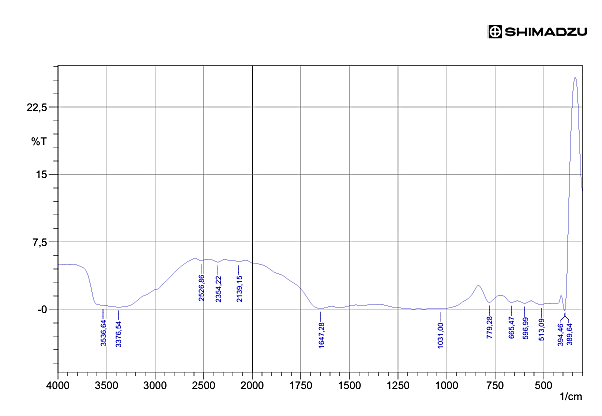
3.1. The broad bands observed near 3536.64 and 3376.54 cm-¹ can be associated mainly with O–H stretching vibrations arising from hydroxyl groups and adsorbed moisture. The band near 1647.28 cm-¹ can be assigned predominantly to H–O–H bending vibrations of molecular water; contributions from functional groups of the polymeric components may also occur in this region.
The strong absorption around 1031.00 cm-¹ is consistent with C–O and C–O–C stretching vibrations associated with the polysaccharide-based Na-CMC component and may also overlap with vibrations of the sulfate-containing mineral phase. The bands in the lower-wavenumber region, particularly around 596.99 and 513.09 cm-¹, are consistent with sulfate-related vibrations characteristic of calcium sulfate phases. The weak features near 394.46 and 389.64 cm-¹ are located in the low-frequency lattice-vibration region and may be associated with mineral-phase vibrations.
The bands at approximately 2526.86, 2354.22, and 2139.15 cm-¹ should be interpreted cautiously because absorption in these regions can arise from overlapping or weak bands and, in some cases, atmospheric CO2 contributions. Therefore, these peaks are not assigned to a specific chemical bond without additional spectral evidence.
Overall, the FTIR spectrum demonstrates the coexistence of organic polymer-associated functional groups and inorganic phosphogypsum-related vibrations in the obtained composite. The FTIR results, together with the SEM–EDS observations, support the formation of a heterogeneous polymer–mineral composite structure. However, the FTIR spectrum alone is not sufficient to establish the formation of new chemical bonds; such a conclusion would require comparison with spectra of the individual starting components and, preferably, additional structural analysis.
3.2. Scanning Electron Microscopy and Energy-Dispersive X-ray Spectroscopy (SEM–EDS). The microstructural morphology and elemental composition of the obtained phosphogypsum-based polymer composite were investigated using a ZEISS EVO 10 scanning electron microscope equipped with an energy-dispersive X-ray spectroscopy (EDS) system. SEM was used to evaluate surface morphology, particle distribution, agglomeration, interparticle contacts, and pore structure, whereas EDS was used to determine the elemental composition of selected regions of the composite. The ZEISS EVO platform supports integrated SEM imaging and EDS microanalysis for material characterization.
Before analysis, the composite samples were dried and prepared as representative fragments with a relatively flat observation surface. SEM micrographs were recorded at selected magnifications, including ×160, with a scale bar of 100 μm for the presented micrograph.
The SEM image revealed a heterogeneous aggregate–porous morphology consisting of irregular mineral particles, agglomerated regions, and interparticle voids. The morphology can be related to the combined presence of sand and the 100–200 μm phosphogypsum fraction together with the Na-CMC and KFS binder components. The preliminary washing, drying, grinding in a Raymond mill for 25–30 min, and subsequent particle-size classification provided a defined phosphogypsum filler fraction for composite preparation. Local agglomeration remained visible, indicating that the mineral particles were not distributed completely uniformly throughout the polymer-containing phase.
The observed pores and interparticle voids may be associated with particle packing during mixing, moisture removal, and consolidation during heat treatment at 105–110 °C. Thus, the SEM observations indicate a heterogeneous polymer–mineral microstructure. SEM morphology alone does not establish mechanical strength or the formation of specific chemical bonds; such conclusions require complementary mechanical and spectroscopic evidence.
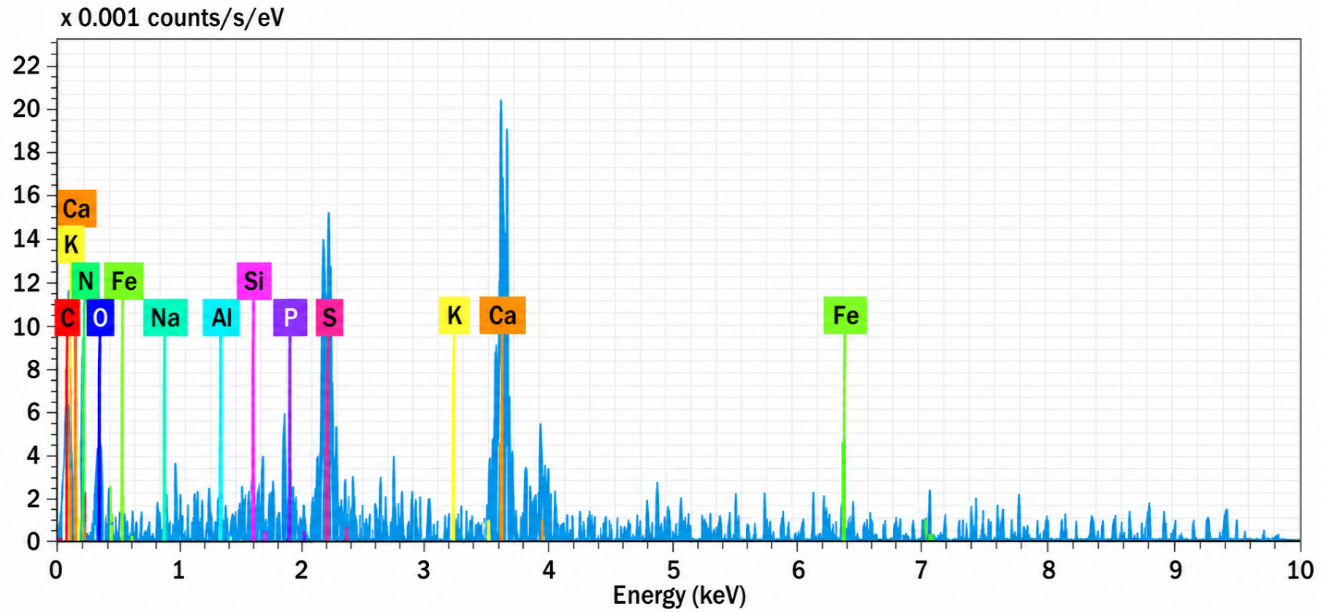
The EDS analysis identified C, N, O, Na, Al, Si, P, S, K, Ca, and Fe in the investigated composite. The normalized elemental composition was: C—43.99 wt.%, N—6.69 wt.%, O—24.62 wt.%, Na—0.32 wt.%, Al—0.17 wt.%, Si—0.15 wt.%, P—1.68 wt.%, S—6.92 wt.%, K—0.30 wt.%, Ca—14.66 wt.%, and Fe—0.50 wt.%, with a total of 100.00 wt.%. The relatively high carbon and nitrogen contents are consistent with the organic polymeric components, particularly Na-CMC and KFS. Calcium, sulfur, phosphorus, and oxygen are consistent with the mineral fraction containing phosphogypsum, while silicon and aluminum can be associated mainly with the mineral components. The simultaneous detection of these elements supports the combined organic–mineral nature of the composite.
The SEM–EDS findings were considered together with the FTIR results to provide complementary information on the morphology, elemental composition, and chemical groups present in the obtained phosphogypsum-based polymer composite.
Sand: phosphogypsum: Na-CMC: KFS were taken in a mass ratio of 2:1:1:1, mixed with each other, and a homogeneous mixture was formed. The resulting homogeneous mixture was baked in a 105 – 110°C furnace to synthesize a composite material. ° At high temperatures, the separation of water molecules disrupts the crystal lattice, forming a denser, anhydrite phase. This process is an endothermic dehydration reaction. Water molecules form coordination bonds around Ca2+ and SO42− ions, restoring a stable «crystal lattice.» This process activates crystal growth. Additives such as CFCs and Na-CMC (chemical modifiers or polymer binders) affect the structural formation of the system. In an amorphous structure, atoms are not arranged in an orderly manner over long distances, which reduces the degree of crystallization. In general, these factors directly determine the microstructure (crystalline or amorphous state) of the material and its mechanical properties.
4. Discussion
4.1. IR spectroscopy. The composite material obtained in the study was analyzed using IR spectroscopy. Based on the obtained spectra, the functional groups in the composite material and their interactions were determined. In the 3536.64 cm−1 and 3376.54 cm−1 bands, the presence of -OH and -NH groups belonging to high-frequency electronegative atoms can be observed. Due to the hydroxyl (-OH) groups of this Na-CMC, wide-band absorption occurs in the regions of 3536.64 cm−1 and 3376.54 cm−1. The peaks at 3536.64 cm−1 and 3376.54 cm−1 correspond to asymmetric and symmetric valence vibrations of the residual secondary amine (-NH-) and primary amine (-NH2) groups in the urea residue. Furthermore, the -OH vibrations of the free methylol (-CH2OH) groups in the resin also fell to the same regions of 3536.64 cm−1 and 3376.54 cm−1, leading to a further expansion of the peak. The peak of 1647.28 cm−1 in the spectrum is one of the most important and intense signals. Since Na-CMC is a salt of a weak acid, the electron density is evenly distributed between the two oxygen atoms in the carboxylate ion (-COO−). The absorption peak of 1647.28 cm−1 in the spectrum clearly indicates the asymmetric valence oscillation of the carboxylate group. The same frequency corresponds to the «Amide» band in the urea-formaldehyde resin. Asymmetric vibrations of the β-1,4-glycoside (C-O-C) bonds forming the main cellulose chain are usually formed in the range of 1030–1050 cm−1, and the obtained value of 1031.00 cm−1 corresponds to this. Also, this 1031.00 cm−1 peak represents the valence vibrations of the C-O bond in the methylol (-CH2OH) groups and in the ether bridges (-CH2-O-CH2-). The peaks of 2526.86 cm−1, 2354.22 cm−1, and 2139.15 cm−1 belong to C-H. The 596.99 cm−1, 513.09 cm−1, 394.46 cm−1 and 389.64 cm−1 peaks in the results indicate the rotational movements of the hydrocarbon skeleton and the rings.
4.2. SEM analyz. A SEM analysis of the polymer composite material was performed.
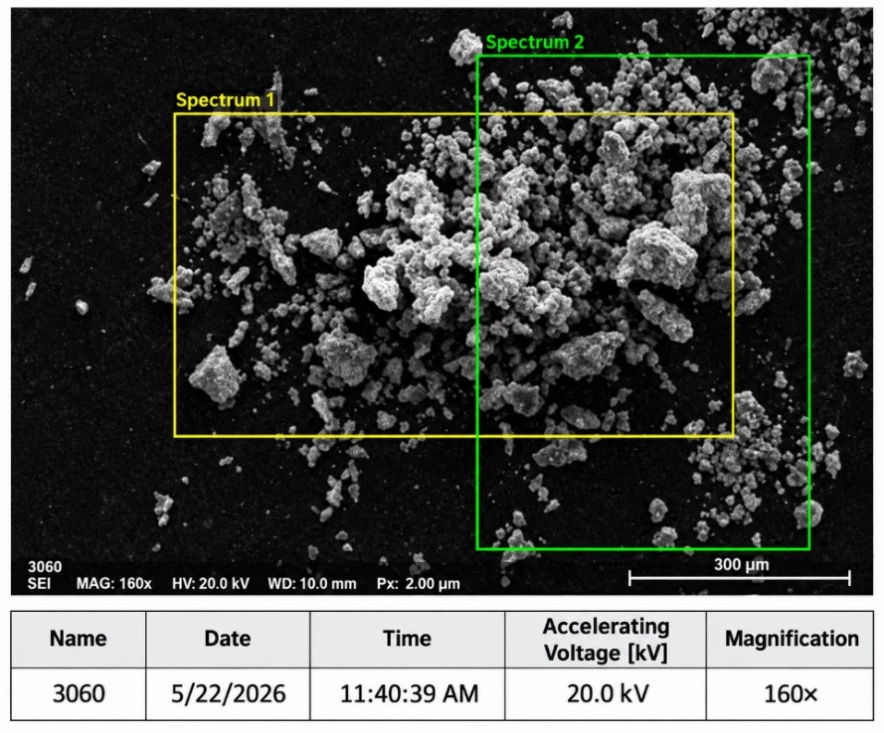
This SEM image was obtained at a ×160 magnification, allowing for an assessment of the overall microstructural state of the material. The image shows that the particles are distributed and agglomerate. The particles are not in a fine dispersed state, but have merged with each other to form large aggregates. This situation indicates the presence of a strong interphase interaction between the components within the composite. In the image, dark areas represent voids and pores, while bright areas indicate that they are composed of denser particles or mineral phases. The porosity in the structure can have a positive impact on the adsorption and acoustic properties of the material. Based on a scale of 100 μm, the size of particles and agglomerates is determined to be in the range of tens of micrometers.
4.3. EDS analyz. The given figure is an EDS spectrum and shows a qualitative analysis of the elements in the material. The main elements in the spectrum are O, C, Ca, Si, Al, Fe, Na, K, P, and S. One of the most intense peaks in the spectrum belongs to the element Ca (calcium), indicating the presence of a phosphogypsum phase based on calcium compounds, especially CaSO4.
| Element | At. No. | Net | Mass [%] | Normalized Mass [%] | Atomic [%] | Absolute Error [%] (1 sigma) |
Relative Error [%] (1 sigma) |
|---|---|---|---|---|---|---|---|
| C | 6 | 111 | 30.92 | 43.99 | 57.61 | 3.84 | 12.41 |
| N | 7 | 4 | 4.71 | 6.69 | 7.52 | 3.44 | 73.17 |
| O | 8 | 43 | 17.31 | 24.62 | 24.21 | 3.03 | 17.52 |
| Na | 11 | 4 | 0.23 | 0.32 | 0.22 | 0.23 | 104.37 |
| Al | 13 | 3 | 0.12 | 0.17 | 0.10 | 0.16 | 139.93 |
| Si | 14 | 4 | 0.11 | 0.15 | 0.09 | 0.14 | 129.37 |
| P | 15 | 40 | 1.18 | 1.68 | 0.85 | 0.37 | 31.77 |
| S | 16 | 175 | 4.86 | 6.92 | 3.39 | 1.23 | 25.37 |
| K | 19 | 7 | 0.21 | 0.30 | 0.12 | 0.13 | 60.86 |
| Ca | 20 | 283 | 10.31 | 14.66 | 5.76 | 2.68 | 25.97 |
| Fe | 26 | 5 | 0.35 | 0.50 | 0.14 | 0.27 | 77.84 |
| Total | 70.29 | 100.00 | 100.00 |
The high calcium content confirms that phosphogypsum was used as the primary mineral component of the composite. The high intensity of the element O (oxygen) indicates the presence of oxides and sulfate compounds. This is explained by the presence of CaSO4·2H2O, SiO2, or other oxide mineral phases. The presence of a Si (silicon) peak indicates the presence of quartz or silicate components in the composition. Silicate phases play a crucial role in enhancing the mechanical strength of the composite. The element Al (aluminum) indicates the presence of aluminosilicate minerals or additional mineral impurities.
The element S (sulfur) is associated with sulfate ions in phosphogypsum, forming a calcium sulfate phase together with Ca. This result confirms the presence of phosphogypsum as the main structural component in the material. The detection of Fe (iron) indicates the presence of natural mineral impurities or oxide impurities introduced during the technological process. Iron oxides can affect the color and some physical properties of the material. Elements Na and K belong to alkali metals and can be derived from mineral additives or natural raw materials. These elements influence the chemical activity of the composite and interphase reactions.
5. Conclusion
Sand, phosphogypsum, Na-CMC, and KFS components were taken at a mass ratio of 2:1:1:1, mechanically mixed, and a homogeneous mixture was obtained. The resulting mixture was heat-treated in a furnace at a temperature of 105–110 °C, and a polymer composite material was synthesized. ° During the heat treatment process, physicochemical bonds were formed between the components, forming a durable composite structure.
The microstructure of the obtained composite material was investigated using SEM and EDS methods. The analysis results indicated that the material possesses a porous-aggregate structure. The pores in the structure ensure that the material possesses high adsorption and thermal insulation properties. At the same time, the relatively uniform distribution of sand and phosphogypsum particles within the polymer matrix serves to increase the mechanical strength of the composite.
Author’s revision note: The bracketed fields above must be replaced with the actual experimental values and instrument specifications from the laboratory records before submission. No unverified instrument model or experimental mass has been introduced.
References