Capparis spinosa L., cultivated in Karakalpakstan: morphological characteristics and quantitative determination of water-soluble B-group vitamins in various plant organs by HPLC
УДК 581.19+615.32
Abstract
This article investigates the quantitative content of water-soluble B-group vitamins (B1, B2, and B6) in the flowers, buds, aerial vegetative parts, and roots of cultivated Capparis spinosa L. plants in the conditions of Karakalpakstan, using High-Performance Liquid Chromatography (HPLC). Based on chromatographic analysis, the separation efficiency, distribution across various morphological parts of the plant, and relative quantitative levels of the vitamins were determined, with results expressed in mg/100 g. The method was validated for linearity, limits of detection (LOD) and quantification (LOQ), accuracy (recovery), and precision (repeatability and reproducibility) in accordance with ICH Q2(R1) guidelines. Each sample was analysed in triplicate (n = 3); data are presented as mean ± standard deviation (SD), and one-way analysis of variance (ANOVA) was used to compare plant organs. The study results revealed an uneven distribution of vitamins across the plant parts. The highest levels were recorded in the flowers, with vitamin B1 at 39 mg/100 g and vitamin B6 at 393 mg/100 g, indicating high metabolic and biosynthetic activity in the generative organs. The aerial vegetative parts were also notable for their high B-group vitamin content, whereas vitamin levels in the roots were relatively low. The data obtained indicate that the content of water-soluble B-group vitamins in the raw material did not decrease significantly during the cultivation process. The research findings serve as an important scientific and practical basis for utilizing Capparis spinosa L. in the production of pharmaceutical raw materials, biologically active supplements, and promising phytopreparations, while also confirming the need for further study of the plant's biological and pharmacological potential.
Аннотация
В данной статье методом высокоэффективной жидкостной хроматографии (ВЭЖХ) исследовано количественное содержание водорастворимых витаминов группы В (В1, В2 и В6) в цветках, бутонах, надземной вегетативной части и корнях культивируемого растения Capparis spinosa L. в условиях Каракалпакстана. На основе хроматографического анализа определены эффективность разделения, распределение по морфологическим частям растения и относительные количественные уровни витаминов; результаты выражены в мг/100 г. Методика валидирована по показателям линейности, пределов обнаружения (LOD) и количественного определения (LOQ), правильности (степени извлечения) и прецизионности (сходимости и воспроизводимости) в соответствии с руководствами ICH Q2(R1). Каждый образец анализировался в трёх повторностях (n = 3); данные представлены как среднее ± стандартное отклонение (SD), для сравнения органов растения использован однофакторный дисперсионный анализ (ANOVA). Результаты выявили неравномерное распределение витаминов по частям растения. Наибольшие уровни зафиксированы в цветках: витамин В1 — 39 мг/100 г, витамин В6 — 393 мг/100 г, что указывает на высокую метаболическую и биосинтетическую активность генеративных органов. Надземная вегетативная часть также отличается высоким содержанием витаминов группы В, тогда как в корнях их уровни относительно низкие. Полученные данные свидетельствуют о том, что содержание водорастворимых витаминов группы В в сырье существенно не снижается в процессе культивирования. Результаты исследования служат важной научно-практической основой для использования Capparis spinosa L. в производстве фармацевтического сырья, биологически активных добавок и перспективных фитопрепаратов, а также подтверждают необходимость дальнейшего изучения биологического и фармакологического потенциала этого растения.
Keywords: Capparis spinosa L; caper; water-soluble vitamins; B-group vitamins; high-performance liquid chromatography; medicinal plant.
Ключевые слова: Capparis spinosa L; каперс; водорастворимые витамины; витамины группы B; высокоэффективная жидкостная хроматография; лекарственное растение.
Introduction
Today, biologically active substances derived from natural medicinal plants are becoming increasingly important for maintaining human health and preventing various diseases. Compared to synthetic preparations, plant-derived substances are valued for their gentler effect on the body and fewer side effects. In this context, the in-depth study of the chemical composition of medicinal plants is a pressing scientific issue. Water-soluble vitamins — specifically B-group vitamins — play a crucial role in metabolism, nerve impulse transmission, enzymatic reactions, and energy exchange processes within the body. A deficiency in these vitamins can lead to various metabolic disorders, nervous system diseases, and a weakened immune system.
Capparis spinosa L. (caper) is a plant adapted to arid climates and rich in biologically active substances; it holds a significant place in the flora of Central Asia. In traditional medicine, almost all parts of this plant are used to treat liver, cardiovascular, thyroid, rheumatic, and endocrine disorders. Although scientific literature indicates the presence of flavonoids, phenolic compounds, ascorbic acid, and antioxidants in Capparis spinosa L., the quantitative composition of water-soluble vitamins has not been sufficiently elucidated. In recent years, it has been noted that the polyphenols and flavonoids found in Capparis spinosa L. possess potent antioxidant properties and exhibit high inhibitory activity in assays such as DPPH, FRAP, and ABTS. This antioxidant potential plays a crucial role in protecting against diseases associated with oxidative stress while simultaneously influencing metabolic processes [1].
Research demonstrates that Capparis spinosa extracts help lower blood sugar and improve glucose metabolism in diabetes models; furthermore, clinical trials have shown that a daily dose of 400 mg significantly reduces HbA1c levels [2, 3]. Additionally, the plant extracts possess anti-inflammatory and immunomodulatory properties, exerting a positive effect on supporting the immune system and modulating inflammatory processes through their flavonoid and phenolic constituents [4]. Thus, scientific studies have confirmed that Capparis spinosa possesses simultaneous antioxidant, antidiabetic, and anti-inflammatory biological activities [4].
Figure 1 illustrates the global natural and introduced distribution range of Capparis spinosa L. It shows that the plant's primary natural range encompasses the Mediterranean basin, Southern Europe, North Africa, the Middle East, the Caucasus, and Central Asia. This distribution confirms that Capparis spinosa L. is a xerophytic species adapted primarily to arid and semi-arid climatic conditions. Instances of its introduction and cultivation in certain regions are also noted.
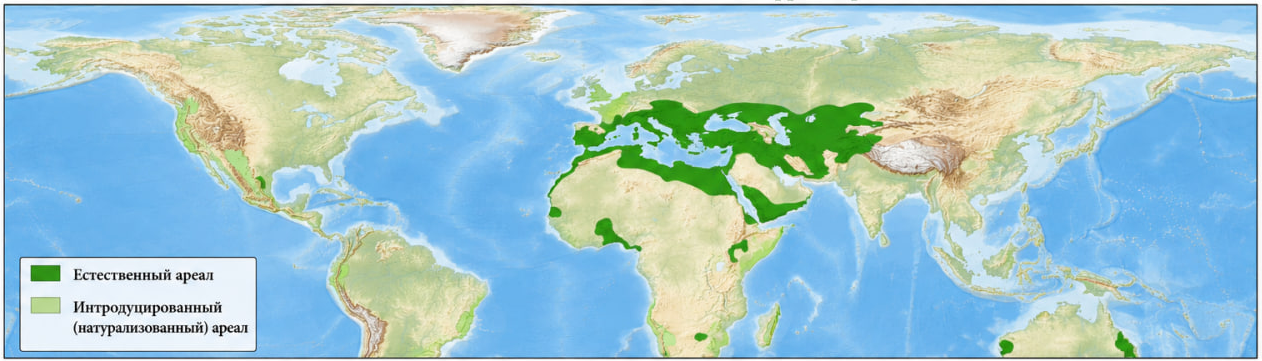
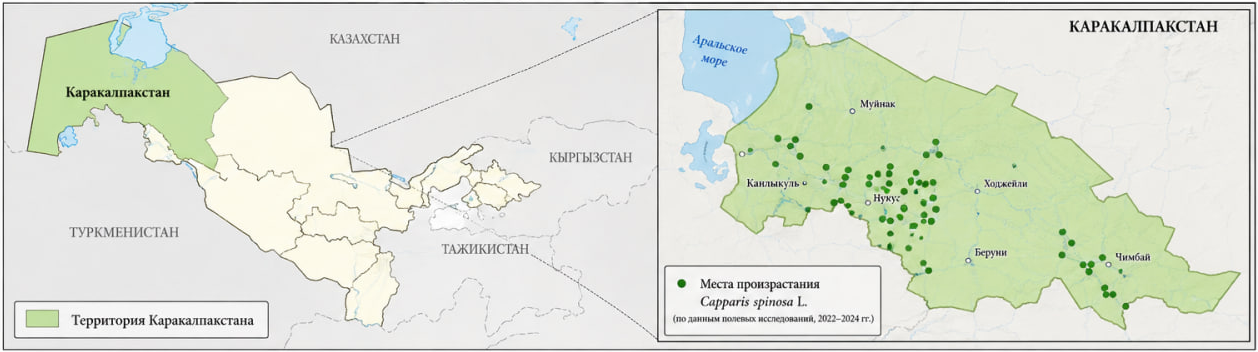
Figure 2 illustrates the distribution of Capparis spinosa L. within the Republic of Karakalpakstan. Research data (2022–2024) indicate that the plant's growth sites are primarily concentrated in the vicinity of Nukus and in the Qanlikol, Khujayli, Beruni, and Chimbay districts. A significant portion of these distribution sites is located in the central and southern parts of the republic, where sandy-saline soils, high temperatures, and low precipitation create relatively favorable ecological conditions for the plant. Distribution sites are comparatively scarce in the northern regions near the Aral Sea; this can be attributed to severe soil salinity, wind erosion (deflation), and the impact of extreme environmental factors. Overall, the data demonstrate that Capparis spinosa L. is well-adapted to the arid and semi-arid landscapes of Karakalpakstan and highlight the existence of promising areas for its cultivation and production as a source of medicinal raw materials. In this context, researchers from the Karakalpakstan Branch of the Academy of Sciences of the Republic of Uzbekistan and the Karakalpakstan Research Institute of Natural Sciences (Kh.K. Matchanova, R.A. Sharafatdinova, et al.) are conducting scientific work on the domestication of Capparis spinosa L., and a patent (No. IAP 8328) has been obtained for the invention titled «Method for cultivating Capparis spinosa L. on saline soils.»
However, most studies in the literature have focused on antioxidants and phenolic compounds, while quantitative data regarding B-group vitamins have not been sufficiently elucidated. Although some sources note the presence of vitamins in general terms, comparative analyses of the plant's specific morphological parts are virtually non-existent. In this context, the present study serves to fill this gap in scientific knowledge.
The aim of the study is to determine the quantitative content of water-soluble B-group vitamins in the flowers (V1.2), buds (V1.4), aerial vegetative parts (V1.7), and roots (V1.9) of the cultivated Capparis spinosa L. plant using high-performance liquid chromatography (HPLC), with validated methodology and statistical processing of the results.
Materials and methods
Plant material
For the study, the flowers, buds, aerial vegetative parts, and roots of the Capparis spinosa L. plant were collected during the growing season. Mechanical impurities were removed from the samples, and they were quickly washed with clean water. The plant parts were dried at a temperature of 25–30 °C in a well-ventilated area protected from direct sunlight. The dried samples were ground to a particle size of 1 mm using a laboratory mill and stored under dry, dark conditions. This step is crucial for preventing the degradation of water-soluble vitamins, as B-group vitamins are sensitive to light and high temperatures [5, 6].
Sample preparation for HPLC
Precisely weighed 1.0 g samples of ground plant material were mixed with 25 ml of pure water. To ensure efficient vitamin extraction, the medium was adjusted to be weakly acidic (pH ≈ 4.0–4.5) using acetic acid [7]. The mixture was stirred on a magnetic stirrer for 30–40 minutes. The extraction process was conducted at a temperature of 40–50 °C, as higher temperatures could lead to the degradation of B-group vitamins [8]. Upon completion of the extraction, the solution was centrifuged at 5000 rpm for 10 minutes. The clear supernatant was collected and filtered through a membrane filter with a pore size of 0.45 μm. This step is crucial for protecting the HPLC column from mechanical particles [9]. The filtered extract was then subjected directly to HPLC analysis.
Derivatization and internal standard. For vitamins B1 and B6, derivatization was not performed; direct UV detection was applied [13]. As an internal standard, p-hydroxybenzoic acid was added to each sample before extraction at a final concentration of 5 mg/mL [15]. Identification of vitamins was based on retention times of standard solutions and confirmed by UV spectral comparison with authentic standards [13, 14].
HPLC conditions
The HPLC method was employed to determine the qualitative and quantitative composition of water-soluble vitamins in various morphological parts of the Capparis spinosa L. plant. Chromatographic separation was performed on a reversed-phase C18 column (Poroshell 120 EC-C18, 2.7 μm, 4.6 × 100 mm). A binary system consisting of a 0.5 % acetic acid solution (A) and acetonitrile (B) was selected as the mobile phase, and separation was conducted in gradient mode: 0–3 min — 5 % B; 3–6 min — 15 %; 6–9 min — 25 %; 9–12 min — 35 %; 12–15 min — 25 %; and 15–17 min — 5 %. These gradient conditions ensured the effective separation of the water-soluble vitamins. The mobile phase flow rate was set at 0.6 ml/min. Vitamins were detected using a UV detector at wavelengths of 254, 265, and 285 nm; identification was based on the retention times of standard solutions, while quantitative analysis was performed by comparing peak areas with those of standard samples [13, 14].
Method validation
The HPLC method was validated in accordance with ICH Q2(R1) guidelines [16, 17] for the following parameters: linearity, limits of detection (LOD), limits of quantification (LOQ), accuracy (recovery), and precision (repeatability and reproducibility).
Linearity. Calibration curves were constructed for vitamins B1, B2, and B6 in the concentration range of 0.5–20 μg/mL (B1), 0.4–20 μg/mL (B2), and 0.5–20 μg/mL (B6). The calibration curves were linear with correlation coefficients (R²) of ≥ 0.993 [13].
LOD and LOQ. LOD and LOQ were calculated based on the standard deviation of the response and the slope of the calibration curve (3.3σ/S and 10σ/S, respectively) [16, 17]. The values obtained were: LOD — 0.06–0.15 μg/mL; LOQ — 0.20–0.50 μg/mL [13].
Accuracy (recovery). Recovery was assessed by spiking samples with known amounts of standard vitamins at three concentration levels. The mean recovery values were 91.5–98.0 % [13].
Precision. Repeatability (intra-day) and reproducibility (inter-day) were evaluated by analysing replicates of the same sample. Relative standard deviation (RSD) values were ≤ 4.7 % for repeatability and ≤ 7.3 % for intermediate precision [13, 14].
Table 1.
Validation parameters of the HPLC method for determination of B-group vitamins
| Parameter | Value / Range | Source |
|---|---|---|
| Linearity range, μg/mL | 0.4–20 | [13] |
| R² | ≥ 0.993 | [13] |
| LOD, μg/mL | 0.06–0.15 | [13] |
| LOQ, μg/mL | 0.20–0.50 | [13] |
| Recovery, % | 91.5–98.0 | [13] |
| Repeatability (RSD, %) | ≤ 4.7 | [13, 14] |
| Reproducibility (RSD, %) | ≤ 7.3 | [14] |
Statistical analysis
Each sample was analysed in triplicate (n = 3). Data are presented as mean ± standard deviation (SD). One-way analysis of variance (ANOVA) was used to compare the content of B-group vitamins across different plant organs. Differences were considered statistically significant at p < 0.05 [18].
Results and Discussion
The water-soluble vitamin content of extracts obtained from various morphological parts (flowers, buds, aerial parts, and roots) of cultivated Capparis spinosa L. was analyzed using high-performance liquid chromatography (HPLC). The HPLC chromatograms demonstrate the separation of water-soluble vitamins, the presence of various vitamin groups, and their distribution within the samples.
The intense peaks observed at early retention times are characteristic of B-group vitamins, indicating a particularly high concentration of vitamins B1 and B6. The height and area of the peaks confirm the high content of biologically active substances in the flower extract.
The content of water-soluble vitamins in various morphological parts of the Capparis spinosa L. plant was calculated by comparing the areas of the chromatographic peaks with those of standard solutions. The peak areas for vitamins in each sample were compared against the peak areas of the standards, and relative quantitative values were expressed in mg/100 g. This approach was used to assess the distribution of B-group vitamins across different parts of the plant, and the results were analyzed in relation to morphological characteristics.
As shown in Figure 3, the highest level of Vitamin B1 (39 mg/100 g) was detected in the flowers, indicating that the plant's reproductive organs are metabolically active. Lower levels of this vitamin were found in the buds (24 mg/100 g), the aerial parts (19.4 mg/100 g), and the roots (14.5 mg/100 g). The highest level of Vitamin B6 was recorded in the flowers (393 mg/100 g). This confirms that caper flowers are rich in biologically active substances. Levels of 155 mg/100 g in the aerial part, 88 mg/100 g in the buds, and 65.5 mg/100 g in the root were determined. Although the Vitamin B2 content was relatively low across all samples, the highest value (1.5 mg/100 g) was recorded in the aerial part.
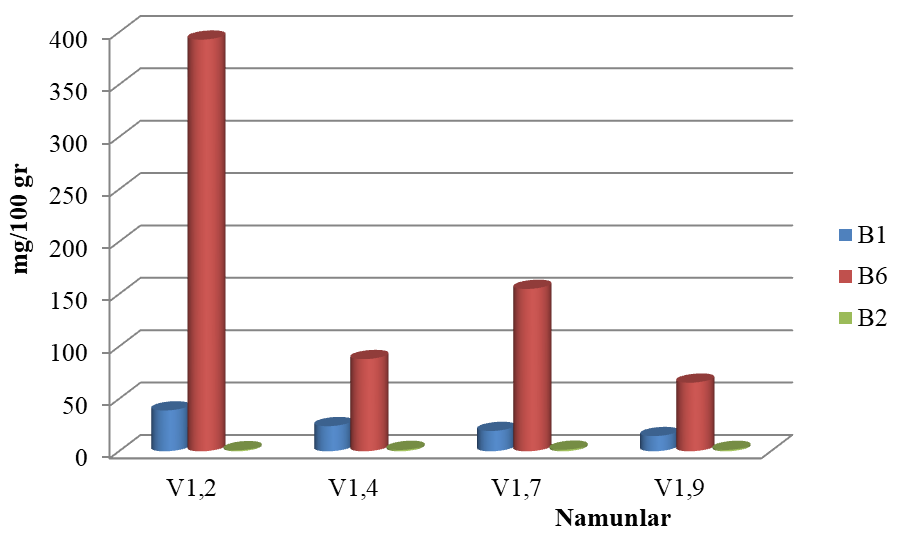
The analysis results obtained using the aforementioned HPLC method demonstrated variations in the content of water-soluble vitamins — specifically vitamins B1, B2, and B6 — across different parts of the Capparis spinosa plant. Existing literature confirms the presence of ascorbic acid and B-group vitamins in C. spinosa, linking them to antioxidant and metabolic activities [2, 3]. Scientific studies verify the presence of flavonoids, alkaloids, saponins, and phenolic compounds in C. spinosa and provide general data on its vitamin content [1, 10, 12]. However, many studies fail to report precise quantitative values for vitamins or do not compare levels across different plant parts. For instance, while research by Tlili et al. documented the levels of ascorbic acid and other antioxidants [2, 3], our findings revealed a notably high vitamin B6 content (393 mg/100 g) in the flower — a specific detail not highlighted in previous studies. Furthermore, existing literature offers limited data on vitamin content in samples from diverse geographical regions; our results, obtained under the conditions of Uzbekistan, help fill this gap [11, 12].
Discussion
The results obtained demonstrated an uneven distribution of water-soluble vitamins across the morphological parts of the Capparis spinosa plant. In particular, the high accumulation of vitamin B6 in the flowers enhances the pharmacological significance of this part of the plant. This phenomenon can be attributed to the more active biosynthetic processes occurring in the generative organs.
Physiological role of B-group vitamins in generative organs. B-group vitamins are essential cofactors in enzymatic reactions involved in energy metabolism, amino acid synthesis, and nucleic acid metabolism. In generative organs (flowers and buds), the demand for these cofactors is significantly higher due to active cell division, pollen formation, and nectar production. Vitamin B6, in particular, is a cofactor for more than 140 enzymatic reactions, including those involved in the biosynthesis of amino acids and neurotransmitters, which may explain its high accumulation in flowers [5, 8]. Vitamin B1 (thiamine) is required for carbohydrate metabolism and is essential for the energy supply of rapidly growing tissues [5]. Thus, the high content of B-group vitamins in flowers reflects the intense metabolic activity of generative organs.
Our results are consistent with the general trend reported in the literature: generative organs of many medicinal plants accumulate higher levels of water-soluble vitamins compared to vegetative organs [2, 3, 12]. However, direct comparison with published data on Capparis spinosa is limited, as most studies focus on phenolic compounds, flavonoids, and antioxidants rather than B-group vitamins. For example, Tlili et al. [2, 3] reported the content of carotenoids and tocopherols in leaves, buds, and flowers of C. spinosa grown wild in Tunisia, but did not quantify B-group vitamins. The review by Sayed et al. [4] and the updated review [12] provide general information on the nutritional value of capers but lack detailed quantitative data on B-group vitamins across plant organs. Our study thus fills this gap by providing quantitative data for C. spinosa cultivated under the conditions of Karakalpakstan.
Regional climatic conditions, soil composition, and growth stages are key factors influencing vitamin synthesis. The arid and semi-arid climate of Karakalpakstan, characterized by high temperatures, low precipitation, and saline soils, creates specific conditions for plant growth. Under such conditions, plants often accumulate higher levels of osmoprotectants and antioxidants, including water-soluble vitamins, to cope with oxidative and osmotic stress [1, 4]. The high levels of B-group vitamins detected in our samples may reflect an adaptive response of C. spinosa to the extreme environmental conditions of the region. This is consistent with the known role of B-group vitamins in stress tolerance and redox homeostasis [5, 8].
The present study has several limitations. First, the analysis was limited to three B-group vitamins (B1, B2, B6); other water-soluble vitamins (C, PP) and fat-soluble vitamins (A, E) were not determined. Second, the study was conducted on plants collected during a single growing season; seasonal and interannual variability of vitamin content was not assessed. Third, the sample size for each plant organ was limited to three replicates (n = 3), which, while sufficient for statistical analysis, may not fully capture the natural variability of the plant population. Fourth, the identification of vitamins was based on retention times; confirmation by mass spectrometry would further strengthen the reliability of the results. These limitations should be addressed in future studies.
The high content of B-group vitamins, especially vitamin B6, in the flowers and aerial parts of Capparis spinosa L. cultivated in Karakalpakstan indicates that this raw material is promising for the production of biologically active supplements and phytopreparations. The data obtained can be used to justify the optimal harvesting periods and plant parts for pharmaceutical raw material production. However, before practical application, additional studies on safety, toxicity, and optimal dosages are required.
Conclusion
The study results revealed that the flowers and aerial vegetative parts of Capparis spinosa L. are the richest in water-soluble B-group vitamins. Data obtained using the HPLC method provided a scientific basis for the plant's medicinal significance. These findings expand the potential for utilizing Capparis spinosa in the future development of promising phytopreparations and biologically active supplements.
Based on the results obtained, the following practical recommendations can be formulated. First, the flowers and aerial vegetative parts of Capparis spinosa L. should be considered as the preferred raw material for the production of B-group vitamin-rich supplements. Second, the harvesting of flowers and aerial parts should be carried out during the period of maximum vitamin accumulation (growing season), with careful drying at 25–30 °C to prevent vitamin degradation. Third, before industrial application, it is necessary to conduct additional studies on the safety, toxicity, and optimal dosages of the obtained extracts.
The present study was limited to three B-group vitamins (B1, B2, B6) and did not include other water-soluble (C, PP) and fat-soluble (A, E) vitamins. The analysis was performed on plants collected during a single growing season; seasonal and interannual variability was not assessed. The identification of vitamins was based on retention times; confirmation by mass spectrometry is recommended for future studies.
Future research should aim to determine the content of other water-soluble vitamins (C, PP) and fat-soluble vitamins (A, E) in Capparis spinosa, as well as investigate their relationship with antioxidant activity. Additionally, studies on seasonal and interannual variability, as well as the influence of different cultivation conditions on vitamin content, are warranted. Further investigation of the biological and pharmacological potential of this plant, including in vivo studies, is also recommended.
References