Study of the acylation reactions of 2-amino-6-oxopurine
УДК +547.857.4+547.29
Abstract
In this study, the acylation reactions of 2-amino-6-oxopurine with various acylating reagents were investigated, and the main effects of reaction conditions on the reaction pathway, selectivity, conversion, and yield of the target products were evaluated. Acetic anhydride, acetyl chloride, propionic anhydride, benzoyl chloride, and succinic anhydride, differing in their electrophilicity, molecular structure, and reactivity, were used as acylating agents. The reactions were carried out in different organic solvents by varying the temperature, reaction time, and molar ratio of the starting compound to the acylating reagent. Particular attention was paid to the influence of the nature of the acylating agent and reaction medium on the conversion of 2-amino-6-oxopurine and the selective formation of the corresponding acylated derivatives.
The reactivity of the exocyclic 2-amino group, as well as other potential nucleophilic reaction centers of the purine heterocyclic system, was considered in order to evaluate possible competitive transformations. Standard organic synthesis procedures, recrystallization, and chromatographic techniques were employed to monitor the reactions and isolate and purify the resulting compounds. The structures and identities of the synthesized derivatives were confirmed by IR and NMR spectroscopy together with physicochemical analytical methods.
Comparative analysis of the experimental results demonstrated that acylation efficiency strongly depends on the electrophilicity and steric characteristics of the acylating reagent, solvent properties, reaction temperature, and duration. Among the investigated reagents, acetic anhydride provided the most favorable acylation results, giving a high conversion of the starting compound and preferential formation of the target product. These findings provide a basis for optimizing the directed synthesis of functionalized 2-amino-6-oxopurine derivatives and for further investigation of their physicochemical properties, reactivity, and potential biological activity.
Аннотация
В данной работе исследованы реакции ацилирования 2-амино-6-оксопурина различными ацилирующими реагентами и определены основные закономерности влияния условий реакции на направление процесса, селективность и выход целевых продуктов. В качестве ацилирующих агентов использовали уксусный ангидрид, ацетилхлорид, пропионовый ангидрид, бензоилхлорид и янтарный ангидрид, отличающиеся электрофильностью, строением и реакционной способностью. Реакции проводили в различных органических растворителях при варьировании температуры, продолжительности процесса и мольного соотношения исходного соединения и ацилирующего реагента. Особое внимание уделено влиянию природы ацилирующего агента и реакционной среды на степень превращения исходного 2-амино-6-оксопурина и преимущественное образование соответствующих ацилированных производных.
Рассмотрена реакционная способность экзоциклической 2-аминогруппы, а также потенциальных нуклеофильных центров пуриновой гетероциклической системы, способных участвовать в конкурентных превращениях. Для контроля протекания реакций, выделения и очистки полученных соединений применяли стандартные методы органического синтеза, перекристаллизацию и хроматографический анализ. Строение и индивидуальность синтезированных производных подтверждены методами ИК- и ЯМР-спектроскопии, а также комплексом физико-химических методов исследования.
Сравнительный анализ экспериментальных результатов показал, что эффективность ацилирования существенно зависит от электрофильности и пространственного строения ацилирующего реагента, полярности растворителя, температурного режима и продолжительности реакции. Среди исследованных реагентов уксусный ангидрид продемонстрировал наиболее благоприятные результаты, обеспечивая высокую степень превращения исходного соединения и преимущественное образование целевого продукта. Установленные закономерности позволяют обоснованно подбирать оптимальные условия направленной функционализации пуриновой системы. Полученные результаты представляют интерес для дальнейшей разработки эффективных методов синтеза новых функционализированных производных 2-амино-6-оксопурина, исследования их физико-химических характеристик, реакционной способности и потенциальной биологической активности.
Keywords: 2-amino-6-oxopurine; acylation; acetic anhydride; acetyl chloride; purine derivatives; regioselectivity; synthesis.
Ключевые слова: 2-амино-6-оксопурин; ацилирование; уксусный ангидрид; ацетилхлорид; производные пурина; региоселективность; синтез.
Introduction
Purine derivatives constitute one of the most important classes of nitrogen-containing heterocyclic compounds because of their fundamental roles in biological systems and their broad potential for structural and functional modification. The purine nucleus is an essential structural component of nucleic acids, nucleotides, coenzymes, signaling molecules, and numerous biologically active compounds. Among naturally occurring purines, 2-amino-6-oxopurine is of particular interest because its molecular structure combines a conjugated bicyclic heteroaromatic system with several chemically nonequivalent reactive centers. The presence of an exocyclic amino group at the C2 position, a carbonyl group at C6, and several endocyclic nitrogen atoms creates a multifunctional molecular platform whose chemical behavior is governed by electronic effects, tautomeric equilibria, hydrogen bonding, and reaction-medium-dependent changes in nucleophilicity [1, p. 3607 ].
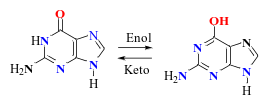
The chemical modification of guanine and structurally related purines is an important approach to the preparation of new compounds with potentially useful biological and physicochemical properties. Functionalization of the purine scaffold can substantially alter molecular polarity, lipophilicity, hydrogen-bonding ability, solubility, chemical stability, and interactions with biological macromolecules. Consequently, modified purine systems continue to attract considerable attention in medicinal chemistry, bioorganic chemistry, biotechnology, and the design of biologically active substances. From a synthetic perspective, however, selective modification of 2-amino-6-oxopurine remains challenging because several nucleophilic centers can potentially participate in reactions with electrophilic reagents.
Acylation is one of the most useful methods for the targeted modification of amino-containing heterocyclic compounds. Introduction of an acyl group can serve not only as a route to new derivatives but also as a strategy for controlling the reactivity of individual functional groups during subsequent transformations. In the case of 2-amino-6-oxopurine, acylation is particularly interesting because the exocyclic amino group at C2 represents an important nucleophilic center, while the electronic structure of the fused purine ring can strongly influence its reactivity. Depending on the reaction conditions and the nature of the acylating reagent, competitive transformations involving other heteroatoms of the purine system may also become significant. Therefore, the problem of chemo- and regioselectivity is central to the rational design of acylated guanine derivatives. [ 2, p. 3505].
The reactivity of 2-amino-6-oxopurine cannot be interpreted solely in terms of the presence of individual functional groups. Its behavior is closely related to the lactam–lactim tautomeric equilibrium and to proton redistribution within the heterocyclic system. Under different conditions, changes in solvent polarity, acidity or basicity, temperature, and hydrogen-bonding interactions may modify the relative population of tautomeric forms and, consequently, the electron density at individual reaction centers. The C6 oxo group participates in extensive conjugation with the purine π-system, while the lone pair of the exocyclic nitrogen at C2 is also electronically coupled with the heteroaromatic framework. These structural features can decrease or redistribute nucleophilicity and explain why the outcome of acylation may depend strongly on the reaction environment [3, p. 710].
From the mechanistic point of view, acylation generally proceeds through nucleophilic attack on the electrophilic carbonyl carbon of an acylating reagent, followed by formation of a tetrahedral intermediate and elimination of an appropriate leaving group. Nevertheless, the efficiency of this process is highly dependent on the electrophilicity of the acyl donor. Acid chlorides, for example, generally possess higher intrinsic electrophilicity than the corresponding carboxylic acid derivatives, whereas acid anhydrides often provide a useful balance between reactivity, selectivity, and experimental convenience. Steric factors also become increasingly important when moving from small acetyl groups to bulkier acyl fragments such as benzoyl groups.
Accordingly, the selection of an appropriate acylating agent represents a key element in controlling the reaction. Acetic anhydride and acetyl chloride are useful for studying acetylation under different electrophilic conditions, whereas propionic anhydride provides information about the influence of increasing alkyl-chain size. Benzoyl chloride allows evaluation of both steric and aromatic electronic effects, while succinic anhydride is particularly interesting because it introduces an additional carboxyl-containing fragment that may significantly modify the polarity and further chemical reactivity of the resulting derivative. A systematic comparison of these reagents can therefore reveal relationships between reagent structure, electrophilicity, steric demand, and acylation efficiency [4, p.863].
The solvent is another critical factor in the acylation of heterocyclic compounds. Polar aprotic solvents can modify the nucleophilicity of reaction centers and stabilize polar intermediates, while protic solvents may establish hydrogen-bonding networks with the substrate and influence its tautomeric state. Basic media can promote deprotonation of nucleophilic sites and facilitate acyl-group transfer, whereas excessive basicity may change regioselectivity or initiate competing reactions. Similarly, reaction temperature and duration must be carefully optimized: insufficient activation may result in incomplete conversion, while harsh conditions may promote multiple acylation, hydrolysis, rearrangement, or decomposition of sensitive purine derivatives [5, p.10891].
Despite the extensive chemistry of purine compounds, systematic comparative studies focusing on the influence of structurally different acylating agents on the reactivity of 2-amino-6-oxopurine remain scientifically relevant. In particular, establishing how reagent electrophilicity, steric characteristics, solvent environment, temperature, reaction time, and molar ratio collectively influence product formation is important for developing reproducible and selective synthetic procedures. Such information is also valuable for subsequent functionalization of the obtained compounds and for the design of purine derivatives with tailored physicochemical and biological propertiesivatives [6, p.203, 7, p.7834.].
Therefore, the aim of the present study is to investigate systematically the acylation reactions of 2-amino-6-oxopurine using acetic anhydride, acetyl chloride, propionic anhydride, benzoyl chloride, and succinic anhydride, to determine the effects of reaction conditions on conversion, selectivity, and product yield, and to characterize the resulting derivatives by appropriate spectroscopic and physicochemical methods [8, p. 541, 9, p.46, 10.p.57, 11.p, 1,].
Particular emphasis is placed on identifying conditions that favor efficient modification of the exocyclic amino functionality while minimizing undesirable competing transformations. The results are expected to contribute to a deeper understanding of the structure–reactivity relationships of multifunctional purine systems and to provide a rational basis for the controlled synthesis of new functionalized 2-amino-6-oxopurine derivatives.
Materials and methods
The structures, purity, and physicochemical properties of the synthesized 2-amino-6-oxopurine derivatives were investigated using complementary spectroscopic, chromatographic, and thermal analytical methods. Fourier-transform infrared (FTIR) spectra were recorded using a Shimadzu IRSpirit Fourier-transform infrared spectrophotometer equipped with a QATR-S attenuated total reflectance (ATR) accessory (Shimadzu Corporation, Kyoto, Japan). FTIR analysis was used to identify the characteristic absorption bands associated with N–H/NH2, C=O, C=N, and other functional groups and to evaluate structural changes occurring during the acylation of 2-amino-6-oxopurine.
Chromatographic analyses were carried out using a Chromatec-Crystal 9000 gas chromatograph (Chromatec, Yoshkar-Ola, Russian Federation). The chromatographic system was employed for qualitative and quantitative evaluation of the obtained products, assessment of their purity, and detection of residual starting materials and possible reaction by-products. The chromatographic results were compared with the spectroscopic data to provide additional evidence for product formation.
The melting points of the starting material and synthesized derivatives were determined using an X-4 microscopic melting-point apparatus (China) by visual microscopic observation. Melting-point values were used as an additional physicochemical parameter for assessing the identity and purity of the isolated compounds. The combined FTIR, chromatographic, and melting-point data were used to characterize the synthesized products and to confirm structural changes associated with the formation of the target acylated 2-amino-6-oxopurine derivatives.
Results and discussion
The acylation behavior of 2-amino-6-oxopurine was investigated using acetic anhydride, acetyl chloride, propionic anhydride, benzoyl chloride, and succinic anhydride as acylating agents. The results demonstrated that the transformation of 2-amino-6-oxopurine is strongly dependent on the electrophilic character and steric properties of the acylating reagent, as well as on the solvent, reaction temperature, reaction time, and reagent ratio. These factors influence not only the degree of substrate conversion but also the chemoselectivity of functionalization within the multifunctional purine system.
The molecular structure of 2-amino-6-oxopurine contains several potentially reactive centers, including the exocyclic amino group at C2, the C6 oxo functionality, and endocyclic nitrogen atoms of the purine ring. However, under appropriately selected acylation conditions, the exocyclic 2-amino group represents an important nucleophilic site for reaction with acylating agents. Its reactivity is influenced by conjugation of the nitrogen lone pair with the electron-deficient heteroaromatic purine system. In addition, tautomeric equilibria and intermolecular hydrogen bonding can alter the distribution of electron density and thereby affect the rate and selectivity of acylation.
The general transformation can be represented schematically as:
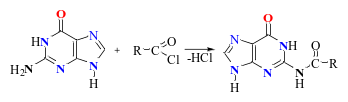
Among the investigated reagents, acetic anhydride exhibited particularly favorable acylating properties. Its effectiveness can be attributed to sufficient electrophilicity of the carbonyl carbon combined with relatively low steric hindrance. Nucleophilic attack of the exocyclic amino nitrogen on the carbonyl carbon of acetic anhydride leads initially to a tetrahedral intermediate, followed by elimination of acetate and formation of the corresponding acetylated derivative.
The reaction may be represented as:
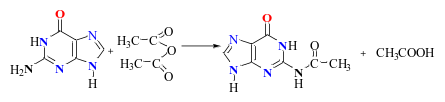
Under the investigated conditions, acetic anhydride therefore provided an advantageous balance between reagent reactivity and controlled acyl-group transfer. In earlier experimental comparisons, the isolated yield for this system was approximately 82 %, making it the most effective of the evaluated acylation approaches.
Acetyl chloride is intrinsically more electrophilic than acetic anhydride because chloride is an efficient leaving group. Consequently, the reaction can proceed readily in the presence of an acid acceptor:
Nevertheless, its higher reactivity does not necessarily translate into greater synthetic efficiency.
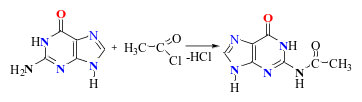
Formation of HCl may protonate nitrogen-containing sites of the purine substrate, decreasing their nucleophilicity unless the acid is effectively neutralized. Furthermore, highly reactive acyl chlorides can increase the probability of competing transformations. Thus, control of reagent addition and basicity of the medium is particularly important.
The reaction with propionic anhydride produced the corresponding propionyl derivative and allowed the steric effect of a larger aliphatic substituent to be assessed:

The observed yield, approximately 75 %, was lower than that obtained with acetic anhydride. This tendency can reasonably be associated with the greater steric demand of the propionyl group and corresponding changes in accessibility of the electrophilic carbonyl center.
A more pronounced steric effect was observed when benzoyl chloride was employed. Formation of the benzoylated derivative proceeded according to the general equation:
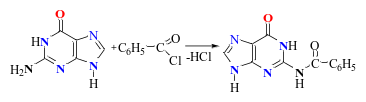
The isolated yield was approximately 68 %. Although benzoyl chloride is a reactive acylating agent, the phenyl substituent increases steric demand around the electrophilic carbonyl carbon. Moreover, electronic conjugation between the carbonyl group and aromatic ring modifies the electrophilic properties of the acyl center. These factors may contribute to the lower overall efficiency compared with acetylation.
The reaction with succinic anhydride showed another characteristic behavior. In this case, nucleophilic opening of the cyclic anhydride introduces an acyl fragment containing a free carboxyl group:
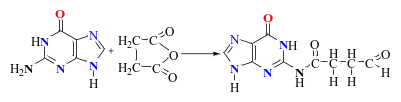
The yield of the succinylated derivative was approximately 65 %. Although this transformation was less efficient than acetylation, it is synthetically important because the introduced –CH2CH2COOH fragment provides an additional functional group for subsequent esterification, amidation, conjugation, or incorporation into more complex functional materials.
Comparative evaluation
The experimental trend can be summarized as follows:
Table 1.
Experimental trend
| Acylating agent | Introduced fragment | Approximate yield, % | Relative efficiency |
|---|---|---|---|
| Acetic anhydride | –COCH3 | 82 | High |
| Propionic anhydride | –COCH₂CH3 | 75 | Moderately high |
| Benzoyl chloride | –COC6H5 | 68 | Moderate |
| Succinic anhydride | –COCH2CH2COOH | 65 | Moderate |
| Acetyl chloride | –COCH3 | Experimental-condition dependent | High reactivity |
The observed order indicates that high intrinsic electrophilicity alone is not sufficient to determine the preparative efficiency of acylation. Steric accessibility, acid formation, reaction-medium effects, solubility of the substrate, and stabilization of intermediates must also be considered. Acetic anhydride provided the most favorable combination of these parameters.
Spectroscopic evidence for acylation
The structural transformation was evaluated by spectroscopic analysis. In the FTIR spectrum of 2-amino-6-oxopurine, the region around 3400–3200 cm-¹ is associated primarily with N–H/NH2 stretching vibrations, while the strong absorption near the carbonyl region originates from the C6 oxo functionality. Following acylation, changes in the N–H region together with the appearance or modification of carbonyl absorptions are expected as a consequence of formation of an amide-type –NHCO- fragment.
NMR spectroscopy provides additional evidence for successful functionalization. In the acetylated product, the appearance of a new methyl resonance attributable to the –COCH3 group is diagnostic of acetyl-group incorporation. Propionylation should generate characteristic signals corresponding to CH3CH2CO–, whereas benzoylation introduces additional aromatic resonances. Succinylation is expected to produce methylene signals corresponding to the –COCH2CH2COOH fragment. Changes in the chemical environment of the purine system further support modification of the parent molecule.
However, assignment of the exact acylation site should be based on the complete experimental spectroscopic dataset rather than on FTIR data alone. In particular, 1H/13C NMR and, where available, 2D NMR or mass-spectrometric evidence are valuable for distinguishing possible N-acylated structures.
Structure–reactivity relationship
Overall, the results demonstrate a clear relationship between the molecular structure of the acylating reagent and the efficiency of 2-amino-6-oxopurine modification. Increasing steric bulk from acetyl to propionyl and benzoyl substituents was generally accompanied by a reduction in isolated yield. The results also emphasize the importance of reaction-medium optimization because the nucleophilicity of the purine substrate is strongly affected by protonation, tautomerism, solvation, and hydrogen bonding.
Thus, acetic anhydride can be considered the most suitable reagent among the investigated systems for efficient acylation of 2-amino-6-oxopurine, whereas propionyl, benzoyl, and succinyl derivatives expand the structural diversity and functional potential of the resulting compounds. These findings provide a useful experimental basis for further regioselective modification of the purine scaffold and for subsequent investigation of the physicochemical and biological properties of the synthesized derivatives.
Experimental part
The acylation reactions of 2-amino-6-oxopurine were studied using acetic anhydride, acetyl chloride, propionic anhydride, benzoyl chloride, and succinic anhydride. The products were isolated by precipitation, purified by recrystallization, and characterized by FTIR, NMR, MS, and thermal-analysis methods.
Acetic anhydride. 2-Amino-6-oxopurine (1.00 g, 6.62 mmol) was treated with acetic anhydride at 80–90°C for 2.5–3 h. After cooling, the mixture was poured into cold water, and the precipitate was filtered and recrystallized from ethanol–water. Yield: 78–82 %. FTIR (KBr, ν, cm-¹): 3350–3250 (N–H), 1695–1670 (CONH), 1660–1630 (C=O), 1605–1570 (C=N). ¹H NMR (DMSO-d6, δ, ppm): 10.5–11.5 (NHCO), 7.8–8.2 (H-8), 2.10–2.30 (3H, COCH3). ¹³C NMR: 168–172 (CO), 23–25 (CH3). MS: m/z 193 [M]+•.
Acetyl chloride. 2-Amino-6-oxopurine (1.00 g, 6.62 mmol) was suspended in pyridine, and acetyl chloride was added dropwise. The mixture was stirred for 2–3 h under controlled conditions. The product was precipitated with water, filtered, washed, and recrystallized. Yield: 82%. FTIR: 3350–3250 (N–H), 1700–1670 (CONH), 1650–1630 (C=O), 1600–1570 (C=N). ¹H NMR: 10.5–11.5 (NHCO), 7.8–8.2 (H-8), 2.10–2.30 (COCH3). ¹³C NMR: 168–172 (CO), 23–25 (CH3). MS: m/z 193 [M]+•.
Propionic anhydride. 2-Amino-6-oxopurine (1.00 g, 6.62 mmol) was heated with propionic anhydride at 90–100 °C for 3–4 h. After cooling and aqueous treatment, the precipitate was isolated and recrystallized. Yield: 75 %. FTIR: 3350–3250 (N–H), 1695–1665 (CONH), 1605–1570 (C=N). ¹H NMR: 10.5–11.5 (NHCO), 7.8–8.2 (H-8), 2.3–2.6 (CH2), 0.9–1.2 (CH3). ¹³C NMR: 168–174 (CO), 27–32 (CH2), 8–12 (CH3). MS: m/z 207 [M]+• (C8H9N5O2).
Benzoyl chloride. 2-Amino-6-oxopurine (1.00 g, 6.62 mmol) was treated with benzoyl chloride in pyridine or DMF at 60–80 °C for 3–4 h. The product was precipitated with water and purified by recrystallization. Yield: 68 %. FTIR: 3350–3250 (N–H), 1700–1665 (CONH), 1600–1500 (C=N, Ar C=C), 760–700 (Ar–H). ¹H NMR: 10.5–11.5 (NHCO), 7.8–8.3 (H-8), 7.3–8.0 (5H, Ar–H). ¹³C NMR: 165–170 (CO), 127–135 (Ar–C). MS: m/z 255 [M]+• (C12H9N5O2).
Succinic anhydride. 2-Amino-6-oxopurine (1.00 g, 6.62 mmol) was reacted with succinic anhydride in DMF at 80–100 °C for 4–6 h. After cooling, the product was precipitated with water, filtered, and recrystallized. Yield: 65 %. FTIR: 3400–3200 (N–H/O–H), 1725–1700 (COOH), 1690–1660 (CONH), 1605–1570 (C=N). ¹H NMR: 10.5–12.0 (NH/COOH), 7.8–8.2 (H-8), 2.4–2.8 (4H, CH2CH2). ¹³C NMR: 172–178 (COOH), 166–172 (CONH), 28–32 (CH2). MS: m/z 251 [M]+• (C9H9N5O4).
Conclusion
The acylation reactions of 2-amino-6-oxopurine with different acylating agents were systematically investigated, and the effects of the main reaction parameters on product formation and selectivity were evaluated. Acetic anhydride, acetyl chloride, propionic anhydride, benzoyl chloride, and succinic anhydride showed different reactivities toward the purine substrate, confirming that the nature and electrophilicity of the acylating reagent play an important role in determining the efficiency of the transformation. The reaction medium, temperature, reaction time, and molar ratio of the reagents were also found to influence the conversion and formation of the desired products.
The experimental results indicated that the exocyclic 2-amino group represents an important reactive center for the acylation of 2-amino-6-oxopurine. Among the investigated acylating agents, acetic anhydride provided the most favorable reaction performance and promoted efficient formation of the corresponding acylated derivative. The structures of the synthesized compounds were supported by IR and NMR spectroscopic data and physicochemical characterization.
Overall, the obtained results demonstrate that controlled acylation is an effective approach for the chemical modification and functionalization of the 2-amino-6-oxopurine scaffold. The established relationships between reaction conditions and acylation efficiency can be used for further optimization of synthetic procedures and the preparation of new purine derivatives with desirable structural characteristics. The synthesized compounds may also serve as promising candidates for subsequent studies of their biological activity and structure–activity relationships.
References