Synthesis and characterization of a mixed-ligand oxovanadium (IV) complex with acetylacetonate and 2-mercaptobenzothiazole
УДК 541.49: 546.881.4
Abstract
A monoligand vanadyl complex [VO(acac)2(MBT)] was synthesized via the reaction of oxovanadium(IV) acetylacetonate [VO(acac)2] with 2-mercaptobenzothiazole (MBT) in ethanol at room temperature. The resulting compound was characterized by a set of physicochemical methods, including scanning electron microscopy with energy-dispersive spectroscopy (SEM–EDS), IR spectroscopy, and thermogravimetric/differential thermal analysis (TGA/DTA). EDS data confirmed the elemental composition of the complex, revealing the presence of V, C, N, O, and S, consistent with the proposed formula of the compound. IR spectral analysis revealed characteristic absorption bands: ν(V=O) at 1000 cm-1, indicating retention of the vanadyl group, as well as ν(V–O) bands in the 482–464 cm-1 region and ν(V–N) at 434 cm-1. The appearance of the latter band indicates coordination of the MBT ligand through the endocyclic nitrogen atom of the thiazole ring rather than through the sulfur atom. Thermal analysis showed the absence of coordinated or crystallization water molecules in the structure of the complex. The compound melts at 166.6 °C and remains thermally stable up to approximately 205 °C, after which decomposition begins. These results confirm the structural stability of the synthesized complex and suggest promising prospects for its further practical application as a potential catalytic or biologically active compound.
Аннотация
Монолигандный комплекс ванадила [VO(acac)2(MBT)] был синтезирован путём взаимодействия ацетилацетоната оксованадия(IV) [VO(acac)2] с 2-меркаптобензотиазолом (MBT) в среде этанола при комнатной температуре. Полученное соединение было охарактеризовано комплексом физико-химических методов, включая сканирующую электронную микроскопию с энергодисперсионной спектроскопией (СЭМ–ЭДС), ИК-спектроскопию и термогравиметрический/дифференциально-термический анализ (ТГА/ДТА). Данные ЭДС подтвердили элементный состав комплекса, зафиксировав присутствие ванадия, углерода, азота, кислорода и серы, что согласуется с предполагаемой формулой соединения. Анализ ИК-спектра выявил характеристичные полосы поглощения: ν(V=O) при 1000 см-1, свидетельствующую о сохранении ванадильной группы, а также полосы ν(V–O) в области 482–464 см-1 и ν(V–N) при 434 см-1. Появление последней полосы указывает на координацию лиганда MBT через эндоциклический атом азота тиазольного кольца, а не через атом серы. Термический анализ показал отсутствие координированных или кристаллизационных молекул воды в структуре комплекса. Соединение плавится при температуре 166,6 °C и сохраняет термическую стабильность вплоть до приблизительно 205 °C, после чего начинается его разложение. Полученные результаты подтверждают структурную устойчивость синтезированного комплекса и открывают перспективы для его дальнейшего практического применения в качестве потенциального каталитического или биологически активного соединения.
Keywords: oxovanadium(IV); vanadyl acetylacetonate; 2-mercaptobenzothiazole; mixed-ligand complex; FT-IR spectroscopy; SEM–EDS; thermal analysis.
Ключевые слова: оксованадий(IV); ацетилацетонат ванадила; 2-меркаптобензотиазол; смешанолигандный комплекс; ИК-спектроскопия; СЭМ–ЭДС; термический анализ.
Introduction
Oxovanadium(IV) complexes attract considerable attention owing to their structural diversity, catalytic activity and biological properties. Vanadium exhibits a wide range of oxidation states, coordination numbers and geometries, and bis(acetylacetonato)oxovanadium(IV), [VO(acac)2], is widely used as a convenient precursor for the synthesis of mixed-ligand vanadium(IV) and vanadium(V) complexes with N-donor heterocyclic ligands. Thus, the reaction of [VO(acac)2] with 2-amino-1-methylbenzimidazole affords a six-coordinate adduct in which the heterocyclic ligand is bound through the imine nitrogen atom in the position cis to the oxo group; at the same time, structural data on vanadium complexes with substituted azoles remain scarce [1]. Benzothiazole derivatives represent another important class of N,S-containing ligands whose metal complexes have been studied extensively. Cd(II), Cu(II), Ni(II), Zn(II) and Co(II) complexes of the benzothiazole-derived Schiff base N-(benzo[d]thiazol-2-yl)-1-(3-((E)-(benzo[d]thiazol-2-ylamino)methyl)phenylmethan imine were shown by FT-IR, UV–Vis, NMR spectroscopy and mass spectrometry to adopt an octahedral geometry; the cobalt(II) complex exhibited the highest antimicrobial activity (inhibition zones of 20–23 mm) [2]. Ce(III) complexes with a benzothiazole-derived ligand were characterized by molar conductance, FT-IR, 1H NMR, TGA and XRD and screened against B. subtilis, S. aureus, E. coli, C. tropicalis and A. niger in comparison with amoxicillin [3]. Co(II), Ni(II), Cu(II) and Zn(II) complexes of a benzothiazole Schiff base were investigated with respect to DNA binding and in vitro cytotoxicity [4], and Cu2+, Co2+ and Cd2+ chelates of a NOON-tetradentate Schiff base bearing α-tetralone and benzothiazole moieties were characterized spectroscopically and biologically [5]. Azo ligands containing tetrahydrobenzothiazole and pyrimidobenzothiazole fragments afforded Cu(II), Co(II), Ni(II) and Zn(II) complexes with moderate to good cytotoxic activity [6]. For Ni(II), Cu(II) and Zn(II) complexes of a benzothiazole derivative, an octahedral geometry was established for the copper and zinc compounds and a distorted square-planar geometry for the nickel compound [7]. The reaction of (E)-2-((2-(benzothiazol-2-yl)hydrazono)methyl)phenol (H2L) with nickel(II) chloride and copper(II) nitrate yielded mono-, di- and trinuclear crystalline complexes that interact with DNA via an intercalative mode [8]. Co(II), Ni(II) and Cu(II) complexes of the benzothiazole–hydrazone Schiff base H2p-NP were characterized by a combination of spectroscopic, electrochemical, DFT and molecular docking methods, the Cu(II) complex being the most active against S. aureus, E. coli and C. albicans [9]. Square-planar copper(II) complexes of Schiff bases derived from 2-aminobenzothiazole exhibit superoxide dismutase-like, antioxidant and DNA-binding activity [10], while Schiff bases of benzothiazoles and their zinc and lanthanum complexes show pronounced antimicrobial activity against C. albicans, E. coli, Staphylococcus, Klebsiella and Bacillus [11].
In contrast, vanadium complexes with benzothiazole-based ligands have received much less attention. The reaction of the tridentate N,N,N-donor ligand (E)-2-(2-(1-(pyridin-2-yl)ethylidene)hydrazinyl)benzo[d]thiazole (HL) with V2O5 afforded the dioxidovanadium(V) complex [VO2L], whereas the reaction with [VO(acac)2] gave a mixture of [VO2L] and the oxidovanadium(IV) complex [VO(acac)L]; both compounds were characterized by single-crystal X-ray diffraction and used as catalyst precursors for the oxidation of olefins with H2O2 [12]. Meanwhile, mixed-ligand complexes of the vanadyl ion with the simplest representative of this class, 2-mercaptobenzothiazole (MBT), which contains potentially donor endocyclic nitrogen and exocyclic sulfur atoms and exists in thione–thiol tautomeric equilibrium, remain insufficiently studied.
The aim of the present work is to synthesize a mixed-ligand oxovanadium(IV) complex based on [VO(acac)2] and 2-mercaptobenzothiazole and to characterize its composition, coordination mode and thermal behaviour by SEM–EDS, FT-IR spectroscopy and simultaneous thermal analysis.
Materials and methods
Bis(acetylacetonato)oxovanadium(IV) (VO(acac)2), 2-mercaptobenzothiazole (MBT) and 96 % ethanol were used for the synthesis. All reagents were commercially available (Sigma-Aldrich) and used as received without further purification.
FT-IR spectra were recorded on an INVENIO-S FT-IR spectrometer (Bruker, Germany) in the range of 4000–400 cm–1 with a resolution of 4 cm–1 using samples pressed into KBr pellets (7 mm in diameter).
Thermal analysis (TGA/DTA) was performed on an SDT 650 simultaneous thermal analyzer (TA Instruments, USA) equipped with a K-type thermocouple (Low RG Silver) using alumina crucibles. The measurements were carried out under a nitrogen atmosphere (flow rate 50 mL/min) in the temperature range of 20–900 °C at a heating rate of 10 °C/min.
The surface morphology and elemental composition of the sample were studied using a JSM-IT200LA scanning electron microscope (JEOL, Japan) equipped with an energy-dispersive X-ray spectrometer (SEM–EDS).
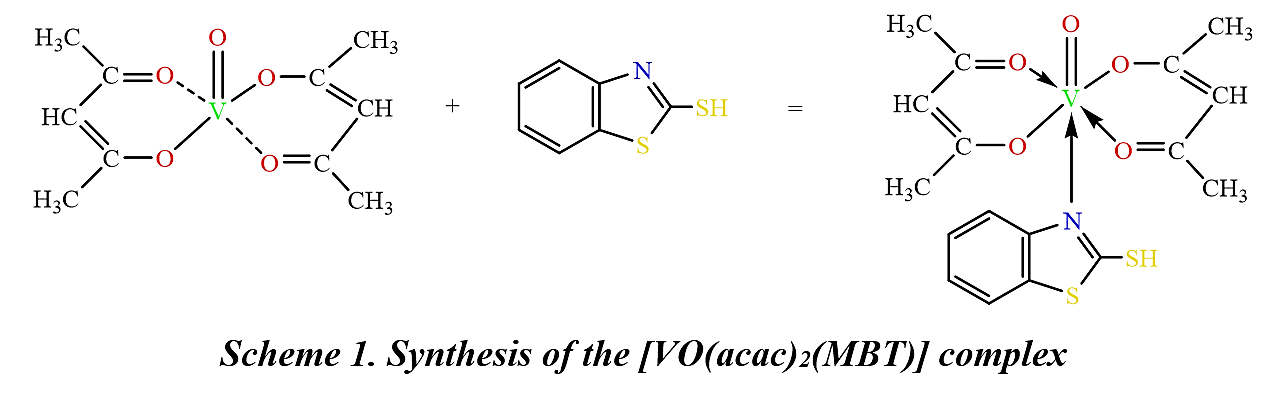
Synthesis of [VO(acac)2(MBT)]. A solution of 2-mercaptobenzothiazole (0.0167 g, 0.1 mmol) in ethanol (5 mL) was added under constant stirring to a solution of VO(acac)2 (0.0265 g, 0.1 mmol) in ethanol (5 mL). The reaction mixture, which turned green, was stirred for 3 h and then cooled to room temperature. Green crystals formed within seven days upon slow evaporation of the mother liquor. The synthesis of the complex is shown in Scheme 1.
Results and Discussion
The composition and structure of the [VO(acac)2(MBT)] complex were studied by SEM–EDS, FT-IR spectroscopy and thermal analysis.
The elemental composition of the complex was determined by EDS analysis (Fig. 1).
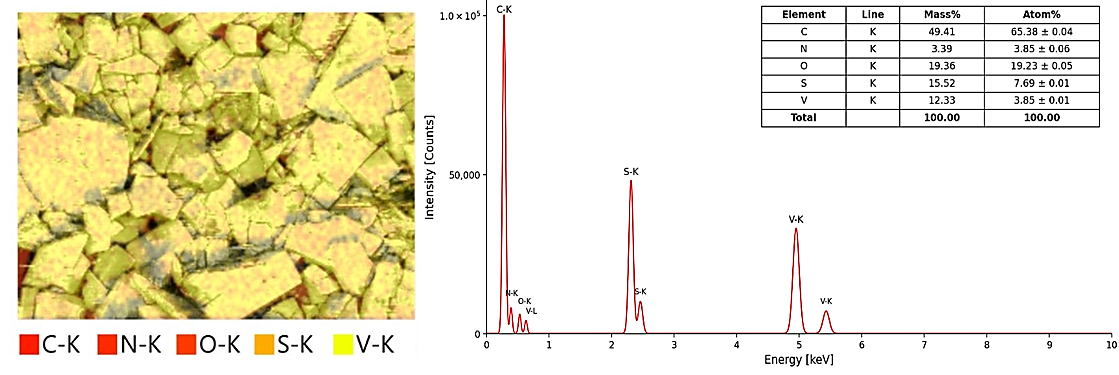
The EDS spectrum displays the characteristic lines of C, N, O, S and V, confirming that both the vanadyl moiety and the MBT ligand are incorporated into the complex, and elemental mapping shows a uniform distribution of these elements over the surface of the crystals, indicating that the sample is homogeneous. It was found that the experimentally determined percentage content of the elements was nearly equal to the theoretically calculated percentage content of the elements.
The FT-IR spectrum of the complex (Fig. 2) retains the main absorption bands of the ligands, although their positions and shapes are partially changed. The most significant changes upon complex formation concern the ν(C=N) stretching vibration of the thiazole ring and the ν(C–O) vibrations of the acetylacetonate ligands, which are shifted by 31–42 cm–1. The intense bands at 1555 and 1522 cm–1 are assigned to the coupled ν(C=O) and ν(C=C) vibrations of the chelating acac ligands, which overlap with the ν(C=N) vibration of the heterocycle in the 1650–1500 cm–1 region. The strong band at 1000 cm–1 is assigned to the ν(V=O) stretching vibration of the vanadyl group, and the bands at 482, 464 cm–1 and 434 cm–1 to the ν(V–O) and ν(V–N) vibrations, respectively; these bands are absent in the spectrum of free MBT.
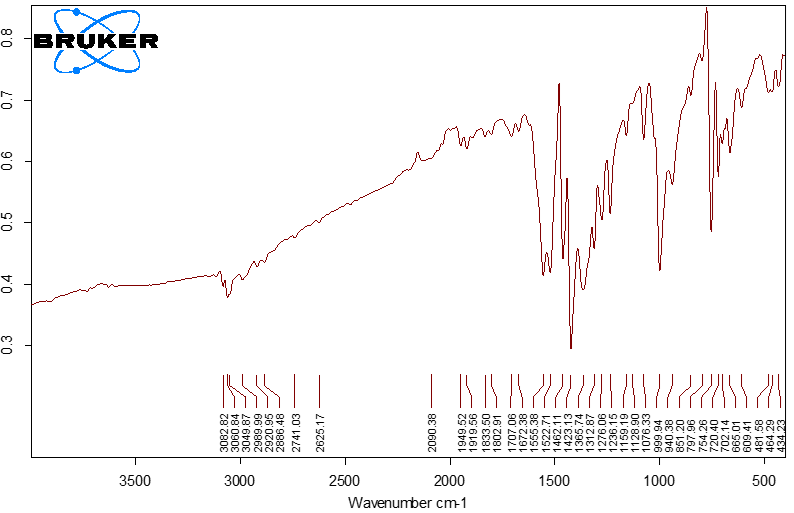
The position of the ν(V=O) band is close to that in the parent [VO(acac)2], which may indicate coordination of the N-donor ligand in the position cis to the oxo group, as established for the related complex with 2-amino-1-methylbenzimidazole [1]. Taken together, the IR data indicate that both acetylacetonate ligands retain their bidentate O,O′-chelating mode, whereas MBT is coordinated to the vanadium atom as a neutral monodentate ligand through the endocyclic nitrogen atom of the thiazole ring, completing a distorted octahedral coordination environment of vanadium(IV).
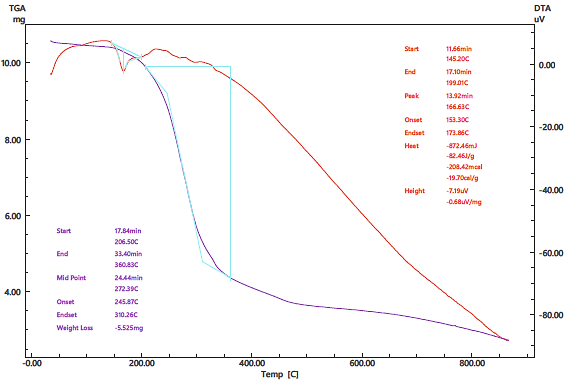
The thermal behaviour of the [VO(acac)2(MBT)] complex was studied in the range of 20–900 °C (Fig. 3). The DTA curve exhibits an endothermic effect in the range of 145–199 °C (onset 153.3 °C, maximum at 166.6 °C, ΔH = 82.5 J/g), which is not accompanied by a noticeable mass loss and is attributed to melting of the complex. The absence of mass loss below 200 °C indicates that the complex contains neither coordinated nor lattice water molecules. The main decomposition stage occurs in the range of 206–361 °C (midpoint 272.4 °C) and is accompanied by a mass loss of 52.3 %. This value exceeds that calculated for the elimination of two acetylacetone molecules (46.3 %), indicating that decomposition of the acac ligands is accompanied by partial degradation of the MBT ligand. In the range of 361–870 °C, a gradual mass loss associated with further decomposition of the organic moiety and evolution of volatile products is observed. The residual mass at the end of the experiment (~26 %) exceeds that calculated for V2O5 (21.0 %), which is typical of thermolysis in an inert atmosphere, where a carbonaceous residue is retained together with vanadium oxides.
Conclusion. A mixed-ligand oxovanadium(IV) complex of composition [VO(acac)2(MBT)] was synthesized by the reaction of VO(acac)2 with 2-mercaptobenzothiazole in ethanol and characterized by a set of physicochemical methods. SEM–EDS analysis confirmed the presence of V, C, N, O and S and their uniform distribution in the sample; the contents of C, O and V agree with those calculated for C17H19NO5S2V. The FT-IR spectrum of the complex shows the ν(V=O) (1000 cm–1), ν(V–O) (482, 464 cm–1) and ν(V–N) (434 cm–1) bands, as well as a shift of the ν(C=N) band of the thiazole ring, indicating coordination of MBT to vanadium(IV) through the endocyclic nitrogen atom with retention of the bidentate chelating mode of the acetylacetonate ligands. Thermal analysis showed that the complex contains no water molecules, melts at 166.6 °C and is thermally stable up to ~205 °C; its decomposition proceeds in two stages, beginning with the elimination of the acetylacetonate ligands.
References