Study of the pressure dependence of water adsorption in K-MOR zeolite
УДК +544.726.2
Abstract
This article investigates the dependence of water vapor adsorption on potassium‑form mordenite zeolite (K‑MOR) on changes in pressure. Zeolites are widely used in water absorption and retention processes due to their unique porous structure, high specific surface area, and ability to undergo ion exchange. During the study, water vapor adsorption isotherms were measured at various pressure values, including the low-, medium-, and high‑pressure regions, and the kinetic characteristics of the adsorption process were analyzed. The results obtained showed that as the pressure increases, the amount of adsorbed water increases sharply up to a certain limit, after which the system transitions to a state close to saturation, which is due to the filling of the zeolite micropores. High selectivity of K‑MOR zeolite towards water has been established. The obtained results indicate the promising potential of using K‑MOR zeolite in gas drying processes, humidity control, and in heat pump systems. The experimental data presented in the article can serve as a basis for further research into the adsorption properties of K‑MOR zeolite, as well as for the development of effective technologies for its practical application.
Аннотация
В данной статье исследована зависимость адсорбции паров воды на цеолите морденит калиевой формы (K-MOR) от изменения давления. Цеолиты широко применяются в процессах поглощения и удерживания воды благодаря их уникальной пористой структуре, высокой удельной поверхности и способности к ионному обмену. В ходе исследования были измерены изотермы адсорбции паров воды при различных значениях давления, включая области низких, средних и высоких давлений, а также проанализированы кинетические характеристики процесса адсорбции. Полученные результаты показали, что с повышением давления количество адсорбированной воды резко возрастает до определённого предела, после чего система переходит в состояние, близкое к насыщению, что обусловлено заполнением микропор цеолита. Установлена высокая селективность цеолита K-MOR по отношению к воде. Полученные результаты свидетельствуют о перспективности применения цеолита K-MOR в процессах осушки газов, регулирования влажности и в системах тепловых насосов. Представленные в статье экспериментальные данные могут служить основой для дальнейших исследований адсорбционных свойств цеолита K-MOR, а также для разработки эффективных технологий его практического применения.
Keywords: K-MOR zeolite; mordenite; water vapor adsorption; adsorption isotherm; equilibrium pressure; porous structure; specific surface area; micropore; mesopore; adsorption–desorption; zeolite adsorbent; gas separation.
Ключевые слова: цеолит K-MOR; морденит; адсорбция водяного пара; адсорбционная изотерма; равновесное давление; пористая структура; удельная поверхность; микропоры; мезопоры; адсорбция–десорбция; цеолитный адсорбент; газоразделение.
Introduction
Zeolites are natural and synthetic crystalline compounds with a microporous aluminosilicate structure, widely used in industry, ecology, and energy owing to their unique porous architecture and cation-exchange capacity. Among zeolites belonging to the mordenite (MOR) group, mordenite occupies a special place, since its structure contains two types of channels a wider 12-membered ring and a narrower 8-membered ring a feature that enables the selective passage and retention of molecules [1, p.218].
The study of water vapor adsorption in zeolites has attracted the attention of researchers for several decades. Earlier studies found that for many natural zeolites, including mordenite, the adsorption isotherms correspond to the classical Brunauer Type I isotherm, that is, a sharp rise in the low-pressure region followed by a plateau at high pressures [2, p.420]. This behavior is associated with the filling of micropores, whereas in the presence of mesopores, an upward shift of the isotherm is observed as pressure increases, owing to additional capillary condensation.
It has been demonstrated in numerous studies that the type of compensating cation in the zeolite composition significantly affects its adsorption properties. In particular, it has been noted that zeolite forms exchanged with the potassium (K+) cation exhibit adsorption behavior in the low-pressure region that differs from that of other monovalent-cation forms (e.g., Na+), which is explained by the cation's charge density and hydration energy [3, p.547]. It has also been shown that cation exchange and decationization processes affect the water adsorption capacity of mordenite–clinoptilolite-type rocks, with decationization somewhat increasing the capacity, while dealumination, conversely, decreases it [4, p.382].
From a practical standpoint, it has been shown that cation-exchanged mordenite samples can be effectively used in gas drying, mixture separation, and tritium recovery systems, since such materials exhibit high selectivity and stability even at low moisture content [5, p.1444]. Furthermore, studies conducted on mordenite-based membranes have found that MOR samples exchanged with H+, K+, and Ca²+ possess a high water adsorption capacity, and that this property can be successfully applied to the pervaporation separation of mixtures [6, p.64].
The literature review presented above shows that a systematic study of the pressure dependence of water vapor adsorption on K-MOR zeolite, and in particular the clarification of the relationship between its porous structure and adsorption capacity, is of pressing scientific and practical importance. The aim of this work is to study the water vapor adsorption of K-MOR zeolite at various relative pressure values and, on the basis of the results obtained, to substantiate its practical fields of application.
Materials and methods. Analytically pure chemical reagents were used to synthesize K-MOR zeolite. Colloidal silicon dioxide (SiO2) (Sigma-Aldrich, reagent grade) was used as the silicon source, aluminum hydroxide (Al(OH)3) (Sigma-Aldrich, reagent grade) as the aluminum source, and potassium hydroxide (KOH) (Sigma-Aldrich, reagent grade) as the mineralizer and alkaline-medium-forming agent. Distilled water was used in preparing the solutions.
The synthesis gel was prepared according to the following molar composition: 10SiO2: 1Al(OH)3: 6.5KOH: 180H2O. For a typical synthesis batch, 24.6 g of colloidal SiO2, 3.2 g of Al(OH)3, and 14.9 g of KOH were successively dissolved in 135 mL of distilled water under continuous magnetic stirring at room temperature for 40 min until a homogeneous alkaline aluminosilicate gel was obtained. The resulting gel was then transferred into a Teflon-lined stainless-steel autoclave and subjected to hydrothermal crystallization at 170 °C for 48 h under autogenous pressure. After crystallization, the solid product was separated by vacuum filtration, washed repeatedly with distilled water until the filtrate reached a pH of 8–9, and dried at 105 °C for 6 h to obtain the K-MOR zeolite in powder form.
Water vapor adsorption isotherms were measured using a vacuum volumetric (static) adsorption apparatus DAK-1 (Experimental Plant of Scientific Instrumentation, USSR). The sample mass was 1.025 g; all masses were weighed on an analytical balance VIBRA HT-224RCE (Vibra, Japan) with a readability of 0.1 mg and an accuracy class of ±0.1 mg. Prior to each measurement, the sample was activated in situ by evacuation at 350 °C for 3 h to remove physically adsorbed moisture and residual gases from the zeolite pores. The adsorption isotherms were subsequently recorded at a fixed temperature (25 °C) by stepwise admission of water vapor into the sample chamber, with the equilibrium pressure and corresponding adsorbed amount registered at each pressure increment [9, p. 125].
Kinetic (flow-calorimetric) experiments were carried out on a Tian–Calvet differential adsorption calorimeter DAK-1-1A (Experimental Plant of Scientific Instrumentation, USSR) [1, 8, 11]. During the experiment, a pre-prepared adsorbent of known mass was placed in the adsorption section of the DAK-1-1A unit. The gas flow under investigation was passed through the adsorbent under fixed flow-rate and temperature conditions. During the process, the inlet and outlet concentrations of the adsorbing component in the gas were determined, and the adsorption efficiency of the adsorbent was evaluated [10, p. 97]. The measured heat effect and the corresponding change in adsorbed amount allowed us to estimate the adsorption kinetics and to characterize the interaction of water molecules with the active centers of K-MOR.
Thus, two complementary techniques were used in this work: (i) vacuum volumetric method on the DAK-1 apparatus for measuring equilibrium adsorption isotherms, and (ii) flow-calorimetric method on the DAK-1-1A unit for studying the kinetics and thermal effects of adsorption.
The experiments examined the effect of adsorption time, temperature, gas flow rate, and adsorbent mass on the efficiency of the process. On the basis of the results obtained, the optimal conditions of the adsorption process on the DAK-1-1A unit were determined, and the efficiency of the adsorbent was evaluated.
Results and discussion
The dependence of water vapor adsorption on the relative pressure (P/Ps) for K-MOR zeolite is shown in Figure 1. As can be seen from the obtained isotherm, the adsorption process exhibits continuous growth throughout the entire pressure range (from 0 to 0.9) and displays two clearly distinguishable stages.
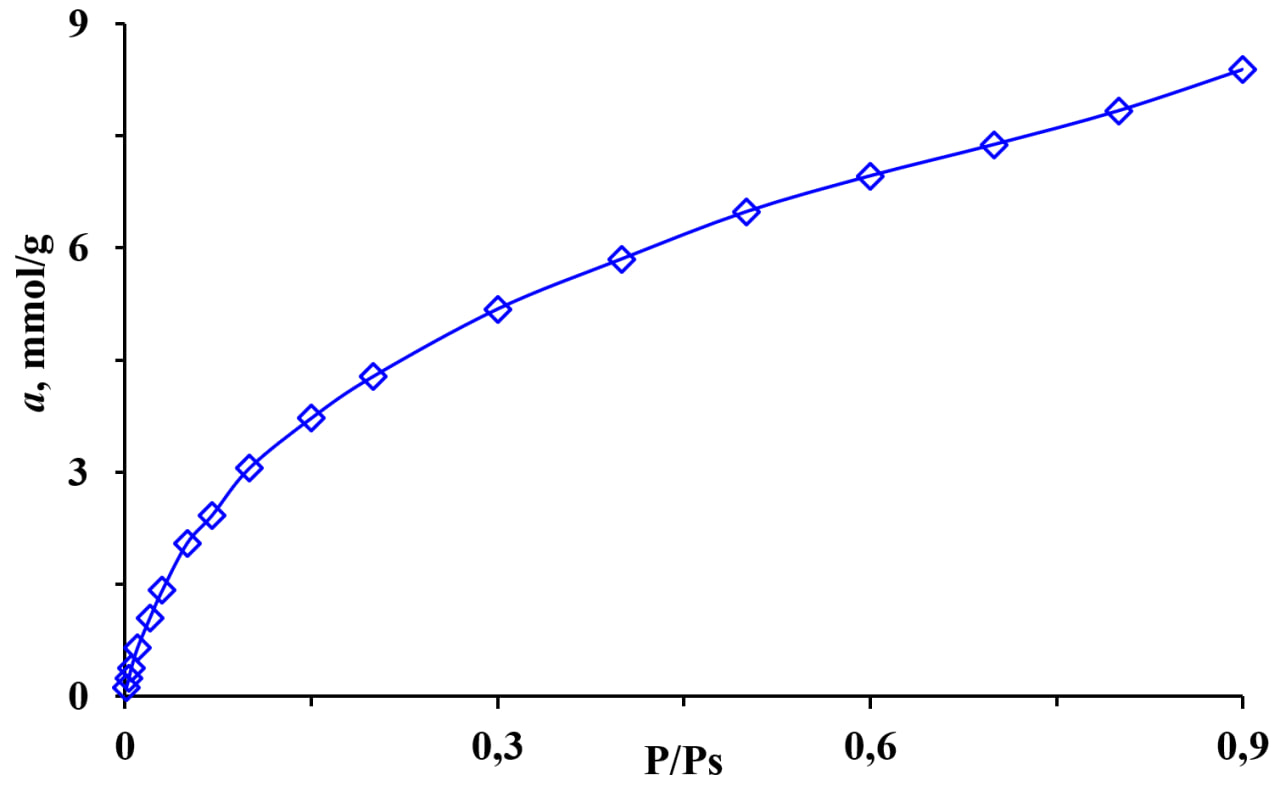
In the low relative-pressure region (P/Ps = 0-0.1), a sharp increase in the amount adsorbed is observed in this interval the adsorption value rises from nearly 0 to about 2 mmol/g. This sharp rise arises from the intensive binding of water molecules at the strong adsorption centers located within the zeolite's micropores (the dipole–ion interaction around the compensating K+ cations). This stage corresponds to the filling of the micropores.
In the medium-pressure region (P/Ps = 0.1-0.5), the slope of the isotherm curve gradually decreases, but the amount adsorbed continues to increase steadily (from approximately 2 to 6.5 mmol/g). At this stage, adsorption no longer proceeds only at the strongest centers but continues owing to the formation of secondary adsorption layers and the filling of relatively larger pores.
In the high-pressure region (P/Ps = 0.5-0.9), the curve shows a relatively slower, nearly linear increase, reaching an adsorption value of about 8.5 mmol/g at a relative pressure of 0.9. No complete saturation (plateau) is observed here, which indicates the presence of mesopores in the sample and the continuation of capillary condensation in them at high pressures.
The overall shape of the obtained isotherm a sharp rise at low pressure, a decreasing slope at medium pressure, and a slow, plateau-free continued rise at high pressure approximates a Type II isotherm according to the IUPAC classification, though the “bend” observed in the intermediate section points to a non-uniform porous structure of the sample, that is, to the coexistence of micro- and mesopores. Such behavior is typical in the literature for natural and modified forms of mordenite, since the presence in their structure of a dual-sized channel system (12-membered and 8-membered rings) causes different adsorption mechanisms to become active depending on pressure.
The adsorption capacity of the K-MOR sample, reaching about 8.5 mmol/g (approximately 153 mg/g) at a relative pressure of 0.9, makes it a promising candidate for practical use as a moisture-absorbing material. In particular, the sharp adsorption activity in the low-pressure region demonstrates the possibility of using the sample in efficient drying processes even at low moisture concentrations, for example in gas dehydration. The continued, non-declining increase in adsorption capacity at high pressures also ensures the material's stable performance over a wide pressure range.
The graph reflecting the dependence of the amount adsorbed on the logarithm of the relative pressure [ln(P/P°)] (Figure 2) depicts the processes in the low-pressure region in a considerably more expanded and precise form compared with the first isotherm, since the logarithmic scale provides a convenient means of examining low-pressure values.
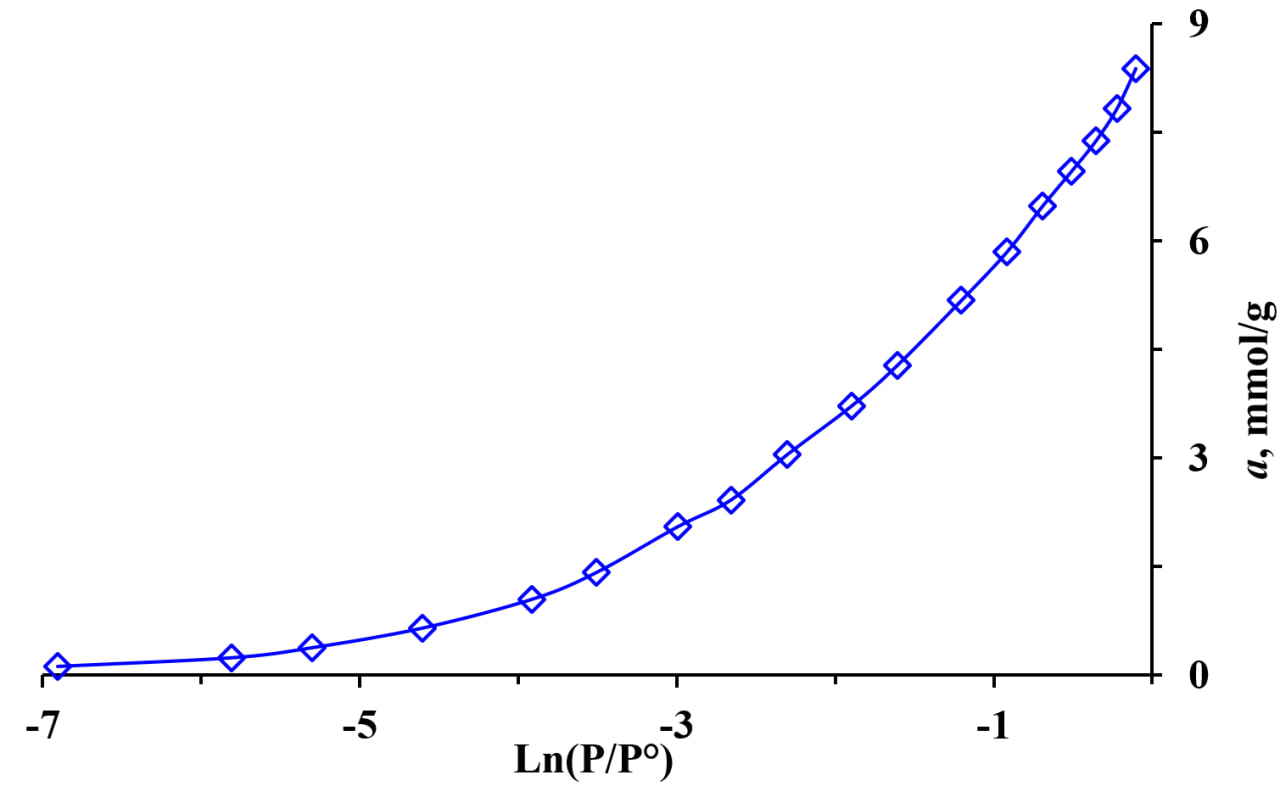
Low-pressure region (ln(P/P°) = -7 to -4). In this interval, that is, at very low relative pressures (corresponding to P/P° of approximately 0.001–0.02), the amount adsorbed increases very slowly (from 0 to about 1 mmol/g). The nearly horizontal, flat course of the curve shows that in this pressure range only the highest-energy adsorption centers — mainly the strong electrostatic-field zones around the K+ cations — begin to retain water molecules. The limited number of such centers keeps the rate of adsorption low.
Medium-pressure region (ln(P/P°) = -4 to -2). In this interval, the curve's slope increases substantially, and the amount adsorbed rises from about 1 to 3 mmol/g. This is attributable to the fact that, in addition to the primary centers, secondary adsorption centers of somewhat lower energy also become involved, and the formation of a second adsorption layer begins.
High-pressure region (ln(P/P°) = -2 to -0.3). In this interval the curve has its steepest slope, and the amount adsorbed sharply increases from about 3 to about 8.5 mmol/g. This stage corresponds to the complete filling of the micropores and, simultaneously, the onset of capillary condensation in the mesopores. At the upper end of the curve (ln(P/P°) ≈ -0.3, that is, at P/P° values above about 0.74), the rate of increase is observed to slow somewhat, although saturation (a plateau) has not yet fully formed.
The graph on the ln(P/P°) scale provides additional information about the adsorption kinetics in the low-pressure region compared with the graph on the linear P/Ps scale: whereas on the linear scale the sharp low-pressure rise appears to occur instantaneously, on the logarithmic scale it becomes clearly apparent that this process actually takes place gradually, through the sequential activation of energetically distinct centers. This, in turn, confirms the energetic heterogeneity of the adsorption centers in K-MOR zeolite and provides a basis for describing it using theoretical models such as Dubinin–Radushkevich or Frenkel–Halsey–Hill.
Conclusion
Within the framework of this study, the dependence of water vapor adsorption on equilibrium pressure for K-MOR zeolite was comprehensively examined, and the following main results were obtained:
A complete adsorption isotherm was obtained for the synthesized and thermally activated K-MOR sample at 25 °C over the relative-pressure (P/Ps) range of 0 to 0.9. The amount adsorbed increased steadily with pressure, reaching approximately 8.5 mmol/g at the highest relative pressure (P/Ps = 0.9), which confirmed that K-MOR zeolite possesses a high adsorption capacity for water vapor.
Analysis of the resulting isotherm curve showed that the adsorption process proceeds in several stages: the sharp rise observed in the low-pressure region was found to be linked to the rapid filling of strong energy centers (mainly around the K+ cations); the steady increase in the medium-pressure region, to the formation of secondary adsorption layers; and the continued increase in the high-pressure region, to the process of capillary condensation in the mesopores.
Re-analysis of the adsorption data on a logarithmic pressure scale revealed the energetic heterogeneity of the adsorption centers in the low-pressure region even more clearly. This indicates that adsorption centers of different sizes and different energies coexist within the porous structure of K-MOR zeolite.
The overall shape of the isotherm, together with the absence of a clearly formed saturation plateau, shows that the sample contains a substantial contribution from mesopores alongside micropores, which makes it possible to characterize K-MOR as an adsorbent with a non-uniform (heterogeneous) porous structure.
The results obtained substantiate that K-MOR zeolite is a promising material for use in the dehydration of gases and other media, moisture regulation, and selective separation processes. In particular, the high adsorption activity manifested even at low pressures allows it to be used in media with low moisture concentrations, while the continued, non-declining increase in capacity at high pressures ensures the material's stability over a wide operating range.
For future research, it is recommended that the structural and morphological characteristics of K-MOR zeolite (XRD, SEM), its textural parameters (BET specific surface area, micro- and mesopore volume), and the thermodynamic characteristics of adsorption (isosteric heat of adsorption, adsorption enthalpy) be quantitatively evaluated using mathematical models — including the Dubinin–Radushkevich, BET, and Frenkel–Halsey–Hill equations — and that the isosteric heat of adsorption be calculated on the basis of additional measurements carried out at various temperatures. This will provide a solid scientific basis for further expanding the practical application fields of K-MOR zeolite and for its implementation in industrial-scale adsorption processes.
References