Determination of water-soluble vitamins in As-Gul, a honey–clove–garlic by HPLC
УДК 543.544+613.292
Abstract
This study aimed to determine the composition of water-soluble vitamins in As-Gul, a natural composition consisting of honey, clove (Syzygium aromaticum), and garlic (Allium sativum) in a ratio of 6:1:1, using high-performance liquid chromatography (HPLC). The composition was prepared under laboratory conditions according to the established formulation, and the vitamin profile was analysed using an optimised reversed-phase HPLC method with ultraviolet detection. The analysis focused on the identification and quantification of nutritionally important water-soluble vitamins. Vitamins B1 (thiamine), B2 (riboflavin), B3 (niacin), B6 (pyridoxine), B9 (folic acid), PP, and vitamin C (ascorbic acid) were successfully identified, whereas vitamin B12 was not detected under the analytical conditions employed. Among the detected compounds, vitamins B3 and B2 were present at the highest concentrations, indicating that these vitamins constitute the major water-soluble vitamin components of the composition. The developed analytical method demonstrated good suitability for evaluating the vitamin profile of this natural product and may be applied in future quality control studies. The obtained results confirm that As-Gul contains several nutritionally valuable water-soluble vitamins and provide a scientific basis for further investigation of its nutritional value, biological properties, and potential application as a functional food or biologically active dietary supplement.
Аннотация
Целью настоящего исследования было определение состава водорастворимых витаминов в композиции As-Gul, состоящей из мёда, гвоздики (Syzygium aromaticum) и чеснока (Allium sativum) в соотношении 6:1:1, методом высокоэффективной жидкостной хроматографии (ВЭЖХ). Композиция была приготовлена в лабораторных условиях по разработанной рецептуре, после чего проведён анализ содержания водорастворимых витаминов с использованием оптимизированного метода ВЭЖХ с ультрафиолетовым детектированием. Исследование было направлено на идентификацию и количественное определение наиболее значимых водорастворимых витаминов. В результате анализа были идентифицированы витамины B1 (тиамин), B2 (рибофлавин), B3 (ниацин), B6 (пиридоксин), B9 (фолиевая кислота), PP и витамин C (аскорбиновая кислота), тогда как витамин B12 обнаружен не был. Среди выявленных витаминов наиболее высокое содержание отмечено для витаминов B3 и B2. Разработанный аналитический метод продемонстрировал пригодность для оценки витаминного состава данной натуральной композиции и может быть использован при её дальнейшем контроле качества. Полученные результаты подтверждают наличие в As-Gul пищево ценных водорастворимых витаминов и создают научную основу для дальнейшего изучения её пищевой ценности, биологических свойств и перспектив применения в качестве функционального пищевого продукта или биологически активной добавки к пище.
Keywords: As-Gul; honey; clove; garlic; functional food; water-soluble vitamins; HPLC.
Ключевые слова: As-Gul; мёд; гвоздика; чеснок; водорастворимые витамины; ВЭЖХ.
Introduction
Natural products have been used for centuries as food ingredients and traditional remedies. Honey, clove (Syzygium aromaticum L.), and garlic (Allium sativum L.) are among the most commonly consumed natural products because of their nutritional value and beneficial effects on human health. These products contain a variety of biologically active substances, including vitamins, minerals, phenolic compounds, organic acids, and other natural constituents that contribute to normal physiological functions and help protect the body against oxidative damage [1–3].
Honey is widely consumed as a natural sweetener and has long been valued as a source of easily digestible carbohydrates, enzymes, vitamins, minerals, and antioxidant compounds. Clove is one of the most popular spices used in food preparation and traditional medicine due to its rich chemical composition and biological activity. Garlic is also an important dietary component that contains sulfur-containing compounds, vitamins, minerals, and other bioactive substances associated with its nutritional and functional properties [2 – 4].
The growing interest in functional foods has encouraged the development of natural formulations prepared by combining plant materials with bee products. Such combinations may exhibit improved nutritional quality because each component contributes different biologically active compounds. Therefore, selecting an appropriate ratio of ingredients is an important step in obtaining formulations with desirable biological properties [5,6].
Although the individual properties of honey, clove, and garlic have been widely investigated, limited information is available on the water-soluble vitamin composition of formulations prepared by combining these natural products in specific proportions. Therefore, further studies are needed to evaluate the nutritional characteristics of such formulations and to support their potential application as functional food products.
The As-Gul formulation, consisting of honey, clove, and garlic in a 6:1:1 ratio, was selected for the present study. Preliminary evaluation using the DPPH radical scavenging assay demonstrated antioxidant activity of the formulation. The ethanolic extract exhibited higher radical scavenging activity (22.36 %) than the aqueous extract (10.32 %) after 30 min of reaction. Based on these preliminary findings, the 6:1:1 formulation was selected for the determination of its water-soluble vitamin composition by HPLC. A comprehensive evaluation of its antioxidant properties was beyond the scope of the present study.
Water-soluble vitamins are essential micronutrients involved in energy metabolism, enzymatic reactions, immune function, and numerous physiological processes. Since they are not stored in sufficient amounts in the human body, their regular intake through food is necessary. Determining the vitamin composition of newly developed natural formulations is therefore important for evaluating their nutritional value and supporting their potential application as functional foods or food supplements [7,8].
This study aimed to determine the composition of water-soluble vitamins in As-Gul using HPLC and to evaluate its nutritional potential as a natural food supplement.
Materials and methods
Natural bee honey, dried clove flower buds (Syzygium aromaticum L.), and fresh garlic (Allium sativum L.) were purchased from a local retail market in Andijan, Uzbekistan. After purchase, the plant materials were visually inspected to remove foreign particles. Garlic cloves were peeled, while clove buds were ground into a fine powder. As-Gul was prepared by mixing honey, clove powder, and fresh garlic in a 6:1:1 ratio until a homogeneous mixture was obtained.
Preliminary DPPH radical scavenging assay. The antioxidant activity of the As-Gul formulation (6:1:1) was preliminarily evaluated using the DPPH radical scavenging assay according to the method of Blois with minor modifications. Ethanolic and aqueous extracts were prepared by ultrasonic extraction (1 g sample with 25 mL solvent for 20 min). Radical scavenging activity was determined spectrophotometrically at 517 nm after 30 min of reaction. The DPPH assay was performed only as a preliminary screening to support the selection of the formulation for subsequent HPLC analysis.
Water-soluble vitamins were extracted from the prepared As-Gul formulation. For this purpose, 1.0 g of the sample was placed into a 50 mL conical flask, followed by the addition of 25 mL of 0.1 N hydrochloric acid. The mixture was treated in an ultrasonic bath (GT SONIC-D3, China) at 60 °C for 20 min to improve the extraction of water-soluble compounds. After cooling, the extract was filtered and its volume was adjusted to 25 mL with distilled water. Before chromatographic analysis, the solution was passed through a 0.22 μm syringe filter. The prepared extract was filtered and directly subjected to HPLC analysis.
Reference standards of vitamins B1, B2, B3, B6, B9, B12, PP, and vitamin C were used for qualitative and quantitative analysis. Vitamins B1, B3, B6, B12, PP, and C were dissolved in 0.1 N hydrochloric acid, whereas vitamins B2 and B9 were prepared in 0.025 % sodium hydroxide because of their better stability under weak alkaline conditions. Calibration solutions of different concentrations were prepared by serial dilution of the stock solutions before chromatographic analysis and used for peak identification and quantification.
Chromatographic analysis was carried out using a Shimadzu LC-40 Nexera Lite high-performance liquid chromatograph equipped with an LC-40D pump, SIL-40 autosampler, and PDA detector. The analytical procedure was adapted from the HPLC method reported by Yessaad et al. [4], and general chromatographic principles for vitamin analysis were considered with reference to the AOAC Official Methods of Analysis [10]. Separation was performed on a Shim-pack GIST C18 column (150 × 4.6 mm, 5 μm). Acetonitrile and 0.5 % aqueous acetic acid were used as the mobile phase under gradient elution. The flow rate was 0.6 mL min-¹, the column temperature was maintained at 40 °C, and the injection volume was 10 μL. Detection wavelengths were selected according to the UV–visible absorption maxima of the target vitamins and the previously reported chromatographic method. Vitamins B1, B3, B6, PP, and vitamin C were monitored at 265 nm because of their strong absorption in this region; vitamin B2 was monitored at 291 nm to achieve higher sensitivity, whereas vitamin B12 was monitored at 550 nm, corresponding to its characteristic absorption maximum. The mobile phase consisted of acetonitrile (A) and 0.5 % aqueous acetic acid (B). The gradient program was as follows: 0–2 min, 0 % A/100 % B; 2–6 min, linear gradient to 50 % A/50 % B; at 6.01 min, the mobile phase was returned to the initial composition (0 % A/100 % B) and maintained until the end of the run (15 min).
Results and discussion
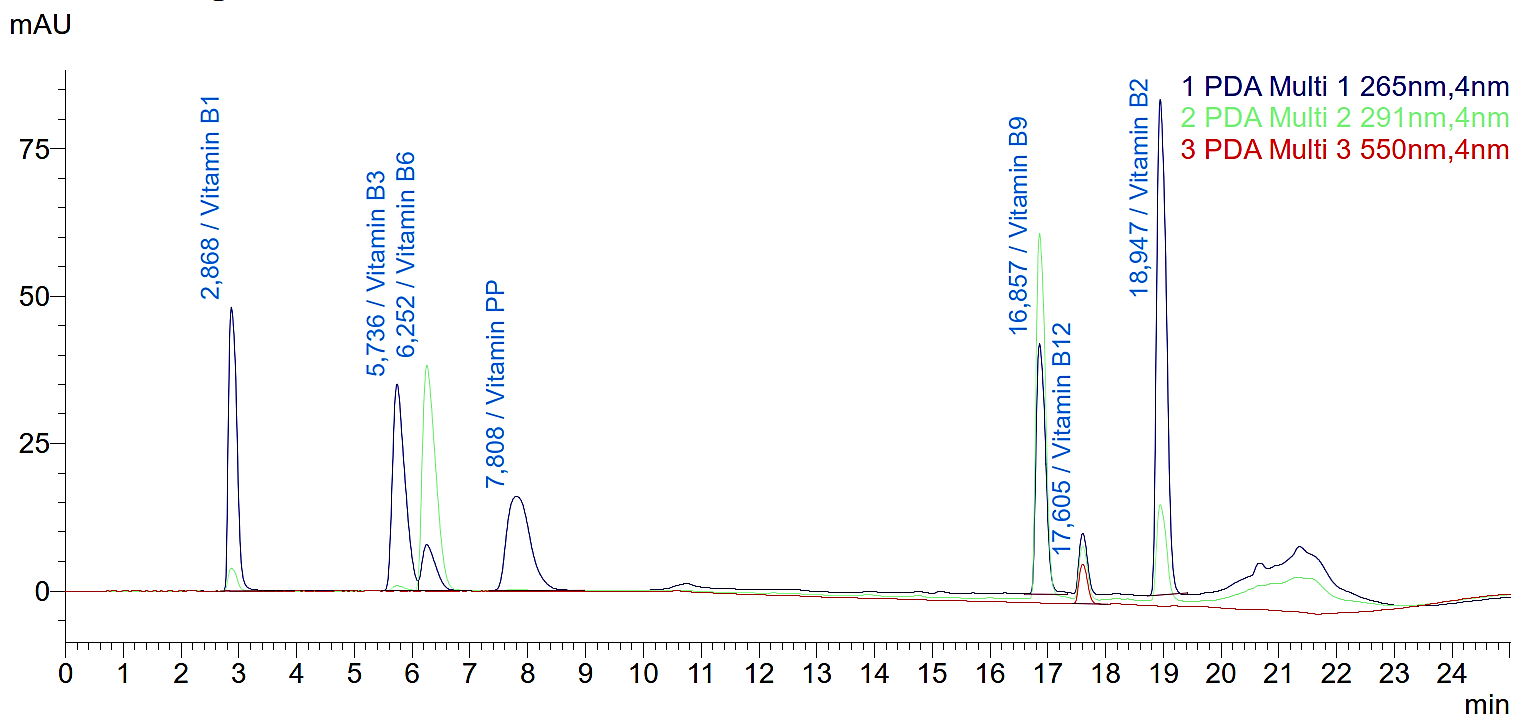
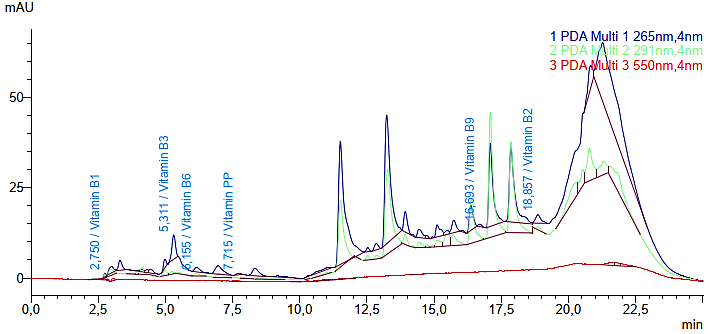
The HPLC analysis confirmed the presence of water-soluble vitamins in As-Gul. Vitamins were identified by comparing the retention times of the sample peaks with those of the corresponding standard solutions. The chromatogram of the mixed standard vitamins is shown in Figure 1, which was used for peak identification during the analysis. The chromatogram obtained for the sample is presented in Figure 2, while the quantitative results are summarized in Table 1. Vitamin B12 was not detected under the selected chromatographic conditions.
As shown in Figure 2, the peaks corresponding to vitamins B1, B2, B3, B6, B9 and PP were clearly separated under the selected chromatographic conditions. The retention times of these compounds were consistent with those of the reference standards, allowing reliable identification of the vitamins detected in As-Gul.
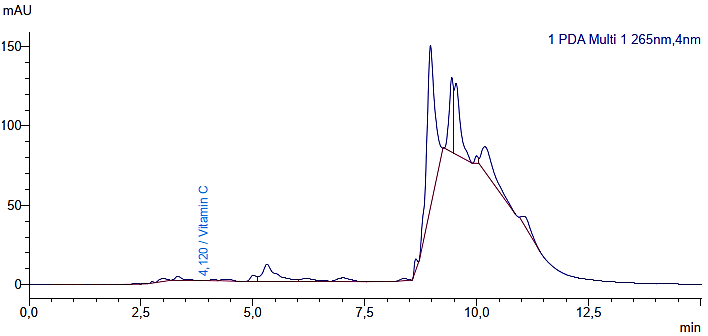
Figure 3 demonstrates the chromatographic peak corresponding to vitamin C. The retention time agreed with that of the standard solution, confirming the presence of vitamin C in the analysed formulation.
Table 1.
Water-soluble vitamin composition of As-Gul
| Vitamin | Retention time (min) | Concentration (mg/L) | Content in 100 g sample (mg) |
|---|---|---|---|
| B1 | 2.750 | 0.224 | 0.560 |
| B3 | 5.311 | 1.596 | 3.990 |
| PP | 7.715 | 0.136 | 0.340 |
| B9 | 16.693 | 0.200 | 0.500 |
| B2 | 18.857 | 0.738 | 1.845 |
| B6 | 6.155 | 0.233 | 0.583 |
| B12 | Not detected | 0.000 | 0.000 |
| Vitamin C | 4.120 | 0.029 | 0.073 |
As shown in Table 1, vitamin B3 was present at the highest concentration (1.596 mg/L). The second highest value was recorded for vitamin B2 (0.738 mg/L), followed by vitamins B6 (0.233 mg/L), B1 (0.224 mg/L), B9 (0.200 mg/L), PP (0.136 mg/L), and vitamin C (0.029 mg/L). The obtained values indicate that As-Gul contains several water-soluble vitamins that contribute to its nutritional value.
The relatively high content of vitamin B3 may reflect the combined contribution of honey, clove, and garlic in As-Gul. Niacin is an essential micronutrient involved in energy metabolism and numerous oxidation–reduction reactions. Its adequate intake supports normal cellular function and contributes to maintaining metabolic activity [4,7].
Vitamin B2 was detected in a relatively high amount compared with the other identified vitamins. Riboflavin participates in many enzymatic processes related to carbohydrate, protein, and lipid metabolism. Together with vitamins B1 and B6, it contributes to the normal functioning of the nervous system and energy production [7,9].
Although vitamins B1, B6, and B9 were detected at lower concentrations, their presence contributes to the nutritional value of As-Gul. These vitamins are involved in carbohydrate metabolism, amino acid conversion, nucleic acid synthesis, and normal cell growth. Even relatively small amounts may contribute to the overall biological value of foods when consumed regularly as part of the diet [4,5].
Vitamin C was identified at a comparatively low concentration. Ascorbic acid is known to be sensitive to oxygen, temperature, and light during processing and storage, which may influence its stability and concentration in food products [6,10].
Vitamin B12 was not detected in the analysed sample. This finding is consistent with the fact that higher plants generally do not synthesise vitamin B12, and its occurrence in plant-derived foods is usually negligible or absent, although it may occasionally be associated with vitamin B12-producing microorganisms in certain fermented products.
Overall, the obtained results demonstrate that As-Gul contains several nutritionally important water-soluble vitamins. These findings contribute to the nutritional characterisation of the formulation and provide a scientific basis for further studies on its potential application as a functional food product and food supplement.
Conclusion
HPLC analysis demonstrated that As-Gul contains several nutritionally important water-soluble vitamins, including vitamins B1, B2, B3, B6, B9, PP, and C, with vitamin B3 and vitamin B2 present at the highest concentrations. These findings suggest that As-Gul has potential for the development of functional foods and dietary supplements.
References