Structural properties of polyester resins modified with polymethylenenaphthalenesulfonic acid
УДК 678.674:547.992
Abstract
This study investigates the synthesis and structural characterization of polymethylenenaphthalenesulfonic acid (PMNS)-modified polyester resin using physicochemical analysis methods. The research aimed to synthesize a modified polyester resin based on polydiethylene glycol adipinate (PDAT) and PMNS, determine its chemical structure, and evaluate its potential application in polymer compositions and paint and coating materials. The resin was synthesized using an optimized PDAT-to-PMNS molar ratio of 70:1. Its molecular structure was characterized by Fourier transform infrared (FTIR) spectroscopy and ^1H/^13C nuclear magnetic resonance (NMR) spectroscopy. FTIR analysis confirmed the presence of hydroxyl, carbonyl, ester, ether, aromatic, and sulfonic functional groups, demonstrating the successful incorporation of PMNS into the polyester matrix. The ^1H and ^13C NMR spectra identified characteristic signals corresponding to naphthalene rings, adipinate fragments, methylene bridges, and diethylene glycol chains, confirming the formation of the expected oligomeric structure. The combined spectroscopic results verified that chemical modification occurred without disrupting the polyester backbone, producing a stable oligomeric system. The synthesized resin exhibited excellent dispersibility, structural stability, and favorable physicochemical properties. These findings indicate that PMNS-modified polyester resin is a promising material for advanced polymer composites, water-based dispersions, adhesives, and high-performance paint and coating formulations, expanding the application of naphthalene sulfonate-based modifiers in polymer materials.
Аннотация
В данном исследовании изучены синтез и структурная характеристика полиэфирной смолы, модифицированной полиметиленнафталинсульфоновой кислотой (ПМНСК), с использованием физико-химических методов анализа. Целью работы являлись синтез модифицированной полиэфирной смолы на основе полидиэтиленгликольадипината (ПДАТ) и ПМНСК, определение её химического строения и оценка перспектив применения в полимерных композициях, лакокрасочных материалах и покрытиях. Смола была синтезирована при оптимизированном молярном соотношении ПДАТ:ПМНСК, равном 70:1. Молекулярная структура продукта исследована методами инфракрасной спектроскопии с преобразованием Фурье (FTIR) и спектроскопии ядерного магнитного резонанса (^1H и ^13C ЯМР). Анализ FTIR подтвердил наличие гидроксильных, карбонильных, эфирных, простых эфирных, ароматических и сульфоновых функциональных групп, что свидетельствует об успешном введении ПМНСК в полиэфирную матрицу. Спектры ^1H и ^13C ЯМР выявили характерные сигналы, соответствующие нафталиновым кольцам, адипинатным фрагментам, метиленовым мостикам и цепям диэтиленгликоля, подтверждая формирование ожидаемой олигомерной структуры. Совокупность спектроскопических данных показала, что химическая модификация происходила без нарушения полиэфирного каркаса, что привело к образованию стабильной олигомерной системы. Синтезированная смола характеризуется высокой диспергируемостью, структурной стабильностью и благоприятными физико-химическими свойствами. Полученные результаты свидетельствуют о том, что полиэфирная смола, модифицированная ПМНСК, является перспективным материалом для создания современных полимерных композитов, водных дисперсий, клеевых композиций, а также высокоэффективных лакокрасочных материалов и покрытий, расширяя области применения модификаторов на основе нафталинсульфонатов в полимерных материалах.
Keywords: polymethylenenaphthalenesulfonic acid; polydiethylene glycol adipinate; modified polyester resin; FTIR spectroscopy; NMR spectroscopy; molecular structure; polymer modification; oligomers; ester bonds; sulfo groups; physicochemical properties; polymer compositions.
Ключевые слова: полиметиленнафталинсульфоновая кислота; полидиэтиленгликольадипинат; модифицированная полиэфирная смола; ИК-спектроскопия с преобразованием Фурье (FTIR); ЯМР-спектроскопия; молекулярная структура; модификация полимеров; олигомеры; эфирные связи; сульфогруппы; физико-химические свойства; полимерные композиции.
Introduction
In recent years, the development of polymer materials with enhanced functional properties, the improvement of their performance characteristics, and the production of locally manufactured import-substituting products have become among the most important directions in polymer chemistry and technology [1]. In particular, modified polyester resins are widely used in coatings, composite materials, dispersed systems, and construction chemistry due to their high adhesive properties, good solubility, thermal stability, and the possibility of incorporating various functional groups into their structure [2–4].
One of the effective approaches to improving the properties of polyester resins is their modification with compounds possessing aromatic and ionogenic characteristics [5]. From this perspective, polymethylenenaphthalenesulfonic acid (PMNS) has attracted considerable scientific interest. The presence of aromatic naphthalene rings and sulfo groups in the PMNS molecule enhances the dispersibility, hydrophilicity, thermal stability, and surface activity of polymer systems [6–7]. However, the molecular structure and structural properties of PMNS-modified polyester resins have not yet been sufficiently investigated [8].
Polydiethylene glycol adipinate (PDAT) is a functional oligomer containing ester and ether linkages, and its combined use with PMNS makes it possible to obtain modified polyester systems with novel properties [9]. Determining the structural features of such polymers, identifying the functional groups present in their composition, and investigating the nature of the formed chemical bonds are of significant practical and theoretical importance [10–11].
Materials
A modified polyester resin based on polymethylenenaphthalenesulfonic acid (PMNS) and polydiethylene glycol adipinate (PDAT) at a molar ratio of 70:1 was synthesized under acidic conditions at atmospheric pressure [12–14]. The following chemicals were used during the synthesis: Shaffer acid (1-naphthylamine-7-sulfonic acid, CAS No. 84-87-7), formaldehyde (CAS No. 50-00-0), adipic acid (CAS No. 124-04-9), diethylene glycol (CAS No. 111-46-6), sulfuric acid (CAS No. 7664-93-9), and sodium hydroxide (CAS No. 1310-73-2).
Methods
During the study, the FTIR spectra of the polyester samples synthesized based on PMNS were recorded using an **IRTracer-100** spectrometer (SHIMADZU CORP., Japan, 2017). The samples were first finely ground in a mortar and then mixed with potassium bromide (KBr) at a ratio of 1:10. The resulting mixture was further ground and compressed into pellets for 4–5 minutes using a pellet mold, after which the samples were analyzed by FTIR spectroscopy [15–17].
In addition, the morphology of the synthesized samples was investigated using a **SEM-EVO MA 10** scanning electron microscope (Carl Zeiss, Germany). Prior to analysis, solid samples were thoroughly dried. Subsequently, 10–20 mg of the sample was dissolved in 0.6–0.7 mL of a deuterated solvent. The prepared solution was transferred into a standard 5 mm NMR tube. To avoid the formation of air bubbles, the solution was mixed gently and then placed in the NMR instrument for analysis [18–19].
Results and Discussion
In the initial stage of the study, FTIR spectroscopic analyses were carried out to identify the structural changes in samples synthesized from polymethylenenaphthalenesulfonic acid (PMNS) and polydiethylene glycol adipinate (PDAT) at a molar ratio of 70:1 and reacted at 98–100 °C for 120 min. Analysis of the obtained FTIR spectra enabled the identification of absorption bands corresponding to the functional groups present in the samples and allowed the evaluation of the structural changes that occurred during the modification process [20]. The spectral data obtained and the principal absorption bands are presented in the following figure (Figure 1).
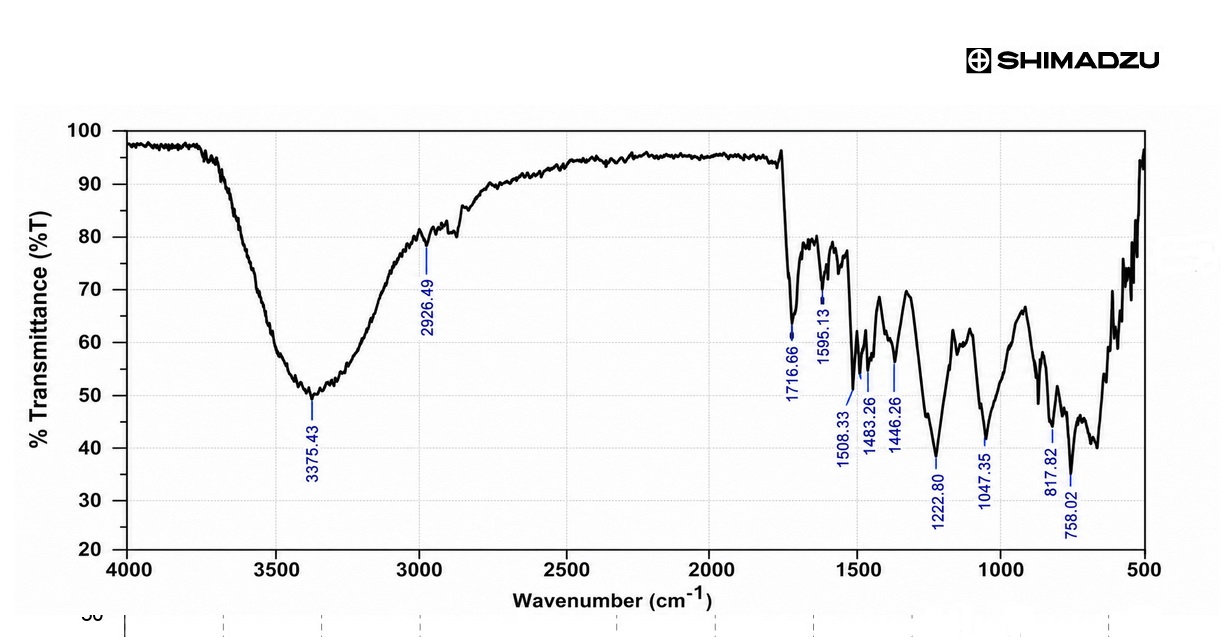
Based on the analysis of the spectrum presented in the graph and the data summarized in Table 2, it was established that the polyester resin modified with PMNS and PDAT contains several characteristic functional groups. The broad absorption band observed at 3381.21 cm-¹ corresponds to the stretching vibrations of hydroxyl (–OH) groups, indicating the presence of hydroxyl fragments associated with polydiethylene glycol residues and sulfonic acid groups. The absorption bands at 2974.23 and 2877.79 cm-¹ are attributed to the stretching vibrations of methylene (–CH2–) groups, confirming the presence of aliphatic fragments in the polymethylenenaphthalene and polydiethylene glycol chains.
The strong absorption band observed at 1728.22 cm-¹ is characteristic of the stretching vibrations of carbonyl (C=O) groups in the polyester resin and indicates the formation of ether- or ester-type linkages during the modification process. The signal at 1456.26 cm-¹ is associated with the deformation vibrations of methylene groups and characterizes the aliphatic segments of the polymer chain. The intense absorption at 1045.42 cm-¹ corresponds to the stretching vibrations of C–O–C groups in ether linkages and S=O bonds in sulfo groups. This signal indicates the incorporation of polydiethylene glycol fragments into the polymer structure and confirms the preservation of sulfo groups derived from polymethylenenaphthalenesulfonic acid.
Table 2.
Comparative analysis of the FTIR spectral characteristics
| № | Functional groups and bond types | Absorption peak in the spectrum, cm⁻¹ | Absorption peak reported in the literature, cm⁻¹ | Intensity and type of vibration |
|---|---|---|---|---|
| 1. | Hydroxyl group (–OH). | 3381.21 | 3200-3450 | v(O-H), b., s. |
| 2. | Methylene group (–CH₂–). | 2974.23 | 2920-2980 | vas(C-H), w. |
| 3. | Aliphatic stretching vibration (–C–H–). | 2877.79 | 2850-2890 | vs(C-H), w. |
| 4. | Carbonyl group (C=O). | 1728.22 | 1720-1750 | v(C=O), b. |
| 5. | Naphthalene ring (aromatic C=C stretching vibration). | 1590-1600 | 1500-1600 | d(C=C), m. |
| 6. | Methylene bridges (–CH₂–). | 1456.26 | 1440-1470 | d(C-H), m. |
| 7. | Dimethylene ether group (–C–O–C–). | 1222.80 | 1200-1275 | vас.(–C–О–C–), С |
| 8. | Sulfonic acid group(–SO₃H). | 1170-1200 | 1150-1250 | vas(S=O), b. |
| 9. | Sulfoxide group(–S=O). | 1042.45 | 1030-1070 | v(C-O), m. |
| 10. | 1,2,6-Substituted naphthalene ring. | 758.02-820 | 740-830 | d(C-H), s. |
In general, the FTIR spectral analysis confirmed the presence of aromatic naphthalene rings, methylene bridges, sulfo groups, hydroxyl groups, as well as ether and carbonyl functional groups in the polyester resin modified with PMNS and PDAT. The obtained results indicate that the modified polyester resin possesses the expected chemical structure.
Following the completion of the FTIR analyses, the synthesized product was further investigated by nuclear magnetic resonance (NMR) spectroscopy to obtain a more detailed understanding of its molecular structure. Initially, the ^1H NMR spectrum of the polyester resin synthesized from polymethylenenaphthalenesulfonic acid and polydiethylene glycol adipinate at a molar ratio of 70:1 was examined, and the chemical shifts of the corresponding protons are presented in the following figure (Figure 3).
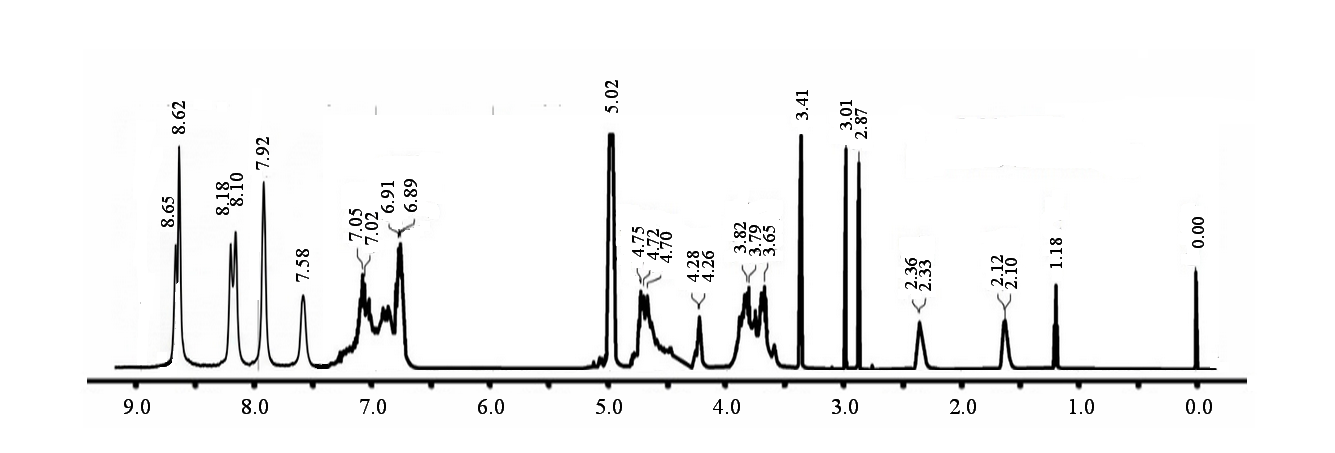
In the above spectrum, the numerous multiplet signals observed in the region of 6.89–8.65 ppm are attributed to the aromatic protons of the naphthalene ring, confirming the preservation of the aromatic fragment within the polymer structure. Owing to the electron-withdrawing nature of the sulfo group, some aromatic protons are shifted downfield and resonate in the range of 8.0–8.7 ppm.
The intense singlet observed at 5.02 ppm is assigned to the protons of the methylene group (Ar–CH2–O–) linking the naphthalene ring through an oxygen atom, indicating the incorporation of the aromatic fragment into the polyester chain. The signals at 4.70–4.75 ppm and around 4.26 ppm are characteristic of the methylene protons (–OCH2–) adjacent to oxygen atoms in the diethylene glycol residue.
The multiplet signals in the range of 3.65–3.82 ppm correspond to the internal –CH2–O–CH2– protons of the diethylene glycol fragment. The presence of these signals confirms the formation of ether linkages within the polyester chain. The signals observed at 2.10–2.36 ppm are attributed to the methylene protons (–COCH2–) adjacent to the carbonyl groups of the adipic acid residue, indicating the incorporation of the adipinate fragment into the polymer structure. The signal at 1.18 ppm corresponds to the central methylene protons of the adipic acid chain.
The simultaneous observation of signals corresponding to aromatic protons, oxygen-bonded methylene groups, and protons associated with the adipinate fragment confirms the presence of naphthalene rings, sulfo groups, and ester and ether linkages in the synthesized product. The obtained results are in good agreement with the proposed structural formula of the polyester resin modified with polymethylenenaphthalenesulfonic acid and polydiethylene glycol. Furthermore, the ^13C NMR spectrum of the same sample was investigated, and the chemical shifts of the corresponding carbon atoms are presented in the following figure (Figure 4).
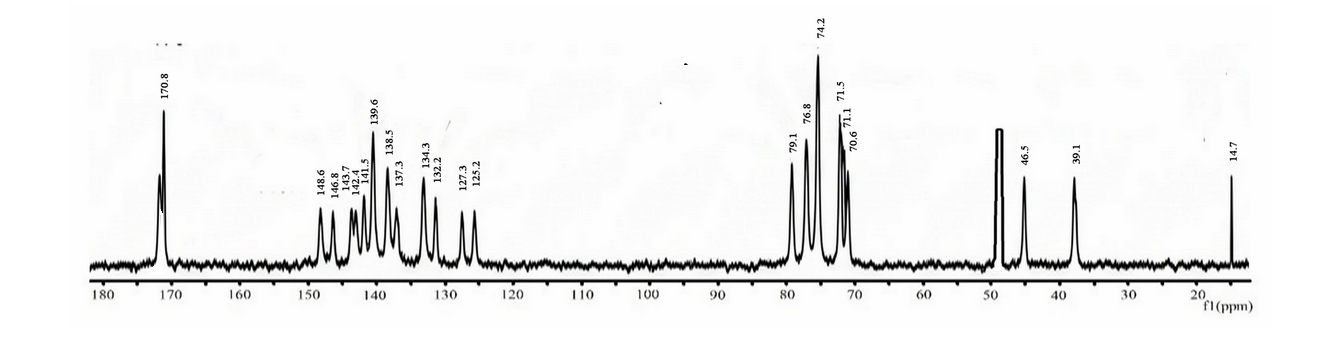
In the presented spectrum, the intense signal observed at 170.8 ppm is attributed to the carbonyl carbon atom of the ester group (–COO–), indicating the formation of the polyester chain. This signal confirms the presence of ester linkages formed through the condensation of adipic acid residues with diethylene glycol fragments.
The numerous resonance signals observed in the range of 149.7–125.2 ppm are assigned to the aromatic carbon atoms of the naphthalene ring. In particular, the downfield signals at approximately 149.7, 148.6, 143.7, and 141.5 ppm correspond to aromatic carbon atoms bonded to sulfo groups and oxygen-containing substituents. The resonances in the range of 139.6–125.2 ppm are attributed to the remaining aromatic carbon atoms of the naphthalene ring. The signals observed at 79.1, 76.8, 74.2, 71.5, and 70.6 ppm are characteristic of the oxygen-bonded methylene carbons (–OCH2–) in the diethylene glycol fragment. These signals indicate the presence of polyester chains in the polymer structure and confirm the successful formation of ether linkages.
The signal observed at 46.5 ppm is assigned to the methylene carbon atom linking the naphthalene ring to the ester fragment (Ar–CH2–O–), confirming the connection between the aromatic and aliphatic segments of the polymer. The signal at 39.1 ppm may be associated with methylene carbons located adjacent to carbonyl groups. The signal observed at 14.7 ppm is attributed to highly mobile aliphatic methylene carbons and provides additional evidence for the presence of the adipinate fragment in the synthesized polymer.
Furthermore, the presence of signals corresponding to ester carbonyl groups, the aromatic naphthalene ring, oxygen-bonded methylene carbons, and aliphatic fragments in the ¹³C NMR spectrum confirms the existence of naphthalene rings, sulfo groups, and ester and ether linkages in the synthesized polymer. The obtained results are in complete agreement with the proposed structural formula of the polyester resin modified with polymethylenenaphthalenesulfonic acid and polydiethylene glycol.
In general, the observation of aromatic proton and carbon signals characteristic of the naphthalene ring in the ranges of 6.89–8.65 ppm in the ¹H NMR spectrum and 125.2–149.7 ppm in the ¹³C NMR spectrum confirms the presence of an aromatic fragment in the polymer structure. The intense signal at 170.8 ppm was assigned to ester carbonyl groups, whereas the signals observed in the ranges of 3.65–5.02 ppm and 70.6–79.1 ppm were attributed to the proton and carbon atoms of the –OCH2– groups in the diethylene glycol fragment. In addition, aliphatic proton and carbon signals characteristic of the adipinate fragment were detected in the regions of 1.18–2.36 ppm and 14.7–39.1 ppm, respectively. These data reliably confirm the presence of a naphthalene ring, sulfo groups, and ester and ether linkages in the synthesized product and demonstrate complete agreement with the proposed structural formula of the obtained polymer.
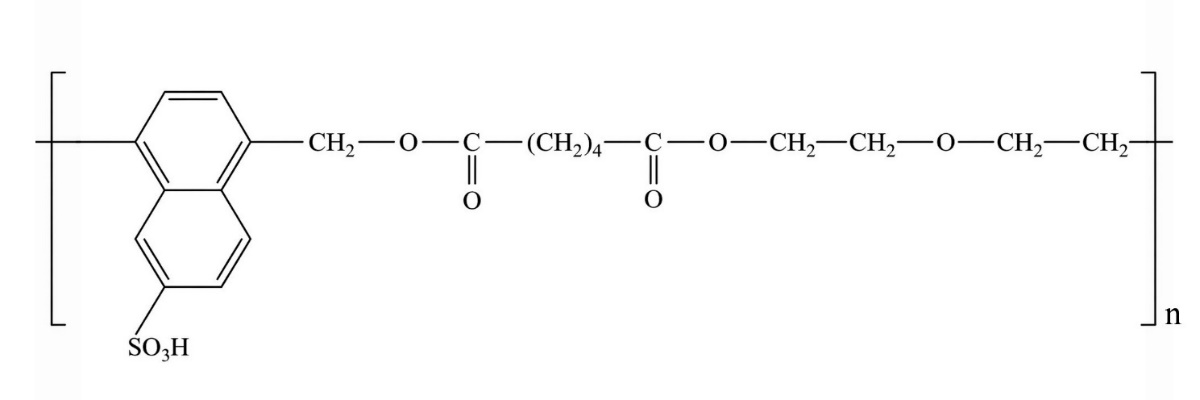
During the study, the proposed structural formula of the modified polyester resin (PMNSP-70/1), synthesized from polymethylenenaphthalenesulfonic acid and polydiethylene glycol adipinate components at a molar ratio of 70:1, was formulated as follows.
Conclusion
In this study, the structural properties of a polyester resin modified with PMNS and PDAT at a molar ratio of 70:1 were investigated using a комплекс of physicochemical methods. The obtained results confirmed the presence of naphthalene rings, sulfo groups, carbonyl, ester, and ether bonds in the polymer structure and demonstrated full agreement with the proposed structural formula of the synthesized product. The findings indicate that PMNS-modified polyester resins are promising compounds for the development of functional polymer materials.
References