
Biochemical composition of raspberry cultivars during summer and autumn harvest seasons in Uzbekistan
УДК + 634.711+ 631.243.5
Abstract
Raspberry (Rubus idaeus L.) fruits are widely consumed due to their high nutritional value, pleasant taste, attractive aroma, and health-promoting properties. In addition, they contain vitamins, organic acids, sugars, and pectin substances that are important for human health. This study investigated the biochemical characteristics of four raspberry cultivars, Progress, Polka, Zyugana, and Heritage, grown under the conditions of the Tashkent region during summer and autumn harvesting periods. The contents of dry matter, total sugars, titratable acidity, vitamins C and A, and pectin substances were determined in the fruits. The results showed that the highest levels of dry matter and sugars in the summer harvest were recorded in the Polka (16.5 %) and Zyugana (14.6 %) cultivars. In the autumn harvest, the vitamin C content increased in all cultivars, reaching the highest value of 35.7 mg% in Zyugana. At the same time, the contents of vitamin A and pectin substances decreased compared with the summer harvest. The obtained results are of significant scientific and practical importance for evaluating raspberry fruit quality, improving long-term storage technologies, enhancing processing efficiency, and improving consumer properties of raspberry products.
Аннотация
Плоды малины (Rubus idaeus L.) широко потребляются населением благодаря высокой пищевой ценности, приятному вкусу, аромату и лечебным свойствам. Кроме того, они содержат важные для здоровья человека витамины, органические кислоты, сахара и пектиновые вещества. В данном исследовании были изучены биохимические показатели сортов малины Прогресс, Полка, Зюгана и Херитейдж, выращиваемых в условиях Ташкентской области, в периоды летнего и осеннего плодоношения. В ходе исследования определяли содержание сухих веществ, общих сахаров, титруемой кислотности, витаминов С и А, а также пектиновых веществ в плодах. Результаты показали, что в летнем урожае наиболее высокие показатели содержания сухих веществ и сахаров были отмечены у сортов Полка (16,5 %) и Зюгана (14,6 %). В осеннем урожае содержание витамина С увеличилось у всех сортов, а максимальное значение было зарегистрировано у сорта Зюгана и составило 35,7 мг%. Одновременно наблюдалось снижение содержания витамина А и пектиновых веществ по сравнению с летним урожаем. Полученные результаты имеют важное научное и практическое значение для оценки качества плодов малины, совершенствования технологий длительного хранения, эффективной переработки и улучшения потребительских свойств продукции.
Keywords: Raspberry; biochemical composition; dry matter; vitamin C; pectin; summer harvest; autumn harvest.
Ключевые слова: Малина; биохимический состав; сухое вещество; витамин С; пектин; летний урожай; осенний урожай.
Introduction
Among small fruit crops, the red raspberry (Rubus idaeus L.) holds a distinct position due to its unique organoleptic profile, exquisite flavor, and rich nutritional value. Beyond its direct consumption as a fresh commodity, raspberry is highly therapeutic and extensively utilized in pharmacological and traditional medicine. In medical practice, both fresh and dehydrated raspberry fruits are widely prescribed as potent diaphoretic and antipyretic agents. Biochemically, raspberry fruits serve as a dense source of vital organic complexes, typically containing 5,0 % to 10,0 % sugars, 0,5 % to 2,5 % organic acids, alongside a comprehensive vitamin profile including vitamins B1, B2, B6, B9, B12, C, D, E, PP, P, and K. The qualitative composition of raspberry berries is greatly affected by genetic traits and environmental conditions during fruit ripening. Modern primocane cultivars yield twice a year-in summer and autumn – introducing variations in physiological parameters and nutritional content. Evaluating pre-storage biochemical components across different harvest cycles is vital for predicting postharvest shelf life and cold storage stability. [1].
Ren et al. (2023) analyzed the metabolite profile of raspberry fruits using UPLC-MS/MS. Their results demonstrated significant differences in the contents of vitamins, organic acids, flavonoids and other bioactive compounds among raspberry samples, depending on genotype and fruit tissue. [6].
The temperature regime during raspberry growth and fruit ripening significantly influences the content and activity of antioxidants, including anthocyanins, ascorbic acid (vitamin C), and total phenolic compounds. In addition, berries grown under conditions of low light intensity and shorter day length have been reported to contain lower levels of sugars and exhibit reduced antioxidant activity. These factors directly affect the biochemical composition of raspberry fruits and, consequently, the quality characteristics of products derived from them. [2].
Miletić et al. (2024) evaluated the chemical composition of healthy raspberry fruits and found that the fruits contained high levels of vitamin C, phenolic compounds and antioxidant activity. The study confirmed that raspberry fruits are an important source of biologically active substances valuable for human nutrition. [7].
Raspberry possesses a higher antioxidant capacity compared to many other fruits and vegetables. Its rich content of ellagitannins, anthocyanins, total phenolic compounds, and ascorbic acid contributes to its high biological activity. These bioactive components play an important role in protecting cells against oxidative stress, and their consumption has been associated with a reduced risk of aging-related disorders, cardiovascular diseases, diabetes, and certain types of cancer. Furthermore, due to its strong antioxidant properties, raspberry is recognized as a functional food with significant dietary and therapeutic value. [3].
Raspberry fruits are rich in vitamins, including ascorbic acid, niacin, and thiamine, as well as various mineral elements, which contribute significantly to their nutritional and functional food value. Previous studies have demonstrated that the concentration and biological activity of bioactive compounds in raspberry fruits are strongly affected by cultivar-specific traits, fruit maturity stage, and postharvest storage conditions.[4].
Ispiryan et al. (2023) investigated the biochemical composition and antioxidant properties of different raspberry plant parts. The authors reported that raspberry fruits are rich in phenolic compounds, flavonoids and antioxidants, confirming their high nutritional and functional value. [5].
Materials and Methods
The study was conducted during 2022–2024 using raspberry (Rubus idaeus L.) plant material grown in the experimental fields of the Scientific Research Institute of Horticulture, Viticulture and Winemaking named after Academician M. Mirzaev, located in the Tashkent region of Uzbekistan. Four raspberry cultivars widely cultivated under local conditions, namely Progress, Polka, Zyugana, and Heritage, were selected as the experimental material.
Fruit samples were collected at the stage of full commercial maturity during two harvesting periods: summer and autumn fruiting seasons. Laboratory analyses were carried out immediately after harvest to evaluate the pre-storage biochemical characteristics of the fruits.The biochemical composition of raspberry fruits was determined using the following standard analytical methods:
Dry matter content was determined according to GOST 33977–2016 using the gravimetric oven-drying method.
Total sugar content was determined in accordance with GOST 8756.13–87.
Titratable acidity was measured according to GOST ISO 750–2013 by titration with 0.1 N sodium hydroxide (NaOH) solution and expressed as malic acid percentage.
Pectin content was determined following GOST 29059–91.
Vitamin C (ascorbic acid) and vitamin A contents were determined according to the methodological guide Analytical Methods for Quality Control of Food Products and Raw Materials. Instrumental Methods of Ecological and Analytical Control (Bykovsky, 2014). All samples were prepared following the recommended analytical procedures. The analyses were performed using a Flexar UHPLC (Ultra High Performance Liquid Chromatography, Perkin Elmer, USA) system, which ensured accurate and reproducible determination of vitamin contents.
Statistical analysis of the experimental data obtained during the three-year study period was performed using analysis of variance. Mean values, standard deviations, and the significance of differences among cultivars and harvesting seasons were calculated to evaluate the reliability of the results.
Results
The three-year comprehensive screening revealed significant seasonal and cultivar-dependent variations in the biochemical metrics of the investigated raspberry fruits.
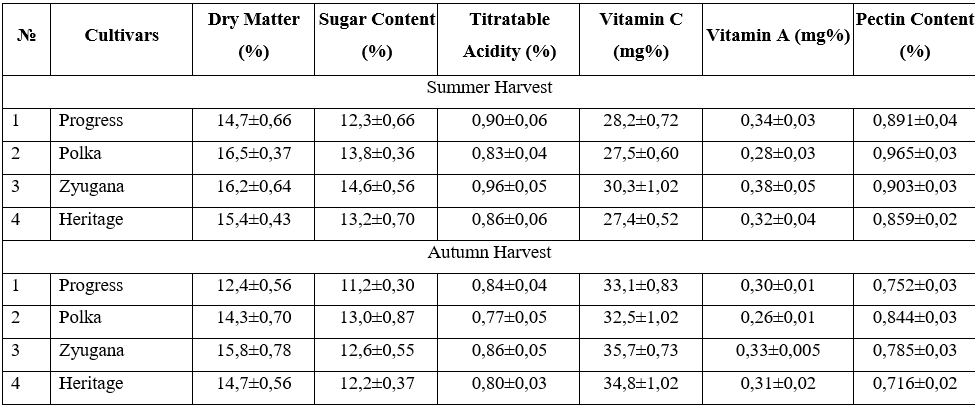
Analysis of the Dry Matter Content during the summer harvest indicated that Polka possessed the highest accumulation at 16,5 %, followed closely by Zyugana at 16,2 %. Conversely, the lowest dry matter value in summer was registered in Progress (14,7 %). During the autumn fruiting phase, a general reduction in dry matter was observed across all cultivars. Zyugana retained the highest autumn dry matter concentration at 15,8 %, whereas Progress dropped to a minimum of 12,4 %.
A similar trend was recorded for Total Sugars. In the summer cycle, Zyugana dominated with 14,6 % sugar content, while Progress displayed the lowest value (12,3 %). The autumn period induced a systematic decrease in sugar concentration across the board; Polka exhibited the highest autumn sugar value at 13,0 %, while Progress recorded the minimum at 11,2 %.
The Titratable Acidity reached its maximum during the summer crop in Zyugana (0,96 %) and its lowest points in Polka (0,83 %) and Heritage (0,86 %). In autumn, titratable acidity values declined markedly across all studied varieties. The highest value in the autumn crop was observed in Zyugana at 0,86 %, while the lowest was observed in Polka at 0,77 %. (Table 1)
Discussion
The most striking physiological pattern identified in this study relates to the inverse dynamics of vitamin accumulation between the seasons. Vitamin C (Ascorbic Acid) analysis revealed that autumn environmental conditions significantly favored the synthesis of vitamin C across all varieties compared to the summer months. In the summer harvest, vitamin C ranged from a maximum of 30,3 mg% (Zyugana) to a minimum of 27,4 mg% (Heritage). However, in the autumn harvest, vitamin C values amplified remarkably, peaking at 35,7 mg% in Zyugana, while the lowest registered value was 32,5 mg% in Polka. This indicates that lower autumn temperatures during fruit ripening stimulate ascorbic acid retention.
In sharp contrast to vitamin C, Vitamin A accumulation exhibited a clear downward trajectory during the autumn harvest phase. In summer, Zyugana yielded the highest vitamin A content at 0,38 mg%, whereas Polka produced the lowest at 0,28 mg%. In autumn, these values dropped across all varieties, with Zyugana decreasing to 0,33 mg% and Polka to 0,26 mg%. Pectin substances followed an identical structural decline in autumn. During the summer fruiting period, Polka displayed the highest pectin concentration at 0,965 %, whereas Heritage showed the lowest at 0,859 %. In the autumn cycle, pectin values uniformly decreased across all genetic lines; Polka maintained the highest relative position at 0,844 %, while Heritage dropped significantly. Higher pectin and dry matter contents in summer crops suggest better structural integrity, which may improve mechanical resistance and postharvest shelf life during cold storage compared to autumn crops.
Table 1.
Biochemical composition of raspberry cultivars based on harvest seasons (2022-2024)
Conclusion
The results of the study demonstrated that the biochemical characteristics of raspberry fruits grown under the conditions of the Tashkent region are significantly influenced by cultivar-specific traits and harvesting season. Considerable differences were observed between the summer and autumn harvests for all investigated cultivars. The summer harvest was characterized by higher contents of dry matter, total sugars, and pectin substances. These parameters contribute positively to fruit taste, storage potential, and transportability. Among the studied cultivars, Polka and Zyugana exhibited the most favorable biochemical characteristics during the summer fruiting period, indicating their suitability for fresh consumption, short-term storage, and commercial distribution.
In contrast, the autumn harvest was distinguished by a significant increase in vitamin C content across all cultivars. The highest concentration of ascorbic acid was recorded in the Zyugana cultivar, reaching 35.7 mg%. However, a decrease in sugar, vitamin A, and pectin contents was observed in comparison with the summer harvest. Based on the obtained results, the cultivars Polka and Zyugana can be recommended as the most promising cultivars for the cultivation of high-quality raspberry fruits under the environmental conditions of the Tashkent region. The findings of this study provide valuable scientific and practical information for improving postharvest storage technologies, selecting suitable processing methods, and increasing the production of raspberry fruits with high nutritional and biological value.
References
