
Human capital development strategies in large textile enterprises of Uzbekistan in the context of the transition to a green economy
УДК 331.105.24
Abstract
The transition to a green economy is reshaping the requirements imposed on human capital in industrial enterprises. This issue is particularly important for Uzbekistan’s textile industry, which combines a large employment base, export orientation, technological modernization and increasing integration into international value chains. The study aims to identify strategic directions for human capital development in large textile enterprises under green transformation. The methodology combines statistical and comparative analysis, systematic interpretation of official policy documents and a review of recent research on green human resource management, green skills and digital transformation. Official data show that more than 6,000 textile enterprises employed about 570 thousand people in 2024, while employment reached 623 thousand and sectoral production amounted to 134 trillion soums in 2025 [10–11]. The article proposes a conceptual human capital development model integrating green skills, digital competencies, technological adaptability, continuous learning and ESG competencies. The analysis shows that technological modernization alone cannot ensure sustainable productivity growth unless employees are able to operate resource-efficient equipment, manage energy and water consumption, apply circular-economy practices and use digital production systems. The proposed strategy links personnel development with resource efficiency, labour productivity, export competitiveness and the green-economy objectives of Uzbekistan.
Аннотация
Переход к зелёной экономике существенно изменяет требования к человеческому капиталу промышленных предприятий. Данная проблема особенно актуальна для текстильной промышленности Узбекистана, которая характеризуется высокой занятостью, экспортной ориентацией, технологической модернизацией и растущей интеграцией в международные цепочки создания стоимости. Цель исследования заключается в определении стратегических направлений развития человеческого капитала на крупных текстильных предприятиях в условиях зелёной трансформации. Методология включает статистический и сравнительный анализ, системную интерпретацию официальных программных документов, а также обзор современных исследований в области зелёного управления человеческими ресурсами, зелёных навыков и цифровой трансформации. Согласно официальным данным, в 2024 году более 6 тыс. текстильных предприятий обеспечивали занятость около 570 тыс. человек, а в 2025 году численность занятых достигла 623 тыс. человек при объёме производства 134 трлн сумов [10–11]. В статье предложена концептуальная модель развития человеческого капитала, объединяющая зелёные навыки, цифровые компетенции, технологическую адаптивность, непрерывное обучение и ESG-компетенции. Показано, что технологическая модернизация не обеспечивает устойчивого роста производительности без соответствующего развития работников, способных эксплуатировать ресурсоэффективное оборудование, управлять энергией и водой, применять принципы циркулярной экономики и использовать цифровые производственные системы. Предлагаемая стратегия связывает развитие персонала с ресурсоэффективностью, производительностью труда, экспортной конкурентоспособностью и целями зелёной экономики Узбекистана.
Keywords: human capital; green economy; textile industry; green skills; labour productivity; digital competencies; technological adaptability; ESG; Uzbekistan.
Ключевые слова: человеческий капитал; зелёная экономика; текстильная промышленность; зелёные навыки; производительность труда; цифровые компетенции; технологическая адаптивность; ESG; Узбекистан.
Introduction
The transition to a green economy is one of the major structural transformations affecting contemporary industrial development. Energy-efficient technologies, renewable energy, circular production, environmental monitoring and sustainable supply-chain requirements are changing not only production processes but also the composition of labour demand. Research on green human resource management shows that environmental objectives become more effective when recruitment, training, performance appraisal, knowledge sharing and employee behaviour are aligned with sustainability goals [1–7].
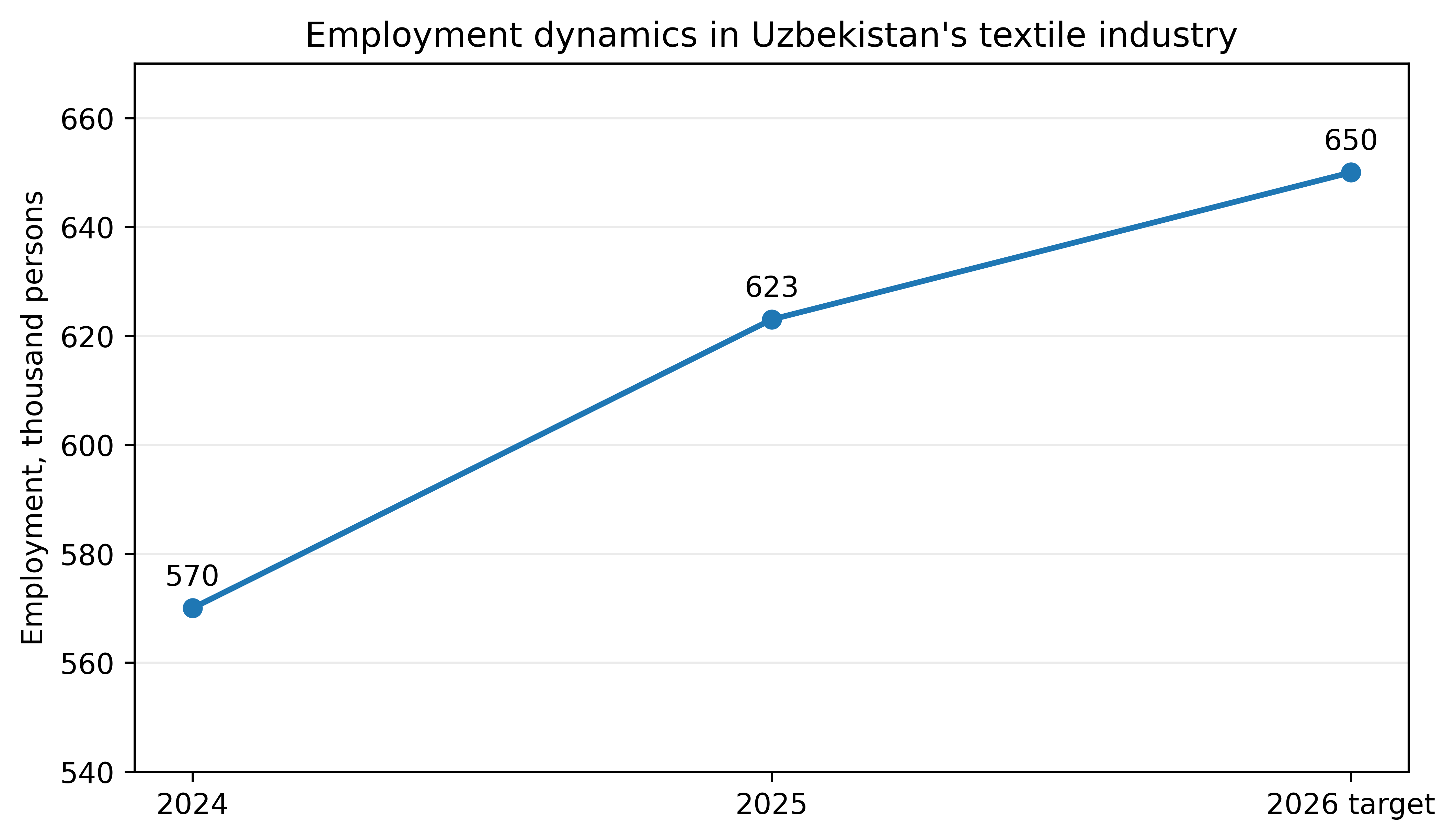
This transformation is particularly relevant for Uzbekistan. In April 2024, official information indicated that more than 6,000 textile enterprises operated in the country and employed about 570 thousand people [10]. By 2025, employment in the sector had reached 623 thousand people and textile production amounted to 134 trillion soums; the official outlook also identified the potential to increase employment to about 650 thousand in 2026 [11]. These dynamics make the textile industry not only an important production and export sector but also a major field for human-capital policy.
The sector is simultaneously becoming more integrated into global value chains. In 2024, textile exports during January–October amounted to USD 2.4334 billion; yarn accounted for 43.5 % and finished textile products for 39.1 % of textile exports [12]. Cooperation with international brands increases requirements for product quality, traceability, environmental performance, production discipline and staff competence. Official information on internationally integrated enterprises identifies Uztex Group, Navbahor Textile Cluster and Global Textile among the large producers cooperating with foreign brands [13].
Uzbekistan’s green-economy agenda adds a further dimension to these changes. National policy targets include higher industrial energy efficiency, greater use of renewable energy and lower greenhouse-gas intensity [13]. Textile production is directly affected because spinning, weaving, knitting, dyeing, finishing and garment manufacturing depend on electricity, thermal energy, water, chemicals and raw materials. Consequently, technological modernization must be accompanied by systematic development of green, digital and managerial competencies (Figure 1) [10–11].
The purpose of this study is to determine strategic directions for human capital development in large textile enterprises of Uzbekistan in the context of the transition to a green economy. The study focuses on the relationship between green skills, digital competencies, technological adaptability, continuous learning and ESG-oriented management, and on their potential contribution to productivity, resource efficiency and international competitiveness.
Materials and methods
The research is based on secondary statistical and analytical information from official sources of Uzbekistan and on peer-reviewed literature concerning green human resource management and green skills. The principal official sources are the National Statistics Committee, the Government and the President of the Republic of Uzbekistan. International and academic sources were used to substantiate the competency framework and the relationship between green HR practices, employee behaviour and sustainable performance [1–9].
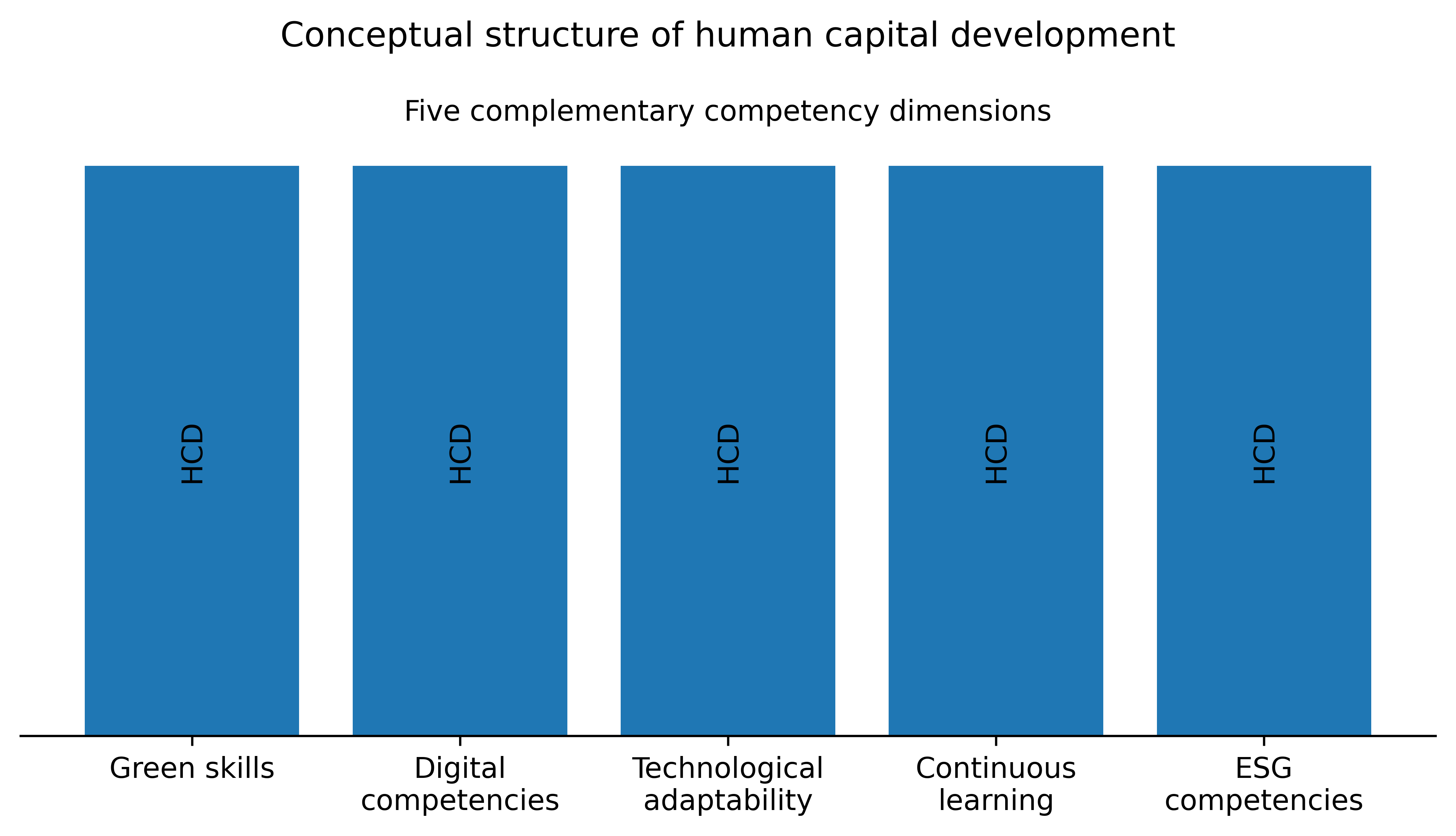
The methodology combines statistical analysis, comparative analysis, content analysis of policy documents and conceptual modelling. At the macro level, employment, production and export indicators were examined. At the enterprise level, publicly available information on selected large textile producers integrated into international value chains was considered. Human capital was analysed through five dimensions: green skills (GS), digital competencies (DC), technological adaptability (TA), continuous learning (CL) and environmental, social and governance competencies (ESG).
The conceptual relationship is expressed as follows:
HCD = β0 + β1GS + β2DC + β3TA + β4CL + β5ESG + ε
where HCD is human capital development; GS is green skills; DC is digital competencies; TA is technological adaptability; CL is continuous learning; ESG represents environmental, social and governance competencies; β0 is the intercept; β1–β5 are coefficients reflecting the contribution of the respective factors; and ε is the random error term.
The equation is used as a conceptual specification rather than an estimated econometric model because comparable enterprise-level datasets on employee qualifications, training expenditure, green competencies and labour productivity are not publicly available for all selected enterprises. Therefore, the paper does not report estimated β-coefficients and does not infer causal effects (Figure 2) [1–9].
Results and discussion
The analysis confirms the growing employment and production significance of Uzbekistan’s textile industry. The increase in sectoral employment from approximately 570 thousand people in 2024 to 623 thousand in 2025 corresponds to growth of about 9.3 %. This expansion strengthens the need for systematic personnel development because a larger workforce must simultaneously adapt to technological modernization, resource-efficiency requirements and international market standards [10–11].
Export data also demonstrate the importance of moving toward higher-value production. During January–October 2024, textile exports amounted to USD 2.4334 billion. Yarn represented 43.5 % of textile exports, while finished textile products accounted for 39.1 % [12]. Increasing the share and competitiveness of higher-value finished products requires employees with competencies in design, quality management, automated production, logistics, marketing, international standards and sustainable manufacturing.
Green transformation changes the structure of labour demand in several ways. First, operators and technical personnel need energy-efficiency competencies because equipment settings, maintenance and production discipline influence electricity and thermal-energy consumption. Second, dyeing and finishing personnel require water-management skills related to water saving, wastewater treatment and reuse. Third, circular-economy competencies are needed to reduce cutting losses, segregate production residues and increase recycling. Fourth, sensors, automated lines, digital quality control and data analytics increase the importance of digital competencies. Fifth, managers require ESG knowledge because international buyers increasingly assess environmental and social performance [1–7].
The selected enterprise examples illustrate why these competencies matter. According to official information, Uztex Group in Khorezm has annual production capacity of approximately 160 thousand tons and works with international brands; Navbahor Textile Cluster in Navoi region has capacity of about 135 thousand tons and cooperates with GEMO; Global Textile in Fergana region produces about 62 thousand tons of knitwear and supplies Kiabi [13]. Integration into such value chains creates a direct relationship between technological capability, quality assurance, environmental compliance and human capital.
Table 1.
Priority green competencies for textile enterprises. Source: compiled by the author based on
| Competency | Main content | Expected economic effect |
|---|---|---|
| Energy efficiency | Efficient equipment operation, energy monitoring | Lower unit energy costs |
| Water management | Water saving, reuse, wastewater control | Lower water consumption |
| Waste management | Sorting, recycling, reuse and circularity | Lower material losses |
| Digital skills | Automation, sensors, digital quality control, data analysis | Higher labour productivity |
| ESG competence | Environmental and social standards, reporting | Improved market access |
| Continuous learning | Reskilling and upskilling for new technologies | Higher adaptability |
The findings are consistent with recent studies showing that green HRM practices can support environmental sustainability through green innovation, green knowledge sharing, employee commitment and environmentally responsible behaviour [1, 2, 4, 6, 7]. For textile enterprises, this means that green transformation should not be delegated only to technical or environmental departments. Recruitment criteria, training plans, performance indicators, internal communication and incentive systems should incorporate measurable green objectives.
A practical human capital development strategy for large textile enterprises should therefore contain five interrelated blocks. The first is green-skills development through targeted training in energy, water, waste and environmental standards. The second is digital upskilling for automated and data-driven production. The third is technological adaptability through multiskilling, rotation and equipment-specific certification. The fourth is continuous learning through partnerships with universities, vocational institutions and equipment suppliers. The fifth is ESG-oriented management, including environmental responsibility, occupational standards, traceability and sustainability reporting.
The proposed framework also has an important economic interpretation. Investment in human capital can reduce the gap between installed production capacity and effectively utilized capacity. When employees understand resource-efficient operating modes, quality requirements and digital monitoring systems, enterprises can reduce downtime, defects, energy losses and material waste. Thus, green human capital becomes a mechanism linking environmental modernization with production-potential management and export competitiveness.
Conclusion
The transition to a green economy creates both challenges and opportunities for Uzbekistan’s textile industry. The sector’s large employment base, increasing production scale and integration into international value chains make human capital a critical factor of future competitiveness. Official data showing growth in employment and production confirm that personnel development must accompany the expansion of physical production capacity [10–11].
The study demonstrates that technological modernization without corresponding investment in human capital may limit the effectiveness of green transformation. Large textile enterprises require employees who combine traditional technical skills with green, digital, adaptive and ESG competencies. These competencies are especially important for energy efficiency, water management, circular use of materials, automated production and compliance with international buyer requirements.
A five-component human capital development framework is proposed: green skills, digital competencies, technological adaptability, continuous learning and ESG-oriented management. The framework can be incorporated into enterprise HR strategies through competency matrices, targeted training, internal certification, performance indicators and cooperation with educational institutions.
At the enterprise level, the proposed approach can contribute to lower resource intensity, higher labour productivity, better quality and stronger access to international markets. At the national level, development of green human capital can support Uzbekistan’s green-economy objectives while improving employment quality and the competitiveness of textile exports. Further research should validate the conceptual model using primary enterprise data and estimate the quantitative relationship between green competencies, training expenditure, labour productivity and resource-efficiency indicators.
References
