Research of physical and chemical properties of waste cooking oils
УДК 665.1.09
Abstract
This study investigated the physicochemical properties of waste cooking oils generated during food preparation in restaurants and street food outlets in Tashkent, Uzbekistan. To comprehensively assess the quality of the investigated oils, acid value, peroxide value, color, moisture content, viscosity, density, and fatty acid composition were determined. The results showed that in waste cooking oil samples collected from restaurants, the acid value ranged from 2,68 to 3,22 mg KOH/g, the peroxide value ranged from 10,8 to 12,7 mmol O2/kg, and the moisture content varied from 0,85 % to 0,91 %. Higher values of these parameters were observed in oil samples collected from street food outlets, indicating differences in the degree of oil quality deterioration depending on the conditions of use. It was also established that the viscosity and density of the investigated oils decreased with increasing temperature. Analysis of the fatty acid composition revealed that oleic, linoleic, palmitic, and stearic acids were the predominant fatty acids. The findings have scientific and practical significance for assessing the quality of waste cooking oils, selecting appropriate processing methods, and identifying promising ways of their effective utilization for technical purposes. The results may serve as a basis for developing technological solutions aimed at the rational use of secondary oil and fat resources and reducing the negative environmental impact of waste.
Аннотация
В настоящем исследовании изучены физико-химические свойства отработанных растительных масел, образующихся в процессе приготовления пищи в ресторанах и точках уличного питания города Ташкента. Для комплексной оценки качества исследуемых масел определяли кислотное и перекисное числа, цвет, содержание влаги, вязкость, плотность, а также жирнокислотный состав. Установлено, что в образцах отработанных растительных масел, отобранных в ресторанах, кислотное число находилось в диапазоне от 2,68 до 3,22 мг КОН/г, перекисное число составляло от 10,8 до 12,7 ммоль O2/кг, а содержание влаги варьировало от 0,85 до 0,91 %. В образцах масел, полученных в точках уличного питания, наблюдались более высокие значения указанных показателей, что свидетельствует о различиях в степени изменения качества масел в зависимости от условий их использования. Также установлено, что с повышением температуры вязкость и плотность исследуемых масел снижались. Анализ жирнокислотного состава показал, что основную долю составляли олеиновая, линолевая, пальмитиновая и стеариновая кислоты. Полученные результаты имеют научно-практическое значение для оценки качества отработанных растительных масел, обоснованного выбора способов их дальнейшей переработки и определения перспективных направлений их эффективного использования в технических целях. Результаты исследования могут служить основой для разработки технологических решений, направленных на рациональное использование вторичных масложировых ресурсов и снижение негативного воздействия отходов на окружающую среду.
Keywords: waste cooking oil; acid value; peroxide value; color; viscosity; density; fatty acid composition.
Ключевые слова: отработанное масло; кислотное число; перекисное число; цвет; вязкость; плотность; жирнокислотный состав.
Introduction
Vegetable oils are widely used in households, restaurants, and the food industry for frying and thermal processing. During frying, the oil acts as a heat transfer medium and imparts a distinctive taste, aroma, and texture to the finished product. However, repeated heating at high temperatures leads to changes in the composition and quality of the oils, limiting their suitability for further use in cooking [1, pp. 2–7; 2, pp. 5744–5765].
The primary chemical processes occurring during frying include oxidation, hydrolysis, and lipid polymerization[3, pp. 4665–4696; 4, pp. 145–157; 5, pp. 2-6]. These reactions can lead to the accumulation of free fatty acids, primary and secondary oxidation products, cyclic compounds, dimers, and polymers. Consequently, the oil may become darker, more viscous, and chemically less stable. The rate and extent of these changes depend on the frying temperature, the duration and frequency of use, the fatty acid composition, exposure to oxygen, and the characteristics of the product being fried [1, pp. 3–9; 2, pp. 5744–5765]. Studies have shown that prolonged heating can lead to an increase in the total content of polar compounds and changes in the fatty acid composition of the oils [6, pp. 1–5].
Therefore, the physicochemical characterization of used vegetable oils is important for assessing their condition and determining appropriate options for their subsequent disposal. Parameters such as acid value, peroxide value, moisture content, insoluble impurities, viscosity, color, and fatty acid composition provide information regarding the degree of oil degradation and its technological properties. Specifically, the acid value reflects the content of free fatty acids, while the peroxide value is used to assess the level of primary oxidation products. Since peroxide compounds can decompose during advanced stages of oxidation, this parameter should be interpreted in conjunction with other quality indicators [1, pp. 3–9; 7, pp. 5–8]. Depending on their composition, level of contamination, and the requirements of specific technological processes, waste vegetable oils can serve as secondary raw materials for the production of biodiesel, soap, and other non-food products[8, pp. 1-15]. Effective disposal requires the selection of appropriate processing methods and a preliminary assessment of their properties to determine potential applications[9, pp. 96-102; 10, pp. 55-76]. Therefore, this study investigates the physicochemical properties of waste cooking oils to characterize their quality and evaluate their suitability for further technological processing.
Materials and methods
Raw materials. The raw materials utilized in this study consisted of waste cooking oil (WCO) collected from various restaurants and street food vendors in Tashkent city. These oils had been primarily used for deep-frying processes, with an unspecified number of frying cycles. The samples were discarded as waste by the establishments only after undergoing significant sensory degradation, specifically exhibiting undesirable alterations in color and odor.
Determination of moisture and volatile matter content. The mass fraction of moisture and volatile matter is determined using a gravimetric method. A sample of known mass is dried in a drying oven (UN30, Germany) until a constant mass is achieved. The initial weighing is performed after two hours, with subsequent weighings carried out every hour. The drying process is considered complete when the difference between the results of two consecutive weighings does not exceed 0.002 g. The mass fraction of moisture and volatile components is calculated based on the difference between the sample's mass before and after drying.
Determination of the density of oils. The density of the oil samples was determined using a hydrometer. Each oil sample was transferred into a clean, dry measuring cylinder and brought to the specified temperature. The hydrometer was carefully immersed in the sample, ensuring that it did not touch the walls of the cylinder. Once the hydrometer had stabilized, the scale reading was recorded. Since oil density varies with temperature, the sample temperature was also recorded at the time of measurement. The density of each oil sample was then determined based on the recorded reading.
Determination of the viscosity of oils. The viscosity of the oil samples was measured using a HAAKE VT 1 plus viscometer. Each sample was placed in a clean measuring container and brought to the specified temperature. The viscometer was prepared for operation in accordance with the manufacturer's instructions, and spindle No. 3 was selected and immersed in the sample. After the instrument was started, the reading was allowed to stabilize before the viscosity value was recorded. Throughout the measurement, the sample temperature and instrument operating conditions were kept constant. The results were used to characterize the viscosity of the oil samples.
Determination of the acid value of the oil. The acid value is used to assess the degree of hydrolytic degradation of the oil. The method is based on titrating the free fatty acids in the oil with an alcoholic KOH solution in the presence of phenolphthalein. The result is converted to the amount of KOH in milligrams (mg) and expressed per gram of oil. The mass fraction of free fatty acids is calculated based on the acid value.
Determination of the peroxide value. The peroxide value is determined to assess the degree of oil oxidation. The analysis is based on titrating the iodine – liberated through the reaction of hydroperoxides in the oil with potassium iodide – using a sodium thiosulfate solution. An increase in the peroxide value indicates an intensification of the primary oxidation process in the oil. This state reflects the occurrence of oxidation, hydrolysis, and polymerization processes within the oil during frying.
Determination of anisidine number. The anisidine number is determined to estimate the amount of secondary oxidation products, mainly aldehydes, in oil. The method according to GOST 31756–2012 is based on measuring the optical density of an oil sample solution after the reaction with a solution of para-anisidine in acetic acid at a wavelength of 350 nm. An increase in the anisidine number indicates the accumulation of secondary oxidation products in the oil. This allows you to assess the degree of deterioration of the oil as a result of oxidation during frying.
Determination of fatty acid composition. The qualitative and quantitative fatty acid composition of the used oil and finished products is determined using gas chromatography(Shimadzu Nexis GC-2030 with SP-2560 capillary column (100 m × 0.25 mm × 0.2 µm)). Prior to analysis, the triacylglycerols in the oil are converted into fatty acid methyl esters. The resulting methyl esters are separated via gas chromatography, and they are identified by comparing their retention times with those of standard samples. Quantitative composition is calculated using an internal or external standard.
Changes in the fatty acid composition of used oils resulting from heating – including the formation of trans-fatty acids – were investigated.
Determination of the color of oils. The color of oils was determined using a Lovibond instrument in accordance with the method specified in GOST 5477. The sample is poured into a cuvette of appropriate path length, which is then placed into the instrument's cell compartment; the lid is closed, and the color of the sample is immediately determined using a set of standard colored glass filters. To obtain an initial estimate, glass filters with a yellow-to-red ratio of 10.0:1.0 are selected. This ratio is then adjusted – minimizing the use of blue or neutral filters – until an exact color match is achieved (note that blue and neutral filters must not be used simultaneously; the values should not exceed 9.0 for blue or 3.0 for neutral filters). The test must be performed twice. The final result is the arithmetic mean of the values obtained from both tests. If the values from the two tests differ significantly, a third test is conducted, and the two closest values among the three are used for the calculation. The result is expressed as the number of red, yellow, and blue (or neutral) units, along with an indication of the optical path length of the cuvette used.
Number of Replicates and Statistical Analysis. The analyzed parameters of each waste cooking oil sample was determined in triplicate (n = 3). The results were expressed as the arithmetic mean ± standard deviation (mean ± SD). Statistical processing was performed using the results of three replicate measurements for each sample.
Results and discussion
Oils used in restaurants and street food in Tashkent were analyzed. The results of the analysis are presented in Table 1.
Table 1.
Physical and chemical properties of waste cooking oils
| Sample | Acid value, mg KOH/g | Peroxide value, mmol O2/kg | Color, red units | Moisture and volatile matter content, % | Anisidine value |
|---|---|---|---|---|---|
| restaurant 1 | 3,22 | 10,8 | 16,3 | 0,85 | 25,3 |
| restaurant 2 | 2,68 | 12,7 | 18,5 | 0,91 | 24,5 |
| street food 1 | 3,52 | 11,2 | 21,1 | 1,21 | 28,6 |
| street food 2 | 4,17 | 16,4 | 23,7 | 1,32 | 24,6 |
According to the data in Table 1, the acid value of restaurant waste oils was 2.68 – 3.22 mg KOH/g, peroxide value 10.8 – 12.7 mmol O2/kg, color 16.3 – 18.5 red units, anisidine value 24.5 – 28.6 and moisture content 0.85 – 0.91 %. The acid value of street food waste oils was 3.52 – 4.17 mg KOH/g, peroxide value 11.2 – 16.4 mmol O2/kg, color 21.1 – 23.7 red units, and moisture content 1.21 – 1.32 %.
Viscosity and density are important physical properties of fats and oils. Repeated use of oils at high temperatures can lead to an increase in viscosity due to chemical changes in the fatty acids. An increase in viscosity can also result from the dissolution of various substances in the oil during the cooking process. Therefore, in subsequent experiments, the density and viscosity of the oil samples were analyzed at various temperatures; the results obtained are presented in Figures 1 and 2.
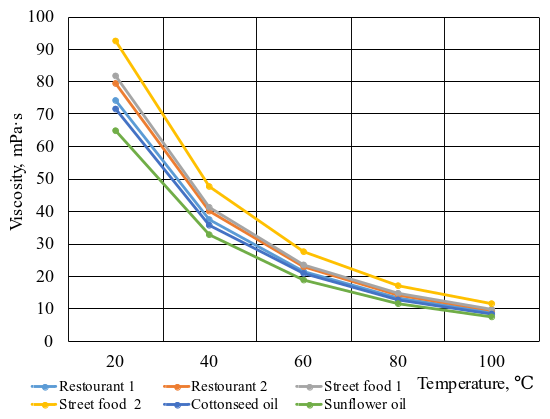
The data in Figure 1 indicate that the density of the waste cooking oils was higher than that of fresh sunflower and cottonseed oils. Among the waste cooking oils, the highest viscosity was observed in the «Street Food 2» sample, while the lowest was found in the «Restaurant 1» sample. The viscosity of all oil samples decreased as the temperature rose. For instance, the viscosity of the «Street Food 2» sample was 92.5 mPa·s at 20°C but decreased to 11.7 mPa·s at 100°C. At 20°C, the viscosity of the used vegetable oils ranged from 74 to 93 mPa·s; this is significantly higher than the viscosity of fresh cottonseed and sunflower oils. This phenomenon is attributed to the presence of polymerized triglycerides and oxidation products in the waste cooking oils.
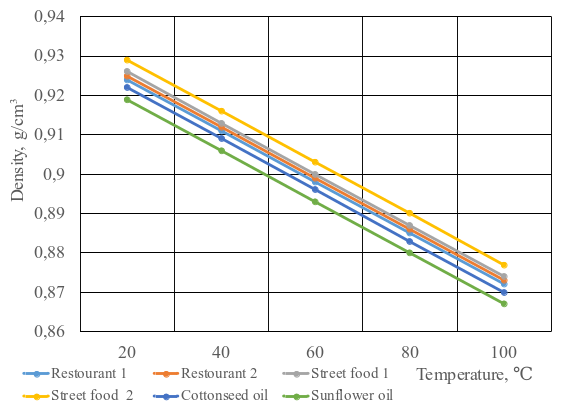
The data in Figure 2 indicate that the density of the waste cooking oils (much like their viscosity indices) was higher than that of the fresh oils. Oil density decreased as the temperature rose. Across all temperature readings, the highest density values were recorded for the «Street Food 2» sample; its density was 0.929 g/cm³ at 20°C and decreased to 0.877 g/cm³ at 100°C. Conversely, the lowest density values were observed in the fresh sunflower oil; its density was 0.919 g/cm³ at 20°C and 0.867 g/cm³ at 100°C.
The application of fats and oils depends on their fatty acid composition. Oils used for frying are rich in saturated fatty acids, whereas those used in liquid products or for purposes other than frying are rich in unsaturated fatty acids. This is directly related to the oxidative stability of the fatty acids; unsaturated fatty acids oxidize more rapidly during high-temperature processing. This process leads to the formation of oxidation products and an increase in peroxide and anisidine values. Therefore, the fatty acid composition of the oils used in subsequent experiments was analyzed. The results are presented in Table 2.
Table 2.
Fatty acid composition of waste cooking oils
| Fatty acids | Chemical symbol | Content, % | |||
|---|---|---|---|---|---|
| restaurant 1 | restaurant 2 | street food 1 | street food 2 | ||
| Lauric acid | (C12:0) | 0 | 0 | 0 | 0,2 ± 0,01 |
| Myristic acid | (C14:0) | 0,129 ± 0,003 | 1,603 ± 0,006 | 0 | 1,073 ± 0,055 |
| Palmitic acid | (C16:0) | 8,8 ± 0,01 | 15,317 ± 0,006 | 9,019 ± 0,001 | 23,393 ± 0,012 |
| Palmitic acid | (C16:1) | 0 | 8,35 ± 0,01 | 0 | 0,8 ± 0,01 |
| Stearic acid | (C18:0) | 4,205 ± 0,013 | 3,085 ± 0,004 | 5,013 ± 0,006 | 3,497 ± 0,015 |
| Oleic acid | (C18:1) | 43,157 ± 0,006 | 28,910 ± 0,010 | 20,727 ± 0,006 | 20,801 ± 0,011 |
| Elaidic acid | (C18:1) trans | 2,103 ± 0,006 | 1,717 ± 0,029 | 2,397 ± 0,015 | 4,502 ± 0,008 |
| Linoleic acid | (C18:2) | 39,74 ± 0,01 | 24,813 ± 0,006 | 57,377 ± 0,006 | 50,398 ± 0,008 |
| Linolenic acid | (C18:3) | 0,2 ± 0,01 | 1,32 ± 0,01 | 0 | 0,01 ± 0,01 |
| Arachidic acid | (C20:0) | 0,43 ± 0,001 | 3,98 ± 0,027 | 0 | 0,2 ± 0,011 |
| Gadolinic acid | (C20:1) | 0 | 1,82 ± 0,002 | 0 | 0,1 ± 0,01 |
| Benzene acid | (C22:0) | 0,748 ± 0,008 | 1,203 ± 0,006 | 0 | 0 |
| Erucic acid | (C22:1) | 0,3 ± 0,005 | 0 | 0 | 0 |
| Lingoseric acid | (C24:0) | 0,3 ± 0,01 | 0 | 0 | 0 |
Table 2 shows the various fatty acids identified in the waste cooking oils. Lauric and gadoleic acids were not detected. Oleic, linoleic, palmitic, and stearic acids were found in the highest concentrations. The presence of small amounts of erucic acid indicates the inclusion of rapeseed oil; high levels of palmitic and linoleic acids point to the presence of cottonseed oil; and high levels of oleic acid indicate the presence of sunflower oil (this assumption is justified because the main vegetable oils used in Uzbekistan are cottonseed, sunflower, and rapeseed oils). Since the trans-fatty acid content in the street food waste exceeded the established 2 % limit [11, pp. 27], consumption is not recommended even after purification; therefore, it is advisable to use these oils for technical purposes.
During cooking, vegetable oils undergo complex physicochemical changes under the influence of high temperatures (160–190°C), oxygen in the air, and moisture in the product. In this case, part of the triglycerides is hydrolyzed to form free fatty acids, oxidized triglycerides as a result of oxidation, and high molecular weight compounds are formed during polymerization. As a result, the amount of total polar compounds in the oil increases. In international practice, the TPC indicator is one of the most important criteria for assessing the quality of the oil used. The chemical composition of the edible oils used in the research was determined and analyzed. The results obtained are presented in Table 3.
Table 3.
Amount of total polar compounds in waste cooking oils
| Indicator name | Content, % | |||
|---|---|---|---|---|
| restaurant 1 | restaurant 2 | street food 1 | street food 2 | |
| Total polar compounds,% Including: |
25,198 ± 0,003 | 25,80 ± 0,01 | 26,533 ± 0,058 | 31,502 ± 0,008 |
| Triacylglycerol dimers | 8,798 ± 0,003 | 8,916 ± 0,0563 | 8,790 ± 0,036 | 12,397 ± 0,006 |
| Oxidized compounds | 8,599 ± 0,002 | 8,803 ± 0,006 | 8,998 ± 0,003 | 9,199 ± 0,002 |
| Diacylglycerols | 5,586 ± 0,024 | 5,797 ± 0,015 | 6,063 ± 0,055 | 6,703 ± 0,006 |
| Monoacylglycerols | 0,503 ± 0,006 | 0,80 ± 0,01 | 0,802 ± 0,003 | 1,017 ± 0,029 |
| Free fatty acids | 1,700 ± 0,005 | 1,503 ± 0,006 | 1,803 ± 0,006 | 2,198 ± 0,004 |
The data in Table 3 show that the total polar compounds content in the studied waste cooking oil samples varied in the range of 25,2–31,5 %. The lowest value was recorded in the Restaurant 1 sample (25,2 %), which indicates that this oil has undergone relatively few chemical changes. The highest value was observed in the Street Food 2 sample (31,5 %). This value is higher than the internationally accepted norm of 24–27 % for the content of total polar compounds, indicating that this oil has been heated many times and its use for food purposes should be limited. Values in this range were also observed in the Restaurant 2 (25,8 %) and Street Food 2 (26,5 %) samples.
Conclusion
Research results indicated that the physical and chemical properties of waste cooking oils in food service establishments in Tashkent differed from those of the original oils. Samples obtained from street food vendors showed higher acid values, peroxide values, moisture content, and color intensity. Increased heating temperatures resulted in reduced oil viscosity and density. Variations in fatty acid composition revealed that the oils originated from diverse sources. A comprehensive assessment of quality parameters is essential before any subsequent use of waste cooking oils. Reusing them for food purposes requires specific testing to ensure compliance with safety standards, whereas technical processing represents a promising avenue for utilization.
References