Многоисточниковая энергетическая система как перспективное направление развития гибридных автомобилей
УДК 629.3.014.1+621.3
Abstract
Improving the energy efficiency of hybrid vehicles requires a comprehensive approach to the use of available onboard energy flows. This study analyzes parallel, series, plug-in hybrid, and range-extender architectures and proposes a multi-source energy system based on a series-hybrid configuration. In the proposed system, the internal combustion engine operates mainly as a generator drive in a stable and efficient mode, while the traction battery functions as a central energy buffer and storage unit. Regenerative braking, exhaust-gas energy recovery, cooling-system heat recovery, thermoelectric generation, and solar energy are considered additional energy sources. The analysis indicates that 30–35 % of fuel energy may be lost with exhaust gases and 25–30 % through the cooling system. Regenerative braking can recover approximately 10–25 % of energy in urban operation, while turbocompounding and thermoelectric conversion provide additional efficiency potential. The proposed concept enables coordinated management of primary and secondary energy flows and represents a promising direction for improving overall fuel utilization in hybrid vehicles under real operating conditions. The aim of this study is to analyze the energy recovery potential of hybrid vehicle powertrain architectures and to develop a conceptual multi-source energy system based on a series-hybrid configuration that integrates primary and secondary energy flows to improve overall energy utilization.
Аннотация
Повышение энергоэффективности гибридных автомобилей требует комплексного использования всех доступных энергетических потоков транспортного средства. В статье проанализированы параллельная, последовательная, подключаемая гибридная схемы и архитектура Range Extender, а также предложена многоисточниковая энергетическая система на базе последовательной гибридной компоновки. В предлагаемой системе двигатель внутреннего сгорания преимущественно работает как привод генератора в устойчивом и эффективном режиме, а тяговая аккумуляторная батарея выполняет функции центрального накопителя и энергетического буфера. В качестве дополнительных источников рассматриваются рекуперативное торможение, использование энергии отработавших газов, тепла системы охлаждения, термоэлектрическая генерация и солнечная энергия. Анализ показывает, что 30–35 % энергии топлива может теряться с отработавшими газами и 25–30 % через систему охлаждения. Рекуперативное торможение позволяет возвращать примерно 10–25 % энергии в городском цикле, а турбокомпаундная система и термоэлектрическое преобразование создают дополнительный потенциал повышения эффективности. Предлагаемая концепция обеспечивает согласованное управление первичными и вторичными энергетическими потоками и является перспективным направлением повышения эффективности использования топлива в гибридных автомобилях. Такой подход позволяет снизить долю безвозвратных энергетических потерь, стабилизировать режим работы двигателя и повысить эффективность энергетического баланса автомобиля в эксплуатации. Целью исследования является анализ потенциала рекуперации энергии в силовых установках гибридных автомобилей и разработка концептуальной многоисточниковой энергетической системы на основе последовательной гибридной схемы, обеспечивающей объединение первичных и вторичных энергетических потоков для повышения эффективности использования энергии.
Keywords: hybrid vehicles; energy efficiency; series hybrid; regenerative braking; waste heat; battery.
Ключевые слова: гибридные автомобили; энергоэффективность; последовательный гибрид; рекуперативное торможение; тепловые потери; аккумулятор.
Introduction
The development of road transport is accompanied by increasingly strict requirements for fuel economy and rational use of energy resources. Even when the internal combustion engine is improved, a considerable part of fuel energy is not converted into useful mechanical work. According to the sources reviewed in the initial material, approximately 30–35 % of the fuel energy leaves the engine with exhaust gases and another 25–30 % is removed through the cooling system [1-3]. These losses form a substantial reserve that can potentially be used in an electrified powertrain. At the same time, modern hybrid vehicles increasingly rely on traction batteries and external charging. In plug-in hybrids and range-extender vehicles, long periods of electric-only operation can reduce the operating time of the engine-generator unit, even though its mass remains part of the vehicle. From the standpoint of onboard fuel-energy utilization, this makes it important to consider a hybrid power plant as a single energy system rather than as a simple combination of an engine and a battery [4-8]. In such a system, the internal combustion engine should operate as close as possible to its efficient operating range, the battery should accumulate and redistribute energy, and secondary energy flows should be returned to the electrical system whenever technically possible [9-10].
The objective of this study is to evaluate the potential for utilizing primary and secondary energy flows in hybrid vehicles and to propose a multi-source energy system based on a series-hybrid architecture. To achieve this objective, the main hybrid powertrain configurations are compared, the principal energy-loss and recovery pathways are analyzed, and a conceptual architecture for integrating regenerative braking, exhaust-gas energy recovery, engine waste-heat recovery, and supplementary renewable energy sources into a common electrical system is developed.
Materials and methods
The study compares four hybrid powertrain architectures: parallel, series, plug-in hybrid, and range extender. The series-hybrid configuration was selected as the basis of the proposed multi-source system because the internal combustion engine operates independently of wheel speed and drives only the generator. The analysis considered the main vehicle energy-loss and recovery channels.
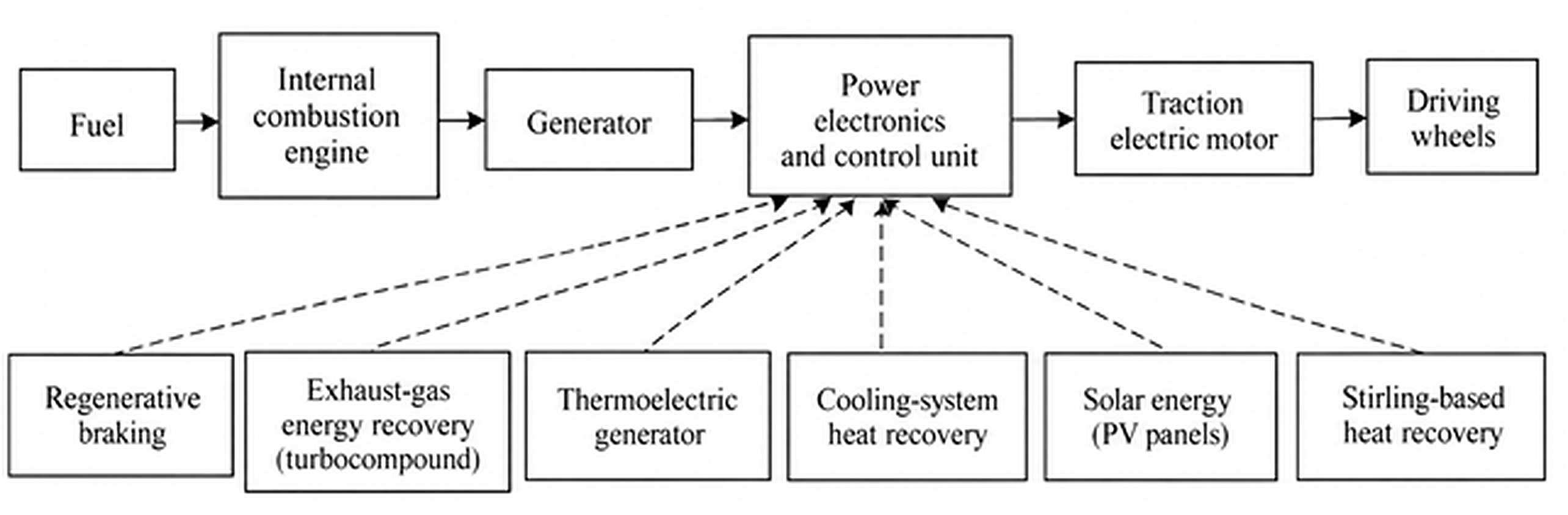
According to the reviewed sources, approximately 30–35 % of fuel energy is lost through exhaust gases and 25–30 % through the cooling system. Regenerative braking can recover about 10–25 % of energy during urban operation, while turbocompounding can improve fuel efficiency by approximately 5 %. Thermoelectric generators convert waste heat into electricity with an efficiency of about 5–8 %. Based on these quantitative indicators, the proposed architecture integrates regenerative braking, exhaust-gas recovery, cooling-system heat recovery, thermoelectric generation, and other auxiliary sources through a common battery buffer.
Results and discussion
The quantitative comparison identified exhaust-gas and cooling-system heat as the two largest energy-loss channels of the internal combustion engine. Exhaust gases account for approximately 30–35 % of the fuel energy, while 25–30 % is rejected through the cooling system; together, these losses represent about 55–65 % of the initial fuel-energy input. In addition, regenerative braking can recover approximately 10–25 % of braking energy during urban operation and return it directly to the electrical storage system. For exhaust-energy recovery, turbocompounding has demonstrated an approximately 5 % improvement in fuel efficiency in heavy-duty diesel applications, whereas thermoelectric generators convert available waste heat into electricity with an efficiency of about 5–8 %.
As summarized in Table 1, these values represent different energy processes and must be interpreted separately. The 30–35 % and 25–30 % values indicate available thermal-loss streams, the 10–25 % value represents recoverable braking energy, the 5 % value reflects the reported fuel-efficiency improvement from turbocompounding, and the 5–8 % value represents thermoelectric conversion efficiency.
The results indicate substantial energy-recovery potential in a series-hybrid architecture. Approximately 30–35 % of fuel energy is lost through exhaust gases and 25–30 % through the cooling system, while regenerative braking can recover about 10–25 % of braking energy in urban operation. Turbocompounding may improve fuel efficiency by about 5 %, whereas thermoelectric generators provide approximately 5–8 % conversion efficiency. These values cannot be directly summed because they represent different physical processes. A common DC bus and traction battery enable recovered energy from multiple sources to be collected, stored, and redistributed efficiently.
Table 1.
Secondary energy flows considered in the proposed multi-source system
| Energy source or loss channel | Recovery / conversion method | Quantitative indicator stated in the reviewed material | Function in the proposed system |
|---|---|---|---|
| Vehicle kinetic energy during braking | Regenerative braking through the traction motor | Approximately 10–25% energy return in urban driving [2, 3] | Recharge the battery and reduce friction-brake demand |
| Exhaust-gas energy | Turbocompound system with electrical generation | About 30–35% of fuel energy may leave with exhaust gas; about 5% fuel-efficiency improvement is reported for a heavy-duty Scania application [1, 4] | Convert part of exhaust-stream energy into electrical power |
| Exhaust heat | Thermoelectric generator (TEG) | Approximately 5–8% conversion efficiency [5] | Provide supplementary electrical generation from temperature difference |
| Cooling-system heat | Thermal recovery / additional steam stage concept | About 25–30% of fuel energy is removed through the cooling system [1]; the proposed recovery route is experimental | Recover a portion of heat otherwise rejected by the radiator |
| Exhaust heat | Compact Stirling engine concept | Experimental; no mass automotive application or quantitative value is stated in the source material | Generate additional power from waste heat |
| External renewable input | Solar panels or other external sources | No quantitative value stated in the source material | Supplement the common electrical energy bus |
Regenerative braking is currently the most practical recovery method, while exhaust-gas, thermoelectric, and cooling-system heat recovery offer additional potential. Further research should evaluate the overall energy balance, component mass and cost, and system performance under representative driving cycles.
Conclusion
The analysis confirms that a series-hybrid architecture is a suitable basis for a multi-source energy system because it separates engine operation from wheel speed and allows the battery to function as a common energy buffer. The main recoverable sources are braking energy, exhaust-gas energy and engine waste heat. Regenerative braking is the most practical recovery method, while turbocompounding, thermoelectric generation and cooling-heat recovery can provide additional benefits. The main advantage of the proposed concept is the coordinated integration of several recovery technologies within one electrical system. However, the available data do not allow the total efficiency gain of the combined system to be quantified. Further research should therefore focus on detailed energy-balance modelling and experimental validation of the overall fuel-saving potential.
References