

Doctoral student, Lecturer Military Department, Azerbaijan State Oil and Industry University, Academy of the Ministry of Emergency Situations, Azerbaijan, Baku E-mail: habil.huseynov.98@gmail.com
Seasonal and spatial variability of monthly discharge along the Yevlakh–Zardab–Surra reach of the Kura river (2021–2025)
28.10.2026
85
Цитировать:
Huseynov H.A. Seasonal and spatial variability of monthly discharge along the Yevlakh–Zardab–Surra reach of the Kura river (2021–2025) // Universum: технические науки : электрон. научн. журн. 2026. 10(151). URL: https://7universum.com/en/tech/archive/item/23569 (дата обращения: 06.11.2026).
Статья поступила в редакцию: 10.10.2026
Статья принята к публикации: 16.10.2026
Статья опубликована: 28.10.2026
DOI - 10.32743/UniTech.2026.151.10.23569
УДК 556.16
Abstract
This study quantifies seasonal discharge patterns and spatial differences at three Kura River gauges during 2021–2025, using 180 reported monthly mean discharges at Yevlakh, Zardab and Surra. Annual and seasonal means were weighted by calendar days; calendar-month profiles and concurrent interstation differences were calculated. Daily records for 2022–2024 supported an internal consistency check and sensitivity analysis. Five-year weighted means were 152.21, 189.61 and 170.35 m³/s, respectively. All three five-year monthly profiles peaked in May, whereas pooled seasonal means peaked in summer at Yevlakh and spring at Zardab and Surra. Zardab exceeded Yevlakh in 52 of 60 months; Surra was below Zardab in 46 months. Replacing checked values with daily-derived means changed five-year station means by less than 0.08 %. The findings provide a recent observational baseline for coordinated monitoring and seasonal water-management assessment. Net spatial contrasts do not identify individual withdrawal or tributary contributions. The short record and monthly means cannot establish long-term trends or flood peaks.
Аннотация
Цель исследования — количественно охарактеризовать сезонные особенности расходов воды и различия между тремя гидрологическими постами реки Куры за 2021–2025 гг. Проанализированы 180 среднемесячных значений расхода воды на постах Евлах, Зердаб и Сурра. Среднегодовые, сезонные и средние за весь период расходы рассчитаны с учётом числа календарных дней в каждом месяце. Дополнительно определены средние значения для одноимённых месяцев пяти лет и разности расходов между постами за одинаковые месяцы. Суточные данные за 2022–2024 гг. использованы для проверки внутренней согласованности и анализа чувствительности результатов. Средние расходы за весь период составили соответственно 152,21, 189,61 и 170,35 м³/с. Максимум средних значений для календарных месяцев на всех постах пришёлся на май. При группировке по трёхмесячным сезонам наибольший расход отмечен летом в Евлахе и весной в Зердабе и Сурре. Расход в Зердабе превышал расход в Евлахе в 52 из 60 месяцев; в Сурре он был ниже, чем в Зердабе, в 46 месяцах. Замена проверенных месячных значений средними, рассчитанными по суточным данным, изменила средние расходы за пять лет менее чем на 0,08 %. Результаты формируют наблюдательную основу для согласованного мониторинга и сезонного управления водными ресурсами. Межпостовые различия не рассматриваются как непосредственные оценки водозабора или притока. Краткость ряда и месячный шаг данных ограничивают выводы о долговременных тенденциях и пиковых расходах воды.
Keywords: Kura River; monthly discharge; seasonality; spatial variability; gauging stations; hydrological monitoring.
Ключевые слова: река Кура; среднемесячный расход воды; сезонность; пространственная изменчивость; гидрологические посты; гидрологический мониторинг.
Introduction
The timing and magnitude of river discharge are essential components of the flow regime [8]. Seasonal analysis complements annual averages because human interventions can redistribute flows within the year [3, 10]. In a regulated river network, the interpretation of an individual gauge also depends on upstream conditions and intervening tributaries [9].
For the Kura basin, published work addresses water-withdrawal management [1], regional flood conditions [7] and long historical streamflow variability [2]. The present study adds a common-period comparison of recent observations at Yevlakh, Zardab and Surra. Its objective is to quantify annual differences, identify the seasonal discharge pattern at each station and determine the direction and persistence of concurrent interstation contrasts during 2021–2025.
Materials and methods
The analysis uses the monthly discharge compilation supplied for the author’s doctoral research within the hydrological and operational dataset of the Azerbaijan State Water Resources Agency. The three stations are ordered downstream as Yevlakh, Zardab and Surra. Zardab lies upstream of the Kura–Araz confluence and Surra downstream [4, pp. 19–20]. The analysis therefore compares observed station conditions, including the part of the river influenced by the Araz, rather than a reservoir-release series.
The designated monthly-summary sheet contains 60 monthly mean discharges per station, January 2021–December 2025: 180 complete, positive values in m³/s. Stage observations in centimetres were excluded. No monthly values were interpolated or selectively corrected. Calendar-day records for 2022–2024 allowed 108 station-month means to be recomputed, excluding ten-day summary rows and noncalendar entries. In 104 comparisons, absolute differences did not exceed 0.5 m³/s; the largest was 2.74 m³/s (1.19 %). The supplied monthly series was retained consistently, and the daily-derived alternative was used only for sensitivity analysis. Daily records for 2021 and 2025 were unavailable in the compilation.
Descriptive analysis follows standard hydrological statistical principles [5]. Annual, seasonal and full-period mean discharges were weighted by the number of calendar days using equation (1):
| (1) |
Here is the day-weighted mean; is the reported monthly mean at station s in month-year t, is the number of days in that month, and T is the set of months being averaged. The complete period contains 1,826 days, including 29 days in February 2024. Seasons are December–February, March–May, June–August and September–November. Each seasonal statistic pools the corresponding months from all five calendar years; the winter group does not represent five consecutive complete winters.
The calendar-month profile gives equal weight to each year and was calculated using equation (2):
| (2) |
Here is the mean for calendar month m, and is its reported discharge in year y. Spatial contrasts were computed as downstream minus upstream discharge for each of the 60 concurrent months. Their reported averages give equal weight to each month. These contrasts are not travel-time-adjusted water balances.
Results and discussion
Annual means increased markedly in 2024 relative to 2021–2023, but the change from 2024 to 2025 differed among stations (Table 1). Yevlakh increased by 13.89 %, Zardab by 0.62 %, while Surra decreased by 7.63 %. Thus, a similar recent period did not produce the same year-to-year response along the river.
Table 1.
Calendar-day-weighted mean discharge (m³/s)
| Period | Yevlakh | Zardab | Surra |
|---|---|---|---|
| 2021 | 97.32 | 106.34 | 99.30 |
| 2022 | 124.88 | 143.02 | 115.19 |
| 2023 | 116.80 | 139.91 | 134.49 |
| 2024 | 197.27 | 278.41 | 261.23 |
| 2025 | 224.67 | 280.13 | 241.32 |
| 2021–2025 | 152.21 | 189.61 | 170.35 |
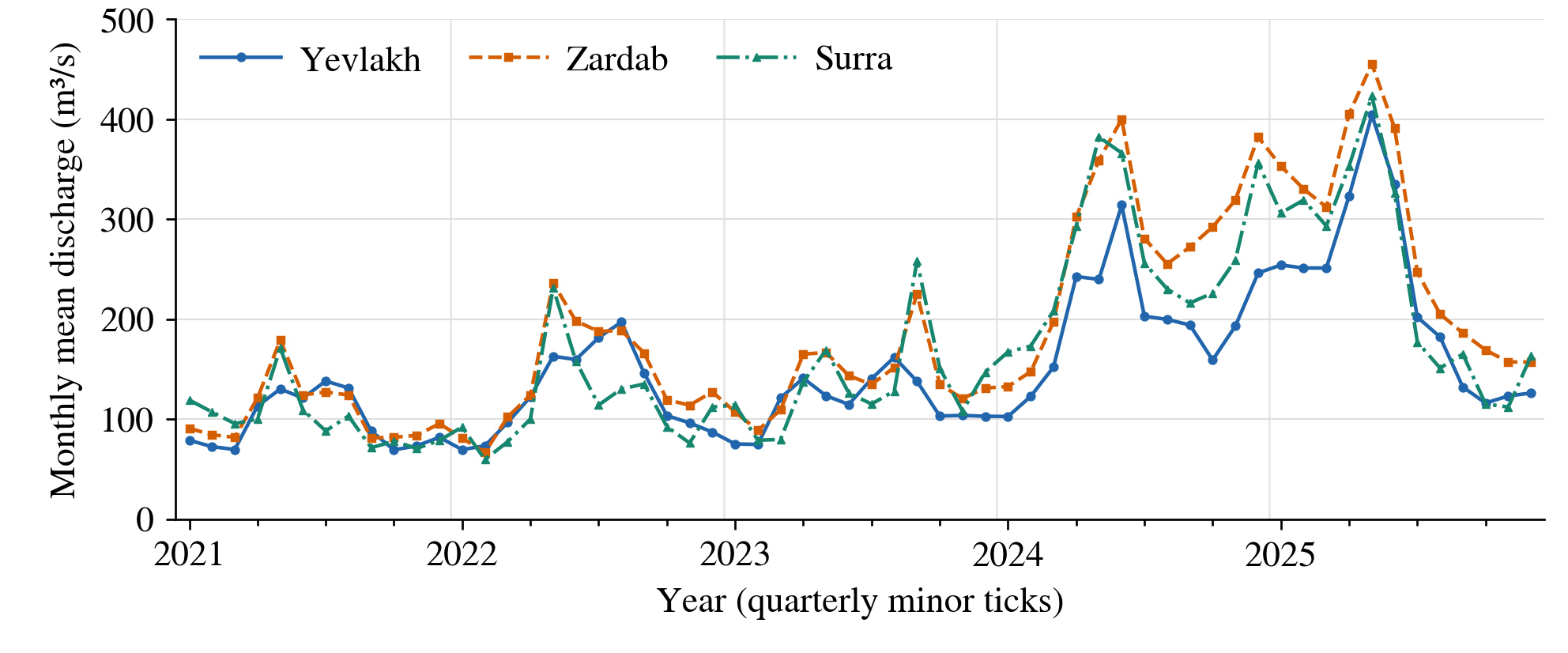
The monthly chronology (Figure 1) shows substantial variation in both magnitude and timing. In 2023 the highest monthly mean occurred in August at Yevlakh and September at Zardab and Surra. In May 2025 all three stations reached their respective study-period maxima: 404.00, 455.00 and 423.00 m³/s. These values are monthly means and must not be interpreted as instantaneous flood peaks.
The five-year calendar-month profiles all peak in May: 211.93 m³/s at Yevlakh, 279.08 m³/s at Zardab and 275.20 m³/s at Surra (Figure 2). Their minima occur in different months: October at Yevlakh (110.11 m³/s), February at Zardab (143.32 m³/s) and November at Surra (125.12 m³/s). The resulting maximum-to-minimum ratios are 1.92, 1.95 and 2.20. These are ratios within the five-year mean monthly profiles, not ratios of individual extreme observations.
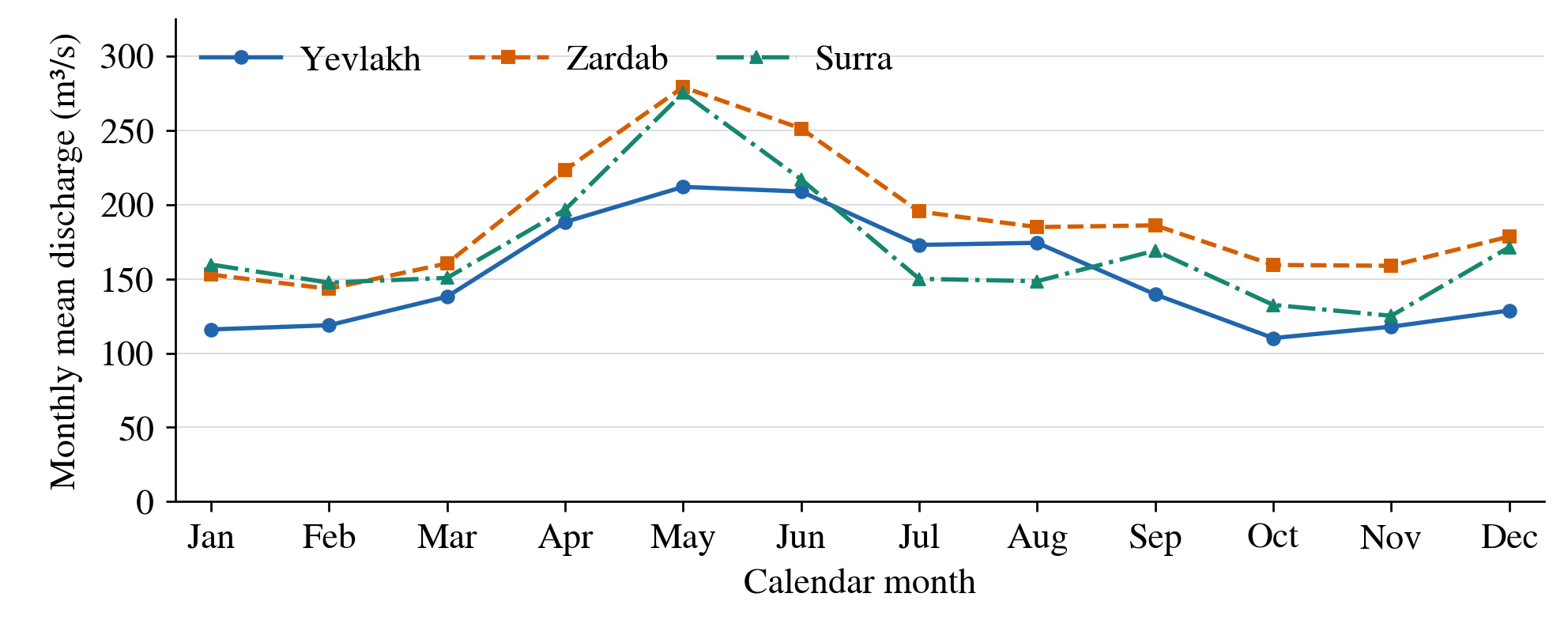
A common May maximum does not imply identical three-month seasonality. At Yevlakh, the June–August weighted mean is 185.04 m³/s, slightly above the March–May mean of 179.32 m³/s. At Zardab and Surra, spring has the highest seasonal means, 220.92 and 207.61 m³/s, compared with summer values of 210.03 and 171.32 m³/s. The distinction reflects the contribution of all three months to a seasonal average, rather than the month of the profile maximum alone.
Zardab discharge exceeds Yevlakh discharge in 52 of 60 months; the equal-month mean difference is +37.34 m³/s. Surra is below Zardab in 46 months, with a mean difference of −19.19 m³/s. The full-period weighted station means likewise place Zardab above Surra and Yevlakh (Table 1). Discharge therefore does not increase monotonically downstream in this compilation, despite Surra’s position below the Araz confluence.
These differences describe the net observed contrast between gauges. Tributary inflows, withdrawals, return flows, channel or floodplain storage, routing and measurement uncertainty cannot be separated with the available monthly series. Historical Kura assessments document regulation and seasonal redistribution [4], while wider studies demonstrate the importance of network context [9]. Neither source establishes the cause of the specific 2021–2025 contrasts. In particular, a negative Surra–Zardab difference is not a direct estimate of water loss or abstraction.
Internal data checks support the stability of the broad findings. Replacing all 108 checked values with calendar-day means changed the five-year weighted means by +0.028 % at Yevlakh, +0.057 % at Zardab and +0.072 % at Surra. Profile maximum and minimum months remained unchanged. This is a consistency assessment within the supplied compilation, not independent validation of gauge accuracy; rating-curve metadata and measurement uncertainties were unavailable.
The five-year record describes recent conditions rather than a climatological normal. Record length requirements depend on the hydrological statistic being estimated [6]; no long-term trend test, climate attribution or flood-frequency calculation is attempted here. Extending the synchronized records and adding tributary, withdrawal and reservoir-operation data would permit a more complete interpretation. The present comparison can support the coordinated monitoring emphasized in basin-management research [11].
Conclusion
The 2021–2025 observations identify a common May maximum in the three calendar-month profiles, alongside a summer seasonal maximum at Yevlakh and spring maxima at Zardab and Surra. Discharge was usually higher at Zardab than at Yevlakh and lower at Surra than at Zardab. These findings remain stable under the available daily-data sensitivity check. They provide a recent baseline for station-specific seasonal monitoring, while identifying the additional water-balance and measurement information needed to explain interstation differences.
References
Информация об авторах