Improvement of drilling and blasting parameters in open-pit mining of the Karakhtai limestone deposit
УДК 622.271
Abstract
The study addresses the improvement of drilling and blasting operations in the open-pit mining of the Karakhtai limestone deposit in the Akhangaran district of the Tashkent Region, Republic of Uzbekistan. The objective is to assess the existing blast-preparation scheme and substantiate a project-based direction for reducing drilling-and-blasting costs while preserving acceptable fragmentation and operational safety. The analysis uses geological and hydrogeological characteristics of the deposit, physical and mechanical properties of limestone, parameters of the mining system, drilling equipment, blasthole layout, initiation systems, and comparative technical and economic calculations contained in the graduation thesis. The studied limestone has a density of about 2.56 t/m³ and a uniaxial compressive strength of 41.3–44.8 MPa in the natural state and 27.4–30.2 MPa when water-saturated. The compared project variant increases blasthole diameter from 130 to 152 mm and changes the drilling pattern from 4 × 4 m to 4 × 6 m with a staggered arrangement. The calculated annual number of blastholes decreases from 9,800 to 6,402, while the considered drilling-and-blasting costs decrease from 851,019.75 to 698,746.29 conventional units. The results are interpreted as a project hypothesis requiring controlled field verification before industrial implementation.
Аннотация
В статье рассматривается совершенствование буровзрывных работ при открытой разработке Карахтайского месторождения известняков в Ахангаранском районе Ташкентской области Республики Узбекистан. Цель исследования заключается в анализе существующей схемы подготовки массива и обосновании проектного направления снижения затрат на буровзрывные работы при сохранении приемлемого качества дробления и требований безопасности. Исходными материалами являются горно-геологические и гидрогеологические характеристики месторождения, физико-механические свойства известняка, параметры системы разработки, применяемое буровое оборудование, параметры сетки скважин, системы инициирования и сравнительные технико-экономические расчёты выпускной квалификационной работы. Плотность известняка составляет около 2,56 т/м³, предел прочности при одноосном сжатии — 41,3–44,8 МПа в естественном состоянии и 27,4–30,2 МПа в водонасыщенном. В рассматриваемом проектном варианте диаметр скважин увеличивается с 130 до 152 мм, а сетка бурения изменяется с 4 × 4 м до 4 × 6 м при шахматном расположении. Расчётное годовое количество скважин уменьшается с 9800 до 6402, а затраты по рассматриваемым статьям БВР — с 851019,75 до 698746,29 условных единиц. Полученные результаты следует рассматривать как проектную гипотезу, подлежащую опытно-промышленной проверке.
Keywords: Karakhtai deposit; limestone; open-pit mining; drilling and blasting; rock fragmentation; water-bearing horizons; blast optimization.
Ключевые слова: Карахтайское месторождение; известняк; открытая разработка; буровзрывные работы; дробление горных пород; водоносные горизонты; оптимизация БВР.
Introduction
The efficiency of open-pit mining of cement and construction raw materials is determined not only by the quantity of extracted rock but also by the quality of its preparation for excavation, transportation, and subsequent crushing. Recent international studies increasingly treat blasting as one component of an integrated size-reduction chain. Fragmentation affects downstream energy demand, productivity, operating costs, recovery, and environmental performance, which means that blast design should be evaluated against the whole production system rather than against drilling or blasting costs alone [1, 2].
Another important research direction is the use of drilling-monitoring information to characterize rock-mass variability and adapt blast design to actual geological conditions. Navarro et al. demonstrated that measurement-while-drilling data can be used to classify structural conditions and support blastability assessment in open-pit operations [1]. This approach is relevant to heterogeneous deposits where rock strength and fracturing vary spatially.
Full-scale research also confirms that the relationship between explosive energy, powder factor, and initiation delay is nonlinear and must be considered as a combined design problem [3]. Sensitivity studies show that several blast-design parameters jointly affect fragmentation outcomes, while digital monitoring and machine-vision approaches increasingly support quantitative assessment of the post-blast muckpile [4–6]. The influence of initiation conditions has also been demonstrated in full-scale field tests at the Kevitsa open pit mine [8, 9].
The Karakhtai limestone deposit is located in the Akhangaran district of the Tashkent Region of the Republic of Uzbekistan, approximately 75 km southeast of Tashkent and 10 km northeast of Akhangaran. The deposit serves as a raw-material base for cement production. Mined limestone is transported by truck to a crushing complex and then delivered by a conveyor approximately 7 km long to the cement plant raw-material stockpile. The deposit is characterized by heterogeneous geological conditions, variable bench heights, overburden thicknesses, and water-bearing horizons, which complicate the selection of drilling and blasting parameters.
The aim of this study is to analyze the existing drilling and blasting scheme at the Karakhtai deposit and to substantiate, on the basis of the graduation thesis calculations, a direction for improving blasthole parameters and layout in order to reduce the number of drilling operations and the associated costs while maintaining acceptable fragmentation, slope stability, and safety constraints.
Materials and Methods
The study is based on the graduation thesis ‘Preparation of an Open-Pit Mining Project for the Karakhtai Deposit’, including its special section on drilling and blasting in water-bearing horizons. The source materials comprise the geological and hydrogeological description of the deposit, physical and mechanical characteristics of the rocks, parameters of the mining system, drilling and excavation equipment, existing blast-design parameters, safety requirements, and comparative technical and economic calculations [10].
The Karakhtai limestone belongs to the Paleogene carbonate sequence. The limestone density adopted in the project is approximately 2.56 t/m³, and the loosening coefficient is 1.35. The uniaxial compressive strength is 41.3–44.8 MPa in the natural state and 27.4–30.2 MPa in the water-saturated state. The softening coefficient is 0.61–0.69. These values indicate that the rock mass requires controlled preparation before excavation and that water saturation may materially influence blasting conditions [10].
The deposit is developed by an open-pit transport system with preliminary loosening of the part of the rock mass that cannot be excavated mechanically. Working bench heights vary by section and are generally 10–15 m. The thesis reports that part of the overburden can be excavated mechanically, whereas the remaining portion requires drilling and blasting. The mining equipment includes hydraulic excavators of the Komatsu PC500LC and Hitachi ZX-450-3 class and equivalent equipment [10].
Rotary-percussive drilling rigs of the KAYSHAN-125D type are considered in the project. The initial design uses vertical blastholes with a diameter of 130 mm and a multi-row arrangement. Short-delay initiation is used to control the sequence of rock breakage. For water-bearing horizons, the thesis considers water-resistant emulsion explosive systems, while non-electric initiation systems are used to provide the required sequence of initiation [10].
The comparative analysis focuses on the parameters that directly affect the number of drilling operations and the calculated cost of the blast-preparation stage: blasthole diameter, drilling pattern, arrangement of holes, annual number of holes, quantity of initiation elements, and the resulting cost of the considered drilling-and-blasting items. The proposed project variant increases the hole diameter from 130 to 152 mm and changes the pattern from 4 × 4 m to 4 × 6 m with staggered placement. The thesis also considers adjustment of the calculated specific explosive consumption. These values are reported here as source-derived project parameters and are not presented as a universal operational blasting prescription.
Results and Discussion
The existing project variant uses a 4 × 4 m drilling pattern with 130 mm blastholes. Such a scheme provides a relatively dense distribution of energy in the rock mass, but it requires a comparatively large number of holes. When the annual production requirement is considered, the drilling volume and associated consumption of initiation elements become significant cost components [10].
The proposed variant changes two interrelated geometric parameters: the blasthole diameter is increased to 152 mm, and the drilling pattern is changed to 4 × 6 m with staggered placement. The increase in spacing means that each blasthole is assigned a larger volume of rock. Consequently, fewer holes are required for a given annual production volume. At the same time, the larger spacing introduces a potential risk of poorer fragmentation if the energy distribution is not adequately matched to the rock structure. International research emphasizes that fragmentation depends on the interaction of rock properties, blast geometry, energy distribution, and initiation conditions [2–4].
The calculated comparison from the graduation thesis gives a reduction in annual blastholes from 9,800 to 6,402, corresponding to 3,398 fewer holes or approximately 34.7 %. The quantity of electrical initiation elements decreases from 19,600 to 12,804, while the number of initiating elements reported in the project calculations decreases by the same proportion. The considered drilling-and-blasting costs decrease from 851,019.75 to 698,746.29 conventional units, giving a calculated difference of 152,273.46 conventional units [10].
These results indicate a substantial calculated economic effect at the drilling-and-blasting stage. However, the reduction in direct costs cannot be treated as the final economic outcome. A wider drilling pattern may increase the proportion of oversize fragments, which can require secondary breakage or reduce excavator and crusher productivity. Reviews of the fragmentation chain emphasize that the optimum blast is the one that minimizes the total cost of size reduction from drilling and blasting through crushing and grinding, rather than the cost of blasting alone [2].
The results also support the importance of considering blastability and geological variability. Navarro et al. showed that drilling-monitoring data can be used to distinguish structural conditions of the rock mass and thereby improve the basis for blast design [1, 7]. For Karakhtai, this suggests that future field verification should not rely solely on average rock strength. The spatial variability of fracturing, water saturation, and bench geometry should be incorporated into the assessment of the proposed pattern.
The role of initiation conditions is equally important. Full-scale studies have shown that changes in initiation position and timing can influence fragmentation, while the interaction between powder factor and delay affects the resulting fragment-size distribution [3, 8, 9]. Therefore, the proposed geometric changes should be evaluated together with the existing initiation system rather than as an isolated drilling modification. This is especially important for water-bearing horizons, where the stability of the explosive system and the reliability of initiation are additional constraints [10].
Digital measurement can strengthen this verification stage. Machine-vision and photogrammetric approaches make it possible to estimate fragment-size distributions and compare actual results with the target fragmentation range [6, 9]. A practical monitoring scheme for Karakhtai could compare the proposed and existing patterns using consistent measurements of fragmentation, oversize, excavation productivity, crusher loading, and slope condition. Such a controlled comparison would allow the calculated economic benefit to be tested against the actual production chain.
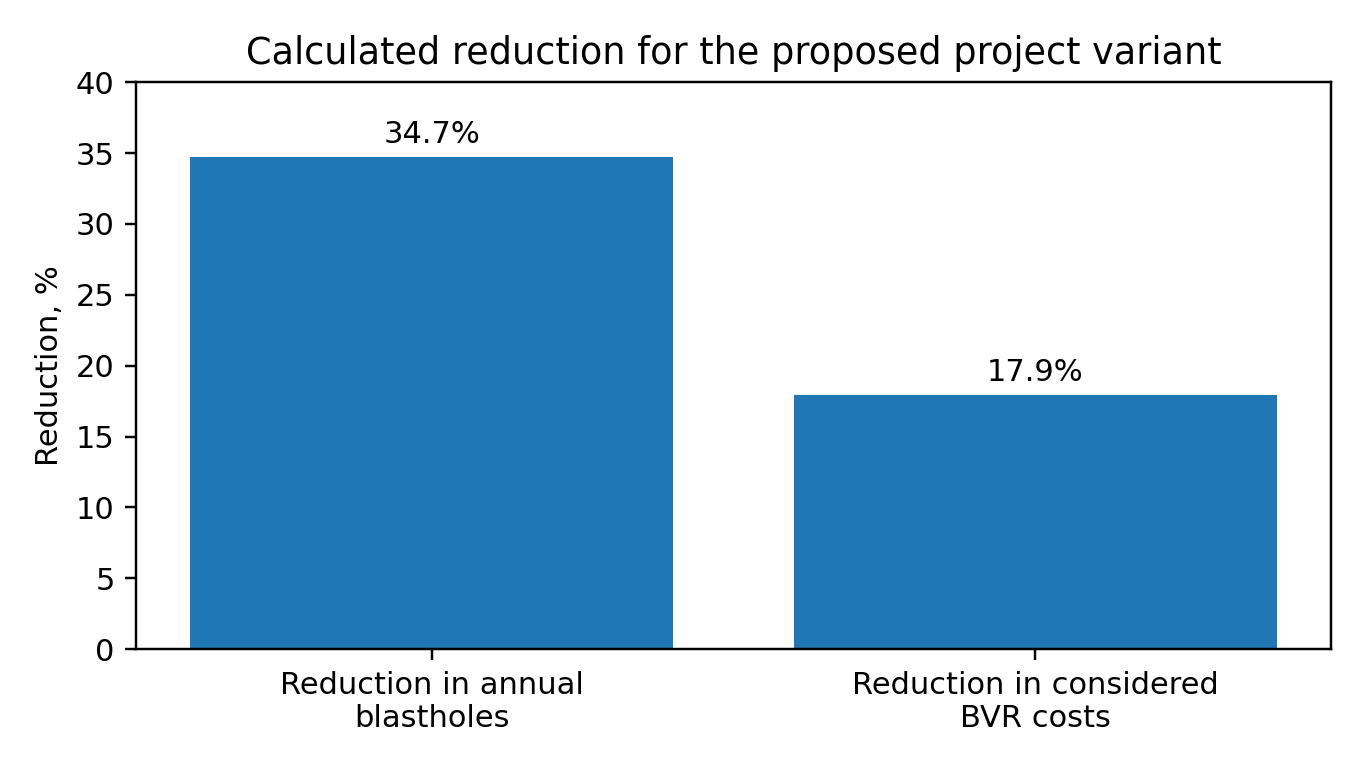
Table 1.
Comparison of the main parameters of the existing and proposed drilling-and-blasting variants
| Parameter | Existing variant | Proposed variant |
|---|---|---|
| Blasthole diameter, mm | 130 | 152 |
| Drilling pattern, m | 4 × 4 | 4 × 6 |
| Hole arrangement | Row | Staggered |
| Annual number of blastholes | 9,800 | 6,402 |
| Electrical initiation elements | 19,600 | 12,804 |
| Initiating elements | 19,600 | 12,804 |
| Considered BVR costs, conventional units | 851,019.75 | 698,746.29 |
| Calculated cost difference, conventional units | — | 152,273.46 |
Note — the numerical indicators are taken from the graduation-thesis calculations and should be refined using current prices and controlled field-test results.
The calculated savings are therefore best interpreted as an initial engineering estimate. The proposed pattern should be accepted for industrial use only after controlled trials confirm that the fragmentation distribution, oversize proportion, excavator productivity, crusher performance, slope condition, and safety indicators remain within the project requirements. This limitation is consistent with the broader international trend toward data-supported blast optimization and continuous monitoring [1, 6].
Safety and environmental constraints remain integral to the assessment. The thesis specifies requirements for trained and certified personnel, hazardous-zone control, bench stability, equipment condition, communication, power supply, industrial sanitation, and emergency response [10]. Blast-induced vibration, dust and gas emissions, flyrock, and potential damage to the final pit walls must be considered together with the economic effect. Recent predictive studies likewise treat vibration control and blast-parameter optimization as interconnected tasks [5].
Conclusion
The analysis shows that the efficiency of drilling and blasting at the Karakhtai limestone deposit depends on the combined influence of rock properties, water-bearing conditions, blasthole geometry, drilling pattern, energy distribution, initiation conditions, and downstream excavation and crushing performance.
On the basis of the graduation-thesis calculations, the proposed project variant increases the blasthole diameter from 130 to 152 mm and changes the pattern from 4 × 4 m to 4 × 6 m with staggered placement. The calculated annual number of blastholes decreases from 9,800 to 6,402, while the considered drilling-and-blasting costs decrease from 851,019.75 to 698,746.29 conventional units.
The calculated reduction in drilling requirements and direct BVR costs demonstrates the potential economic value of the proposed approach. At the same time, the result cannot be considered sufficient evidence for immediate industrial implementation because a wider pattern can influence fragmentation quality, oversize generation, excavation productivity, crushing performance, and slope condition.
For water-bearing horizons, the selection of water-resistant explosive systems and reliable non-electric initiation methods is an essential project constraint. The final technical decision should therefore be based on controlled field verification with quantitative monitoring of fragmentation, oversize, equipment productivity, slope stability, environmental effects, and actual operating costs.
The main practical conclusion is that the Karakhtai project has a substantiated basis for further optimization of drilling and blasting parameters, but the proposed values should be treated as project-specific hypotheses requiring experimental confirmation rather than universal blasting recommendations.
References