Influence of elastane yarn distribution on the technological properties of fleece knitted fabrics
УДК 677.025
Abstract
This study investigates the effect of the amount of elastane yarn and its distribution sequence within the structure of weft-knitted fleece fabric on its technological and geometrical characteristics. Experimental studies were carried out using spun cotton yarn and highly elastic elastane yarn on a single-bed Wellknit knitting machine. Five variants of fleece knitted fabrics were developed, differing in the elastane yarn content and its distribution across the fabric courses. During the experiments, the main geometrical and physical parameters of the produced samples were determined and comparatively analyzed, including loop pitch, course height, horizontal and vertical density, yarn length consumed per loop, areal density, thickness, and bulk density. Changes in these parameters were evaluated in relation to the elastane yarn content and its arrangement within the fabric repeat. The experimental results demonstrated that both the proportion of elastane yarn and its distribution pattern within the repeat have a significant effect on the structural parameters of fleece knitted fabrics. In particular, the sample containing elastane yarn in all courses exhibited increased horizontal and vertical density, accompanied by greater fabric thickness and a higher tendency toward elastic deformation. Although variants III, IV, and V showed relatively high thickness values, they demonstrated acceptable bulk density and raw material consumption characteristics..
Аннотация
Данное исследование изучает влияние количества эластановой пряжи и последовательности её распределения в структуре уточно-вязаной ткани флиса на её технологические и геометрические характеристики. Экспериментальные исследования проводились с использованием пряжи из кардного хлопка и высокоэластичной эластановой пряжи на одноигольной вязальной машине Wellknit. Разработано пять вариантов трикотажных тканей флиса, отличающихся содержанием эластановой пряжи и её распределением по рядам ткани. При проведении экспериментов определены и сравнительно проанализированы основные геометрические и физические параметры полученных образцов, включая шаг петли, высоту ряда, горизонтальную и вертикальную плотность, длину пряжи, расходуемую на одну петлю, поверхностную плотность, толщину и объёмную плотность. Изменения указанных параметров оценивались в зависимости от содержания эластановой пряжи и её размещения в пределах раппорта ткани. Результаты экспериментов показали, что как доля эластановой пряжи, так и её схема распределения в пределах раппорта оказывают значительное влияние на структурные параметры трикотажных тканей флиса. В частности, образец, содержащий эластановую пряжу во всех рядах, продемонстрировал повышенные горизонтальную и вертикальную плотность, сопровождаемые большей толщиной ткани и более высокой склонностью к упругой деформации. Хотя варианты III, IV и V показали относительно высокие значения толщины, они продемонстрировали приемлемые объёмную плотность и характеристики расхода сырья.
Keywords: elastane yarn; knitted fabric structure; loop pitch; fabric density; areal density; thickness; bulk density.
Ключевые слова: эластановая пряжа; структура трикотажной ткани; шаг петли; плотность ткани; поверхностная плотность; толщина; объёмная плотность.
Introduction
Fleece knitted fabrics are among the widely used knitted materials in the modern textile industry, and their structural characteristics and technological parameters are important factors determining the quality and functional performance of finished products [1; 26-28 p, 2; 329-351 p]. Parameters such as loop pitch, course height, horizontal and vertical density, areal density, and thickness affect not only the stability of the fabric formation process but also the fit, comfort, and appearance retention of products manufactured from these fabrics [3; 352-365 p].
Spun cotton yarn is widely used as the primary raw material in the production of conventional fleece knitted fabrics. The hygienic properties, moisture absorption capacity, and consumer-related characteristics of cotton fibers make them suitable for such products. The incorporation of elastane yarn into the fabric structure can affect the geometrical configuration of loop elements, their mutual arrangement, the degree of fabric compaction, and the overall structure of the fabric in its relaxed state [4; 463-479 p].
In addition to the amount of elastane yarn, its distribution within the fabric structure is an important technological factor in determining the final properties of fleece knitted fabrics. The placement of elastane yarn in the plain or fleece courses, as well as its repetition according to a specific sequence within the fabric repeat, alters the conditions under which the loop elements are formed [5; 741-754 p, 6; 310-319 p ].
Studies aimed at optimizing the technological parameters of knitted fabrics consider the combined effects of factors such as raw material type, yarn linear density, yarn length per loop, machine operating conditions, interaction between the needle beds, and fabric structure as important research variables [7; 1-7 p, 8; 1-11 p].
The aim of this study is to develop different variants of fleece knitted fabrics using spun cotton yarn and elastane yarn and to determine the effect of the amount and distribution of elastane yarn within the fabric structure on key technological parameters, including loop pitch, horizontal and vertical density, areal density, thickness, and bulk density.
Materials
The effect of elastane yarn on the technological and physical-mechanical properties of knitted fabric was studied at the “Terry Jar” enterprise, with particular attention to determining its appropriate content. The experiments were carried out on a single-bed Wellknit knitting machine. Spun cotton yarn of 20 tex and highly elastic elastane yarn of 7.7 tex were used for producing the experimental samples. During the experimental study, five variants of fleece knitted fabric were produced. All samples were knitted under identical technological conditions; the machine settings, yarn tension, and production speed were kept constant throughout the process. The samples differed only in the amount of elastane yarn incorporated into the fabric and its arrangement within the structure. This approach allowed the obtained results to be compared accurately and reliably [9; 1-7 p].
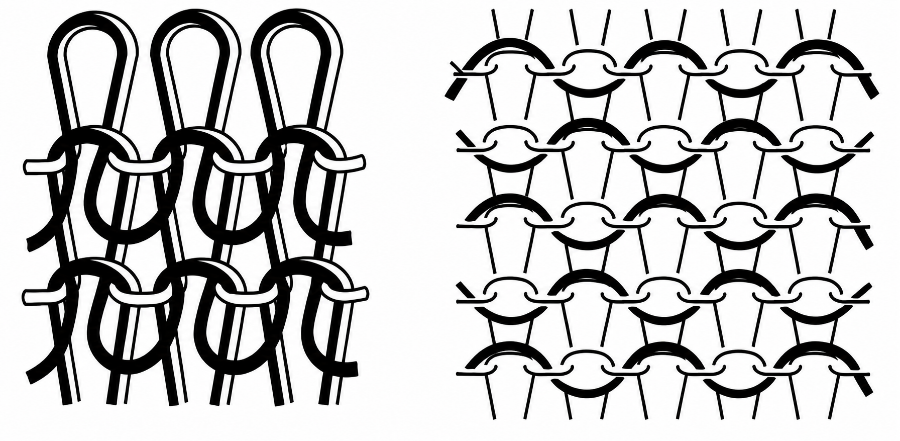
Figure 1 presents the graphical notation of the produced fleece knitted fabric sample. It provides a basis for analyzing the structural elements of the fabric, their arrangement, and the patterns of their interconnection in detail [10; 1-8 p].
In Variant I, the fabric repeat consisted of two courses. The first was a plain course knitted using spun cotton yarn combined with elastane yarn. The second was a fleece course formed exclusively from spun cotton yarn. Variant II also consisted of a two-course repeat. The first plain course was knitted from spun cotton yarn. In the second course, elastane yarn was combined with spun cotton yarn as the ground yarn, while only spun cotton yarn was used as the fleece yarn. In Variant III, the repeat likewise consisted of two courses. The first plain course was knitted from a combination of spun cotton and elastane yarns. In the second course, spun cotton yarn combined with elastane yarn was used as the ground yarn, while spun cotton yarn was used as the fleece yarn. In Variant IV, the repeat was composed of four courses. The first and second courses were knitted from spun cotton yarn. In the third course, spun cotton yarn was combined with elastane yarn. In the fourth course, spun cotton and elastane yarns were used together as the ground yarn, while spun cotton yarn was used as the fleece yarn. Variant V also had a four-course repeat. The first course was a plain course knitted from spun cotton yarn. In the second and fourth courses, spun cotton yarn combined with elastane yarn was used as the ground yarn, while spun cotton yarn served as the fleece yarn. The third course was a plain course knitted from a combination of spun cotton and elastane yarns. In this variant, elastane yarn was distributed more uniformly throughout the repeat, which was intended to provide a balanced combination of fabric elasticity and shape retention.
Results and Discussion
The linear densities of the yarns used in the fleece knitted fabrics and their proportions in the fabric are presented in Table 1.
Table 1.
Technological parameters of fleece knitted fabric
| Parameter | I | II | III | IV | V |
|---|---|---|---|---|---|
| Raw material type and proportion in the fabric, % (fleece/ground/elastane) | 54.8/45.2/- | 51.4/44.6/4 | 50.8/44.9/4.3 | 53/43.2/3.8 | 51/44.4/4.6 |
| Loop pitch A, mm | 0.74 | 0.72 | 0.69 | 0.71 | 0.71 |
| Course height V, mm | 0.63 | 0.63 | 0.61 | 0.65 | 0.62 |
| Horizontal density Rg | 68 | 69 | 72 | 70 | 70 |
| Vertical density Rv | 79 | 79 | 82 | 77 | 81 |
| Yarn length per loop, mm | 6.1 | 6.5 | 5.9 | 6 | 6.1 |
| Fabric areal density Ms, g/m² | 262 | 283 | 279 | 259 | 277 |
| Thickness T, mm | 1.15 | 1.35 | 1.3 | 1.22 | 1.27 |
| Bulk density δ, mg/cm³ | 228 | 210 | 214 | 212 | 218 |
The data given in Table 1 indicate that the introduction of 3.8–4.6 % elastane yarn into the fleece knitted fabric changes its technological parameters in a consistent manner. One of the most noticeable changes is the reduction in loop pitch with increasing elastane content. This behavior is associated with the elastic recovery of the yarn. Once the fabric is removed from the knitting machine and reaches a relaxed state, the elastane yarn contracts and pulls the adjacent loops closer together. As a result, the distance between the loops decreases and the knitted structure becomes more compact
The areal density of the fleece knitted fabrics is closely associated with the repeat structure and the amount of elastane yarn incorporated into the fabric. The relationship between these parameters is illustrated graphically in Figure 2.
The experimental results further demonstrate that both areal density and thickness vary according to the amount and distribution of elastane yarn within the fabric structure. A comparison of Variants I and II shows that the areal density increases from 262 to 283 g/m², corresponding to an increase of approximately 8.0 %. Fabric thickness also rises from 1.15 to 1.35 mm. This increase can be attributed to the contraction of elastane yarn and the resulting rearrangement and compaction of the loop structure when the fabric reaches its relaxed state. The incorporation of elastane yarn into the fleece course therefore affects not only the density of the fabric but also its thickness and overall structural configuration.
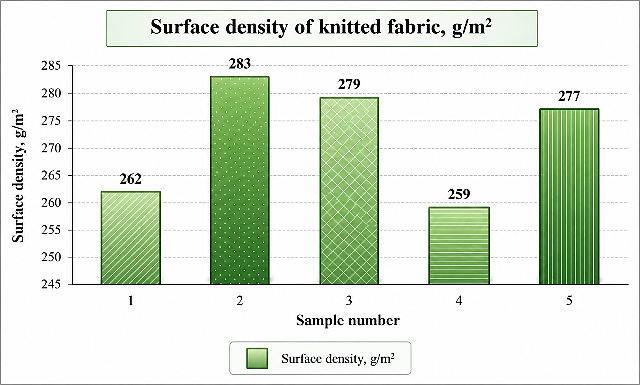
Variant III, in which elastane yarn was incorporated into all courses, showed the highest areal density and thickness values among the investigated samples. This suggests that the more uniform distribution of elastane yarn throughout the fabric structure promotes greater structural compaction and affects the elastic behavior of the knitted fabric.
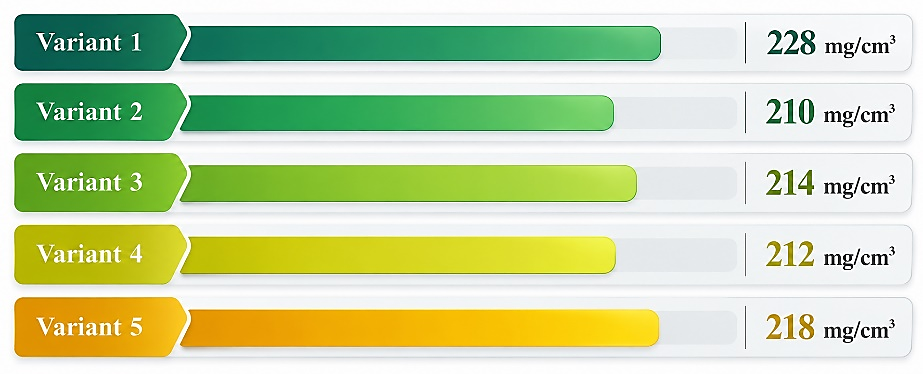
The bulk density of Variant II was 1.9 % lower than that of Variant I. Similarly, the bulk density of Variant IV was lower than that of Variant V. According to the values presented in Table 1, these parameters were 212 and 218 mg/cm³, respectively, corresponding to a difference of approximately 2.8 %. The lowest bulk density was observed in Variant II, at 210 mg/cm³, rather than in Variant III. This indicates that the increase in fabric thickness in Variant II was accompanied by a relatively lower increase in areal density, resulting in a lower overall bulk density and a more open internal structure.
The bulk density values of the investigated knitted fabric samples ranged from 210 to 228 mg/cm³, as shown graphically in Figure 3. The obtained results demonstrate that both the amount of elastane yarn and its distribution within the knitted structure influence not only fabric density and thickness but also its bulk characteristics, including lightness, internal porosity, and the efficiency of raw material utilization.
Conclusion
The experimental results demonstrate that both the content and distribution of elastane yarn within the repeat have a substantial effect on the structural and technological characteristics of fleece knitted fabrics. Increasing the elastane content and modifying its position within the repeat altered the loop pitch, horizontal and vertical density, areal density, thickness, and bulk density of the fabrics. The incorporation of elastane yarn promoted structural compaction and elastic recovery of the knitted fabric after its removal from the machine. At the same time, differences in elastane distribution produced distinct changes in fabric thickness and bulk characteristics. Among the investigated samples, Variants III, IV, and V demonstrated a favorable combination of thickness, bulk density, and material consumption. These results indicate that rational distribution of elastane yarn can be used to regulate the structure of fleece knitted fabrics and obtain products with an appropriate balance between material efficiency, lightweight construction, thickness, elasticity, and shape retention.
References