Dynamic problem of a wedge-shaped working tool of soil-tilling implement
УДК 631.3+531.3
Abstract
This study aims to determine the dynamic reaction forces exerted by the soil against a wedge-shaped soil-tilling implement. Specifically, it focuses on the reaction forces produced by a single-sided wedge. The problem is addressed using theoretical mechanics based on the D’Alembert principle approximation, leading to an expanded solution to existing analytical formulations. A scheme illustrating the active and passive forces acting on the wedge is created by utilizing the principle of release from constraints. Based on the fundamental law of dynamics, equations of motion for the wedge-shaped working element are derived in projections along Cartesian coordinate axes. Using these equations, the dynamic reaction forces for the wedge are determined. Analytical expressions for the reaction force in this dynamic problem are developed under the condition that the wedge is subjected to a constant force, with the wedge's motion following a periodic law. The analysis incorporates an open system, applying Coulomb's formula for dry friction alongside a new method that differs from d'Alembert's principle. Under d'Alembert's principle, the differential is replaced with the object's inertial forces, reducing the differential equation to the ordinary equilibrium equation of statics. In this paper, an alternative approach is used; instead of relying on a differential equation, an ordinary equation is derived by differentiating the given law governing the wedge's motion.
Аннотация
Целью данного исследования является определение динамических реакционных сил, воздействующих со стороны почвы на клинообразное почвообрабатывающее орудие. В частности, исследование сосредоточено на реакционных силах, создаваемых односторонним клином. Задача решена методами теоретической механики на основе принципа Д'Аламбера, что привело к развитию существующих аналитических формулировок. Схема действующих активных и пассивных сил на клин построена с использованием принципа освобождения от связей. На основе фундаментального закона динамики выведены уравнения движения клинообразного рабочего элемента в проекциях на оси декартовой системы координат. С помощью этих уравнений определены динамические реакционные силы клина. Развиты аналитические выражения для реакционной силы в данной динамической задаче при условии, что клин подвергается постоянной силе, а его движение следует периодическому закону. Анализ включает открытую систему с применением формулы Кулона для сухого трения наряду с новым методом, отличающимся от принципа Д'Аламбера. При применении принципа Д'Аламбера дифференциал заменяется силами инерции объекта, что сводит дифференциальное уравнение к обычному уравнению статического равновесия. В данной работе используется альтернативный подход: вместо опоры на дифференциальное уравнение получено обычное уравнение посредством дифференцирования заданного закона, управляющего движением клина.
Keywords: wedge; dynamic problem; equilibrium equation; reaction forces.
Ключевые слова: клин; динамическая задача; уравнение равновесия; реакционные силы.
1. Introduction
Determination of the reaction forces of constraints of composite wedge pairs is the foundation for the study of the dynamic processes of many mechanisms used in mechanical engineering. Agricultural machines are equipped with V-belts and wedge friction gears, wedge valves are used in oil products transportation lines, freight car bogies are equipped with wedge spring-friction sets. Wedge pairs are widely covered in the literature [1, 2].
Using the method of addition of forces between two infinitesimal sections of the rod, in accordance with the d'Alembert principle, a differential equation of longitudinal vibrations of a wedge pair was compiled [3]. The general and particular solutions of the differential equation of longitudinal oscillations of a wedge pair are presented and their propagation under the action of a constant force corresponding to the given initial and boundary conditions is studied.
A generalized model of a spring-friction set of a freight car bogie was created in [4]. Critically discussing the lack of methods of classical mechanics in multiple publications, according to the principle of the release of constraints, an equation for the equilibrium of friction wedges was compiled and an analytical expression for the reaction of a friction wedge was obtained in [5].
This article addresses the dynamic problem of a wedge. The objective of the study is to determine a general solution by applying d'Alembert's principle, as well as a particular solution for a wedge-shaped working element under a periodic law of motion using a new method.
2. Research methods
The research methods are based on the classical methods of theoretical mechanics for compiling the equations of dynamics according to the d'Alembert principle and the analytical method for determining the reaction force of constraints.
3. Material
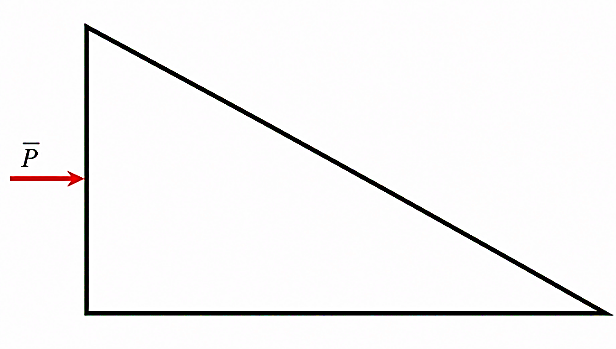
Let force make an effort to move a homogeneous wedge (Fig. 1). It is necessary to determine the dynamic reaction forces of constraints on the wedge.
To do this, we use the d'Alembert principle. The equation of dynamics according to the d'Alembert principle has the following form [6, 7, 8]
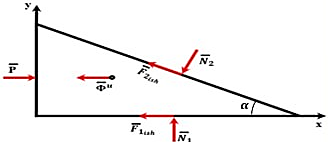
where is the force of inertia, expressed as , is the active force, expressed by force , is the passive force, which consists of the forces of friction and the forces of normal reaction .
To determine the reaction force, we set a coordinate system and determine the projections of all forces along the coordinate axes of this coordinate system (Fig. 2). Normal reaction forces of the working planes are directed perpendicular to these planes. Friction forces of these surfaces lie in the working planes. The force of inertia is directed in the opposite direction of force direction.
Let us derive an equation for the projections of all wedge forces along the -axis:
| . | (1) |
Let us derive an equation for the projections of all wedge forces along the -axis:
| . | (2) |
Then we determine :
| (3) |
Taking into account relation for the friction force (where is the coefficient of friction), from the last equation we obtain:
Then we determine
| (4) |
By integrating over time in (4), we obtain an expression for the velocity:
| . | (5) |
Thus, the forces of normal reaction and of the working planes have the following form:
| (6) |
| (7) |
By substituting the inertial forces of the wedge from equations (6) and (7) into equation (6), we can calculate the dynamic reaction forces of a single-sided wedge, generated on the two working surfaces of the wedge.
4. Results
Thus, the analytical expressions for the dynamic reaction forces of a single-sided wedge are determined. Substituting the inertial forces of the wedge from (6) and (7) into (6), we can determine.
In a particular case, if the law of motion of the wedge is given in the following form:
| (8) |
then, differentiating this expression twice, we obtain:
| (9) |
Substituting (9) into (6) and from (6), (7) we obtain expressions for the dynamic normal reaction forces
| (10) |
| (11) |
5. Conclusion
By applying d'Alembert's principle, an analytical solution to the dynamic problem of a one-sided wedge is obtained.
For a periodic law of wedge motion, the problem is solved using a new method that differs from d'Alembert's principle. According to d'Alembert's principle, the differential is replaced by the object’s inertial forces, which allows us to reduce the differential equations to the ordinary equilibrium equations of statics. In this paper, by differentiating the law of motion of the wedge, we obtain an ordinary equation from which we can derive expressions for the dynamic reaction forces of a single-sided wedge acting on its two surfaces.
References