Nuclear-physical methods for analyzing the elemental composition of samples of man-made and environmental objects
УДК 539.14+543.06
Abstract
This paper presents the application of nuclear-physical methods for determining the elemental composition of samples collected from technogenic objects and environmental media. The study focuses on the use of instrumental neutron activation analysis (INAA), prompt gamma neutron activation analysis (PGNAA), and gamma activation analysis (GAA) for qualitative and quantitative determination of macroelements, trace elements, and technologically significant components in ores, soils, rocks, waters, and industrial products. Experimental investigations were carried out using the VVR-SM research reactor and high-resolution HPGe gamma spectrometers at the Institute of Nuclear Physics of the Academy of Sciences of the Republic of Uzbekistan. Certified reference materials, including IAEA-336 Lichen, IAEA-375 Soil, and NIST SRM 1572 Citrus Leaves, were used to verify the accuracy and reliability of the analytical procedures. The obtained results demonstrated good agreement with certified values and confirmed the high sensitivity, selectivity, and reliability of the applied methods. The elemental composition of samples collected from technogenic territories of Uzbekistan was determined, and the concentrations of environmentally significant and toxic elements were evaluated. The study also assessed the analytical capabilities, detection limits, and practical applicability of neutron-radiation and gamma-activation methods for environmental monitoring, geological exploration, and technological process control in mining and metallurgical industries.
Аннотация
В данной работе представлены результаты применения ядерно-физических методов анализа элементного состава проб техногенных объектов и компонентов окружающей среды. Основное внимание уделено использованию инструментального нейтронно-активационного анализа (ИНАА), нейтронно-радиационного метода анализа и гамма-активационного анализа для качественного и количественного определения макро-, микроэлементов и технологически значимых компонентов в рудах, почвах, горных породах, водах и продуктах переработки минерального сырья. Экспериментальные исследования выполнены на базе исследовательского реактора ВВР-СМ Института ядерной физики Академии наук Республики Узбекистан с применением современных гамма-спектрометрических систем на основе полупроводниковых HPGe-детекторов. Для оценки точности и достоверности результатов использованы сертифицированные стандартные образцы IAEA-336 Lichen, IAEA-375 Soil и NIST SRM 1572 Citrus Leaves. Полученные результаты показали хорошее соответствие сертифицированным значениям и подтвердили высокую чувствительность, селективность и надежность применяемых методов. Определён элементный состав образцов, отобранных на территориях техногенных объектов Узбекистана, а также проведена оценка содержания токсичных и экологически значимых химических элементов. Установлены пределы обнаружения и аналитические возможности исследованных методов, что подтверждает перспективность их использования для экологического мониторинга, геологоразведочных работ и аналитического контроля технологических процессов горно-металлургической промышленности.
Keywords: Elemental composition; atomic nucleus; nuclear-physical methods; photonuclear reaction; gamma radiation; spectrometry; detector.
Ключевые слова: Элементный состав; атомное ядро; ядерно-физические методы; фотоядерная реакция; гамма-излучения; спектрометрия; детектор.
Introduction
The elemental composition is a fundamental characteristic of a substance that determines its properties, structure, and the nature of physical, chemical, biological, technological, and other processes. To date, a wide range of methods has been developed and applied to analyze and control the composition of substances in various states. The current level of scientific and technological advancement makes it possible to determine both trace and major quantities of elements in natural, environmental, biological, and technogenic objects [5, 7].
However, in practice, analytical procedures are always subject to specific requirements, such as analysis time, sensitivity, location, and cost, which significantly limit the number of methods suitable for solving a particular analytical task. As a result, many scientific and industrial problems cannot yet be fully addressed using existing analytical techniques. For instance, the issue of providing efficient analytical support for geological exploration and prospecting activities remains insufficiently resolved.
A particularly critical challenge is the analytical control of technological processes in the mining and metallurgical industry. This is associated with the development of automated process control systems, the introduction of new technologies, and increasing demands for product quality and production efficiency. In this context, methods for analyzing and controlling the composition of substances based on nuclear-physical principles can play a significant role in solving these problems.
The study focuses on the use of instrumental neutron activation analysis (INAA), prompt gamma neutron activation analysis (PGNAA), and gamma activation analysis (GAA) for qualitative and quantitative determination of macroelements, trace elements, and technologically significant components in ores, soils, rocks, waters, and industrial products.
Materials and methods
Main Nuclear-Physical Methods for Elemental Analysis of Technogenic and Environmental Samples
Due to its electrical neutrality and other unique properties, the free neutron exhibits a wide range of interactions with atomic nuclei. In particular, it can easily penetrate the nucleus and induce various nuclear transformations. The interaction of a neutron with a nucleus may lead to several types of processes, including elastic scattering (n, n), inelastic scattering (n, n′), reactions accompanied by the emission of multiple neutrons such as (n, 2n) and (n, 3n), reactions with the emission of charged particles (n, p) and (n, α), radiative capture (n, γ), and nuclear fission (n, f) [8, 9].
Each of these nuclear reactions can be utilized for determining the concentration of specific chemical elements in complex compounds. Among the most widely used nuclear-physical methods for elemental analysis under neutron irradiation is instrumental neutron activation analysis (INAA). In addition, other nuclear-physical analytical techniques are of considerable interest, including methods based on prompt gamma-ray spectrometry of neutron capture (often referred to as neutron capture gamma analysis) and methods based on photonuclear reactions induced by bremsstrahlung radiation, known as gamma activation analysis (GAA) [1, 3, 6].
Instrumental Neutron Activation Analysis (INAA)
Neutron activation analysis of the elemental composition of complex samples, when performed using research nuclear reactors and modern gamma spectrometers based on high-purity germanium (HPGe) semiconductor detectors, enables the determination of concentrations of more than 40 elements in soil, plants, water, food products, and human biological substrates (e.g., hair) with high sensitivity.
The use of high-resolution gamma spectrometers equipped with HPGe detectors significantly expands the range of detectable elements, reduces detection limits, and increases analytical throughput.
Application of INAA for Macro and Microelement Analysis
The application of instrumental neutron activation analysis (INAA) for macro- and microelement determination was carried out at the Laboratory of Ecology and Biotechnology of the Institute of Nuclear Physics of the Academy of Sciences of the Republic of Uzbekistan. The experimental facility includes a VVR-SM type research nuclear reactor with a thermal power of 10 MW.
The gamma spectrometric system is based on a high-purity germanium (HPGe) semiconductor detector with an energy resolution of 1.8 keV at the 1332 keV gamma line of 60Co and a relative efficiency of 20 %. The use of such a detector enables the separation of elements with closely spaced gamma energies. For example, zinc and scandium (1115.5 and 1120.5 keV, respectively), as well as magnesium and manganese (843.8 and 846.7 keV), can be resolved and quantified independently based on their distinct peaks without mutual spectral interference.
This significantly improves the sensitivity and accuracy of elemental determination, which is particularly important for the analysis of scandium and zinc in soils, as well as magnesium and manganese in biological samples.
Soil samples collected from technogenic regions of Uzbekistan were prepared for analysis using standard procedures. The collected samples were homogenized, dried, ground, and sieved. Representative subsamples were prepared using the quartering method. For neutron activation analysis, sample masses of 20 – 30 mg were used for short-lived isotopes, while 50 – 70 mg samples were prepared for medium- and long-lived isotopes.
The weighed samples were hermetically sealed in labeled polyethylene containers and irradiated in the neutron flux of the VVR-SM reactor. The irradiated samples were subsequently analyzed using the gamma spectrometric measurement system of the Laboratory of Ecology and Biotechnology at the Institute of Nuclear Physics.
To determine elemental concentrations via radionuclides with different half-lives, various analytical time regimes were applied, including irradiation time, decay (cooling) time, and measurement time. Based on the analysis of characteristic gamma spectra of the activated samples, optimal conditions were selected.
Determination of Elements via Short-Lived Radionuclides
The investigated samples, together with reference standards, were placed in polyethylene containers and irradiated in the vertical channel of the reactor with a neutron flux of 5 × 10¹³ n/cm²·s for 30 seconds.
The induced activity was measured three times: 10 minutes after irradiation for the determination of magnesium and chlorine, and 4 hours after irradiation for sodium, copper, potassium, and manganese. The determination of copper in soil and plant samples was additionally performed on the following day. The counting time for each measurement ranged from 200 to 300 seconds.
Determination of Elements via Medium-Lived Radionuclides
For the determination of calcium, bromine, lanthanum, gold, uranium, and other elements, the samples were wrapped in aluminum foil and irradiated in the reactor’s wet channel for 20 hours. The induced activity was measured 10 days after irradiation based on the characteristic gamma emissions of the corresponding radionuclides. The counting time for each sample ranged from 200 to 300 seconds.
Determination of Elements via Long-Lived Radionuclides
For the determination of elements via long-lived radionuclides, samples irradiated for 20 hours were measured 30 days after irradiation using their corresponding gamma lines. This methodology made it possible to determine the concentrations of cerium, thorium, chromium, cesium, nickel, iron, zinc, and other elements.
Quality Control and Validation Using Reference Materials
At present, one of the most reliable approaches for verifying the accuracy of analytical results is the use of certified reference materials (CRMs). The most robust validation involves either the certification of newly developed international reference materials or the analysis of existing CRMs with compositions unknown to the analyst. Independent validation of analytical results by internationally recognized organizations is of particular importance.
Experimental Results and Discussion
To assess the accuracy of the developed and applied methodology, the following reference materials were used: IAEA-336 (Lichen), NIST SRM 1572 (Citrus Leaves), and IAEA-375 (Soil). The results of the analysis of these reference materials are presented in Table 1.
Table 1.
Comparison of Experimental Results with Certified Reference Values NIST Standard Reference Material 1572 - CITRUS LEAVES
|
Elements |
As | Ba | Br | Cl | Cr | Fe | Mn |
|
Certified value |
3.1±0.3 | 21±3 | 8.2±0.5 | 414±25 | 0.8±0.2 | 90±10 | 23±2 |
|
Determined |
2.9 | 25 | 7.9 | 400 | 0.76 | 87 | 21 |
| Elements | Ni | Rb | Na | Sc | Sr | Zn | - |
|
Certified Value |
0.6±0.3 | 4.84±0.6 | 160±20 | 0.01 | 100±2 | 29±2 | - |
| Determined | 0.68 | 4.9 | 162 | 0.009 | 110 | 31 | - |
As can be seen from the results presented in Table 1, the methodologies developed in the laboratory demonstrate a high level of agreement with the certified values and can be reliably applied in neutron activation analysis of natural samples. To assess the environmental conditions in areas surrounding industrial facilities, the elemental composition of soils and water from technogenic regions of Uzbekistan was investigated using neutron activation analysis. This method enables the determination of a large number of elements in various types of samples with exceptionally high sensitivity. To graphically illustrate the agreement between the determined and certified values, the data from Table 1 are presented in Figure 1.
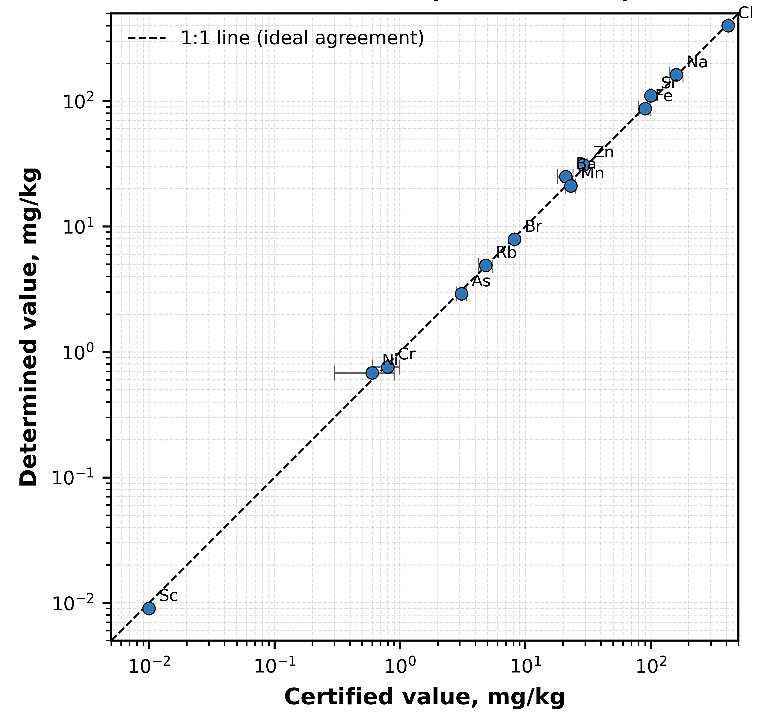
As shown in Figure 1, all data points lie close to the 1:1 line across more than four orders of magnitude, confirming the consistency of the developed methodology over a wide concentration range.
The results of the analysis of rock samples collected from territories surrounding technogenic objects in Uzbekistan, obtained using INAA, are presented in Table 2.
Table 2.
NAA Results for Samples from Technogenic Areas of Uzbekistan
| Elements | 1 | 2 | 3 | 4 | 5 | 6 | 7 | 8 | 9 | 10 |
| Sm | 5.88 | 4.6 | 6.8 | 5.04 | 3.73 | 4.0 | 5.19 | 6.56 | 4.58 | 3.92 |
| Mo | 3.3 | 3.08 | 2.0 | 1.7 | 3.97 | 3.53 | 2.48 | 2.33 | 3.1 | 1.66 |
| Lu | 0.26 | 0.3 | 0.35 | 0.3 | 0.34 | 0.35 | 0.35 | 0.334 | 0.29 | 0.385 |
| U | 3.2 | 10.5 | 5.15 | 6.26 | 8.0 | 5.06 | 5.6 | 5.89 | 4.35 | 5.17 |
| Yb | 2.38 | 2.7 | 2.96 | 2.54 | 2.89 | 2.83 | 3.13 | 2.92 | 3.65 | 3.34 |
| Au | 0.007 | 0.0072 | 0.01 | 0.003 | 0.0086 | 0.0095 | 0.014 | 0.0098 | 0.004 | 0.009 |
| Nd | 18.23 | 26.57 | 31 | 24.56 | 25.52 | 34.54 | 42.1 | 35.61 | 24.76 | 39.93 |
| As | 7.19 | 9.1 | 9.94 | 9.5 | 2.1 | 7.23 | 8.75 | 7.54 | 7.64 | 8.4 |
| Br | 5.3 | 4.22 | 4.22 | 2.75 | 2.06 | 4.37 | 2.27 | 5.52 | 3.83 | 6.36 |
| Ca | 2.14 | 9.73 | 3.07 | 6.72 | 8.87 | 7.48 | 10.38 | 7.97 | 7.54 | 9.55 |
| La | 26.83 | 32.52 | 25.1 | 32.1 | 36.13 | 38.8 | 38.64 | 39.66 | 29.8 | 38.3 |
| Ce | 41.55 | 54.54 | 62.9 | 54.34 | 60.57 | 64.2 | 65.5 | 64.89 | 52.29 | 65.5 |
| Tb | 0.51 | 0.54 | 0.64 | 0.49 | 0.69 | 0.64 | 0.73 | 0.78 | 0.58 | 0.69 |
| Th | 8.01 | 24.81 | 12.01 | 8.76 | 25.15 | 9.53 | 11.99 | 13.58 | 9.53 | 10.79 |
| Cr | 41.74 | 62.34 | 67.5 | 60.74 | 60.7 | 60.98 | 70.87 | 38.67 | 67.83 | 62.9 |
| Hf | 3.69 | 3.98 | 4.09 | 4.65 | 4.83 | 4.95 | 5.99 | 5.51 | 3.7 | 8.42 |
| Ba | 1581 | 1159 | 1321 | 1257 | 1048 | 1336 | 1051 | 1130 | 1386 | 788.8 |
| Sr | 243 | 401 | 229 | 393 | 363 | 211 | 241 | 246 | 340 | 479.36 |
| Cs | 4.69 | 7.86 | 8.05 | 7.31 | 7.1 | 6.94 | 7.58 | 6.79 | 6.7 | 6.3 |
| Ni | 13.41 | 28.7 | 19.54 | 19.2 | 25.61 | 24.66 | 24.1 | 24.47 | 19.19 | 18.42 |
| Sc | 8.62 | 10.76 | 10.91 | 9.93 | 10.22 | 10.71 | 10.72 | 9.96 | 10.24 | 9.63 |
| Rb | 57.72 | 110 | 122 | 119 | 91.33 | 110 | 122 | 109 | 102.72 | 92.1 |
| Fe | 22948 | 31253 | 31403 | 28766 | 29358 | 29416 | 30713 | 30206 | 29534 | 28732 |
| Zn | 117.9 | 115 | 112 | 98 | 138 | 107 | 117 | 108 | 108 | 96.77 |
| Co | 8.79 | 12 | 11.7 | 9.67 | 11.2 | 10.2 | 11.27 | 10.7 | 11.35 | 10.75 |
| Ta | 0.59 | 0.81 | 1.05 | 0.86 | 1.07 | 0.88 | 1.12 | 1.03 | 1.05 | 1.14 |
| Eu | 0.84 | 0.94 | 1.04 | 1.02 | 1.14 | 1.02 | 1.14 | 1.06 | 0.93 | 1.05 |
| Sb | 1.42 | 2.01 | 1.84 | 1.69 | 1.99 | 3.59 | 1.81 | 1.54 | 4.35 | 2.5 |
| Mn | 500 | 570 | 550 | 470 | 635 | 510 | 570 | 565 | 540 | 520 |
| Na | 7200 | 10400 | 12500 | 13500 | 11900 | 12700 | 12700 | 13000 | 12700 | 10700 |
| K | 14100 | 21300 | 24100 | 22100 | 20600 | 24400 | 21600 | 22900 | 21600 | 19100 |
Neutron Capture Gamma-Ray Analysis (Prompt Gamma Neutron Activation Analysis, PGNAA)
The neutron radiation method of analysis is based on the application of prompt gamma-ray spectrometry arising from neutron capture by atomic nuclei of chemical elements, i.e., the capture of neutrons accompanied by the simultaneous emission of gamma radiation [3].
The principal processes governing the interaction of slow neutrons with atomic nuclei are elastic scattering and radiative capture. In the energy range below 10 MeV, the interaction mechanism is predominantly characterized by neutron capture processes. Neutron capture leads to the formation of a compound nucleus in an excited state, with excitation energy determined by the following expression:
| (1) |
where M is the mass of the formed (compound) nucleus, m is the mass of the neutron, Bn is the binding energy of the neutron in the compound nucleus, and En is the kinetic energy of the neutron prior to interaction.
The excited nucleus transitions to a lower energy state through the emission of particles, gamma quanta, or via fission. This transition occurs after a characteristic time that is long compared to the nuclear timescale (~10-²² s). The mode of de-excitation does not depend on the mechanism by which the compound nucleus was formed; rather, it depends solely on its excitation energy.
The excitation energy (W) of the compound nucleus is given by:
where εn is the binding energy of the captured neutron in the compound nucleus, En is the kinetic energy of the neutron prior to capture, and A is the mass number of the nucleus.
The gamma-ray spectrum resulting from neutron capture, depending on the neutron binding energy (εn) in the product nucleus, spans a wide energy range-from approximately 0.1 MeV (e.g., for nuclei such as Mn, Fe, As, Nb, Ag, Sb, Cs, Eu, Hf, Ta) up to 10 MeV or higher (e.g., for nuclei such as B, N, Ti, V, Sr, Se, Ge).
Such a broad energy range makes it possible, in principle, to develop multi-element analytical methods based on prompt gamma-ray spectrometry of neutron capture. The sensitivity of the analysis depends on the intensity of the analytical gamma lines and their position within the spectrum, which determines the ability to distinguish them from the background and overlapping peaks.
The developed analytical methodologies for copper-molybdenum ores and related technological products allow, in addition to iron and copper, the simultaneous determination of potassium, sodium, manganese, chlorine, titanium, and aluminum from a single sample.
Table 3 presents the detection limits of several chemical elements determined in technogenic and environmental samples.
Table 3.
List of Elements Determined in Technogenic and Environmental Samples by Neutron Capture Gamma-Ray Spectrometry
| Elements | Minimum Economic Grade, % | Limit of Detection, % | Elements | Minimum Economically Viable Concentration, % | Limit of Detection, % |
| Sodium | 10 | 0.3 | Manganese | 2.5 | 0.05 |
| Aluminum | 10 | 0.7 | Iron | 25 | 0.16 |
| Silicon | 40 | 1.6 | Cobalt | 0.15 | 0.03 |
| Sulfur | 5 | 0.2 | Nickel | 0.25 | 0.1 |
| Chlorine | 20 | 0.008 | Copper | 0.7 | 0.14 |
| Potassium | 8 | 0.3 | Arsenic | 5 | 1 |
| Calcium | 20 | 0.7 | Cadmium | 0.1 | 0.003 |
| Scandium | 0.04 | 0.03 | Samarium | 0.02 | 0.009 |
| Titanium | 2 | 0.03 | Gadolinium | 0.01 | 0.0003 |
| Vanadium | 0.03 | 0.2 | Mercury | 0.1-1 | 0.005 |
| Chromium | 2 | 0.2 |
As can be seen from the results presented in Table 3, the developed analytical methodologies for environmental and technogenic samples enable the simultaneous determination of potassium, sodium, manganese, chlorine, titanium, and aluminum within a single sample. A comparison of the detection limits with the minimum economically viable concentrations for each element is shown in Figure 2.
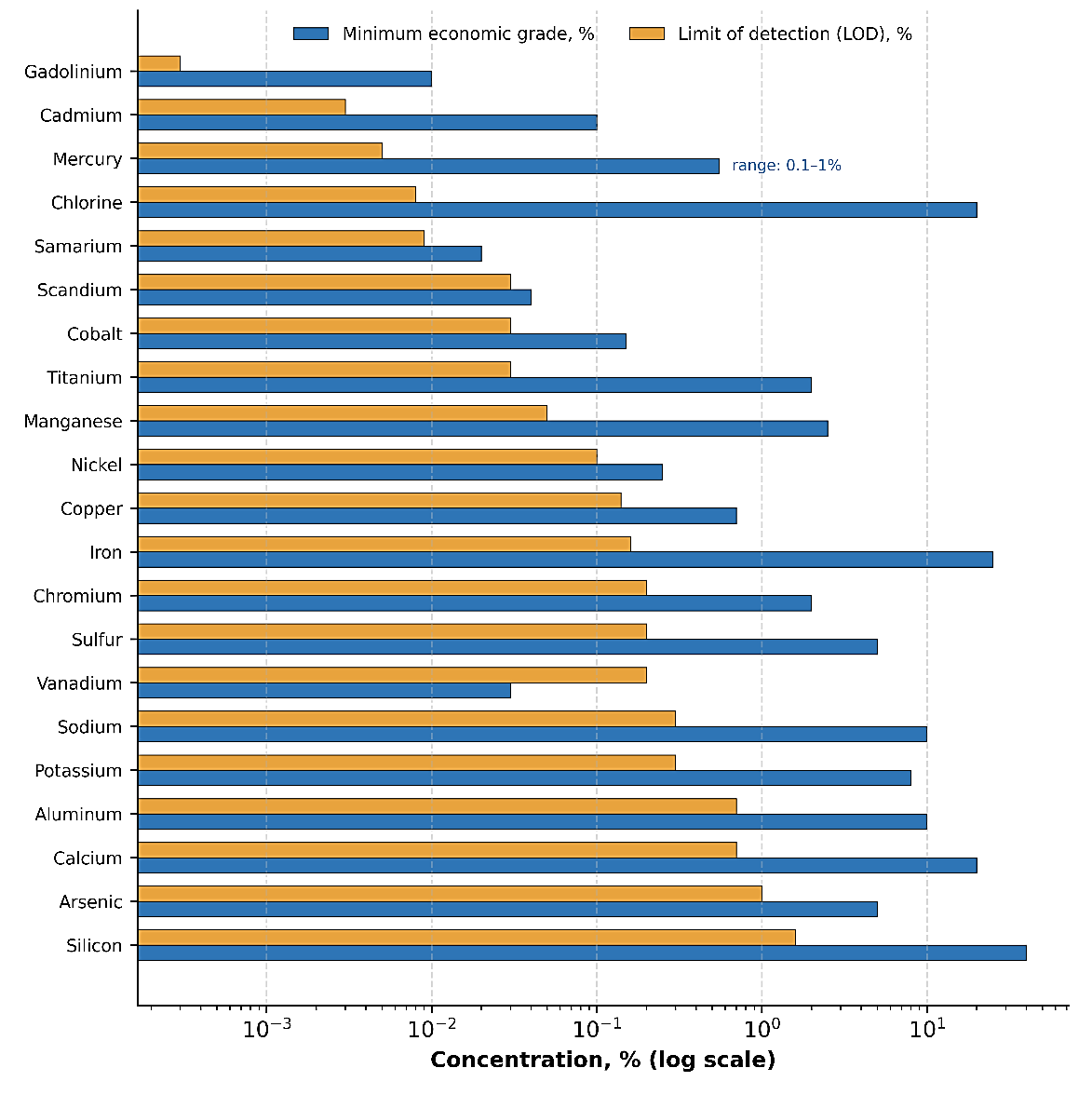
Figure 2 demonstrates that the detection limits achieved are, for most elements, one to three orders of magnitude below the corresponding economic threshold, indicating sufficient analytical sensitivity for practical applications.
Gamma Activation Analysis (GAA)
A relatively less studied but promising method of elemental analysis is based on the use of gamma spectrometry of radiation generated in photonuclear reactions under the influence of bremsstrahlung radiation.
As a result of the interaction of gamma quanta with atomic nuclei via reactions of the type Xᴀ(γ, γ′)Xᴀᵐ, gamma-emitting isomeric states are formed [2, 4]. In certain elements with atomic mass greater than 33, such photonuclear reactions lead to the formation of isomers with sufficiently long half-lives.
The probability of photonuclear reactions leading to the formation of isomeric nuclei exhibits a threshold behavior. That is, for each atomic nucleus, such reactions occur only when the energy of the incident high-energy gamma quanta exceeds a specific threshold value.
The main nuclear-physical characteristics governing the formation of isomers (i.e., metastable nuclear states) and the corresponding analytical methods based on them include: the cross-section of the photonuclear reaction, the threshold energy required for the reaction, the half-life of the resulting isomer, and the yield and energy of the emitted gamma radiation.
Nuclear isomerism is determined by the structural features of atomic nuclei. Isomeric states arise when the transition of a nucleus to a lower energy state via gamma emission is hindered. Such isomers are particularly common in specific regions of mass numbers, often referred to as “islands of isomerism” (A ≈ 50, 82, 126).
The threshold energy of the (γ, γ′) reaction is determined by the fundamental properties of atomic nuclei, primarily the nuclear charge and mass. An important role is also played by the gamma-ray yield and the intensity of the emitted radiation.
As the atomic number decreases, the threshold energy for the (γ, γ′) reaction generally increases, which can be exploited for the selective determination of specific elements. For practical applications of the (γ, γ′) reaction in elemental analysis, it is advisable to use gamma radiation with energies below 20 MeV.
According to literature data on gamma activation analysis, when the energy exceeds approximately 12 MeV, the variety of photonuclear reactions increases significantly. In addition to the (γ, γ′) reaction, other processes such as (γ, n), (γ, p), and (γ, f) reactions may occur. The presence of these additional reactions complicates the resulting gamma spectrum emitted by the sample, leading to difficulties in spectral identification and in accounting for the influence of interfering elements during analytical measurements.
The experimental studies in this work were carried out using a linear electron accelerator of the UELR-8-10A type, which produces bremsstrahlung radiation with a maximum energy of approximately 8.5 MeV.
Experimental Setup and Analytical Procedure for Gamma Activation Analysis
A relatively large sample mass of approximately 500 g was used. The experimental setup was designed with a vertical configuration. At a height of 12 meters, both the investigated and reference samples were weighed and then allowed to move vertically under the influence of gravity, stopping at the irradiation position where they were exposed to a bremsstrahlung beam with an energy of 8.5 MeV.
The irradiation time was selected based on the half-lives of the isomers formed in the investigated and reference samples as a result of photonuclear reactions. Experimental studies were carried out using model mixtures based on gold- and silver-bearing sulfide ore matrices with varying concentrations of Au, Ag, W, Y, and Re. These model mixtures were prepared by mixing known quantities of the target elements according to certified reference mixture preparation procedures. As a result, correlations were established between the intensity of gamma radiation emitted by metastable nuclei formed in photonuclear reactions and the concentration of the target elements in the model samples [10, 11].
The spectrometric system was based on a high-purity germanium (HPGe) semiconductor detector with an energy resolution of 1.7 keV at the 1333 keV gamma line of 60Co. The gamma spectra were processed using the modern spectrometric software package Genie-2000.
Under irradiation with bremsstrahlung radiation of 8.5 MeV and photon flux densities in the range of 10¹³–10¹5 photons/(cm²·s), photonuclear reactions leading to the excitation of isomeric states occur only in a limited number of elements, including yttrium (89Y), gold (¹97Au), silver (¹07,¹09Ag), tungsten (¹8³W), and others.
Analysis of the gamma spectra of irradiated samples showed that the isomer ¹07ᵐAg, with a half-life of 44.3 s, exhibits an analytical gamma line at 93.2 keV, while the isomer ¹09ᵐAg, with a half-life of 39.6 s, has a gamma line at 88 keV.
As a result of the following photonuclear reactions, short-lived isomers of silver are formed:
107Ag (γ, γ’) 107mAg; 109Ag (γ, γ’) 109mAg (3)
Samples with known silver contents (reference materials) and unknown samples were irradiated sequentially, and the mass fraction of silver in the samples was determined using a relative method.
Taking into account the half-lives of the isomers ¹07ᵐAg and ¹09ᵐAg, the optimal analytical time regimes were calculated as follows: irradiation time t(irr) = 40 s, cooling time t(cool) = 2 s, and measurement time t(meas) = 38 s. The total time required for determining the silver content in a single sample was approximately 80 seconds.
Thus, based on the conducted studies evaluating the applicability of nuclear-physical methods for elemental analysis of technogenic and environmental samples, the effective analytical ranges and detection limits for the determined chemical elements were established.
Conclusion
The elemental composition of soils and plants collected from industrial and technogenic regions of Uzbekistan was investigated using instrumental neutron activation analysis (INAA). Certified reference materials, including IAEA-336 (Lichen) and NIST SRM 1572 (Citrus Leaves), were used to verify the accuracy and reliability of the analytical procedures. The comparison of experimental and certified values demonstrated good agreement and confirmed the validity of the developed methodologies.
The neutron-radiation analytical method was applied to ores and rocks, and its capabilities for the simultaneous determination of iron (Fe), copper (Cu), potassium (K), sodium (Na), manganese (Mn), chlorine (Cl), titanium (Ti), and aluminum (Al) were demonstrated. The obtained results indicate that neutron-based analytical techniques provide high sensitivity, multi-element determination, and low detection limits, making them suitable for environmental monitoring and technological process control.
In addition, the applicability of gamma activation analysis for determining the elemental composition of technogenic and environmental samples was evaluated. Based on the conducted studies, the analytical ranges and detection limits for a number of chemical elements were established. The results confirm that nuclear-physical analytical methods are effective tools for the investigation of environmental and technogenic objects and have significant potential for applications in ecological assessment, geological exploration, and mining-metallurgical industries.
References