
Research on the flotation enrichment process of “Changi” glauconite using alkylbenzenesulfonic acid
УДК 622.7+553.6
Abstract
The technological parameters of the use of alkylbenzenesulfonic acid as a reagent in the enrichment of the “Changi” glauconite mineral using a flotation machine were studied in laboratory conditions. A glauconite sample passed through a 0.075 mm sieve was used for the study. Flotation experiments were conducted in a laboratory flotation machine in an environment with pH = 5 – 7. The pulp composition was prepared from 332 g of mineral and 2 l of water (solid: liquid = 1: 6). Flotation was carried out in three stages. According to the final results, the total mass of the concentrate was 145 g, the sediment was 184 g, and the loss was 3 g. The yield of the concentrate in terms of percentage concentration was 43.67 %, the sediment yield was 55.42 %, and the loss was 0.90 %. The results obtained indicate that alkylbenzenesulfonic acid has the potential to increase flotation efficiency by selectively hydrophobizing glauconite particles.
Аннотация
Изучены технологические параметры использования алкилбензолсульфоновой кислоты в качестве реагента при обогащении минерала глауконита «Чанги» с помощью флотационной машины в лабораторных условиях. Флотация — один из наиболее эффективных физико-химических методов разделения при обогащении полезных ископаемых. Этот метод основан на изменении гидрофобных или гидрофильных свойств поверхности минеральных частиц. Эффективность реагента зависит от крупности частиц, плотности пульпы, расхода реагента, продолжительности флотации и значения pH среды. Для исследования использовался образец глауконита, прошедший через сито размером 0,075 мм. Флотационные эксперименты проводились в лабораторной флотационной машине в среде с pH = 5–7. Состав пульпы готовился из 332 г минерала и 2 л воды (твердое: жидкое = 1: 6). Флотация проводилась в три стадии. По окончательным результатам общая масса концентрата составила 145 г, осадка — 184 г, потерь — 3 г. Выход концентрата в процентном отношении концентрации составил 43,67 %, выход осадка — 55,42 %, потери — 0,90 %. Полученные результаты показывают, что алкилбензолсульфоновая кислота имеет потенциал повышения эффективности флотации путем селективной гидрофобизации частиц глауконита.
Keywords: Glauconite; flotation; alkylbenzenesulfonic acid; collector; enrichment; concentrate; mineral raw materials; proportions; crushing.
Ключевые слова: Глауконит; флотация; алкилбензолсульфоновая кислота; собиратель; обогащение; концентрат; минеральное сырье; пропорции; дробление.
Introduction
Glauconite is an iron‑potassium hydrosilicate with a layered structure, which, due to its high content of K2O (up to 6–8 %), Fe2O3 (up to 20–25 %), as well as aluminium and silicon, is a promising multifunctional raw material for agriculture, the chemical industry, and the production of sorbents and mineral pigments. Glauconite‑bearing rocks are widespread in the region, and among them, the “Changi” deposit is of particular interest. It was previously established that glauconite sandstones from eastern Uzbekistan are a promising raw material for the production of mineral pigments [1]. The general characteristics of glauconite‑containing sands in the republic and the directions for their practical use are substantiated in work [2].
The issues of beneficiation of glauconite‑containing rocks from the “Changi” deposit have been considered in a number of publications. Thus, D.K. Adylov and his co‑authors investigated the possibility of beneficiation of glauconite‑containing sandstones from this deposit [3]. Makhsudova Z.I. and her co‑authors studied the enrichment of pigment‑containing sandstones from the same deposit [4]. Bauatdinov S.N. and Aimbetov I.K. developed recommendations for the use of enriched glauconite sand as a fertilizer in agriculture [5].
Flotation is one of the most effective physicochemical separation methods used in the enrichment of minerals. It is based on changing the hydrophobic or hydrophilic properties of the surface of mineral particles due to the adsorption of collectors. Among the anion-active reagents, alkylbenzenesulfonic acid (ABSC) stands out, which is characterized by its ability to adsorb on the surface of silicate minerals and stabilize the foam layer [9]. Previously, the effectiveness of ABSC application was shown in the flotation enrichment of graphite ores from the Taskazgan deposit [6, 7, 8].
At the same time, there are no systematic studies of flotation enrichment of glauconite from the Changi deposit using alkylbenzenesulfonic acid as a collector in the available literature. The influence of the reagent consumption, the duration, and the number of stages in the process on the concentrate yield remains unstudied. Chemical and mineralogical studies have confirmed the suitability of “Changi” glauconites for the production of ceramic pigments [10], which further substantiates the relevance of developing an effective technology for their enrichment.
The aim of this work is to study the technological parameters of flotation enrichment of glauconite from the “Changi” deposit using alkylbenzene sulfonic acid under laboratory conditions and to determine the optimal process conditions.
Materials and methods
The enrichment of “Changi” glauconite with alkylbenzenesulfonic acid in a flotation machine under laboratory conditions, the effect of reagent consumption and flotation duration on concentrate yield was determined.
Object of the study. The object was a sample of glauconite ore from the Changi deposit, collected using the standard method for sampling solid mineral deposits.
Material preparation. The initial sample weighing 322 g was dried at 105 °C until it reached a constant mass, then crushed and ground, after which it was sifted through a laboratory sieve with a mesh size of 0.075 mm. The choice of this particle size class is due to the need to increase the specific surface area of the particles to intensify the adsorption of the collector and increase the likelihood of adhesion to air bubbles.
Equipment. Flotation experiments were conducted in a laboratory flotation machine with mechanical mixing and air supply. The pulp pH was monitored using a pH meter and maintained within the range of 5–7 using buffer solutions.
Pulp preparation. The pulp was prepared by mixing 332 g of the prepared material with 2 L of tap water, with a solid-to-liquid ratio of 1:1.6. Alkylbenzene sulfonic acid (ABS) was used as a collector – an anion‑active reagent that provides hydrophobization of the surface of silicate minerals.
Flotation scheme. The flotation was carried out in three stages. At each stage, the reagent consumption (in drops, converted to grams), the duration of the process, and the mass of the obtained concentrate were recorded. Stage 1: 28 min at a consumption of 0.390 g (15 drops); Stage 2: 20 min at a consumption of 0.208 g (8 drops); Stage 3: 18 min at a consumption of 0.130 g (5 drops). After each stage, the foam product (concentrate) was separated, dried, and weighed. The chamber product (sediment) was sent to the next stage.
Assessment of results. The enrichment efficiency was assessed based on the concentrate yield (the ratio of the concentrate mass to the mass of the original sample, %). Losses were determined as the difference between the mass of the original sample and the sum of the masses of the concentrate and the sediment.
Research results
During the three‑stage flotation of glauconite ore from the Changi deposit using alkylbenzene sulfonic acid, the following results were obtained.
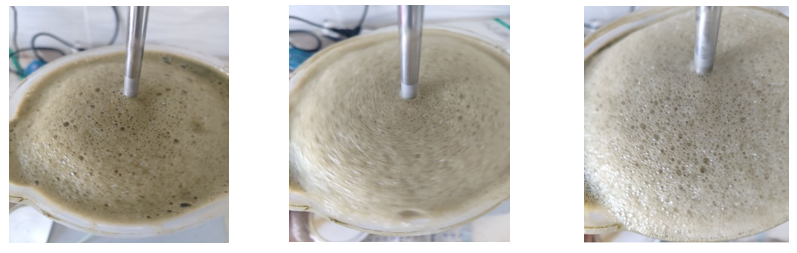
At the first stage (reagent consumption: 0.390 g, 28 min), 69 g of concentrate was separated, which amounted to 42.76 % of the total yield. The froth layer was thick and stable, which indicates active release of hydrophobic particles.
At the second stage (0.208 g, 20 min), 39 g of concentrate (26.90 %) was obtained. The froth layer became less intense, but flotation continued steadily.
At the third stage (0.130 g, 18 min), an additional 44 g of concentrate (30.34 %) was isolated. A fine‑bubbled froth layer was observed, which ensured the additional extraction of the remaining particles.
The total mass of the concentrate after three stages was 152 g (69 + 39 + 44), the mass of the sludge was 184 g, and the losses were 3 g. The concentrate yield was 43.67 %, the sludge yield was 55.42 %, and the losses were 0.90 % (Tables 1, 2).
The highest concentrate yield was achieved at the first stage, which is explained by the maximum consumption of the collector and the high content of hydrophobic particles in the initial pulp. The decrease in yield at subsequent stages is naturally linked to a reduction in reagent consumption and the separation of the bulk of the flotable particles at previous stages. The three‑stage scheme ensures a higher degree of recovery compared to the single‑stage one. Losses of less than 1 % confirm the correctness of the methodology and the maintenance of the material balance.
Table 1.
Results of triple flotation enrichment of glauconite ore
| Name | Water quantity (l) | Glauconite ore (gr) | Amount of ABSK flotation agent, (drops, gr) |
Flotation time (min) | Finished concentrate (gr), (%) |
Residue after flotation (gr), (%) |
|---|---|---|---|---|---|---|
| First enrichment | 184 (55,42%) |
|||||
| Sample 1 | 2,0+0,9=2,9 | 332.0 | 15 / 0,390 | 28 | 69 (42,76%) | |
| Second enrichment | ||||||
| Sample 2 | 1,0 | - | 8 / 0,208 | 20 | 39 (26,90%) | |
| Third enrichment | ||||||
| Sample 3 | 1,0 | - | 5 / 0,130 | 18 | 44 (30,34%) | |
Table 2.
Concentrate formed during flotation enrichment
| Name | Weight (g) | Mass fraction (%) |
|---|---|---|
| Concentrate | 145 | 43,67 |
| Sediment | 184 | 55,42 |
| Loss | 3 | 0,90 |
| Total | 332 | 100,00 |
In the second stage, the amount of reagent was reduced from 0.390 g to 0.208 g. Due to the decrease in reagent concentration and the separation of most of the flotation-prone particles in the first stage, the concentrate yield was 39 g. This represents the natural kinetic law observed in multi-stage flotation.
Although the reagent consumption in the third stage was reduced to 0,130 g, 44 g of concentrate was separated. This result is explained by the additional flotation of small and relatively weak hydrophobic particles remaining in the pulp after the second stage. This indicates that the three-stage flotation scheme provides a higher overall separation efficiency compared to single-stage flotation.
In total, 145 g of concentrate was recovered, representing a concentrate yield of 43.67 %. The tailing (sediment) fraction was 55.42 %, while the technical loss was only 0.90 %. A loss of less than 1 % indicates that the experimental methodology was correctly selected and that the mass balance was almost fully preserved under laboratory conditions.
The following photographs show the gradual formation of flotation foam. In the first stage, the foam layer was thick and stable, indicating active separation of hydrophobic particles. In the second stage, the foam layer became relatively thin, but flotation continued. In the third stage, a fine-bubble foam was observed, which provided additional separation of the remaining particles [7, 8, 9, 10, 11].
|
||
|---|---|---|
Figure 1. General view of the foam layer formed in the first flotation stage (0.390 g reagent, 28 min) |
Figure 2. Foam stabilization in the second flotation stage (0.208 g of reagent, 20 min) |
Figure 3. Structure of the fine-bubble foam formed in the third flotation stage (0.130 g reagent, 18 min) |
The flotation process is a complex process that depends on the physicochemical properties of mineral particles, reagent type, pulp composition, flotation duration, and particle size. In this study, alkylbenzenesulfonic acid was used as a collector for “Changi” glauconite, and a three-stage flotation scheme was tested.
Conclusion
The results obtained showed that the “Changi” glauconite of alkylbenzenesulfonic acid can be used as an effective collector in flotation enrichment. The three-stage flotation scheme allows obtaining a higher concentrate than the single-stage process. These results can serve as initial laboratory data for the development of industrial-scale glauconite enrichment technology.
The flotation time in the first stage was 28 minutes, during which time sufficient conditions were created for adsorption of the collector to the mineral surface and the formation of stable aggregates with air bubbles. Although the flotation time was reduced to 20 and 18 minutes in the subsequent stages, the additional concentrate obtained demonstrates the importance of choosing a balance between the process duration and the consumption of reagents.
References
