Catalytic synthesis of acetic aldehyde from acetylene
УДК 547.314.2:54 – 44
Abstract
The objective of this work is to develop and evaluate active, selective, stable, and long-lasting catalysts for acetaldehyde production processes and to determine the main factors influencing their catalytic performance. The effects of catalyst composition, preparation method, active components, support materials, and operating conditions on activity, selectivity, stability, and service life were analyzed. Particular attention was paid to metal oxide and modified multicomponent catalytic systems because of their high thermal stability, catalytic activity, and resistance to deactivation. The results indicate that highly active catalysts can improve raw material conversion and increase acetaldehyde yield, whereas highly selective systems reduce the formation of undesirable by-products. Stable and durable catalysts can also decrease energy consumption, production costs, and the frequency of catalyst replacement. In addition, the possibility of catalyst regeneration is an important factor in increasing the economic efficiency of industrial processes. Environmental aspects of catalyst application were also considered. The use of low-toxic, environmentally friendly, and regenerable catalysts can reduce hazardous waste and minimize adverse environmental impacts. Thus, the development of efficient, selective, durable, and recyclable catalytic systems is a promising approach for improving the technological efficiency, environmental safety, and sustainability of acetaldehyde production.
Аннотация
Целью данной работы является разработка и оценка активных, селективных, стабильных и долговечных катализаторов для процессов производства ацетальдегида, а также определение основных факторов, влияющих на их каталитические характеристики. Было проанализировано влияние состава катализатора, метода его приготовления, активных компонентов, материалов-носителей и условий проведения процесса на активность, селективность, стабильность и срок службы катализаторов. Особое внимание уделено металлоксидным и модифицированным многокомпонентным каталитическим системам благодаря их высокой термической стабильности, каталитической активности и устойчивости к дезактивации. Результаты показывают, что высокоактивные катализаторы способны повышать степень конверсии исходного сырья и увеличивать выход ацетальдегида, тогда как высокоселективные системы способствуют снижению образования нежелательных побочных продуктов. Стабильные и долговечные катализаторы также позволяют снизить энергопотребление, производственные затраты и частоту их замены. Кроме того, возможность регенерации катализаторов является важным фактором повышения экономической эффективности промышленных процессов. Также были рассмотрены экологические аспекты применения катализаторов. Использование малотоксичных, экологически безопасных и регенерируемых катализаторов способствует сокращению объёма опасных отходов и минимизации негативного воздействия на окружающую среду. Таким образом, разработка эффективных, селективных, долговечных и пригодных к повторному использованию каталитических систем является перспективным направлением повышения технологической эффективности, экологической безопасности и устойчивости производства ацетальдегида.
Keywords: acetaldehyde; catalyst; catalytic activity; selectivity; metal oxides; chemical industry; stability.
Ключевые слова: ацетальдегид; катализатор; каталитическая активность; селективность; оксиды металлов; химическая промышленность; стабильность.
Introduction
The Kucherov reaction is a method for synthesizing acetaldehyde by the hydration of acetylene with water in the presence of a mercury (II) oxide catalyst dissolved in sulfuric acid. This process is one of the most important reactions in the organic synthesis industry and is based on the electrophilic addition reaction of acetylene. The reaction initially produces vinyl alcohol, which is converted to acetaldehyde by tautomerization. The process is usually carried out in an acidic environment and at a certain temperature [1-2].
The mechanism of this reaction is still unclear. It is believed that the following reactions occur in the presence of mercuric sulfate. Based on the following mechanism, an unsaturated alcohol is regrouped into an oxo compound.
The process of acetylene hydration is mainly carried out in industry on a continuous technological scheme. In this case, acetylene gas is passed through a catalyst solution – that is, through a solution of mercury (II) sulfate in sulfuric acid (to ensure good mixing of gas and liquid and efficient reaction) is carried in the form of tiny gas bubblesDuring the process, acetylene reacts with water to initially form vinyl alcohol, which quickly tautomerizes to acetaldehyde. This method is one of the important technological processes for obtaining acetaldehyde in the organic synthesis industry [3-4].
The concentration of sulfuric acid in the catalyst solution in various technological devices is usually in the range of 6–35 %. With an increase in the acid concentration, the hydration reaction of acetylene accelerates and the volume of the catalyst solution decreases. At the same time, if the acidity of the medium is too high, a number of additional reactions occur. In particular, the formation of crotonaldehyde, tarring of organic products, and the formation of resinous substances are observed. These conditions reduce the productivity of the process and lead to contamination of the equipment [5-6].
The content of mercury (II) oxide in the catalyst usually does not exceed 1 % and is often used in a lower concentration. The hydration process is mainly carried out in the temperature range of 75–100 °C. With increasing temperature, the reaction rate increases, but at the same time the degree of tarring of acetylene and the resulting products also increases. Therefore, the optimal temperature is selected depending on the catalyst composition, the design of the apparatus and the volumetric velocity of acetylene [7-8].
Experimental and Discussion Part
In the preparation of the catalyst, Zn(NO3)2·6H2O, Mg(NO3)2·6H2O, Fe(NO3)3·6H2O, Mn(NO3)2·6H2O and ZrO(NO3)2 salts were used as sources of active components. The mass fractions of these salts in the initial catalytic composition were taken in the ratio of 5:3:5:3:1, respectively. These ratios represent the mass percentages of the initial salts, not the oxides [9-10].
Accordingly, to prepare 100 g of the initial catalytic composition, 5.0 g of Zn(NO3)2·6H2O, 3.0 g of Mg(NO3)2·6H2O, 5.0 g of Fe(NO3)3·6H2O, 3.0 g of Mn(NO3)2·6H2O, and 1.0 g of ZrO(NO3)2 were taken. Since the total amount of salts was 17.0 g, the remaining 83.0 g of the composition corresponds to the contribution of activated bentonite (YKS) used as a carrier.
Table 1.
Amount of components per 100 g of starting composition
| No. | Component | Mass fraction, % | Quantity, g |
|---|---|---|---|
| 1 | Zn(NO₃)₂·6H₂O | 5 | 5.0 |
| 2 | Mg(NO₃)₂·6H₂O | 3 | 3.0 |
| 3 | Fe(NO₃)₃·6H₂O | 5 | 5.0 |
| 4 | Mn(NO₃)₂·6H₂O | 3 | 3.0 |
| 5 | ZrO(NO₃)₂ | 1 | 1.0 |
| 6 | Activated bentonite (HSZ) | 83 | 83.0 |
Initially, 83.0 g of activated bentonite (HSZ) was prepared. Metal salts, which are precursors of the active components, were weighed on an analytical balance at specified masses and dissolved in distilled water separately or under compatible dissolution conditions. The resulting salt solutions were gradually introduced into the UCS-based system and continuously mixed using a magnetic stirrer until a homogeneous suspension was formed [9-10].
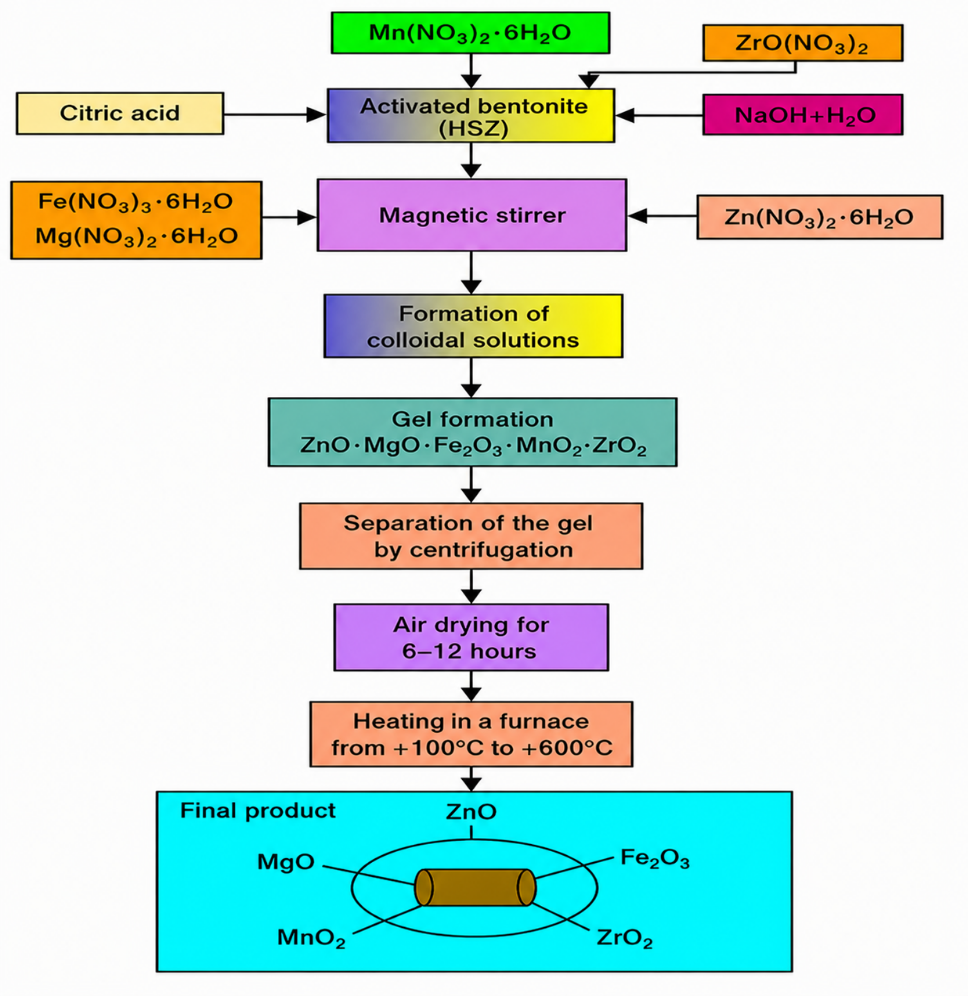
During the mixing process, a uniform distribution of metal ions on the carrier surface was ensured and a colloidal system was formed. In the next step, the system was converted to a gel state, forming a homogeneous gel containing Zn, Mg, Fe, Mn and Zr components. The resulting gel was separated from the liquid phase by centrifugation. The separated gel was air-dried under atmospheric conditions for 6–12 h. The dried sample was initially kept at low temperature, then the temperature was gradually increased and thermally treated up to 600 °C. During the thermal treatment, the dehydration and decomposition of the precursor salts resulted in the formation of catalytically active oxide phases, which ensured the formation of a multicomponent catalytic system consisting of ZnO·MgO·Fe2O3·MnO2·ZrO2 on the surface of the HSZ.
Thus, the mass composition of the initial components is Zn(NO3)2·6H2O:Mg(NO3)2·6H2O:Fe(NO3)3·6H2O:Mn(NO3)2·6H2O:ZrO(NO3)2
A catalytic composition with the ratio of :HSZ = 5:3:5:3:1:83 was prepared.
Results and Discussion
The effect of various factors (temperature, volume flow rate, acetylene:water ratio, catalyst composition, etc.) on the product yield and process selectivity in the catalytic hydration reaction of acetylene was studied. Table 2 presents the effect of the catalyst active components on the reaction products [10].
Table 2.
Effect of starting materials on catalyst activity in the catalytic hydration reaction of acetylene
| No. | Catalyst composition | С2H2 of conversion, % |
Selectivity % |
|
|---|---|---|---|---|
| General | To acetaldehyde | |||
| 1 | ZnO:Fe2O3:MnO2/ HSZ | 62.4 | 50.8 | 81.4 |
| 2 | ZnO:MgO:MnO2/ HSZ | 63.2 | 51.9 | 82.1 |
| 3 | ZnO:MgO:Fe2O3/ HSZ | 70.2 | 60.3 | 85.8 |
| 4 | ZnO:Fe2O3:MnO2:ZrO₂/ HSZ | 75.8 | 66.5 | 87.7 |
| 5 | ZnO:MgO:MnO2:ZrO₂/ HSZ | 85.7 | 78.9 | 92 |
| 6 | ZnO:MgO:Fe2O3:MnO2/ HSZ | 92.8 | 87.6 | 94.3 |
| 7 | ZnO·MgO·Fe₂O₃·MnO₂·ZrO₂/ HSZ | 97.7 | 93.5 | 95.7 |
| 8 | ZnO:Сo2O3:Сr2O3:MnO2:ZrO₂/ HSZ | 90.2 | 84.2 | 93.3 |
| 9 | ZnO:Сo2O3:Сr2O3:Mn2O3:ZrO₂/ HSZ | 84.3 | 76.2 | 90.3 |
| 10 | ZnO:Fe2O3:Сr2O3:Mn2O3:V2O5/ HSZ | 78.3 | 65.4 | 83.5 |
As can be seen from the data presented in the table, the activity of pure ZnO:Fe2O3: MnO2/ HSZ is much higher. With its participation, the total conversion of acetylene is 62.4 %, and the selectivity of acetaldehyde is 81.4 %. The introduction of Сo2O3 and Mn2O3 into this catalyst leads to a decrease in the yield of acetaldehyde. The introduction of MgO and ZrO2 into the catalyst composition prepared from ZnO:Fe2O3/YKS has a different effect on the yield of acetaldehyde.
Studies have shown that the highest acetaldehyde yield is achieved when ZrO2 is added to the ZnO:MgO: Fe2O3: MnO2/ HSZ catalyst. The addition of ZrO2 to the catalyst composition had a positive effect on the activity of the catalyst. With the addition of ZrO2, the acetylene conversion increased from 92.8 % to 97.7 %, and the selectivity increased from 94.3 % to 95.7 %.
Selectivity indicates how much of the starting material (i.e., the converted material, in our Table 1, the converted acetylene) is converted into the target product (acetaldehyde).
Based on the above, we selected a catalyst with high activity, selectivity, and productivity, with high selectivity and thermal stability, using a suspension method based on local raw materials.
When studying the effect of temperature on the yield of acetaldehyde formation in the presence of the newly developed catalyst No. 7, which has high activity and productivity, it was found that the optimal temperature for the acetylene hydration reaction is 330 – 340℃ (Table 3).
Table 3.
Effect of temperature on the yield of acetaldehyde and the selectivity of the process for the conversion of acetylene (cat. No. 7)
| No. | Temperature, ohC |
Total acetylene conversion, % | AcetaldehydeProduction, % | Selectivity S % to Acetaldehyde |
|---|---|---|---|---|
| 1 | 10-250 | 66.2 | 47.6 | 71.9 |
| 2 | 255-275 | 79.4 | 62.2 | 78.3 |
| 3 | 280-300 | 87.2 | 73.2 | 83.9 |
| 4 | 310-325 | 89.9 | 77.7 | 86.4 |
| 5 | 330-340 | 97.7 | 93.5 | 95.7 |
| 6 | 345-375 | 90.1 | 82.4 | 91.4 |
| 7 | 380-400 | 82.4 | 70.5 | 85.5 |
As can be seen from the table, when the temperature reaches 330 – 340℃, the yield of acetaldehyde formation is 93.5 %, and the selectivity of the process towards acetaldehyde is 95.7 %.
The metal reactor (7) is 40 mm in diameter and 380 mm high, with a mesh substrate for the catalyst installed in the lower part. The upper flange cover is equipped with two fittings: a valve for supplying the steam-gas mixture (acetylene saturated with water vapor) and a thermowell (8). The lower flange-bottom part is equipped with fittings for removing the reaction products.
TEN-06 heating elements with a total power of 3.6 kV are evenly distributed around the reactor vessel (7), which are connected to a 220 V network through a control transformer (9). To prevent overheating, it is not allowed to supply a voltage of more than 220 V.
The reactor surface is insulated and wrapped to retain heat and ensure a stable temperature. The temperature in the reactor was measured by a THC thermocouple with signals output to the temperature control unit (11), the readings were recorded on a KSP potentiometer or indicating device.
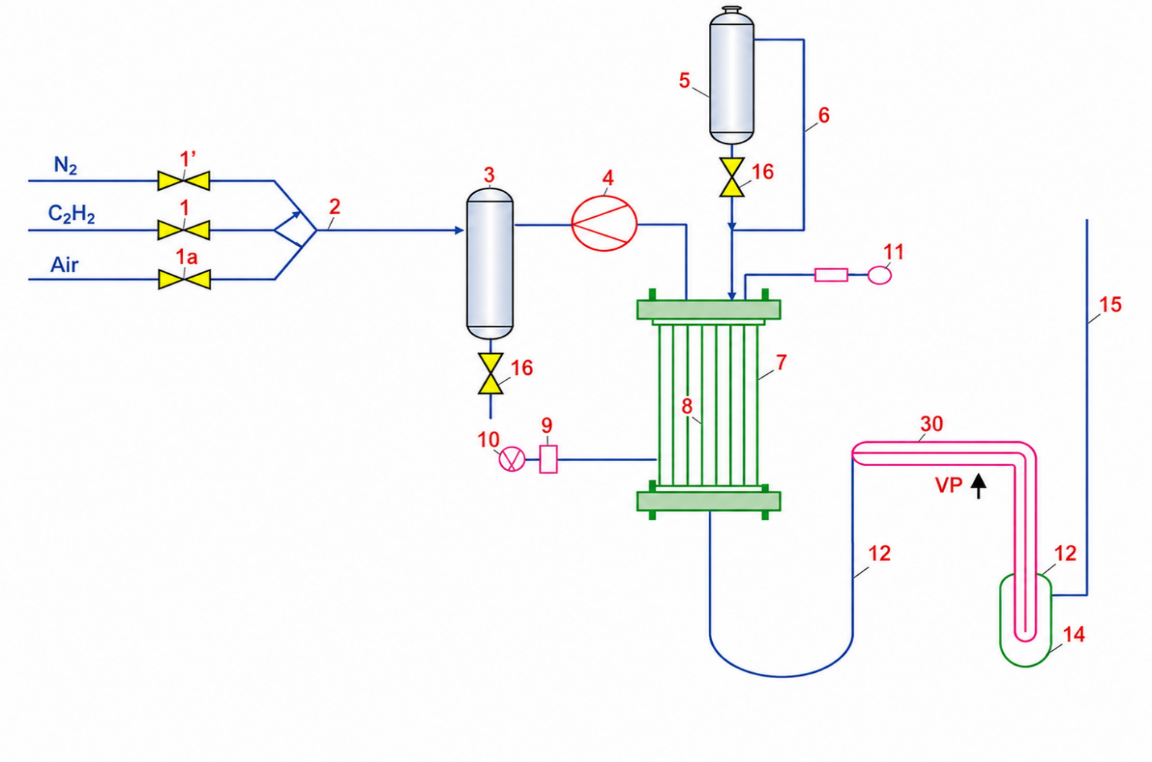
1-needle valve; 2-flexible removable part; 3-drip eliminator;
4-rheometer; 5-water distribution funnel; 6-bypass line; 7-reactor; 8-thermowell; 9-transformer; 10-voltmeter; 11-block for temperature control in the reactor; 12-air cooler; 13- water-cooled refrigerator (Lebix); 14-reaction gas scrubber; 15 – exhaust gas discharge line; 16-tap
To carry out the synthesis, a certain amount of catalyst was loaded into the reactor. The catalyst was heated in a nitrogen stream. When the temperature reached 330 – 340°C, the valve on the mixed gas line of workshop No. 007 was opened (or acetylene concentrate from a cylinder), and the valve on the nitrogen line was closed. Water (5) with a temperature of ≈70 – 80°C was passed through the bypass line (6) to saturate it with water vapor. Then the gas saturated with vapor entered the reactor, where it reacted with the catalyst at a temperature of 330 – 340°C. During the reaction, the parameters of the technological regime, temperature conditions, and flow rates of the supplied components were measured.
The gaseous reaction products were cooled first in an air cooler (12) and then in a water-cooled refrigerator (Liebig) (13). The condensate and acetaldehyde vapors were absorbed in absorbers with xylene (14) placed in an ice bath (3 – 8°C). The reaction products obtained with the collected xylene were chromatographically analyzed for their composition. The inlet and outlet gases were periodically analyzed by gas chromatography.
After 120 hours, the supply of acetylene to the system is stopped. The system is purged with nitrogen and the catalyst is regenerated. Regeneration is carried out at a temperature of 330 – 340℃ for 12 hours. After the acetylene is squeezed out of the system, a nitrogen-air mixture is supplied. Regeneration is considered complete if the carbon dioxide content in the gases does not exceed 0.4 %.
Based on the results of the experiment and the qualitative and quantitative composition of the reaction products, the following mechanism of acetone formation in the presence of the given catalyst was proposed:
The formation of acetaldehyde can be expressed as the following summation equation:
2C2H2 + 3H2O → CH3COCH3 + 2H2 + CO2
We explain the formation of acetylene based on the following plausible mechanism: first, acetylene is hydrated and acetaldehyde is formed:
C2H2 + H2O → CH3CHO
Conclusion
The development of active and long-lasting catalysts for the production of acetaldehyde is important for increasing the efficiency of the process. Highly active catalysts increase product yield, reduce energy consumption and production costs. Metal oxides and modified catalytic systems provide high stability and selectivity. Also, the use of environmentally friendly and regenerable catalysts is relevant for the modern chemical industry.
References