
Retrospective analysis of factors affecting pressure pipelines in pumping stations
УДК 621.65+628.2
Abstract
The article examines the factors and characteristics affecting pressure pipelines at pumping stations. Retrospective analysis of factors affecting pressure pipelines. During the retrospective analysis of factors affecting pressure pipelines at pumping stations, a pressure test was conducted on the water pipelines. The main technical characteristics and causes of failure of the closed irrigation system, as well as biological corrosion of metal pipes and concrete structures of pumping stations, were analyzed. Methods for diagnosing the technical condition of pipelines, namely X-ray, ultrasound, and acoustic emission and thermal imaging, were proposed, and the results were analyzed. To improve pipeline efficiency, we extend the service life of pipelines by performing hydrodynamic cleaning under high pressure, operating outgoing robots, cleaning with chain devices via brush feed or brush feed, and applying coatings to water pipelines during repair, specifically using an epoxy mixture. In addition, painting them with various varnishes and paints also helps to increase the service life of the pipes. Furthermore, it will be possible to achieve more efficient use of the pumping station without observing the cavitation process occurring in the pumps.
Аннотация
В статье рассматриваются факторы и характеристики, влияющие на напорные трубопроводы на насосных станциях. Ретроспективный анализ факторов, влияющих на напорные трубопроводы. При ретроспективном анализе факторов, влияющих на напорные трубопроводы насосных станций, были проведены испытания давления в водопроводных трубопроводах. Проанализированы основные технические характеристики и причины отказов закрытой оросительной системы, а также биологическая коррозия металлических труб и бетонных конструкций насосных станций. Предложены методы диагностики технического состояния трубопроводов, т.е. рентгеновские, ультразвуковые и акустические методы эмиссии и контроля, и проанализированы результаты. С целью повышения эффективности трубопроводов гидродинамическая очистка под высоким давлением, запуск выходящих роботов, очистка цепными устройствами с помощью щеточной подачи или щеточной подачи, нанесение покрытия на водопроводные трубы при их ремонте, то есть использование эпоксидной смеси, продлевает срок службы труб. Кроме того, их окраска различными лаками и красками также способствует увеличению срока службы труб. Также создается возможность достижения более эффективного использования насосной станции без наблюдения процесса кавитации, происходящего в насосах.
Keywords: Pump; retrospective; closed irrigation; pipeline; diagnostics; hydrodynamic cleaning; pressure; epoxy mixture.
Ключевые слова: Насос; ретроспективный; закрытый полив; трубопровод; диагностика; гидродинамическая очистка; давление; эпоксидная смесь.
Introduction
The large number of failures of land reclamation pipelines in the closed network and the unevenness of their distribution during the irrigation period are associated with severe operating conditions: seasonality and interruptions, periodic full or partial discharge, uneven water supply, significant changes in total and individual water consumption caused by frequent switching on and off sprinkler equipment, and the inability to quickly redistribute pressure and flow velocity. All of this negatively affects the occurrence of dynamic loads, the strength of the pipelines, the tightness of the pipeline walls, and, consequently, the reliability of the network.[2]
The lack of internal insulation in steel water pipes and the continuous contact of the metal with the corrosive environment allow for the development of almost all types of corrosion.[8]
A distinctive feature of corrosion processes is their complexity and multi-stage nature. Usually, the corrosion process consists of at least three main stages: transferring the reactants to the phase interface—the reaction zone; essentially, a heterogeneous reaction; and removing reaction products from the reaction zone (Fig. 1.1).[4]
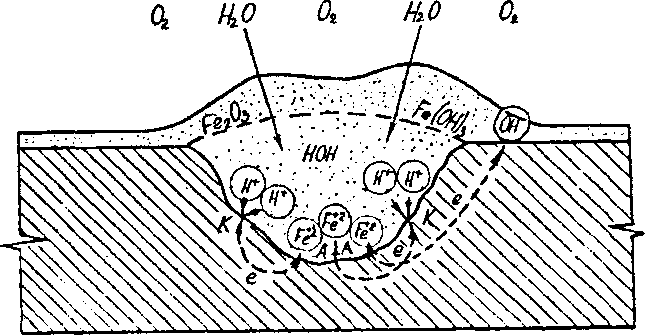
K – cathode sites for reducing oxygen or hydrogen;
A – anodic sites for iron reduction.
Iron corrosion in a neutral aqueous medium occurs with oxygen depolarization. In this case, the cathodic process is the process of ionization of oxygen by the reaction[4]:
О2 + 4е+2Н2О = 4ОН, (1.1)
and anodic – the process of ionizing iron by reaction:
Fe + 2H2O = Fe2+ 2Н2О + 2е (1.2)
During operation, corrosion products, together with particles of mineral origin, form deposits of various shapes and densities on the walls, which leads to a deterioration in the hydrodynamic properties of the pipes, an increase in energy costs for water transport, and water loss due to corrosion.
The results of physical examinations and laboratory analyses have been reviewed, proving the biocorrosive wear and tear of pressure pipelines and reinforced concrete structures of pumping stations. A study of the movement of fine particles showed that the components of the water flow do not contain abrasive materials, as sand materials with a diameter of more than 0.01 mm settle in the pump station's advance chamber. Therefore, complete wear of the entire internal surface of the steel pipeline is not observed.
Materials and methods
Diagnosing the technical condition of existing pipelines is one of the most important indicators affecting their operation. The degree of wear and tear of water pipelines is determined by the reliability indicators of their operation. To ensure the safety and efficient operation of piping systems, the piping system must be inspected regularly.[1]
The choice of the method for repairing an existing pipeline is based on an analysis of the technical and economic indicators of its technical condition. The determining factor, in this case, should be the presence of continuity of the pipeline walls in the test zone and the number of their disruptions.
Diagnosing the condition of the pipeline is a vital component of ensuring the safety and efficient operation of the system. This makes it possible to identify problems at an early stage, prevent accidents and pipe cracks, and extend the service life of the pipes. Various diagnostic methods, such as X-ray, ultrasound, pressure testing, and the use of acoustic emission technology, provide rapid and accurate information about the condition of the pipes. Regular cleaning and inspection of pipes will help reduce economic losses, plan repairs, and meet regulatory requirements.[7],[9]
Currently, the most common methods for diagnosing pipelines are as follows[5]:
The X-ray method: in which X-rays are passed through tubes and an image is recorded on film or a sensor to detect defects. A uniform background illumination on the developed film indicates the absence of defects. If a leak is detected, it is a thickening of the weld or a drop of metal (weld joint). If a blackening is detected, it is a defect, i.e., a hole.
Ultrasound and acoustic emission methods: Mechanical ultrasonic oscillations are sent to the metal pipe using a transducer in a direction specified by the operator and observed on a defect detector. The ultrasound hits the defect surface, is reflected, and returns to the transducer.
Tele-inspection method: The tele-inspection method developed by TARIS NPO consists of moving a robot equipped with a video camera along the pipeline being diagnosed and transmitting the video image to a computer display.
Results and discussion
Pressure testing: a method that evaluates the strength and tightness of pipes by applying increased pressure to the system. There are two main types of pressure tests[3]:
• Hydrostatic testing: This method involves filling a pipeline with water or another liquid and then applying a specified pressure. By monitoring pressure fluctuations and searching for fugitives, you can determine the presence of damage in the system. This method is typically used during the construction stage or after pipe repairs.
• Pneumatic test: In this case, the pipeline is filled with air or gas, and the pressure is raised to a certain level. Then, a leakage test is performed using specialized equipment to detect pressure changes.
Advantages of pipe diagnostics[1]:
• Increased safety: regular inspection of underground pipelines helps prevent accidents and displacements, which helps ensure the safety of personnel and the environment.
• Reducing economic losses: Identifying problems at an early stage allows for measures to be taken to eliminate them before they lead to serious disruptions or accidents. This helps reduce economic losses associated with equipment downtime or system shutdowns.
• Extending the service life of pipes: regular diagnostics allow for the detection and elimination of damage, wear, and corrosion at early stages, which helps extend the service life of pipes. Regular maintenance and repair help maintain their efficiency and reliability over the long term[6].
Mechanical pipe cleaning
• Cleaning with brushes – effective for removing debris and other small pollutants.
• Rubber mats – Do not damage the pipe surface during the process of removing large obstacles, as well as during cleaning.
Restoration and repair of pressure pipelines
To eliminate minor problems occurring inside the pressure pipelines, restoration work is carried out using the following methods (Fig. 1.2).
1. hydrodynamic high-pressure cleaning;
2. running outgoing robots;
3. by brush feed;
4. cleaning by chain devices or brush feed.
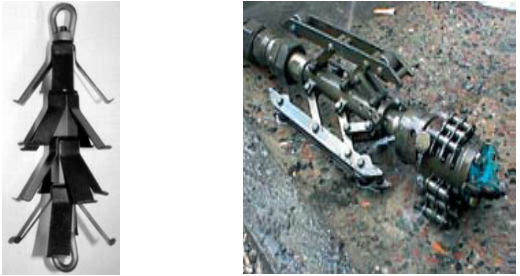
The selection of technologies or methods for pipe repair is initially carried out based on the general or specific situations of the problems observed in them.
Coating (cement or paint). Manual repair.
When repairing water pipelines, it is possible to apply a coating to them, but it is necessary to take special measures against negative changes in water quality. The use of cement in the coating method is considered obsolete, and in Germany and the UK, an epoxy mixture is currently used instead of this material. In addition, painting them with various varnishes and paints also helps to increase the service life of the pipes.
Conclusion
The pressure pipelines of pumping stations are one of the most important and responsible parts of hydraulic structures, and their reliable and safe operation largely depends on a comprehensive study and assessment of the factors influencing the operation process. The conducted retrospective analysis shows that the service life, durability, and occurrence of emergency situations in pressure pipelines are directly linked to a complex of interconnected natural, technical, and technological factors.
In general, a retrospective analysis of the operating conditions of pressure pipelines over the past period allows for the development of scientifically grounded preventive measures and a new diagnostic system to prevent future accidents, increase the reliability of pumping stations, and improve their energy efficiency.
References
