
Production of butanol by hydrogenation of croton aldehyde using CuO·ZnO·NiO·Cr₂O₃/HSZ catalyst
УДК 66.094.3+66.095.26
Abstract
In this work, a hybrid catalyst based on complex oxide (CuO·ZnO·NiO·Cr2O3) and high-silica zeolite (HSZ) was synthesized, and its activity in the hydrogenation of croton aldehyde to n-butanol with high selectivity was studied. The catalyst was prepared by the precipitation method, and the reaction was carried out in a flow hydrogenation reactor. Varying the quantitative ratios of ZnO, Cr2O3 and NiO oxides, as well as additionally introducing CuO or ZnO into the catalyst composition, further increased the activity and selectivity of the catalyst. Particularly, by adding CuO and ZnO to the complex composition, high results were achieved in terms of reaction conversion and selectivity relative to vinyl acetate. In this scientific work, the process of producing butanol was studied in the presence of various catalysts, and an effective new catalyst composition and preparation conditions were determined. The prepared CuO·ZnO·NiO·Cr2O3 catalyst was able to convert croton aldehyde into n-butanol with high selectivity and conversion. The synergy of multicomponent oxides and the structural support of the zeolite provided thermal and mechanical stability to the catalyst. This system is considered promising for implementation in industrial hydrogenation processes. In this composition, the overall conversion of butanol was high, and the formation of by-products in the reaction was recorded at a minimal level.
Аннотация
В данной работе был синтезирован гибридный катализатор на основе сложного оксида (CuO•ZnO•NiO•Cr2O3) и высококремнеземного цеолита (ВКЦ), а также исследована его активность в реакции гидрирования кротонового альдегида до н-бутанола с высокой селективностью. Катализатор был получен методом осаждения, а реакция проводилась в проточном реакторе гидрирования. Изменение количественного соотношения оксидов ZnO, Cr2O3 и NiO, а также дополнительное введение CuO и ZnO в состав катализатора способствовали дальнейшему повышению его активности и селективности. В частности, введение CuO и ZnO в состав сложного оксидного катализатора обеспечило высокие показатели конверсии и селективности процесса гидрирования кротонового альдегида до н-бутанола. В данной научной работе исследован процесс получения н-бутанола в присутствии различных катализаторов, определены эффективный состав нового катализатора и оптимальные условия его приготовления. Синтезированный катализатор CuO•ZnO•NiO•Cr2O3 обеспечил высокую степень конверсии кротонового альдегида и высокую селективность по н-бутанолу. Синергетическое взаимодействие многокомпонентных оксидов и структурная роль высококремнеземного цеолита обеспечили катализатору высокую термическую и механическую стабильность. Данная каталитическая система рассматривается как перспективная для применения в промышленных процессах гидрирования. При использовании данного катализатора достигнуты высокая конверсия кротонового альдегида в н-бутанол и минимальное образование побочных продуктов реакции.
Keywords: Butanol; catalyst; oxidation; hydrogenation; conversion; selectivity; reaction rate; molar ratio; by-products; kinetic laws; eco-friendly technology; energy efficiency; industrial synthesis.
Ключевые слова: бутанол; катализатор; окисление; гидрирование; конверсия; селективность; скорость реакции; молярное соотношение; побочные продукты; кинетические законы; экологически чистая технология; энергоэффективность; промышленный синтез.
Introduction
Currently, one of the important directions of the chemical industry is the synthesis of highly efficient organic substances and the improvement of their purification technologies. In this respect, butanol and its isomers, belonging to the class of monohydric aliphatic alcohols with four carbon atoms, are of great practical importance [1-2]. Butanol is widely used in the chemical industry as a solvent, a raw material in the production of plasticizers, a component of paint and varnish materials, and a fuel additive. In addition, in recent years, significant attention has also been paid to technologies for producing butanol as a biofuel [3-4].
Butanol is an organic compound belonging to the class of monohydric saturated alcohols with four carbon atoms, expressed by the general chemical formula C4H9OH. Several isomers of butanol exist, including n-butanol, isobutanol, sec-butanol, and tert-butanol [5-7]. These alcohols are colorless liquids with a characteristic odor, limited solubility in water, and good miscibility with many organic solvents. Due to its physicochemical properties and relatively low volatility, butanol is widely used as an effective solvent in industry [8-10].
Experimental and Discussion Part
The process of separating croton aldehyde into an individual fraction was carried out under laboratory conditions based on the fractional distillation method. This methodology is one of the classic physicochemical methods widely used for the separation and purification of carbonyl compounds with low and medium boiling points. The main goal of the process is to isolate the croton aldehyde fraction from the reaction mixture at high purity and ensure its complete separation from by-products.
The laboratory setup used during the separation process is presented in Figure 1 and consists of the following main parts. The setup was assembled hermetically to minimize vapor loss and ensure a stable distillation process [11; PP. 54–56].
Before starting the experiment, the distillation flask (1) was filled with the reaction mixture containing croton aldehyde. Then, the system was hermetically assembled, and constant water circulation was provided through the condenser (3). In the next stage, the mixture was gradually heated using a heating device (2). During heating, the temperature was continuously monitored via a thermometer (4). As the temperature approached the boiling range of croton aldehyde, its vaporization began. The generated vapors were directed through a connecting adapter (5) into the condenser, where they underwent condensation. The condensed liquid was collected into a receiving flask (7) through a bent tube (6).
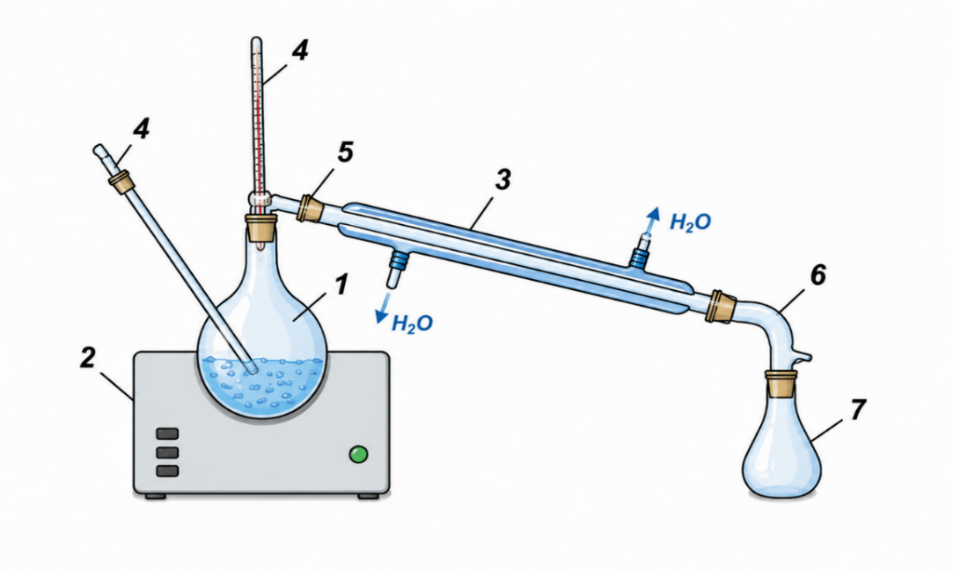
1 – round-bottom distillation flask; 2 – electric heating mantle or heating device with a magnetic stirrer; 3 – Liebig-type condenser; 4 – thermometer and additional reagent feeding device; 5 – connecting adapter; 6 – bent distillate delivery tube; 7 – receiving flask
Results and Discussion
To ensure a stable and efficient distillation process, a number of technological parameters were kept under constant control. These include the temperature regime, which allows taking effective advantage of the difference between the boiling points of the fractions; the distillation rate, which ensures the balance of evaporation and condensation processes; the intensity of the water flow in the cooler required for complete condensation of vapors; and the hermetical sealing of the system to prevent the loss of volatile products.
During distillation, the heating rate was strictly controlled, preventing sharp temperature fluctuations. This ensured the clear separation of fractions and the recovery of the target component, croton aldehyde, at high purity. The efficient operation of the cooling system served for complete condensation of vapors, while the airtightness of the apparatus prevented product loss and increased the reliability of experimental results.
The applied methodology enabled the effective separation of croton aldehyde from the reaction mixture. The fractional distillation process is characterized by high selectivity and reproducible results, serving to obtain pure croton aldehyde for subsequent chemical syntheses.
The croton fraction was heated slowly, with the temperature increasing by 0.5◦C per minute (30◦C per hour). During distillation, the following fractions were collected:
Table 1.
Main characteristics of fractions isolated during fractional distillation of croton aldehyde
| Fraction Data | Fraction I | Fraction II | Fraction III | Fraction IV |
|---|---|---|---|---|
| Quantity | 65g (75 sm3) | 15g (17 sm3) | 20 g (24 sm3) | 75 g (87 sm3) |
| Vapor Temperature | 70-81◦C | 81.5-85◦C | 86-101◦C | 101.5-106◦C |
| Flask Temperature | 83-92◦C | 94-105◦C | 105-112◦C | 113-126◦C |
| Croton aldehyde Content | 38% (by weight) | 77–80% | 88.95–94.8% | 95–98.5% |
| Water Content | – | 9–12% | 2.3–8.22% | Less than 1% |
The fractional distillation results showed that with an increase in boiling temperature, the concentration of croton aldehyde in the fractions increases significantly. In Fraction I, the croton aldehyde content was relatively low, and a higher proportion of highly volatile components was observed. Starting from Fraction II, the content of the target product increases, and the main portion of croton aldehyde accumulates in Fractions III and IV. Condensates of Fractions II, III, and IV were selected for the experiment. Their compositions are given in Tables 2.
According to the obtained results, the mass fraction of croton aldehyde in Fraction III was in the range of 88.95–94.80 %, while in Fraction IV this indicator reached up to 95.0–98.0 %. At the same time, a decrease in water content and a reduction in the proportion of highly volatile impurities were observed. In particular, the high concentration of croton aldehyde and low water content in Fraction IV characterize it as the most optimal feedstock for subsequent hydrogenation processes.
To determine the qualitative composition of Fractions III and IV isolated by distillation, their samples were analyzed using gas chromatography. During the analysis, the content of croton aldehyde as the main component, as well as the mass fractions of methyl acetate, butanol, propyl alcohol, water, and other impurities, were determined. The obtained results allow for evaluating the efficiency of the fractional distillation process and selecting the most optimal fraction for the subsequent hydrogenation stage.
As seen from Table 2, while the mass fraction of croton aldehyde in Fraction III ranges between 88.95–94.80 %, in Fraction IV this value reaches up to 95.0–99.0 %. Simultaneously, it is observed that the amounts of water and highly volatile components in Fraction IV are significantly lower compared to Fraction III. This situation indicates that croton aldehyde concentrates in higher-purity fractions as the boiling temperature increases.
Based on the analysis results, Fraction IV was characterized as the product with the highest concentration of croton aldehyde. In this fraction, the content of the main substance reached up to 99.0 % in some samples, while the amounts of water and other auxiliary components were kept at a minimal level. Therefore, Fraction IV was selected as the main raw material for subsequent catalytic hydrogenation experiments.
Table 2.
Component composition of condensates of Fractions III and IV (gas chromatography analysis results, mass %)
| № | Fraction III (Boiling range 86-101o C), wt % |
Fraction IV (Boiling range 101.5-106o C), wt %, |
||||||||||
|---|---|---|---|---|---|---|---|---|---|---|---|---|
| Methyl acetate | Buta nol |
Propyl alcohol | Croton aldehyde | Wa ter |
Impuri ties |
Methyl acetate | Buta nol |
Propyl alcohol | Croton aldehyde | Wa ter |
Impuri ties |
|
| 1 | 0.046 | 0.13 | 0.23 | 94.3 | 3.6 | 1.694 | 0.045 | 0.02 | 0.25 | 96.6 | 0.4 | 2.685 |
| 2 | 0.07 | 0.24 | 0.29 | 94.8 | 2.33 | 2.27 | 0.04 | 0.05 | 0.22 | 97.5 | 0.34 | 1.85 |
| 3 | 0.04 | 0.64 | 0.52 | 92.69 | 4.45 | 1.66 | 0.014 | 0.01 | 0.22 | 97.6 | 0.17 | 1.91 |
| 4 | 0.02 | 0.45 | 0.17 | 94.4 | 2.74 | 2.22 | 0.04 | 0.04 | 0.17 | 97.4 | 0.12 | 2.23 |
| 5 | 0.02 | 1.00 | 0.12 | 90.9 | 5.2 | 2.76 | 0.04 | 0.18 | 0.17 | 97.2 | 0.10 | 2.33 |
| 6 | 0.02 | 0.88 | 0.10 | 90.3 | 6.11 | 2.59 | 0.02 | 0.19 | 0.2 | 96.2 | 0.11 | 3.28 |
| 7 | 0.02 | 0.90 | 0.11 | 90.7 | 6.0 | 2.27 | 0.02 | 0.49 | 0.12 | 97.02 | 0.22 | 2.12 |
| 8 | 0.02 | 0.68 | 0.11 | 92.71 | 4.3 | 2.18 | 0.02 | 0.28 | 0.21 | 97.14 | 0.26 | 2.09 |
| 9 | 0.02 | 0.27 | 0.14 | 94.0 | 2.3 | 3.27 | 0.018 | 0.18 | 0.06 | 99.0 | 0.41 | 0.332 |
| 10 | 0.01 | 4.5 | 0.10 | 89.7 | 8.22 | 2.53 | 0.01 | 0.27 | 0.14 | 95.0 | 1.31 | 3.27 |
| 11 | 0.18 | 3.8 | 0.10 | 89.10 | 5.39 | 1.43 | 0.05 | 0.9 | 0.10 | 97.2 | 0.61 | 1.14 |
| 12 | 0.02 | 2.4 | 0.11 | 90.58 | 4.88 | 2.01 | 0.03 | 0.44 | 0.12 | 97.09 | 0.34 | 1.98 |
| 13 | 0.08 | 1.8 | 0.12 | 88.95 | 6.41 | 2.64 | 0.02 | 0.02 | 0.37 | 97.59 | 0.6 | 1.4 |
Butanol is an important product widely used in the chemical industry, and obtaining it by hydrogenation of croton aldehyde is one of the highly efficient methods. Multiphase catalysts based on copper, zinc, nickel, chromium oxides, and zeolites exhibit high activity in the selective hydrogenation of aldehydes. In this study, a hybrid catalyst with the composition CuO·ZnO·NiO·Cr2O3/HSZ was synthesized, and the reaction efficiency was evaluated.
Overall, the practical aspects of butanol are very broad: it holds great importance in various sectors of the economy as a solvent, chemical raw material, fuel additive, and biofuel. Varying the quantitative ratios ZnO·Cr2O3 and NiO of oxides, as well as additionally introducing CuO or ZnO into the catalyst composition, further increased catalyst activity and selectivity. In particular, by adding CuO and ZnO into the complex composition, high values were achieved for reaction conversion and selectivity relative to vinyl acetate. Maximum selectivity was observed when CuO (3–5 % relative to the catalyst mass) was used as a promoter.
(T = 443-453K, CH3-CH=CH-CHO: H2 = 1:3, V(H2) = 400 h-1)
Table 3.
Effect of starting materials on catalyst activity in the catalytic synthesis reaction of butanol
| № | Catalyst Composition | Conversion of СН3CH2CH2СH2ОН , % | Selectivity, S % |
|
|---|---|---|---|---|
| Total | To Croton aldehyde | |||
| 1 | CuO:ZnO/HSZ | 66.8 | 43.6 | 65.2 |
| 2 | CuO:NiO/HSZ | 77.4 | 54.2 | 70.1 |
| 3 | CuO:ZnO:Cr2O3/HSZ | 80.9 | 60.9 | 75.3 |
| 4 | CuO:ZnO:NiO/HSZ | 81.1 | 65.44 | 80.7 |
| 5 | CuO:NiO:Cr2O3/HSZ | 82.2 | 68.8 | 83.7 |
| 6 | ZnO:NiO:Cr2O3/HSZ | 85.3 | 72.4 | 84.9 |
| 7 | CuO:CdO:Cr2O3/HSZ | 91.2 | 82.2 | 90.2 |
| 8 | CuO:ZnO:NiO:Cr2O3/HSZ | 86.6 | 80.8 | 93.2 |
| 9 | PbO:SbO:NiO:Fe2O3/HSZ | 71.7 | 65.5 | 91.3 |
| 10 | CuO:CdO:NiO:Fe2O3/HSZ | 68.9 | 55.5 | 80.5 |
Based on studying the effect of various factors on the reaction rate in the presence of the selected catalyst (CuO·ZnO·NiO·Cr2O3/high-silica zeolite), the kinetic laws of the process were studied, and a reaction mechanism was proposed.
In the presence of Catalyst No.8 in Table 4, the effects of various factors (such as temperature, space velocity, C4H6O:H2 molar ratios, catalyst preparation method) on the yield of butanol, process selectivity, and conversion of starting materials were studied.
When studying the effect of C4H6O:H2 ratios on the yield of butanol and the selectivity of the process, the most normal condition was determined to be 1:3.
Table 4.
Butanol yield conversion and selectivity under the influence of CH 3 -CH=CH-CHO:H 2 molar ratio
| CH3-CH = CH-CHO:H2 Molar Ratio | Conversion of СН3CH2CH2СH2ОН,% | Selectivity, S % | |
|---|---|---|---|
| Total | To Croton aldehyde | ||
| 3:1 | 51.4 | 31.2 | 60,7 |
| 2:1 | 56.0 | 42.4 | 75.8 |
| 1:1 | 68.8 | 56.7 | 82.4 |
| 1:2 | 82.4 | 70.4 | 85.4 |
| 1:3 | 95.6 | 89.1 | 93.2 |
| 1:4 | 84.88 | 76.8 | 90.5 |
| 1:5 | 92.2 | 95.7 | 88.3 |
As seen in Table 4, as the molar ratio of initial materials in the reaction mixture increases, the overall conversion of butanol increases. However, when the molar ratio of starting materials exceeds a certain value (the optimal ratio), the yield of butanol decreases due to the formation of additional by-products (e.g., esters, aldehydes, and other oxygenated compounds).
Following this, the effect of various factors—temperature, molar ratios of starting materials, space velocity, catalyst type and amount, as well as the interaction of reaction products—on the rate of the butanol synthesis process was studied. The obtained results showed that when optimal conditions are selected, the level of butanol formation is high, and the amount of by-products decreases significantly.
Table 5.
Effect of temperature on the yield of croton aldehyde hydrogenation reaction (CH3-CH=CH-CHO): H2 = 1:3, V = 400 h-1)
| № | Temperature, ∘C | Conversion of СН3CH2CH2СH2ОН % | Selectivity, S % | |
|---|---|---|---|---|
| Croton aldehyde | To Butanol | |||
| 1 | 120-130 | 88.0 | 63.1 | 71.7 |
| 2 | 140-150 | 84.01 | 65 | 77.7 |
| 3 | 160-170 | 84.9 | 85.6 | 89.3 |
| 4 | 170-180 | 95.6 | 89.1 | 93.2 |
| 5 | 190-200 | 94.1 | 83.2 | 88.4 |
| 6 | 210-220 | 89.6 | 75.4 | 84.15 |
| 7 | 230-240 | 88.2 | 69.8 | 70.79 |
With increasing temperature, total conversion increases up to a certain temperature and then decreases. Conversion to butanol is maximal at 170–180 °C. Above 180 °C, by-products (ethanol, 2-butenol, tars) increase, and selectivity decreases.
Conclusion
In this scientific work, the process of obtaining butanol was studied in the presence of various catalysts, and an effective new catalyst composition and preparation conditions were identified. The prepared CuO·ZnO·NiO·Cr2O3/HSZ catalyst was able to convert croton aldehyde to n-butanol with high selectivity and conversion. The synergy of multicomponent oxides and the structural support of zeolite ensured the thermal and mechanical stability of the catalyst. This system is considered promising for implementation in industrial hydrogenation processes. In this composition, the total conversion of butanol was high, and the formation of by-products in the reaction was recorded at a minimal level.
References
