
Strategic sales management of building materials in a highly competitive regional market
УДК 658.8:691
Abstract
The article examines the strategic management of building materials sales in a highly competitive regional market. The relevance of the study is determined by the fact that building materials trading companies operate in an environment characterized by high price sensitivity, seasonal demand, dependence on construction activity, logistics constraints, and continuous pressure from local competitors, federal retail chains, and online sales channels. The aim of this study is to develop a strategic sales management model for building materials based on assortment management, warehouse management, customer segmentation, and performance indicators. The methodological framework of the study includes an analysis of scientific literature, conceptual modeling, and the systematization of sales factors. The study identifies the specific features of the regional building materials market, determines the key sales drivers, and proposes a sales management model for a building materials trading company together with a system of performance indicators. The practical significance of the findings lies in the possibility of applying the proposed approach in the activities of regional building materials trading companies serving private customers, contractors, renovation teams, construction companies, and corporate clients.
Аннотация
В статье рассматривается стратегическое управление продажами строительных материалов в условиях высокой конкуренции на региональном рынке. Актуальность рассматриваемой темы исследования определяется тем, что торговые дома строительных материалов функционируют в среде высокой ценовой чувствительности, воздействия на них сезонного спроса, зависимости от строительной активности, логистических ограничений и постоянного давления со стороны локальных конкурентов, федеральных сетей и онлайн-каналов. Цель статьи состоит в разработке модели стратегического управления продажами строительных материалов с опорой на управление ассортиментом, складом, клиентскими сегментами и показателями результативности. Методическая основа исследования включает анализ научной литературы, а также концептуальное моделирование и систематизацию факторов продаж. В результате раскрыты особенности регионального рынка строительных материалов, определены основные факторы стимулирования продаж, предложена модель управления продажами торгового дома и система показателей оценки эффективности. Практическая значимость полученных результатов состоит в возможности применения предложенного подхода в деятельности региональных торговых домов, работающих с частными клиентами, подрядчиками, ремонтными бригадами, строительными организациями и корпоративными заказчиками.
Keywords: building materials; regional market; strategic sales management; trading company; assortment; warehouse; customer segments; competitiveness; sales performance indicators.
Ключевые слова: строительные материалы; региональный рынок; стратегическое управление продажами; торговый дом; ассортимент; склад; клиентские сегменты; конкурентоспособность; показатели продаж.
Introduction
Sales of building materials in regional markets are influenced by the level of construction and renovation activity, seasonality, logistics costs, inventory levels, product assortment, service quality, and the trust of contractors. In a highly competitive environment, a building materials trading company must establish a strategic sales management system aligned with its target market segments.
In the scientific literature, sales strategies are primarily regarded as a factor influencing sales performance through customer segmentation, customer engagement priorities, and the value proposition offered to customers. For example, H. Terho, A. Eggert, A. Haas, and W. Ulaga rightly argue that sales strategy is closely associated with customer orientation and value-based selling; in their view, sales performance depends on the salesperson's ability to communicate the value of the offering to the customer [1]. Accordingly, in the building materials market, customers evaluate product availability, delivery options, the possibility of ordering additional materials, the quality of consultation, delivery terms, and subsequent support throughout the construction project.
Sales management is also influenced by the external environment. In regional markets, this is reflected in seasonal fluctuations, changes in procurement prices, construction project delays, and competition for contractors. Therefore, strategic sales management should incorporate demand forecasting, customer segmentation, inventory management, and a system of performance indicators. Taken together, these considerations define the objective and scope of the present study.
The aim of the study is to develop a strategic sales management model for building materials in a highly competitive regional market.
Research methodology. The study is based on scientific publications addressing strategic sales management, supply chains in the construction industry, assortment management, inventory management, and regional trade management. The research employs the methods of systematization, classification, conceptual modeling, and comparative analysis.
The subject of the study is a building materials trading company operating in a regional market. As a business organization, it procures materials from manufacturers and distributors, stores them in warehouses, develops commercial offers for different customer groups, and sells its products through sales managers, sales offices, telephone channels, its website, online marketplaces, and direct deliveries to construction sites, all of which determine the specific characteristics of its business processes.
Strategic sales management is understood in this study as a system of decisions aimed at selecting target customer segments, developing the product assortment, managing inventory, establishing pricing policies, enhancing service quality, and monitoring sales performance. A central element of this system is the relationship between the assortment matrix and warehouse availability, since listing a product in a commercial offer without having it in stock results in customer attrition. Conversely, when the warehouse is filled with slow-moving inventory, the trading company ties up capital and reduces its ability to respond to current demand. Achieving an optimal balance between these factors determined the focus of the proposed conceptual model.
Results and discussion
The regional building materials market comprises sellers, buyers, suppliers, contractors, and logistics providers involved in construction, renovation, and finishing projects within a specific geographic area. A defining characteristic of this market is the close relationship between demand and local construction activity, as sales volumes depend on residential construction, private housing projects, renovation activities, municipal projects, commercial construction, and seasonal work.
Construction is characterized by project-based work organization and fragmented interactions among participants. A. Dubois and L.-E. Gadde describe the construction industry as a loosely coupled system in which interdependencies are shaped by temporary project-based relationships [2]. For a building materials trading company, this results in demand instability, as a large-scale project may sharply increase demand for materials, while a delivery delay may lead to the loss of a customer.
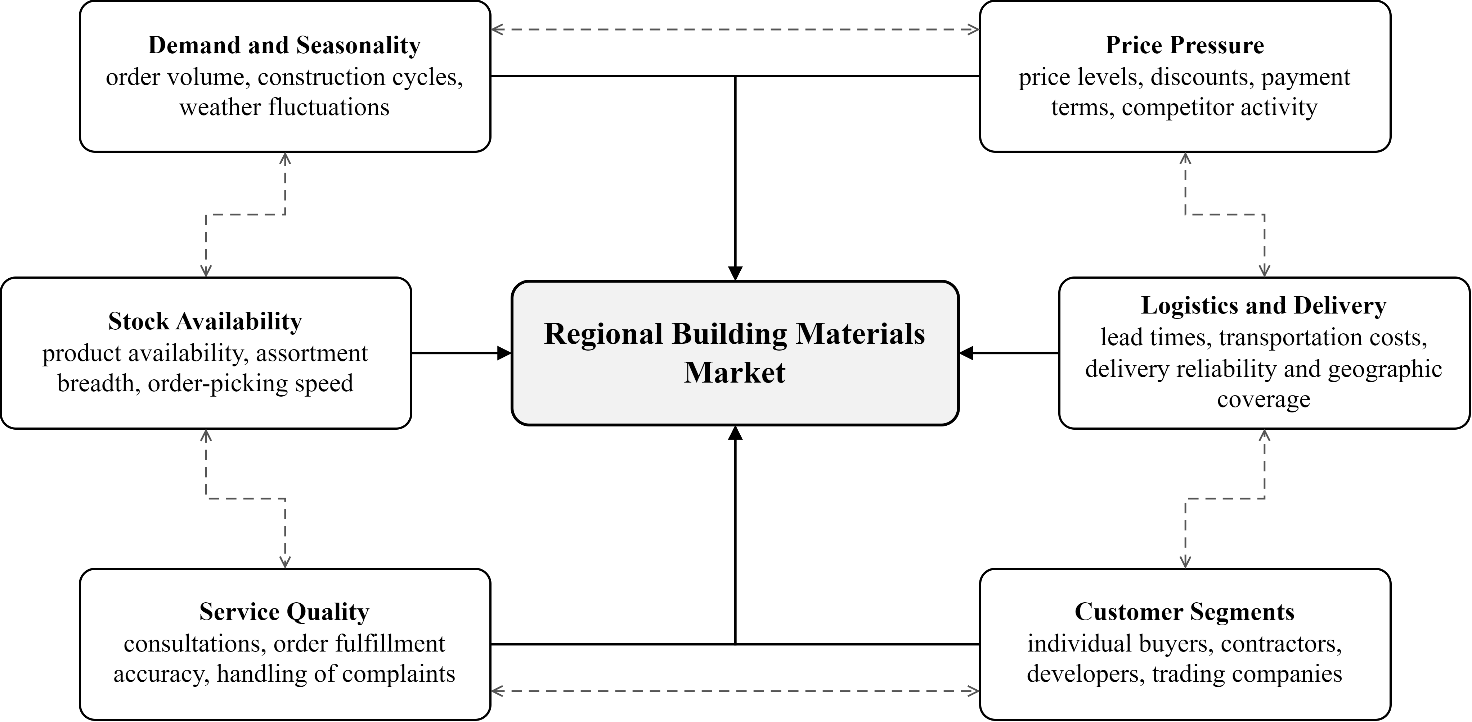
Considering the above, the typical competitive characteristics of the regional market can be summarized as follows (Figure 1):
1. high customer price sensitivity;
2. similarity of product offerings across competing sellers;
3. dependence on product availability;
4. the impact of delivery costs on the final purchase price;
5. the significant role of personal relationships with contractors;
6. seasonal fluctuations in peak demand;
7. competition from retail chain stores;
8. the growing importance of online ordering and advance inventory availability checks.
The supply chain plays a particularly important role in the operations of a building materials trading company, as it directly affects costs, delivery reliability, and coordination among participants [3]. The sales process is completed only after the product has been handed over to the customer or delivered to the construction site; therefore, warehousing and logistics are integral components of the sales system. This requires monitoring production and shipment schedules, maintaining close communication with suppliers, and planning inventory levels. Sales activities, warehouse operations, and customers' construction projects are closely interconnected; therefore, sales managers must take into account the stage of each project and anticipate future demand.
Recent research confirms that materials management practices influence the performance of construction projects, increasing the importance of inventory availability and supply reliability in sales management [8].
Poor coordination among processes increases the risk of delivery disruptions and customer defection to competitors. This risk can be mitigated through an effective assortment and inventory management system.
Supply-related risks also require regular assessment [9]. In the proposed model, these include supplier reliability, lead times, stock-out risk, and delivery disruptions.
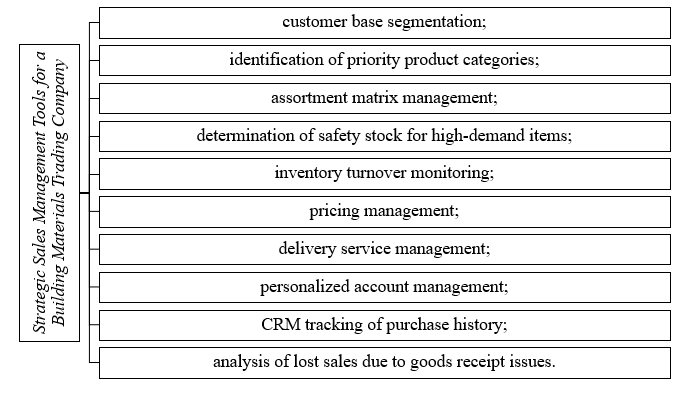
It should be noted that the strategic sales management tools employed by a building materials trading company include the following (Figure 2):
The product assortment forms the foundation of a company's competitive offering [4]. In a building materials trading company, this concept is reflected in both the warehouse and commercial assortment matrices. Accordingly, the assortment should be divided into core, seasonal, project-specific, and made-to-order categories. The core assortment is maintained in stock at all times, the seasonal assortment is expanded in anticipation of expected demand, the project-specific assortment is selected to meet the requirements of individual construction projects, and the made-to-order assortment is used for low-demand items that are not economically justified for permanent inventory.
Warehouse availability is another critical factor, as it determines the actual ability of a trading company to sell a product. Recent research considers assortment, inventory, and pricing as interrelated decisions [5]. Accordingly, inventory levels should be planned based on customer groups, demand frequency, and product profitability.
All these elements formed the basis of the proposed strategic sales management model for building materials (Figure 3):
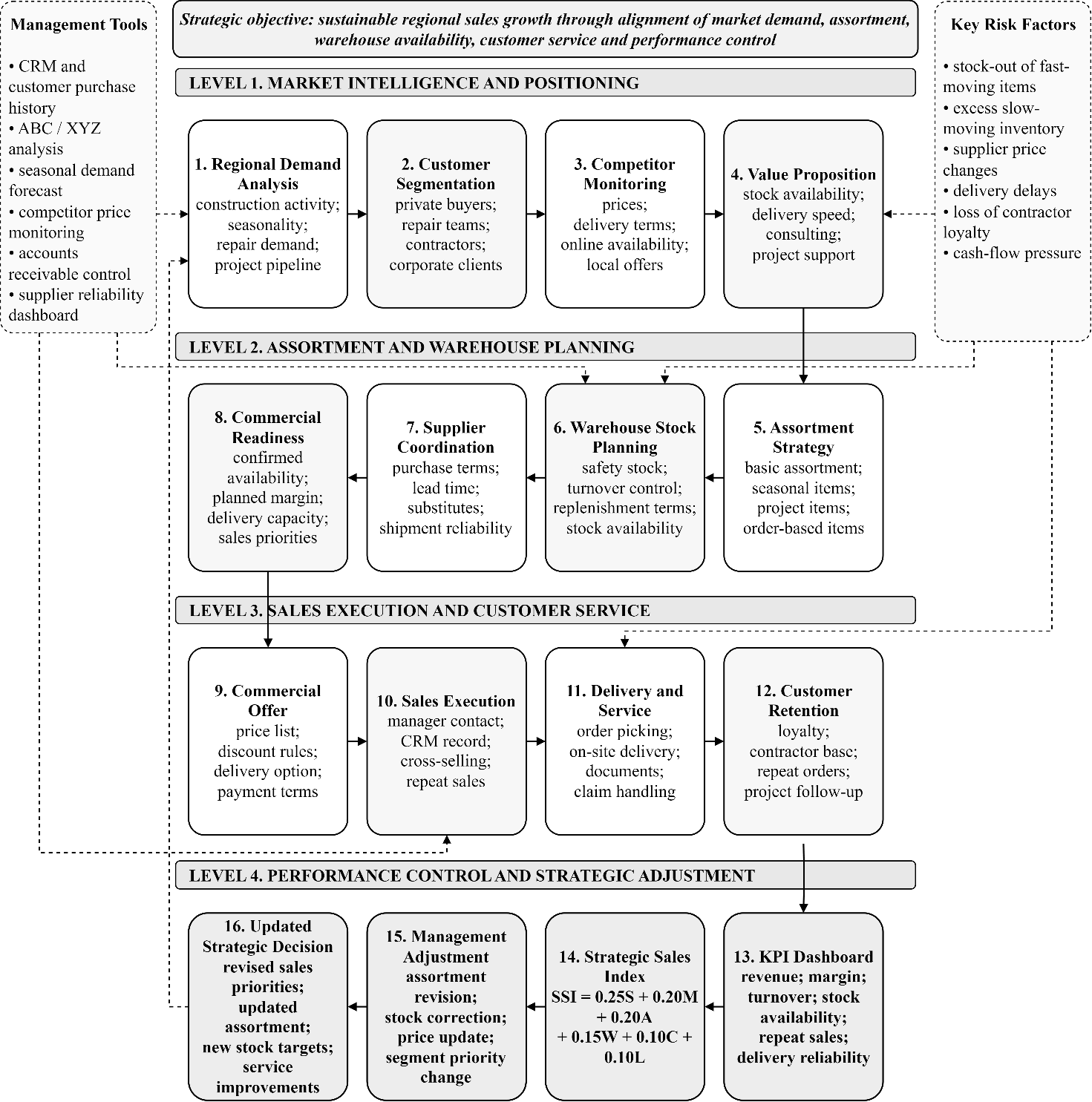
The proposed model is based on the alignment of four interconnected levels, each defining a distinct aspect of strategic sales management for building materials. Within the model, customer segments are classified into private customers, renovation teams, construction contractors, corporate clients, municipal customers, and dealers. Sales parameters are tailored to each segment according to its specific needs and priorities. The effectiveness of sales management should be assessed using several groups of performance indicators (Table 1).
Customer segmentation should also take into account purchase frequency, average order value, repeat purchases, and expected margin contribution [7].
CRM data, demand forecasts, and KPI dashboards improve coordination of sales, inventory, and customer relationships [10, 11]. The described tools support the adjustment of assortment, stock levels, and service parameters.
Table 1.
Performance indicators for evaluating building materials sales in the regional market
| Performance indicator group | Indicator | Managerial purpose |
| Sales | Revenue, profit margin, average order value | Assessment of commercial performance |
| Customers | Repeat sales, customer retention, active contractors | Assessment of the customer base |
| Assortment | Inventory turnover, share of high-demand products, slow-moving inventory | Assessment of assortment matrix quality |
| Warehouse | Product availability, replenishment lead time, inventory accuracy | Assessment of sales readiness |
| Logistics | Delivery lead time, share of on-time deliveries | Assessment of service quality |
| Competition | Price index, share of successful customer inquiries | Assessment of competitive position in the regional market |
The proposed model can be further enhanced by using an integrated sales performance indicator:
SSI = 0.25S + 0.20M + 0.20A + 0.15W + 0.10C + 0.10L,
where SSI – Strategic Sales Performance Index;
S ‒ sales plan achievement;
M ‒ profit margin level;
A ‒ assortment quality;
W ‒ warehouse availability;
C ‒ customer retention;
L ‒ logistics performance.
The weighting coefficients reflect the relative importance of the indicator groups in the proposed model. Sales plan achievement receives the highest weight (0.25), followed by profit margin and assortment quality (0.20 each), warehouse availability (0.15), customer retention and logistics performance (0.10 each). The weights are analytically specified and may be empirically calibrated in further studies.
Each indicator is normalized to a scale from 0 to 1, and the resulting index makes it possible to assess both revenue growth and the quality of its achievement.
For example, with S = 0.88, M = 0.76, A = 0.82, W = 0.90, C = 0.78, and L = 0.84, the index is:
SSI = 0.25 × 0.88 + 0.20 × 0.76 + 0.20 × 0.82 + 0.15 × 0.90 + 0.10 × 0.78 + 0.10 × 0.84 = 0.833.
The resulting SSI equals 0.833, or 83.3 % of the target level; the lowest values are observed for profit margin and customer retention.
Given the critical role of inventory management and logistics in the construction industry, sales performance depends on the warehouse's ability to maintain the availability of high-demand products and on the logistics system's ability to deliver them to customers within the agreed time frame [6].
Conclusion
Strategic sales management of building materials integrates customer relationship management, assortment management, warehouse operations, and supplier coordination. Competitive advantage is determined by responsiveness, accurate identification of customer needs, the availability of high-demand products, and continuous performance monitoring. Sales should be viewed as a manageable system based on customer segmentation, the assortment matrix, warehouse availability, inventory turnover, and repeat sales.
References
