The role of visual art in emotional recovery during crisis situations: a conceptual analysis in the context of forced Ukrainian displacement
УДК 615.851.82:314.151.3 – 054.73(477)
Abstract
The study seeks to conceptualize the mechanisms by which engagement in visual art practice may support self-perceived emotional recovery among forcibly displaced Ukrainians. The article offers a theoretical and analytical review of published research on art therapy and arts-based reflective practices involving refugees and forcibly displaced populations. The included sources were examined comparatively across five analytic categories: internal experience, visual externalization, reflective distance, formal structuring, and meaning reconstruction. This analysis led to the proposed Visual Transformation of Internal Experience Framework. The framework indicates that creating an image should not be treated as equivalent to emotional recovery on its own. Any meaningful change may instead depend on whether an individual can view the depicted experience from an alternative standpoint, structure visual material using formal artistic elements, and link the image to personal history and cultural identity. The framework further includes neutral and adverse pathways, such as the absence of perceived change, increased emotional distress, and interpretations of visual symbols imposed from outside. Its practical relevance is grounded in offering a foundation for designing arts-based reflective support programs and for conducting subsequent empirical studies. The study does not establish the clinical effectiveness of visual art practice and does not position it as a replacement for professional mental health care.
Аннотация
Цель исследования состоит в осмыслении механизмов, благодаря которым практики визуального искусства способны включаться в субъективно переживаемое эмоциональное восстановление вынужденно перемещённых украинцев. Работа выполнена как теоретико-аналитическое исследование опубликованных источников по арт-терапии и художественно-рефлексивным практикам, ориентированным на беженцев и вынужденно перемещённых лиц. Сопоставление материала осуществлялось по пяти аналитическим категориям: внутреннее переживание, визуальная экстернализация, рефлексивная дистанция, формальное структурирование и реконструкция смысла. В итоге сформулирована модель визуальной трансформации внутреннего опыта. Она демонстрирует, что само по себе создание изображения не тождественно эмоциональному восстановлению. Возможное изменение связано с вероятностью взгляда на переживание со стороны, с организацией визуального материала посредством средств формы и с соотнесением создаваемого образа с личной историей и культурной идентичностью. Модель также принимает во внимание нейтральные и отрицательные сценарии, включая отсутствие изменений, усиление эмоционального напряжения и принудительную интерпретацию символов. Практическая значимость предложенной модели заключается в том, что её можно использовать при проектировании программ художественно-рефлексивной поддержки и в последующих эмпирических исследованиях. Исследование не устанавливает клиническую эффективность визуального искусства и не рассматривает художественную практику как замену профессиональной психологической помощи.
Keywords: visual art; emotional recovery; forced displacement; Ukrainian refugees; visual externalization; reflective distance; cultural identity.
Ключевые слова: визуальное искусство; эмоциональное восстановление; вынужденное перемещение; украинские беженцы; визуальная экстернализация; рефлексивная дистанция; культурная идентичность.
1. Introduction
1.1. Research Context
Ultimately, this study highlights the value of combining creative, culturally responsive strategies with psychosocial support models. Given the continually rising number of displacement crises in most regions worldwide, it is long past time to develop new prevention policies that address not only the physical needs of displaced individuals but also their emotional and psychological needs. As this paper argues, visual art offers a practical and accessible way to facilitate emotional healing and strengthen resilience during crises.
1.2. Crisis, Trauma, and Displacement
Crisis-related displacement is among the most urgent global humanitarian challenges, bringing substantial psychological and social repercussions for affected populations. Forced migration frequently exposes people to traumatic experiences such as violence, the loss of loved ones, and the destruction of homes, all of which can markedly shape mental health outcomes. Displacement undermines not only physical safety but also social institutions, cultural identity, and individuals’ sense of belonging [2, 17].
The Ukrainian displacement crisis illustrates these dynamics: millions have been compelled to seek refuge in different countries amid conditions characterized by uncertainty and instability. Research indicates that displaced Ukrainian populations face a broad spectrum of psychological difficulties, including anxiety, depression, emotional instability, and challenges in adapting to new socio-cultural environments [2, 3, 9, 13, 15]. These emotional reactions are often intensified by sustained uncertainty and the stress associated with integrating into host communities.
Emotional recovery in such circumstances is a complex, non-linear process. It entails regulating emotions, reconstructing identity, and adjusting to new life conditions. In this article, emotional recovery is defined as a non-linear, self-perceived process that may include emotion regulation, the rebuilding of meaning and identity, and adaptation to altered circumstances. It does not necessarily mean the complete disappearance of distress or a return to the pre-crisis state. Nevertheless, in many displacement contexts, access to formal psychological support remains restricted, which underscores the need for alternative approaches to emotional healing.
1.3. Visual Art and Emotional Expression
Visual art is widely recognized as an effective tool for communication and emotional expression. In contrast to verbal expression, visual art enables people to express internal experiences symbolically and in a non-linear manner, which makes it particularly suitable for situations involving trauma, when language may be insufficient or unavailable.
As a structured therapeutic practice, art therapy is grounded in the idea that creative activities can promote emotional processing, support self-identity, and facilitate psychological recovery. Systematic reviews and intervention studies indicate that visual art therapy may be linked to improvements in specific psychological outcomes, including anxiety and depressive symptoms. However, the reported effects differ across populations, intervention formats, and study designs [6–9, 11, 12].
In addition, visual art helps people engage with complex emotions connected to trauma by translating abstract feelings into concrete, tangible expressions. This externalization process not only supports the release of emotions but also allows individuals to return to, review, and reinterpret their experiences. Reviews focused on adults with depressive or anxiety symptoms suggest that visual art interventions may be associated with improvements in selected psychological outcomes. These results should not be applied directly to forcibly displaced Ukrainians, because the populations involved and the intervention settings differ [6–8, 12].
1.4. Art in Humanitarian and Crisis Contexts
The use of visual art in humanitarian contexts has attracted increasing attention for promoting psychosocial well-being among displaced populations. Art-based interventions may also be implemented in community centers, non-governmental organization (NGO) programs, and refugee camps during crisis situations, where they can offer a safe space for expression and interaction.
The aims of these interventions differ. At the individual level, they facilitate emotional recovery by enabling participants to communicate grief, fear, and hope. At the social level, they foster community participation and improved coping by bringing people together around a shared creative life. At the social level, group-based artistic activities may further create opportunities for interaction and shared experience. Studies on creative arts therapies and arts-based interventions have examined their potential relevance for refugee populations [4, 5, 13, 16, 17].
In addition, art may be essential for maintaining cultural identity, which displacement often undermines. Visual representation can support identity reconstruction by allowing individuals to preserve cultural heritage and personal histories and thereby retain a connection to their past. In cases of displacement from Ukraine, culturally meaningful images can visually link personal memory, place attachment, and identity continuity. Nevertheless, assign interpretations to an image only when the participant reports them or the original study documents them [2, 3, 9, 13, 15].
1.5. Psychological Resilience and Emotional Recovery
One of the most important determinants of emotional recovery is psychological resilience, especially in times of crisis and for those who have been displaced. In essence, it is an individual's ability to deal with adversity constructively and put in place a recovery plan after emotional distress. Resilience should not be thought of as static; it is more of an evolutionary process shaped by the various personal, social, and environmental forces at work.
Research shows a link between resilience and emotional recovery. People who can keep their emotions in check and hold on to a sense of purpose are generally better equipped to handle adverse conditions. In the case of displacement, resilience is heavily influenced by community ties, family cohesion, and the support one has from others.
Visual art can promote psychological resilience by enabling people to express their feelings, strengthen self-efficacy, and cultivate a sense of accomplishment. Creative activities can support this goal by helping individuals feel a sense of control and agency—resources that crises readily undermine. In addition, art-based interventions may improve coping strategies by providing alternative ways to manage stress and trauma.
1.6. From Emotional Expression to Visual Transformation
Prior research has highlighted non-verbal expression as a key advantage of visual and creative arts practices. At the same time, expression alone cannot explain how interacting with an image can alter a person’s relationship to a challenging experience. Making an image, then watching it, revising it, and interpreting it may represent distinct phases within the reflective process.
Visual externalization refers to translating an internal experience into an observable form using color, line, shape, symbol, or composition. Once the experience is represented outside the individual, it becomes available for reflection without requiring a fully developed verbal account. This procedure does not eliminate emotional experience but may render it more noticeable and more structured.
Reflective distance captures the movement from being absorbed in an experience to examining its visual depiction. The image can operate as an intermediary object linking the individual and the difficult experience. This distance should not be read as emotional avoidance; instead, it may provide a temporary standpoint that lets the person engage with the experience at an intensity they can tolerate.
Formal structuring occurs when the individual arranges visual elements by establishing boundaries, relationships, contrasts, rhythm, balance, or spatial order. Within this approach, artistic form is not understood as mere decoration. Rather, it is viewed as a means by which emotionally fragmented material can take on a visible, manageable organization.
Meaning reconstruction involves interpreting the finished or developing image in relation to the individual’s memories, identity, losses, cultural background, and anticipated future. This phase is especially important in the context of displacement, because forced migration may disrupt continuity between a person’s prior environment, current circumstances, and future orientation.
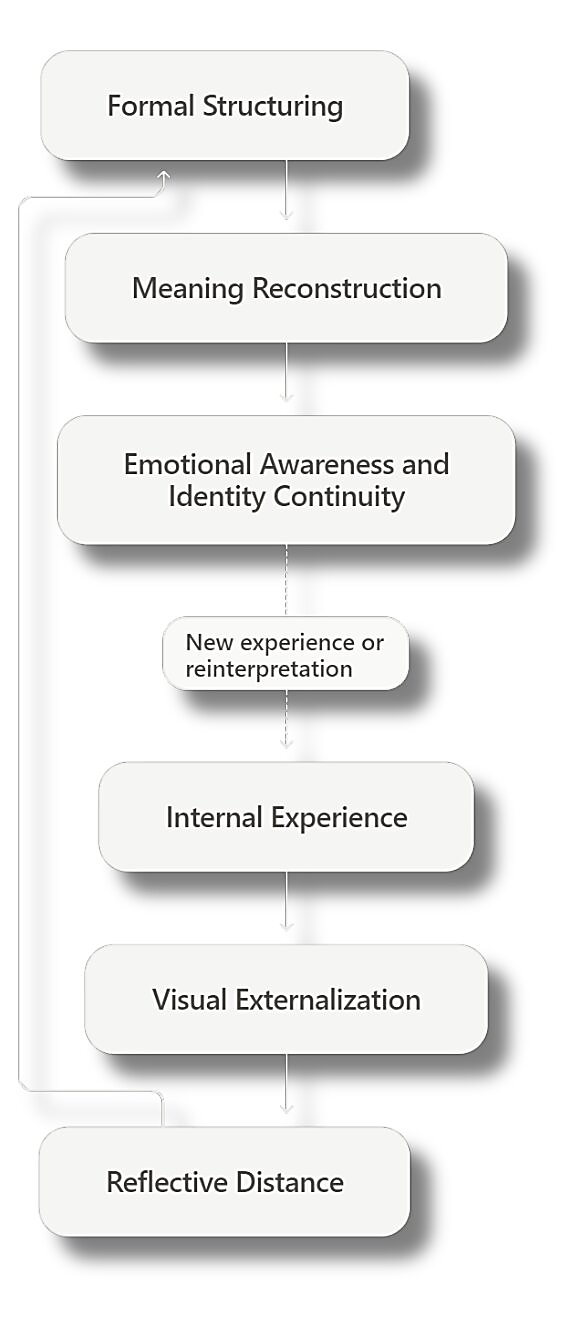
Figure 1 illustrates the proposed Visual Transformation of the Internal Experience Framework. The model frames visual involvement as an evolving process rather than as a single therapeutic event. It initially conveys an internal experience through visual elements, thereby rendering it externally observable. The resulting image may then create reflective distance, enabling the person to examine the experience and approach it from another standpoint. By arranging color, line, boundary, space, and composition, the visual material develops structure. Reading and interpreting this structured image can subsequently support meaning reconstruction, emotional awareness, and continuity of identity. The dotted return pathway suggests that the process may be recursive instead of strictly linear.
1.7. Research Gap and Scientific Novelty
Existing research generally treats visual art as a broad therapeutic or psychosocial intervention and examines its relationship with anxiety, depression, post-traumatic stress, emotional expression, or general well-being. Yet it does not clearly explain the internal mechanism by which an initially unstructured emotional experience becomes a visual form that a displaced person can watch, arrange, and interpret. Consequently, involvement in visual art is often handled as a single intervention rather than as a series of psychologically and artistically distinct processes.
This study addresses that gap by proposing the Visual Transformation of Internal Experience Framework, a process-oriented conceptual model with five interconnected stages: internal experience, visual externalization, reflective distance, formal structuring, and meaning reconstruction. The framework explains how a challenging internal experience may first be translated into an external visual image, after which the person can create some reflective distance from it. By intentionally organizing color, line, shape, boundary, space, and composition, an emotionally fragmented experience gains a discernible structure. That structure can then help the individual interpret it personally and reconstruct meaning.
The study’s scientific contribution is distinguishing visual externalization from reflective distance and formal structuring. These processes are frequently grouped together under broad notions such as emotional expression or art engagement. In contrast, the proposed framework treats them as analytically distinct mechanisms that may serve different roles in emotional recovery. Externalization renders the experience visible; reflective distance alters the individual’s relationship to it; formal structuring introduces boundaries and organization; and meaning reconstruction links the visual outcome to identity, memory, and personal continuity.
A further contribution involves applying the framework to Ukrainian displacement. Forced displacement can entail not only psychological distress but also disruption of attachment to place, cultural identity, social roles, and continuity between the past and the present. Accordingly, the framework includes personal and culturally meaningful visual symbols as potential mechanisms that allow displaced individuals to maintain identity and reinterpret their experiences without requiring immediate verbal disclosure.
The proposed model does not assume that visual practice automatically produces therapeutic gains or replaces professional mental health care. Instead, it provides a theoretically testable account of how non-clinical, arts-based reflective practices may foster emotional awareness, symbolic organization, and meaning-making. The framework can inform future qualitative and mixed-method research that examines which stages participants experience, how the stages interact, and under what conditions visual engagement is viewed as helpful, neutral, or emotionally challenging.
1.8. Research Aim and Questions
This study seeks to develop a process-oriented conceptual framework explaining how engagement in visual art practice may support individuals’ self-perceived emotional recovery in the context of forced displacement from Ukraine. Using a structured qualitative analysis of published secondary sources, the study investigates five interconnected processes: internal experiencing, visual externalization, reflective distancing, formal structuring, and meaning reconstruction. It further examines the circumstances under which arts-based reflective practice may be experienced as beneficial, affectively neutral, or emotionally challenging. The study does not evaluate the clinical effectiveness of art therapy, nor does it test or establish a causal link between participation in visual art activities and emotional recovery.
Based on the identified research gap, the study addresses the following research questions:
RQ1. How are difficult internal experiences associated with forced displacement represented through visual elements such as color, line, shape, symbol, boundary, and composition?
RQ2. How might an externally generated visual image create reflective distance between an individual and the experience being depicted?
RQ3. What role may formal visual structuring play in transforming emotionally fragmented material into a form that is perceptible and interpretable?
RQ4. How might personal and culturally meaningful symbols contribute to meaning reconstruction and the maintenance of identity continuity among displaced Ukrainians?
RQ5. Under what conditions may arts-based reflective practice be experienced as helpful, neutral, or emotionally difficult?
1.9. Operational Definitions
For this study, internal experience refers to an individual’s subjectively perceived combination of emotions, bodily sensations, memories, thoughts, and associations related to crisis or displacement. Visual externalization refers to representing aspects of this experience through observable visual elements. Reflective distance refers to the participant’s perceived shift from immediate emotional immersion to observing the represented experience. Formal structuring refers to organizing visual material through boundaries, spatial relationships, composition, rhythm, contrast, or other formal properties. Meaning reconstruction refers to the participant’s interpretation or reinterpretation of the image in relation to personal experience, identity, cultural memory, or future orientation.
These concepts describe potential reflective processes and should not be interpreted as clinical diagnoses, standardized treatment stages, or guaranteed psychological outcomes.
2. Materials and Methods
This article provides a qualitative conceptual analysis of secondary sources. The analytical corpus included publications addressing art therapy or arts-based practices with refugees and forcibly displaced populations, studies involving Ukrainian participants, and systematic reviews intended to situate the potential psychological outcomes of visual art interventions. Sources that focused on displacement without an arts-based component were included only to describe the social, cultural, and identity-related context and were not treated as evidence of art’s psychological effects.
Publications were included if they described at least one of the following elements: participants’ internal experiences before or during art-making; the transformation of an experience into a visual image; participants’ or facilitators’ observations about reflection on the finished image; the use of visual form, composition, boundaries, color, line, or symbols; or the interpretation of an image in relation to memory, cultural identity, displacement, or future orientation. Publications that were not connected to visual practice, emotional experience, identity, or psychosocial support were excluded from the main analytical corpus.
We examined each retained publication through five analytical categories derived from the proposed Visual Transformation of Internal Experience Framework: internal experience, visual externalization, reflective distance, formal structuring, and meaning reconstruction. We recorded a category as present only when the primary publication included a participant statement, facilitator observation, or direct description of the corresponding process. We coded categories as present, partially described, or not reported.
We did not assign psychological interpretations to colors, symbols, lines, objects, or compositional elements independently. We regarded a visual element as culturally or emotionally meaningful only when the participant reported such meaning or when the authors of the primary study explicitly documented it. Symptom reductions reported in clinical studies or identified in meta-analyses were not transferred to Ukrainian community art practices in a way that would treat them as findings of the present study.
The study contains no new interviews, questionnaires, clinical measurements, or independent analysis of participants’ artworks. Accordingly, its results reflect a conceptual synthesis of published evidence rather than outcomes from a new intervention or clinical study. The analysis seeks to develop theoretically testable propositions for subsequent qualitative or mixed-method research involving forcibly displaced Ukrainians.
The credibility of the analysis was strengthened by distinguishing statements from the reviewed publications from the author’s conceptual interpretations and by applying the same five analytical categories to each source. However, because the source selection was purposive rather than systematic, the study does not claim exhaustive coverage of the literature and cannot calculate intervention effects.
3. Results and Discussion
The results are structured in line with the Visual Transformation of Internal Experience Framework. They do not present new interview transcripts. Instead, they identify which stages are addressed in published arts-based work involving displaced Ukrainians and in closely comparable refugee programs, and which stages are still only weakly documented. A stage is marked as present only when participant or facilitator language explicitly refers to that process. Symptom reductions reported in mixed-population meta-analyses are not carried over to Ukrainian workshops as though they were findings of this study.
3.1. Visual externalization
Externalization is the act of rendering an internal state into a visible image. In contexts of displacement, that state is frequently a compound of fear, grief, insomnia, loss of one’s home, and an inability to give a coherent verbal account. The reviewed studies describe visual art as a way for refugees to represent difficult experiences without relying solely on a complete verbal account [4, 5, 17].
Work with Ukrainian refugees likewise treats drawing and painting as plausible starting points when verbal expression is hard to sustain or emotionally taxing [9, 13]. The analytical focus is limited. The feeling is no longer only within the individual; it takes up a surface that can later be observed. This shift does not yet amount to regulation, insight, or recovery. In some cases, it may even intensify the feeling. Accordingly, externalization functions as a necessary first operation in the model rather than evidence that art generally “expresses emotion.”
3.2. Reflective Distance
Reflective distance is a form of repositioning: rather than staying entirely within the state that generates an image, a person regards the image. In the proposed framework, reflective distance denotes a perceived move away from immediate immersion in an experience toward observing, and when relevant, discussing, its visual representation. The reviewed literature offers a theoretical foundation for this distinction, even though the process is not consistently described as a distinct outcome [1, 13].
Distance is not the same as distraction or avoidance. Distraction leaves the experience unexamined. Distance keeps the experience present, but transforms it into an object. Not all participants reach this stage. Some make markings and refuse to look again, while some leave the session before any viewing occurs. The framework records this as an interruption. A workshop that compels immediate group display can prevent reflective distance by returning the person to public exposure before they have had the chance to privately observe the image.
3.3. Formal structuring
Formal structuring is the arrangement of what is placed on the surface: edge, ground, contrast, repetition, center and margin, a division between before and after, and the completion or intentional incompletion of a shape. In the proposed framework, formal structuring denotes the organization of visual material through boundaries, spatial relationships, contrast, repetition, composition, or intentional completion and incompletion. The reviewed refugee art-therapy literature offers a contextual foundation for investigating these processes, but it does not consistently present formal visual changes as distinct psychological outcomes [4, 5].
Here, form is treated as a psychological operation rather than an aesthetic attribute. Fragmented material becomes perceptible because it gains limits. Most visual-art-therapy reviews continue to report anxiety or depression scores instead of line, boundary, or composition [6–8, 12]. Those reviews provide background regarding possible symptom change. They do not demonstrate that Ukrainian participants structured the form in a particular manner. For this study, structuring is inferred only when authors describe how the picture was constructed.
3.4. Meaning reconstruction and cultural symbols
Meaning reconstruction interprets the structured image by relating it to memory, place, family roles, and a potential future. In practice, connected to Ukrainian contexts, the stage is most convincing when the motifs are locally specific: interiors of a former home, a city or steppe outline, family objects, ornamental patterns, or colors employed as a claim to belonging rather than as a generic sign of hope [9, 13].
A cultural motif can support this stage only if the maker links it to a personal before-and-after. Without that connection, the image remains decoration or externalization. Research on Ukrainian adaptation in host countries documents identity strain, role loss, and pressure to present oneself as “already fine” [2, 3, 15]. These findings clarify why continuity of self is at issue. They do not demonstrate that depicting those symbols leads to recovery. Analyses of media representations of Ukrainians by others are not evidence of how Ukrainians reconstruct meaning in their own images, and they are not used for this stage.
Table 1.
Summary of Key Findings and Thematic Insights
| Theme | Description | Experiences Reported in the Reviewed Studies | Potential Relevance to Emotional Recovery |
|---|---|---|---|
| Emotional Expression | Use of art to express complex emotions non-verbally | Drawing feelings of fear, hope, and loss | Emotional release and self-awareness |
| Identity Reconstruction | Rebuilding personal and cultural identity through artistic representation | Inclusion of cultural symbols and personal narratives | Sense of purpose and continuity |
| Stress Reduction | Engagement in art as a calming and therapeutic activity | Feeling relaxed and Focused during art creation |
Reduced anxiety and improved mood |
| Social Connection | Group art activities fostering relationships and shared experiences | Participation in community art programs | Reduced isolation and stronger networks |
The reviewed sources indicate that visual art may be linked to multiple processes pertinent to emotional recovery, such as visual externalization, reflective distancing, formal organization, meaning reconstruction, and social connectedness. Taken together, these patterns form a conceptual synthesis of the published research and should not be read as evidence of a causal relationship or a universally therapeutic impact.
3.5. When the process stalls or increases distress
The fifth set of findings addresses RQ5 and constrains the article’s claim. The sequence is not automatic and is not a kind of psychotherapy.
Visual externalization may elicit or heighten challenging emotions in some participants, especially when facilitation and psychological support are insufficient. This consideration underlines the need for voluntary participation, appropriate boundaries, and the right to stop the activity [1, 17]. Reflective distance may not hold in brief, noisy, or highly performative, exhibition-like sessions. Formal structuring can harden an experience into a closed image that the person later rejects. A facilitator can impose meaning reconstruction by assigning an interpretation (for example, “this blue means peace”) rather than asking what the maker perceives.
Pipere et al. [13] set out how arts therapists working with Ukrainian refugees manage linguistic differences, cultural meanings, and the constraints of short-term interventions. Factors that increase the likelihood of progress through the stages include voluntary attendance, the right not to interpret the image, private viewing before any group discussion, and a facilitator who does not complete the meaning for the participant. Under the opposite conditions, the same materials may be experienced as neutral or harmful.
Table 2.
Stages of visual transformation in the reviewed sources
| Stage | What is described in the sources | When the stage helps | When the stage stalls |
|---|---|---|---|
Externalization [1, 4, 5, 9, 13, 17] |
Image appears where a full verbal account does not | The experience becomes visible and bounded | The image floods the person |
Reflective distance [1, 4, 5, 13, 17] |
Looking at or speaking about the picture | The person can approach the experience at a tolerable intensity | Refusal to look; public exposure too early |
| Formal structuring [4, 5, 13] | Edge, order, split composition, completed or held form | The experience feels holdable | Empty decoration; imposed neatness |
Meaning reconstruction [2, 3, 9, 13, 15] |
Personal or cultural reading of the image | Continuity of self across before and after | Facilitator’s interpretation; cliché symbols |
The four earlier themes—emotional expression, identity, stress reduction, and community—are not abandoned. Instead, they are reassigned. Expression primarily involves externalization. Identity primarily involves meaning reconstruction. Stress reduction can result from taking distance or applying structuring, but it serves as an endpoint rather than a stage. Community functions as an environment that can support or hinder the sequence; it is not, by itself, a visual mechanism.
Future quantitative and mixed-methods studies could build on qualitative findings by assessing distinct psychological outcomes linked to arts-based interventions.
3.6. Theoretical Contribution of the Proposed Framework
The proposed framework builds on existing conversations about arts-based support by separating out processes that are often bundled within the broad domain of emotional expression. Its core claim is that creating an image is not necessarily the same as processing or understanding an experience. By externalizing an experience visually, it becomes observable; however, reflective distance alters the person’s relationship to it. Subsequent formal structuring introduces visual boundaries and connections, while meaning reconstruction links the emerging form to personal and cultural interpretations.
This theoretical distinction matters because participants may progress through different phases of the overall process. One participant might externalize an experience without intending to interpret it. Another might maintain reflective distance but fail to reconstruct meaning. A third participant might draw on culturally meaningful imagery to relate personal loss to a wider sense of identity. Accordingly, the model does not treat all visual engagement as uniform or automatically therapeutic.
In the setting of displacement, the framework also ties emotional processing to the continuity of identity. Ukrainian landscapes, domestic spaces, traditional motifs, family objects, or culturally meaningful colors can operate not only as depictions of heritage, but also as visual links connecting experience, present displacement, and anticipated future life. This, in turn, supports examining visual form as a mediator between emotional experience and identity reconstruction.
The study’s main theoretical contribution is reframing visual engagement as a multistage, potentially recursive process. The Visual Transformation of Internal Experience Framework differentiates between giving an experience visual form, establishing reflective distance from that form, organizing it through artistic elements, and interpreting it in relation to identity and personal meaning. By making these distinctions, the framework offers a more precise foundation for future empirical research than models that treat emotional expression and art engagement as single, undifferentiated processes.
Future research should assess whether participants’ narratives and visual artifacts reflect the proposed stages, whether they follow a consistent sequence, and whether states may be missing or experienced differently across individuals. Attention should be paid to situations in which visual externalization heightens distress, fails to produce reflective distance, or does not result in meaning reconstruction.
3.7. Limitations
This study has several limitations. First, it relies solely on published secondary sources and does not incorporate original interviews, questionnaires, clinical assessments, or independent analysis of artworks produced by forcibly displaced Ukrainians. Second, the purposive selection of sources is not a systematic review and does not guarantee comprehensive coverage of the literature. Third, the studies reviewed vary markedly in participant characteristics, displacement settings, types of visual practice, facilitation formats, and reported outcomes, which restricts direct comparison. Finally, the Visual Transformation of Internal Experience Framework is a conceptual model that has not yet been empirically validated. Future research should assess whether participants can recognize their proposed stages in narratives and visual materials, and whether these stages emerge consistently across individual and cultural contexts.
4. Conclusion
This study investigated whether visual art practice can be conceptually linked to self-perceived emotional recovery in the setting of forced displacement from Ukraine. Drawing on a structured qualitative analysis of secondary sources, it proposed the Visual Transformation of Internal Experience Framework, which distinguishes five interrelated processes: internal experience, visual externalization, reflective distance, formal structuring, and meaning reconstruction.
The findings indicate that producing an image should not be treated as synonymous with emotional recovery. Any potentially beneficial change may hinge on whether an individual can view the depicted experience from an alternative standpoint, arrange visual materials using formal artistic elements, and relate the resulting image to personal history and cultural identity. The framework further acknowledges that visual practice may be seen as neutral or emotionally challenging, and that participants may not necessarily move through every proposed stage.
The study does not demonstrate a causal relationship between involvement in visual art and emotional recovery, nor does it establish the clinical effectiveness of the proposed framework. Its primary contribution is a theoretically testable structure to guide future empirical research. The framework may also support the careful development of voluntary, culturally sensitive arts-based support programs, assuming participants retain the right not to disclose, interpret, or share their work and have access to appropriate professional support when intense emotional responses emerge.
References