From chaos to form: integrating traditional and digital art in a structured practice of translating inner experience
УДК 7.01:159.9
Abstract
The study seeks to frame the authorial From Chaos to Form practice as a systematic artistic procedure in which internal experience is translated into a visual object through an intentional blending of conventional and digital media. Its methodology combines conceptual analysis, practice-informed reflection, a comparative affordance analysis of material and digital media, and the synthesis of scholarship spanning art therapy, visual culture, and artistic research. The outcome is a seven-stage model consisting of safe recognition, sensory mapping, medium selection, externalization, forming chaos, reflective distance, and integration with closure. Findings indicate that traditional materials help sustain embodiment, engage material resistance, and preserve the singularity of the trace, whereas digital tools offer reversibility, layering, variation, and controlled revision. When used sequentially, these modes function as more than a stylistic hybrid; they operate as an integrated system enabling movement from sensation to image and from image to a clearly articulated form. The article concludes that the model may support artistic self-inquiry and the creation of an individual studio method, yet it should not be portrayed as clinical art therapy without qualified professional participation and empirical validation. Its practical value is a transferable framework for artists, educators, and facilitators working with non-clinical creative programs, assuming that participation remains voluntary and that interpretation, privacy, and closure stay under the participant’s control.
Аннотация
Цель исследования заключается в том, чтобы концептуализировать авторскую практику «От хаоса к форме» как структурированный художественный процесс, в котором внутренний опыт преобразуется в визуальный объект благодаря последовательному сочетанию традиционных и цифровых средств. Методологический подход включает концептуальный анализ, практико-ориентированную рефлексию, сопоставление материальных и цифровых медиумов по их выразительным возможностям, а также синтез исследований в области арт-терапии, визуальной культуры и художественной практики. В результате была выработана семиступенчатая модель, включающая в себя безопасное распознавание переживания, сенсорное картирование, выбор художественного языка, экстернализацию и создание хаоса, рефлексивную дистанцию, а затем интеграцию и завершение. Исследование демонстрирует различия: традиционные материалы придают телесность, оставляют уникальный след и дают почувствовать сопротивление материала, цифровые же инструменты предлагают обратимость, вариативность, многослойность и возможность редактирования под контролем. Взаимодействие тех и других в определённой последовательности создаёт некий функциональный механизм для перехода от ощущения к осмысленной форме и образу, а не стилистический гибрид.
Приходят к заключению, что данная модель уместна как способ художественного самоисследования и выработки авторского метода, но ни в коем случае не может быть альтернативой клинической арт-терапии, где требуется присутствие квалифицированного специалиста и эмпирическая проверка. Что касается практической стороны, то художники, педагоги, руководители творческих программ могут пользоваться этой моделью, если будут придерживаться конфиденциальности, принципов добровольности и авторской интерпретации, а также обеспечат безопасность завершения.
Keywords: inner experience; hybrid art practice; traditional media; digital art; externalization; reflective distance.
Ключевые слова: внутренний опыт; гибридная художественная практика; традиционные материалы; цифровое искусство; экстернализация; рефлексивная дистанция.
Introduction
Contemporary artists increasingly operate across physical and digital environments. A drawing can start as a bodily gesture made in charcoal, then be photographed, reorganized into layered compositions, printed, painted over, and finally returned to the screen. This kind of movement is often labeled hybrid practice, yet hybridity by itself does not account for what each transition does to lived experience. The key issue is not whether an artwork is traditional or digital. Rather, it concerns how a selected medium reshapes the artist’s relationship to an initially diffuse, pre-verbal, or emotionally charged condition.
Artistic work has long offered ways for experience to become visible. In art therapy, externalization is understood as a method for placing affect, memory, or conflict into a perceptible object that can be approached from some distance [6; 9; 12; 17]. In artistic research, making is likewise treated as a mode of inquiry: knowledge arises not only in verbal propositions before the work, but also through material choices, revisions, failures, and reflection on the resulting form [8; 15; 16]. These viewpoints overlap, but they are not the same. Clinical art therapy calls for professional competencies, ethical safeguards, and a therapeutic frame. An artist’s structured self-inquiry may be psychologically significant without amounting to treatment.
Digital media both blur this distinction and broaden the available artistic lexicon. Features such as undo functions, layering, duplication, scaling, masking, and versioning can reduce the cost of experimentation and make transformations more transparent [3–5]. At the same time, digital practices may diminish tactile feedback, invite endless revision, and bring intimate images into storage and privacy-related risks [1; 4; 18]. Traditional materials, by contrast, provide different affordances: friction, weight, drying time, irreversibility, and the singular trace left by contact. Neither approach is intrinsically more authentic. Each one organizes attention and agency differently.
Mariien previously advanced the wider conceptual premise that emotional intensity functions as artistic material rather than as a completed artistic form in her discussion of the artist as a translator of inner chaos [10, pp. 452–468]. The author also developed the seven-stage framework examined in this article as part of the practice-based project Translating Inner Experience: From Chaos to Form and recorded it in an unpublished methodological manuscript. This article offers the first formal conceptual analysis of the author’s seven-stage framework as it relates to hybrid artistic practice, digital media, and relevant art therapy scholarship. It outlines seven sequential stages that proceed from noticing an experience to charting its sensory dimensions, choosing an artistic language, externalizing it, imposing form, achieving reflective distance, and concluding the process. The present article revisits that practice as a conceptual model and addresses three questions: (1) what role does each stage play in the translation from inner experience to artwork; (2) how can traditional and digital media be assigned complementary, rather than interchangeable, functions; and (3) what boundaries are needed for the practice to remain ethically clear and methodologically defensible? The aim is to develop a structured, transferable model for non-clinical artistic self-inquiry and to identify propositions that can later be tested empirically.
The study’s contribution is its decision to handle hybrid media not as a visual style or a technological improvement, but as a set of functional transitions [2; 13]. The proposed framework links sensory attention, material selection, image formation, reflection, and closure. It also constrains what can be claimed: the model structures practice and produces research hypotheses, but it does not demonstrate therapeutic effectiveness.
Materials and Methods
This practice-led, conceptual study investigates the author’s seven-stage framework documented in the unpublished methodological manuscript Translating Inner Experience: From Chaos to Form [11]. It examines the framework as an object of practice-led and conceptual analysis, rather than as an empirically validated therapeutic intervention. Secondary materials include scholarship on art therapy and the expressive therapies continuum, digital art therapy, visual methodology, and practice-based artistic research [1–9; 12–18]. Sources were chosen because of their direct relevance to at least one of four analytical domains: externalization and reflective distance; material and digital affordances; artistic knowledge generated through making; or ethics and the limits of psychologically oriented creative work.
The analysis proceeded through three operations. First, the seven stages were reconstructed as functions rather than instructions. For instance, I defined sensory mapping not by a particular exercise, but by its role in transforming undifferentiated experience into observable qualities such as color, pressure, tempo, temperature, texture, direction, and bodily location. Second, I compared traditional and digital media via affordance analysis. Here, affordance is used in a practical sense: what a medium makes easier, harder, reversible, visible, or shareable within an artistic process. Third, the stages and affordances were synthesized into a process model that includes explicit safeguards and stopping points.
Practice-led reflection articulates tacit studio knowledge. This approach assumes that artistic decisions can produce situated knowledge, while also requiring the researcher to specify the conditions, limits, and interpretive position from which claims are made [8; 15; 16]. Accordingly, the article advances conceptual and procedural claims rather than causal clinical claims. The term “result” therefore refers to the constructed framework and the propositions derived from it, not to evidence of treatment effectiveness.
The unit of analysis focused on transitions between stages. Each transition was evaluated using four criteria: agency, meaning who determines the interpretation and the subsequent action; distance, meaning how the experience becomes observable without being refused; material fit, meaning whether the medium can support the sensory and formal characteristics that were identified; and closure, meaning whether the process returns the creator to a workable, present-oriented condition. These criteria were selected because expressive freedom without agency or closure may keep a participant in an activated state, whereas overly extensive interpretation can shift the creator’s own meaning.
Ethical analysis was grounded in four principles. Participation must be voluntary; the creator must retain ownership over interpretation; personal images remain private unless explicit permission is provided; and facilitators must not diagnose or promise clinical outcomes beyond their level of competence. Digital files call for further choices regarding storage, cloud synchronization, metadata, and deletion. These issues align with published discussions of technology and ethics in art therapy [1; 4].
No participants were recruited, no health data were gathered, and no outcome measures were administered. The analysis was confined to the internal structure of the authorial framework and its conceptual comparison with the selected scholarly literature. Accordingly, the article advances conceptual and procedural assertions rather than causal or clinical claims. The term “result” denotes the constructed framework and the propositions derived from it, not evidence of therapeutic effectiveness.
Results and Discussion
The translation principle
The central finding is a model of translation rather than discharge. “Chaos” refers to an experience that lacks sufficient differentiation for deliberate artistic work: it may be intense, contradictory, bodily, fragmented, or difficult to name. By “form,” I mean not decorative finish or the laying bare of one’s emotions; it is an external organization that lets something be seen, ordered, made sense of, and, for the time being, closed. In this view translation is a matter of moving among the different ways we know things: from reflective language to visual relation, from material action to the sensory quality and felt sensation of it.
One will find this is no simple cathartic model. While making marks right away can be a release, expression alone is no guarantee of understanding. The fifth and sixth stages have the maker go back over what has been produced and impose a sequence, a hierarchy, rhythm or boundaries of some kind, to see what object comes of it. There is a fundamental change in perspective from “this experience is all of me” to “I have made a form in relation to an experience.” Such distance is a way of regaining choice, not of evading feeling.
The model also clashes with how diagnostic images are interpreted. Experts do not ascribe universal meaning to a symbol; a repeated line, a figure in fragments, or a dark field is uninterpretable without the maker's context. Meaning in an image is a function of how it is viewed, composed, put about and made [14], so interpretation is always provisional and dialogic. The artwork may raise questions, but the maker’s word matters.
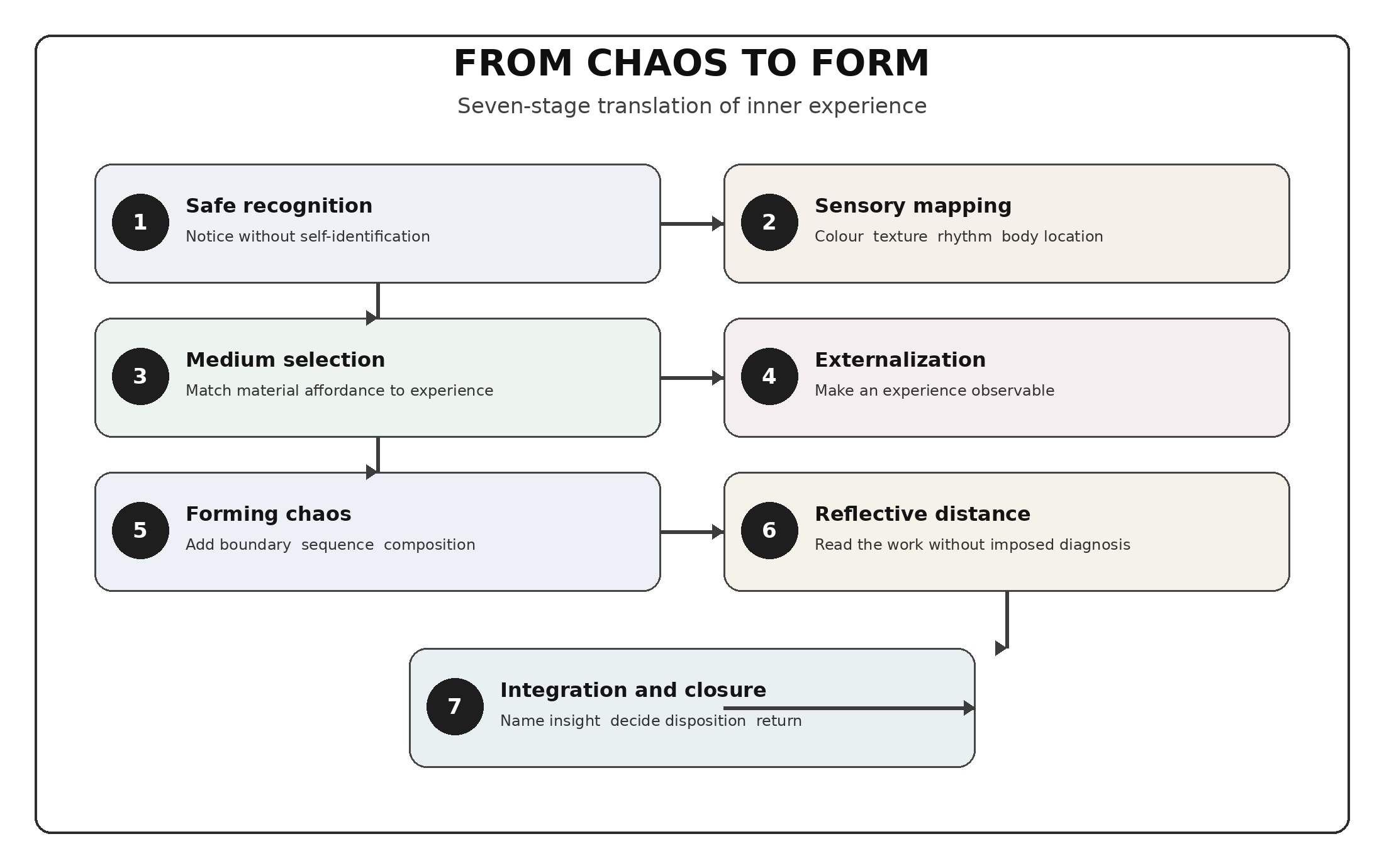
Seven stages from experience to form
1 Safe recognition. Without having to put it into words straight away, the maker can put a name to an experience. Some brief orientation to the here and now, whether by way of posture or breathing or in noting what support is at hand, makes for a distinction between being wholly absorbed and merely noticing. “Something is present” is the operative idea, as opposed to “this is who I am.” Agency is thus protected, and there is an option to discontinue.
2 Sensory mapping. The experience is articulated using non-diagnostic variables: color, temperature, density, texture, rhythm, pressure, scale, movement, sound associations, and bodily location. In doing so, it converts a general state into discrete elements that can inform artistic decisions. The map may be expressed verbally, drawn, gesturally, or built from samples. Its role is to distinguish components rather than to judge aesthetic quality.
3 Medium selection. The maker chooses a medium because its affordances align with the mapped qualities. Charcoal can accommodate pressure and smearing; thread can support tension and connection; clay can bear weight and resist form; a tablet can enable transparency, repetition, and fast transformation. Choice of medium is also interpretive: it asks what sort of contact the experience calls for.
4 Externalization. The inner material is shifted into an object or an event. The first version may be rough, incomplete, and nonrepresentational. The standard is not resemblance, but recognizability to the maker: the work must retain sufficient aspects of the experience to be encountered outside the body. Externalization is only fully achieved when the maker can perceive a distinction among self, experience, and artifact.
5 Forming chaos. The maker revisits the initial externalization and introduces structure. Operations may include framing, cropping, sequencing, repeating, erasing, separating, layering, balancing, or changing scale. This phase converts an outpouring into an authored composition. By adding form, the artist demonstrates the ability to work on the material without denying its intensity.
6 Reflective distance. The work is examined from a different physical or temporal standpoint: across the room, through a camera, after a pause, in grayscale, mirrored, or as a sequence of versions. Questions stay descriptive at first and then become interpretive: What draws attention? Where does the image retain or release tension? What changed across versions? What does the maker now decide to label? The artwork functions as a partner in inquiry rather than as evidence for diagnosis.
7 Integration and closure. The maker states what is understood at this point, even if only partly; decides whether to keep, modify, cover, archive, share, or destroy the work; and indicates an ending. Closure can involve cleaning tools, exporting or securely deleting files, writing a sentence, adjusting the studio lighting, or redirecting attention to immediate surroundings. This phase blocks ongoing processing and brings ordinary time back.
Complementary roles of traditional and digital media
The analysis suggests that integration is strongest when the two media families are given distinct roles. Traditional materials emphasize contact. Their friction, viscosity, weight, smell, drying time, and resistance register the body’s actions. Because many marks cannot be fully undone, the maker weighs consequence against acceptance. The resulting object carries scale, texture, edge, and a record of material history. These features can support sensory mapping and enable externalization.
Digital tools emphasize transformability. Layers retain alternative options; undo reduces the risk of trialing a move; duplication enables comparison; zoom changes how detail relates to the whole; masks and opacity make concealment and revelation controllable; and animation or time-lapse renders sequence visible. Digital settings can therefore be particularly useful both during making and when maintaining reflective distance. Research in digital art therapy likewise reports both broader expressive possibilities and the need to understand how interfaces shape engagement [4; 5; 7].
A sequential hybrid workflow can draw on both sets of affordances. A maker might start with a tactile, time-limited drawing; photograph it; identify a recurring form; test scale, color, and layering digitally; print a version; and then reintroduce it with paint, cutting, or stitching. The key value is not the number of media, but the visibility of decisions. Each translation introduces a difference that can be observed: what was kept, what was protected, what became editable, and what had to remain singular.
Digital reversibility is not always advantageous. Unlimited undo can reinforce avoidance or perfectionism, while limitless layers can delay closure. In contrast, material irreversibility may feel constraining for one maker and threatening for another. Medium selection therefore needs to remain adjustable. One low-risk approach could begin digitally and then move toward physical commitment; one grounding approach could start with resistant materials and add digital tools later to support comparison. The model specifies functions rather than imposing a required order of technologies.
Table 1.
A Comparative Assessment of the Advantages of Traditional and Digital Media
| Dimension | Traditional media | Digital media | Use in the model |
|---|---|---|---|
| Feedback | Pressure, friction, weight, drying time | Interface response, zoom, filters, automation | Sensory mapping and medium selection |
| Revision | Erasure leaves traces; alteration may be irreversible | Undo, versioning, duplication, non-destructive layers | Forming chaos through visible alternatives |
| Embodiment | Whole-body gesture and direct contact | Mediated gesture; variable scale and input device | Choose according to desired distance |
| Object status | Singular physical artifact | Copyable file with metadata and storage risks | Clarify ownership, privacy, and disposition |
| Closure risk | Material limit may force stopping | Potentially endless editing | Use time, layer, or version limits |
A structured studio protocol.
For practical use, the model can be structured into three phases. Orientation comprises safe recognition and sensory mapping. Translation comprises medium selection, externalization, and formation. Return comprises reflective distance, integration, and closure. This three-phase rhythm renders the method teachable while maintaining the specificity of all seven stages. It also establishes checkpoints: a maker may stop after orientation without producing an artwork, or after externalization without public interpretation.
The facilitator’s role is to safeguard conditions rather than provide meanings. Suitable prompts are process-oriented: “What quality needs to be more visible?”, “Would resistance or reversibility be more useful now?”, “What boundary would make this image manageable?”, or “What would count as enough for today?”. Unsuitable prompts include diagnostic assertions, pressure to disclose a personal story, or promises that a technique will heal trauma. The practice becomes more ethically robust when the participant can refuse, pause, conceal, or destroy work without penalty.
Documentation should differentiate artwork from research data. A private studio image is not automatically available for teaching, publication, or model development. Consent for participation, photography, quotation, and publication should be separable. When digital platforms are used, facilitators should explain where files are stored, whether synchronization is active, and who can access exported files. Ethical questions arise not after the image is made, but when the tool is selected [1].
For artists working alone, closure merits particular emphasis. The final state need not be aesthetically resolved. It may be a bounded version, a dated export, a covered surface, or a written decision not to proceed. The goal is to end the encounter deliberately. If the process produces overwhelming distress, dissociation, risk of self-harm, or loss of functioning, studio practice should stop and appropriate professional support should be sought.
Theoretical contribution and research propositions
The model advances hybrid-art discourse by locating hybridity in transitions rather than in visible appearance. Accordingly, completed work may present as fully digital while depending on a materially grounded process, or it may seem handcrafted while being assembled through digital variation. Analytically, the crucial question is which affordance was employed at each stage and how that choice reshaped the maker’s agency, distance, and ability to bring the process to closure.
It also supports practice-based research by making tacit decisions describable. Artistic knowledge frequently remains embedded in gestures and judgments that are hard to articulate [15; 16]. The seven-stage structure provides a traceable account of how an initially unclear experience becomes a composition. This account can inform reflective journals, studio teaching, and comparative case studies while avoiding reducing the work to psychological symptoms.
Four propositions are proposed. First, sensory mapping is expected to enhance medium fit by substituting generic emotional labels with actionable qualities. Second, alternating material resistance with digital reversibility is expected to increase perceived agency more effectively than relying on either mode alone. Third, deliberate forming together with version comparison is expected to generate greater reflective distance than unstructured expression. Fourth, an explicitly specified closure stage is expected to reduce unfinished activation and strengthen the maker’s sense of completion. These propositions serve as hypotheses for future research, not conclusions drawn from the present conceptual study.
Future empirical work could adopt a mixed-method design involving adult artists or non-clinical creative participants. Process data might comprise stage-completion logs, version histories, material selections, and participant-authored descriptions. Outcomes could include perceived agency, clarity, tolerability, and completion, assessed before and after a session and supplemented by qualitative interviews. Comparing traditional-only, digital-only, and intentionally hybrid conditions would test whether sequencing, rather than mere tool availability, accounts for any observed differences. Any study that involves vulnerable populations would require formal ethics review, qualified support, and a protocol for adverse responses.
Limitations
The framework stems from an authorial practice and has not yet been tested through controlled or longitudinal research. Although its seven stages may correspond to a potentially useful studio logic, they are not universal. Because cultural traditions vary in how they interpret inner experience, authorship, privacy, symbolism, and communal art-making, the model should be adapted to context rather than exported as a culturally neutral sequence.
The boundary between traditional and digital media is best understood as analytical rather than absolute. Styluses offer tactile feedback; physical works can be highly revisable; digital files may become singular in particular contexts; and hybrid tools continually blur categorical distinctions. Accordingly, the affordance matrix should be read as a set of tendencies. Finally, the article’s synthesis cannot demonstrate therapeutic benefit. Any assertions about changes in symptoms, trauma processing, or mental-health treatment must be supported by separate clinical research and professional supervision.
Conclusion
From Chaos to Form presents artistic practice as a structured process of translating inner experience into visual meaning. Its seven stages—safe recognition, sensory mapping, medium selection, externalization, forming chaos, reflective distance, and integration with closure—track a shift from undifferentiated sensation toward a visual form that is authored and bounded. What distinguishes the framework is not simply that traditional and digital techniques can coexist, but that they work together.
Traditional materials can heighten bodily contact, resistance, and the trace's singularity. Digital tools, by contrast, can make alternatives, layers, and transformations visible while reducing the expense of revision. Their integration becomes methodologically significant when each medium is selected for what it makes possible at a given transition. The resulting artwork functions as both an expressive object and a record of decisions through which the maker repositions themselves relative to experience.
The model fits artistic self-inquiry, studio pedagogy, and carefully supported non-clinical creative programs. It is not a diagnostic tool and not a substitute for psychotherapy. Responsible use depends on voluntary participation, maker-directed interpretation, privacy, adjustable intensity, and explicit closure. As a conceptual article, the study provides a coherent framework and testable propositions. The next step is empirical: to investigate how different sequences of tactile and digital work influence agency, reflective distance, tolerability, and completion across a range of artistic and cultural contexts.
References