Obtaining and physicochemical characterization of a natural sericin–reduced graphene oxide (SS-rGO) nanocomposite
УДК 547.962.95
Abstract
In recent years, the development of environmentally friendly, highly functional, and biodegradable polymer nanocomposites based on renewable natural resources has become an important research area in modern polymer chemistry and materials science. The use of natural protein polymers and carbon nanomaterials makes it possible to obtain materials with improved structural and functional characteristics. In this study, a sericin/reduced graphene oxide (SS-rGO) nanocomposite was synthesized by an alkaline condensation method using sericin, a water-soluble protein extracted from silk fiber waste. The structure and physicochemical properties of the obtained nanocomposite were investigated using attenuated total reflectance Fourier-transform infrared spectroscopy (ATR-FTIR) and X-ray diffraction (XRD). The ATR-FTIR results showed the presence of interfacial interactions between sericin and graphene oxide, as well as the formation of strong hydrogen bonds between the functional groups of the components. According to the XRD results, an increase in the content of the β-sheet phase of sericin and evidence of partial reduction of graphene oxide were observed during the formation of the nanocomposite. The identified structural changes indicate the formation of a stable interfacial system and confirm the structural stability of the SS-rGO nanocomposite. The obtained results demonstrate the potential of the synthesized material for the development of functional polymer films, humidity sensors, and biomedical materials.
Аннотация
В последние годы разработка экологически чистых высокофункциональных и биоразлагаемых полимерных нанокомпозитов на основе возобновляемого природного сырья стала важным направлением исследований в области современной химии полимеров и материаловедения. Использование природных белковых полимеров и углеродных наноматериалов позволяет получать материалы с улучшенными структурными и функциональными характеристиками. В данной работе методом щелочной конденсации был синтезирован нанокомпозит серицин/восстановленный оксид графена (SS-rGO) на основе серицина — водорастворимого белка, выделенного из отходов шелкового волокна. Структура и физико-химические свойства полученного нанокомпозита были исследованы с использованием инфракрасной спектроскопии с ослабленным полным внутренним отражением (ATR-FTIR) и рентгеновской дифракции (XRD). Результаты ATR-FTIR показали наличие межфазных взаимодействий между серицином и оксидом графена, а также образование прочных водородных связей между функциональными группами компонентов. Согласно результатам XRD, в процессе формирования нанокомпозита наблюдалось увеличение содержания β-складчатой фазы серицина и признаки частичного восстановления оксида графена. Выявленные структурные изменения свидетельствуют о формировании стабильной межфазной системы и подтверждают структурную стабильность нанокомпозита SS-rGO. Полученные результаты демонстрируют перспективность использования синтезированного материала для разработки функциональных полимерных пленок, датчиков влажности и биомедицинских материалов.
Keywords: sericin; graphene oxide; reduced graphene oxide; nanocomposite; biomaterial; condensation synthesis.
Ключевые слова: серицин; оксид графена; восстановленный оксид графена; нанокомпозит; биоматериал; конденсационный синтез.
1. Introduction
In recent years, the development of polymer nanocomposites based on renewable natural raw materials—exhibiting eco-friendly, biodegradable, and highly functional properties—has become one of the most relevant fields in materials science and macromolecular chemistry [1,2]. In particular, the production of high-value biomaterials from silk industry by-products is of significant scientific and practical importance from the perspective of implementing «green chemistry» principles and achieving effective waste utilization [2,3]. Sericin protein, derived from silk industry waste, is an eco-friendly, biodegradable, and biocompatible natural biopolymer. The presence of active functional groups such as amine, hydroxyl, and carboxyl groups in the structure of sericin enables its modification with various nanomaterials. However, the relatively low mechanical strength, thermal stability, and water resistance of pure sericin limit its scope of practical applications. To overcome these limitations, the development of nanocomposites based on graphene oxide (GO) and reduced graphene oxide (rGO) represents one of the most promising approaches [1,2].
Silk fiber is mainly composed of fibroin and sericin proteins, with sericin accounting for 20–30 % of the total mass of silk fiber [2]. Although sericin extracted during the degumming process in the textile industry was long considered waste, it currently attracts significant interest as a biomaterial due to its high content of amino acids, superior hydrophilicity, antioxidant activity, biocompatibility, and film-forming ability [2,3]. The presence of hydroxyl (–OH), amine (–NH2), and carboxyl (–COOH) groups in the sericin molecule enables it to form intermolecular bonds with various nanomaterials [2].
However, pure sericin-based materials exhibit low mechanical strength, insufficient water resistance, and a tendency to swell rapidly in humid environments. Furthermore, their thermal stability and electrical conductivity are inadequate for modern functional devices. Consequently, extensive research is being conducted on modifying sericin with various inorganic nanofillers [4,5].
Carbon-based nanomaterials, particularly graphene, graphene oxide (GO), and reduced graphene oxide (rGO), represent among the most promising materials for developing polymer nanocomposites due to their two-dimensional crystal lattice, high mechanical strength, large specific surface area, chemical stability, and electrical conductivity [4,6]. The presence of hydroxyl, epoxy, and carboxyl functional groups in GO enables the formation of strong hydrogen bonds and electrostatic interactions with protein molecules [6]. Consequently, GO is widely used as an effective nanofiller for biomacromolecules.
In recent years, the application of composite materials based on sericin and graphene oxide in humidity sensors, flexible electronics, and biomedical fields has expanded significantly. Lee et al. demonstrated that multilayer films prepared from GO/sericin/multi-walled carbon nanotubes exhibited high sensitivity within a relative humidity range of 11–97 % and represented a promising material for real-time respiration monitoring [1]. The authors emphasized that the hydrophilic nature of sericin, combined with the GO layers, enhances the adsorption of water molecules and significantly reduces the sensor's response time.
Cho et al. discovered that in flexible sensors based on rGO/silk fibroin, the formation of a robust interface between the silk protein and graphene layers significantly increases the elastic modulus of the material and maintains high stability under repeated bending [7]. These results demonstrate that combining graphene-based nanomaterials with silk proteins enhances both mechanical and functional properties.
Jain et al. summarized research on humidity and gas sensors based on silk and its composites, highlighting that the high sensitivity, fast response time, and biocompatibility of sericin- and graphene-based systems make them promising materials for wearable electronics [2]. Furthermore, graphene-based materials are widely applied in bioengineering and regenerative medicine. Das et al. demonstrated that rGO-modified silk biomaterials stimulate cell proliferation and enhance electrical conductivity [3].
An analysis of the existing literature indicates that studies dedicated to the synthesis of sericin–reduced graphene oxide (SS-rGO) nanocomposites via an alkaline condensation method in the presence of ammonium carbonate, as well as the comprehensive investigation of their structural changes using XRD and ATR-FTIR spectroscopy, remain limited. In particular, the transition of the sericin secondary structure into β-sheet phases, the mechanism of interfacial bond formation, and the alterations in the electronic structure of the nanocomposite have not been sufficiently elucidated.
In this context, the objective of this work is to synthesize the SS-rGO nanocomposite based on sericin and graphene oxide via a condensation method, to conduct a comprehensive structural analysis of the obtained material using XRD and ATR-FTIR spectroscopy, and to evaluate the physicochemical properties of the resulting nanocomposite.
2. Materials and Methods
Research Materials. In this study, natural sericin protein was utilized as the biopolymer matrix. Sericin was extracted during the degumming process of silk fibers, purified under laboratory conditions, and dried. The bleached and purified sericin served as the primary polymer component in subsequent experiments. Due to the abundance of hydroxyl (–OH), amine (–NH2), and carboxyl (–COOH) functional groups in its structure, sericin possesses a high capacity to form strong intermolecular interactions with graphene oxide [1–3].
Graphene oxide (GO) dispersion was used as the nanofiller. Graphene oxide is characterized by a large specific surface area, the presence of oxygen-containing functional groups, and its ability to form stable dispersions in aqueous media. These features make it an effective component for the synthesis of protein-based nanocomposites [4,6].
Analytical grade ammonium carbonate ((NH4)2CO3) reagent was used to create an alkaline medium during the synthesis process. Distilled water was employed as the reaction medium.
Table 1.
Reagents used in the synthesis of SS-rGO nanocomposite
| Reagent | Chemical Formula | Function |
|---|---|---|
| Sericin | Protein | Biopolymer matrix |
| Graphene oxide | GO | Nanofiller |
| Ammonium carbonate | (NH₄)₂CO₃ | Alkaline agent / pH regulator |
| Distilled water | H₂O | Solvent |
Research Methods
The synthesis of the SS-rGO nanocomposite was carried out using a condensation synthesis method. Initially, 0.1g of sericin protein was dissolved in 10ml of distilled water to prepare a 1 % (w/v) aqueous solution of sericin. Bleached sericin was dissolved in the required amount of distilled water with continuous stirring on a magnetic stirrer until complete dissolution was achieved.
In a separate container, an aqueous dispersion of graphene oxide was prepared. Subsequently, the sericin solution and graphene oxide dispersion were mixed at a 1:0.5 mass ratio. This ratio was selected to ensure a uniform distribution of graphene oxide particles within the sericin matrix and to enhance the structural stability of the nanocomposite [5,6].
The reaction was conducted via the condensation method within a temperature range of 80–100 °C. Since composite formation was performed in an alkaline medium, ammonium carbonate was added to the reaction mixture. The alkaline medium enhances the activation of functional groups on the sericin molecules, facilitating the formation of hydrogen bonds and other intermolecular interactions with graphene oxide [2,4].
Upon completion of the reaction, the resulting composite was cooled to room temperature and dried to a constant weight. The dried sample was then prepared for subsequent physicochemical analyses.
ATR-FTIR Analysis. ATR-FTIR spectroscopy was employed to identify functional groups within the nanocomposite and to evaluate the intermolecular interactions between sericin and graphene oxide. Spectra were recorded in the range of 4000–500 cm-¹. Changes in the Amide I, Amide II, and Amide III regions were analyzed in the obtained spectra to assess the mechanism of composite formation [1,3].ATR-IR Fourier spectroscopy analyses were performed on a “FTIR 4600 JASCO” (Japan) spectrophotometer.
X-ray Diffraction Analysis (XRD)X-ray diffraction was utilized to determine the degree of crystallinity and phase composition of the nanocomposite. Based on the XRD diffractograms, the secondary structure of sericin and the degree of reduction of graphene oxide were evaluated [4,7]. Crystallinity degree of the samples were measured by powder x-raydiffraction (XRD, Rigaku, The SmartLab SE, Japan(Khorezm Mamun Akademy lab))
3. Experimental section
The synthesis of the sericin–reduced graphene oxide (SS-rGO) nanocomposite was carried out via a condensation method. First, a 1 % (w/w) aqueous solution was prepared by dissolving 0,1g of purified sericin in 10ml of distilled water using a DLAB MS7-H550-S magnetic stirrer with continuous stirring until a homogeneous solution was obtained. In a separate vessel, an aqueous dispersion of graphene oxide was prepared and added to the sericin solution at a mass ratio of 1:0.5. The mixture was maintained under constant stirring until homogeneity was achieved.
The formation of the nanocomposite was conducted in an alkaline medium, with ammonium carbonate ((NH4)2CO3) utilized to maintain alkalinity. The alkaline medium promotes the ionization of functional groups within sericin, enhancing intermolecular interactions with the oxygen-containing groups of graphene oxide.
The reaction proceeded within a temperature range of 80–100 °C. During heating, hydrogen bonding and other non-covalent interactions developed between sericin and graphene oxide, resulting in a three-dimensional nanocomposite structure. Upon reaction completion, the product was cooled to room temperature and dried to a constant mass.
The dried sample was ground and prepared for physicochemical characterization using ATR-FTIR and X-ray diffraction (XRD). These analyses enabled the evaluation of the functional groups, crystallinity, and optical properties of the nanocomposite.
4. Results and Discussion
In this study, the structural and optical properties of the synthesized SS-rGO nanocomposite were investigated using ATR-FTIR and X-ray diffraction (XRD). The obtained experimental results enabled the identification of intermolecular interactions occurring between sericin and graphene oxide, the evaluation of the crystal structure of the composite, and the characterization of alterations in its optical properties.
During composite formation, the amine, hydroxyl, and carboxyl groups of the sericin molecule interact with the oxygen-containing functional groups of graphene oxide. As a result of these interactions, specific changes occur in the molecular structure, secondary structure, and electronic states of the composite. These modifications were elucidated using spectroscopic methods, providing insights into the mechanism of composite formation.
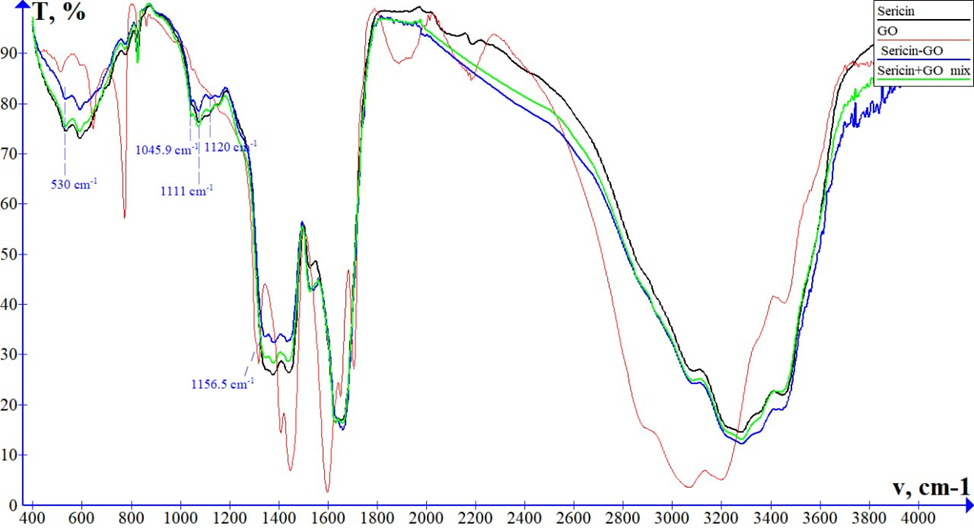
ATR-IR Fourier spectroscopy analyses were performed on a “FTIR 4600 JASCO” spectrophotometer and studied in the range of 4000 – 400 cm-1 [8].
In the ATR-FTIR analysis of the Sericin-GO sample, a decrease in peak intensity was observed at 1631 cm-¹, accompanied by an enhancement of the peak at 1660 cm-¹ (Figure 1). In proteins, the 1600–1700 cm-¹ region corresponds to Amide I (C=O stretching) and is highly sensitive to the secondary structure of sericin. The reduction of the peak at 1632 cm-¹ indicates the disruption of the ordered β-sheet structures of sericin, as the 1615–1635 cm-¹ region typically corresponds to β-sheet conformations. The intensity enhancement in the 1651.5–1660 cm-¹ range aligns more closely with the random coil/α-helix region. In other words, the interaction with GO led to a conformational rearrangement in the secondary structure of sericin or its transition into another type of conformation (α-helix/random coil).
In the protein backbone, the 1520–1550 cm-¹ range (Amide II region) corresponds to N–H bending and C–N stretching vibrations. In the ATR-FTIR analysis of the SS-rGO sample, a decrease in intensity at 1527 cm-¹ and the appearance of a new peak at 1542 cm-¹ were observed. This indicates a change in the chemical environment surrounding the –NH groups of sericin (due to bonding with GO functional groups). Furthermore, the slight blue shift of the Amide II peak suggests alterations in the N–H hydrogen bonding and the electron density around the –C–N– bonds.
The enhancement of the peak at 1156 cm-¹ and the emergence of a new peak at 1120 cm-¹ correspond to C–O and C–O–C (ether/polysaccharide/alcohol) stretching, as well as C–N vibrations in some instances.
Sericin contains abundant –OH, –NH2, and –COOH groups, while GO possesses numerous –OH, –O–, –COOH, and C–O–C bonds, allowing these functional groups to interact. New hydrogen bonds are formed between the oxygen-containing groups of GO and the –OH/–NH groups of sericin, or ester/ether-type C–O–C and C–O bonds are strengthened.
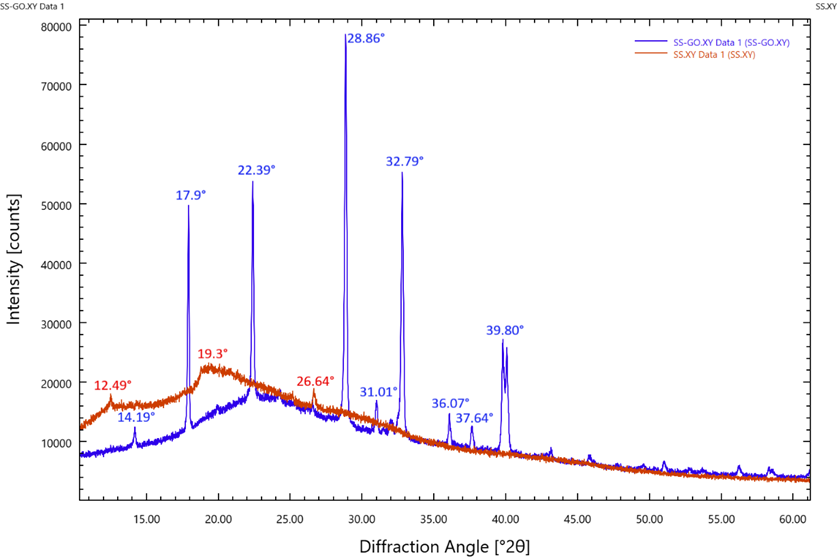
X-ray diffraction (XRD) analysis of the SS-rGO nanocomposite was performed (Figure 2). The XRD analysis of isolated sericin exhibited a broad, prominent diffraction peak at 2θ≈ 19.3°. This peak is associated with random coil and α -chain conformations, indicating a low content of β-sheet structure and demonstrating that sericin consists primarily of an amorphous phase [7]. The peak at 2θ≈ 26.64° is typically not observed in the XRD spectrum of pure sericin protein. The appearance of this peak is attributed to the denser packing of β-sheet structures in sericin, a phenomenon established to occur mainly as a result of ethanol precipitation and heat drying of sericin [9,10]. The minor peak at 12.49° may indicate partial crystallization of sericin.
The characteristic peak corresponding to GO was not observed in the diffractogram. Typically, GO exhibits a strong (001) reflection at 9°–12°. Here, a smaller peak was detected at 14.19°, which may be associated with the formation of partially reduced GO (rGO) due to interactions with sericin. The emergence of a peak at 17.9° is attributed to the transformation of α -helix or random coil chains into β-sheets. The diffraction peaks at 22.39° and 28.86° correspond to β-sheet crystals (characteristic of the Silk II phase in silk proteins). While sericin is predominantly amorphous, the incorporation of GO induces β-sheet structure formation [12,13]. The peaks at 31°, 32.79°, 36.07°, 37.64°, and 39.80° are associated with new phases or induced crystalline structures within the sericin–GO composite resulting from the enhancement of β-sheet content. Overall, the addition of GO organized the sericin structure, facilitating a transition from an amorphous state to an ordered β-sheet conformation, which consequently increased the degree of crystallinity of the composite.
5. Conclusion
In this study, an SS-rGO nanocomposite material was successfully synthesized via a condensation method using natural sericin protein and graphene oxide. During the synthesis process, a 1 % solution of sericin and a graphene oxide dispersion were mixed at a 1:0.5 mass ratio, and the reaction was carried out in an alkaline medium at 80–100 °C. Ammonium carbonate was utilized to establish the alkaline medium.
The experimental results demonstrated that the selected synthesis conditions were effective in forming a stable composite structure between sericin and graphene oxide. The alkaline medium and heating process enhanced the interactions between the functional groups of the sericin molecules and the oxygen-containing groups of graphene oxide, creating favorable conditions for nanocomposite formation.
The resulting SS-rGO nanocomposite, as a highly functional biopolymer material, holds strong potential for applications in humidity sensors, functional coatings, biosensors, and other advanced composite materials. The findings of this study indicate that modifying sericin-based natural biomaterials with carbon nanomaterials significantly expands their practical application scope.
References