Foam-forming anionic surfactants: comparative application of sulfanol and AOS in the oil and gas industry
УДК 665.615.2:66.061.94.
Abstract
Sulfanol (alkylbenzene sulfonate, ABS) and alpha-olefin sulfonate (AOS), both belonging to the class of anionic surfactants, have been widely used in the oil and gas industry for many years. Based on an analysis of scientific publications and patents from 1977 to 2026, this paper examines the industrial application of both surfactant classes in chemical enhanced oil recovery (surfactant, ASP and micellar flooding), foam-assisted mobility control (CO2/N2 foam EOR), foam-assisted liquid unloading (deliquification) in gas wells, well stimulation by acidizing and hydraulic fracturing, and as an additive for drilling fluids. Reported quantitative indicators include incremental oil recovery of up to 26.8 % in ASP flooding and 6–10 % with CO2 and AOS solution co-injection. The two classes are shown to be complementary: sulfanol-type systems are applicable to micellar-alkaline flooding under moderate temperature and salinity, whereas AOS is preferred where stable foam is required. Recommendations are given for priority testing of domestically produced sulfanol under the conditions of Uzbekistan.
Аннотация
Сульфанол (алкилбензолсульфонат, АБС) и альфа-олефинсульфонат (АОС), оба относящиеся к классу анионных поверхностно-активных веществ, в течение многих лет широко применяются в нефтегазовой промышленности. В данной работе на основе анализа научных публикаций и патентов за 1977–2026 годы рассматривается промышленное применение обоих классов ПАВ в химических методах увеличения нефтеотдачи (заводнение с ПАВ, ASP и мицеллярное заводнение), регулировании подвижности с помощью пены (EOR с пенами CO2/N2), удалении жидкости с помощью пены (деликвификация) из газовых скважин, стимуляции скважин кислотными обработками и гидравлическим разрывом пласта, а также в качестве добавки для буровых растворов. Приведены количественные показатели: прирост нефтеотдачи до 26,8 % при ASP-заводнении и 6–10 % при совместной закачке CO2 и раствора АОС. Показано, что сульфанол и АОС взаимно дополняют друг друга: сульфаноловые системы применимы в мицеллярно-щелочном заводнении при умеренной температуре и минерализации, тогда как АОС предпочтителен там, где требуется устойчивая пена. Даны рекомендации по первоочередным испытаниям отечественного сульфанола в условиях Узбекистана.
Keywords: sulfanol; alkylbenzene sulfonate; alpha-olefin sulfonate (AOS); EOR; foam; deliquification; well stimulation.
Ключевые слова: сульфанол; алкилбензолсульфонат; альфа-олефинсульфонат (АОС); увеличение нефтеотдачи; пена; деликвификация; стимуляция скважин.
Introduction
As the production life of gas fields increases, most wells eventually experience liquid loading at the wellbore, which sharply reduces well deliverability. Anionic surfactants play a central role in addressing this problem.
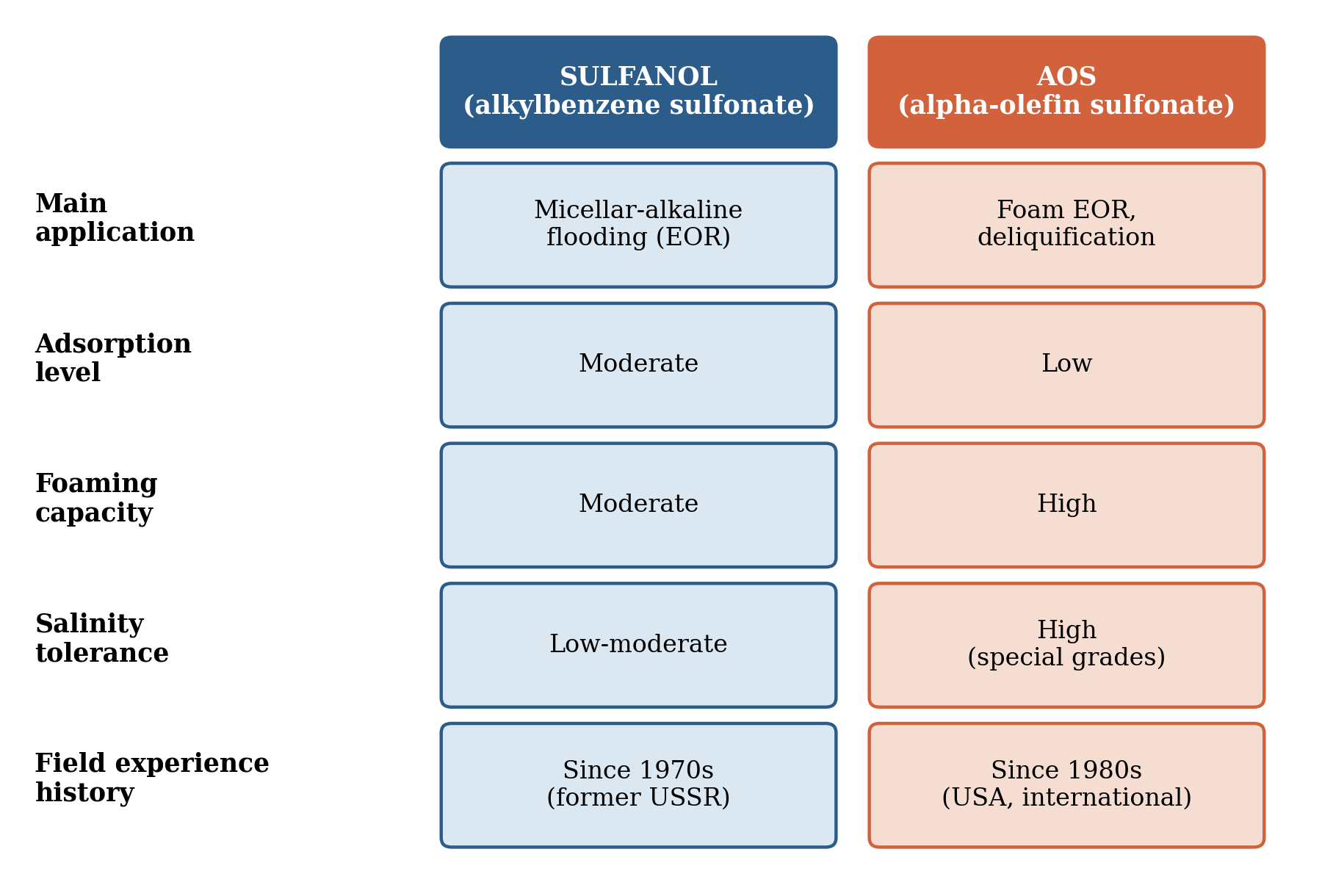
Sulfanol and AOS surfactants are used throughout the oil and gas industry in chemical EOR (surfactant, ASP and micellar flooding), foam-based mobility control, deliquification of gas wells, well stimulation, and drilling-fluid formulation. The purpose of this paper is to comparatively analyze the main application areas of sulfanol and AOS in the oil and gas industry and to assess the prospects for their use under the conditions of Uzbekistan (Figure 1).
Materials and Methods
This paper is a review study based on the analysis of scientific publications and patents concerning the use of sulfanol (alkylbenzene sulfonate) and alpha-olefin sulfonate (AOS) surfactants in the oil and gas industry. Sources were selected from the ScienceDirect, Springer, PubMed Central and OSTI electronic libraries, as well as from the US Patent and Trademark Office (USPTO) and Google Patents databases. The search used the keywords sulfanol, alkylbenzene sulfonate, alpha-olefin sulfonate, EOR, foam, deliquification and well stimulation. The review included sources published between 1977 and 2026 that reported experimental results on the application of surfactants in oil and gas technologies. The collected data were grouped by application area, and the performance indicators of sulfanol and AOS were compared.
Results and Discussion
Chemical Enhanced Oil Recovery (EOR)
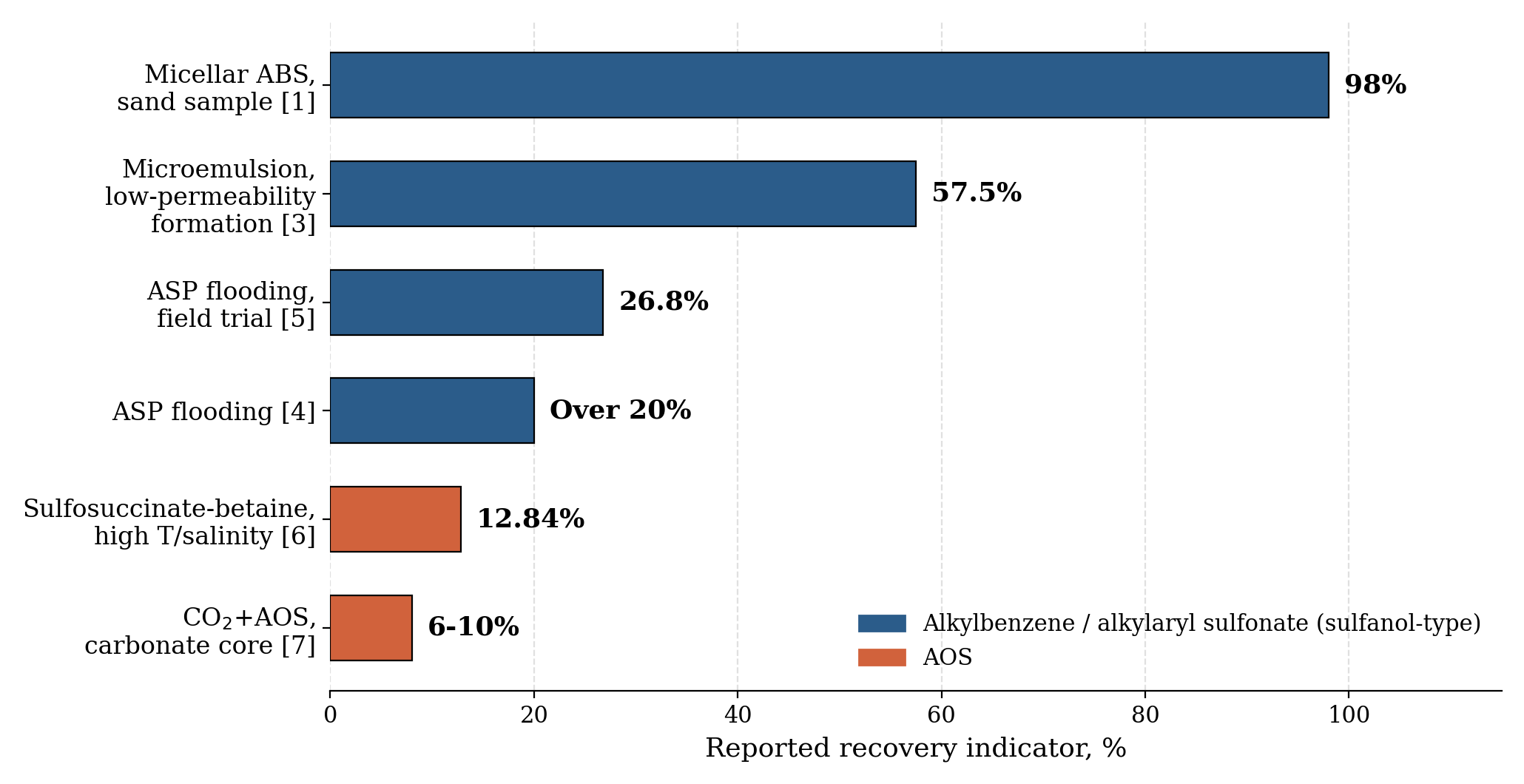
Alkylbenzene and alkylaryl sulfonates were studied as the principal component of micellar flooding as early as the 1970s. Experiments with 12 different alkylbenzene sulfonates recovered up to 98 % of the oil from sand samples with an initial residual oil saturation of 25–28 % [1]. The micellar aggregation properties of the surfactants (critical micelle concentration, interfacial tension) were investigated separately, demonstrating the importance of adapting these parameters to reservoir conditions [2]. Recent studies have shown that a middle-phase microemulsion system based on heavy alkylbenzene sulfonate can mobilize up to 57.5 % of the residual oil in low-permeability formations [3]. In alkaline–surfactant–polymer (ASP) flooding using alkylaryl sulfonate, oil recovery increased by more than 20 % [4], and some field trials reported an incremental recovery of up to 26.8 % [5]. In offshore fields under high-temperature (90°C) and high-salinity (34 g/L) conditions, a sulfosuccinate–betaine composition yielded 12.84 % incremental oil recovery, confirming that modern sulfonate formulations can be adapted to harsh reservoir environments [6].
AOS, in turn, is distinguished by its low adsorption (particularly on sandstone) and high tolerance to hard water, which ensures deeper penetration into the reservoir [7]. For this reason, AOS is increasingly preferred in modern surfactant-flooding projects [5].
Foam-Assisted Mobility Control (Foam EOR)
AOS, particularly its C14–C16 homologue (AOS 14 – 16), is the most widely used anionic surfactant for improving sweep efficiency by reducing gas mobility through CO2 and nitrogen foam. In an experiment on carbonate core samples, co-injection of CO2 and AOS solution yielded an incremental oil recovery equal to 6–10 % of the original oil in place [7]. However, the presence of crude oil is the main limitation of foam stability. To overcome this, adding nanoparticles (fly ash, SiO2, Al2O3) or a polymer (guar gum) to AOS has been shown to significantly increase foam stability even in the presence of crude oil [8]. For high-salinity conditions (10–25 wt% TDS), special C10–C16 AOS formulations have been developed [9].
Foam-Assisted Liquid Unloading (Deliquification) in Gas Wells
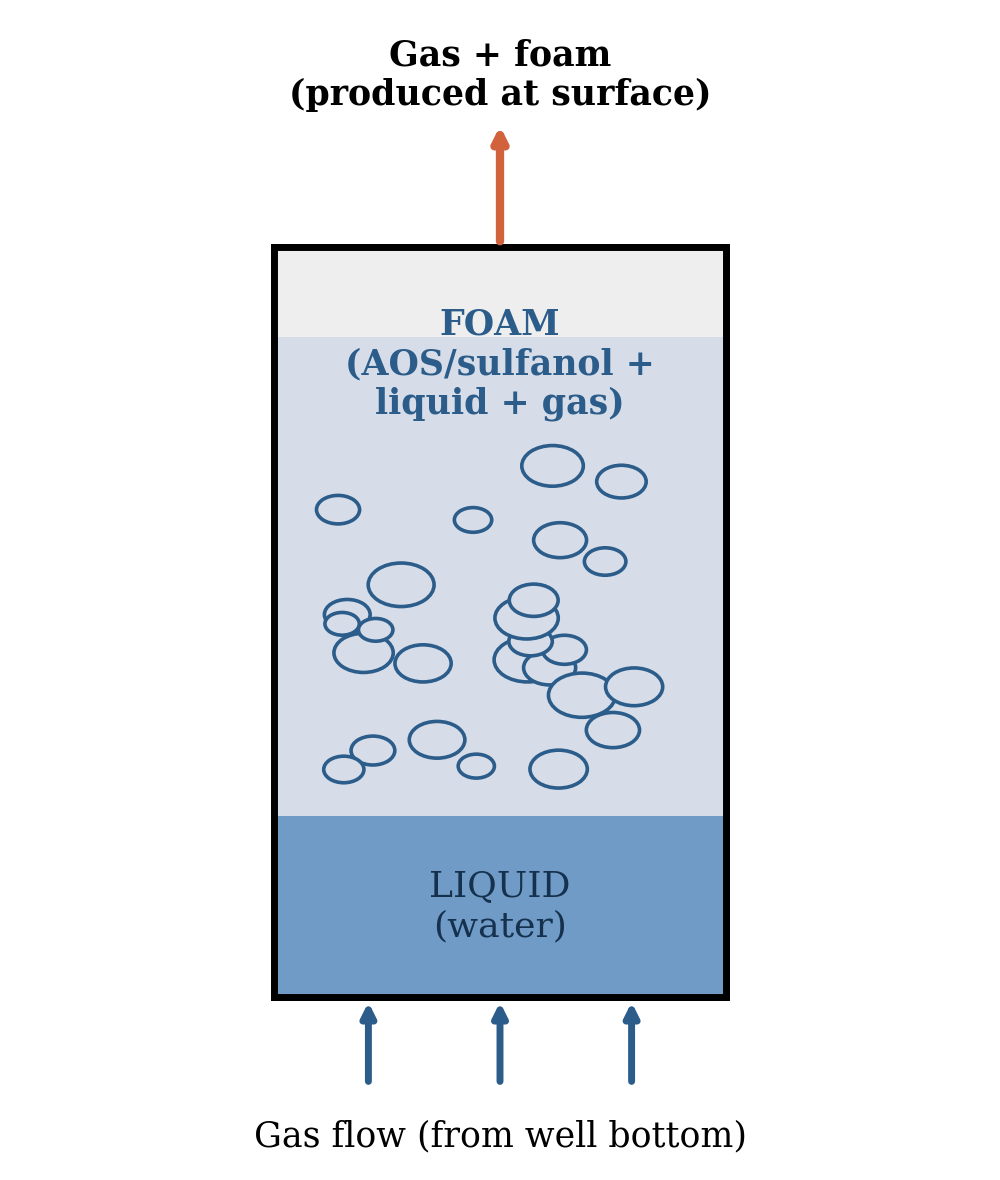
AOS (often in its sodium form, known as AOST) is the most commonly used anionic surfactant for removing accumulated liquid from gas wells, owing to its high foaming capacity and low adsorption. In modern formulations, AOST is combined with cationic (CTAC) and amphoteric (CDAB) surfactants together with the nonionic surfactant AEO7, producing a composite foam system resistant to formation water, salinity, and the presence of methanol (added to prevent hydrate formation) [10].
In gas wells, AOS is mainly used in high-pressure wells that have been in operation for many years and have since become inactive. For example, sulfanol (AOS-type product) is currently used at the Gazli underground gas storage facility located near the town of Gazli, Bukhara Province. When liquid accumulation in a gas well reduces its deliverability or injectivity, sulfanol is applied in one of two ways. The first method involves mixing sulfanol with water to form an aqueous solution, which is poured into the upper part of the well; however, this method is relatively ineffective in high-pressure wells. For this reason, the second method is more commonly used, in which sulfanol is pressed into a solid ‘checker’ (briquette) form. The sulfanol briquettes are introduced from the wellhead and, owing to their weight, descend to the bottom of the well more rapidly. At present, however, even this method is becoming less effective, as the foam generated from sulfanol and the produced liquid no longer remains stable for a sufficient length of time.
Well Stimulation (Acidizing and Hydraulic Fracturing)
In acid treatments, foam compositions based on AOS and alkyl ether sulfate blends are used, producing foamed acid solutions with a half-life of at least 30 minutes and a foam quality above 60 % [11]. In hydraulic fracturing operations, a suspension of solid-form AOS surfactant in an organic-based fluid is used to thicken drilling and stimulation fluids and to improve well cleanup efficiency [12].
Additive for Drilling Fluids
AOS surfactants are used in organic-based (diesel or vegetable oil) drilling fluids as a solids-suspending agent, performing the functions of polymer hydration, wetting, and dispersion [12]. Such formulations are also effectively used during well-completion operations [12].
Discussion
The analysis shows that the application domains of alkylbenzene and alkylaryl sulfonates (sulfanol-type surfactants) and alpha-olefin sulfonates (AOS) are closely related to their molecular structure and physicochemical properties. Alkylbenzene and alkylaryl sulfonates, including sulfanol-type surfactants, can be used in micellar-alkaline flooding under relatively low to moderate temperature and salinity conditions. The efficiency of such systems depends on the composition of the medium, temperature, salinity level, and the oil–water–surfactant interaction.
AOS surfactants, in turn, are regarded as a promising component in a number of modern oil and gas technologies that require foam generation, including CO2-EOR, well deliquification, and certain acid-treatment processes. Their molecular structure can influence surface activity, adsorption behavior, and foam stability. For this reason, AOS-based systems may be applied to form stable foam under specific conditions.
For both surfactant classes, high salinity and the presence of various components in crude oil can affect micelle formation and foam stability. In this regard, combining surfactants with polymers, nanoparticles, or other surface-active agents — such as betaines and gemini surfactants — is one of the possible methods for controlling their functional properties. However, the efficiency of such composite systems should be evaluated experimentally under specific geological and technological conditions.
For conditions in Uzbekistan, given the availability of domestically produced sulfanol, it is recommended to first test it in mature oil fields using micellar-alkaline flooding and in low-productivity gas wells using simple foam-deliquification formulations, and to combine it with performance-enhancing additives to form hybrid compositions. It is subsequently recommended to compare these formulations with imported AOS in order to determine under which conditions each surfactant is more economically and technically advantageous.
It should be separately noted that foam-assisted liquid removal represents only the initial stage of the technological chain for preparing gas produced from underground gas storage (UGS) facilities: after free liquid has been removed from the bottom of the well, an additional absorption- or adsorption-based drying stage is required to reduce the residual moisture content of the gas to the required dew point. This subsequent stage has been addressed by the authors in separate studies, which examined the applicability of adsorption-based gas drying under the UGS conditions of Uzbekistan [13], an integrated efficiency criterion for the absorbents and solid adsorbents used in gas drying [14], and methods for enhancing the regeneration capacity of inorganic adsorbents [15]. Together with the foam technology discussed in this paper, these studies form a coherent technological chain for the comprehensive treatment of UGS gas.
Conclusion
Sulfanol and AOS were found to be mutually complementary classes of anionic surfactants that can, in practice, be applied across virtually all major technological processes of the oil and gas industry. Further laboratory and pilot-scale studies are recommended to determine the efficiency of their application under local conditions, including in combination with additional stabilizers such as fly ash.
References