Effect of temperature on the synthesis of a cation exchanger based on urea, formaldehyde and tartaric acid
УДК 541.64:544.726
Abstract
This research focuses on the synthesis of a new polymeric cation exchanger based on the urea-formaldehyde-tartaric acid (UFT) system, featuring active functional groups containing nitrogen and oxygen. The study comprehensively investigated the influence of polycondensation temperature and duration on the ion-exchange and sorption properties of the resulting cation exchanger. Experimental results established the optimal synthesis conditions for the polymer sorbent: a process temperature of 120°C and a reaction time of 2.5–3 hours. The static exchange capacity (SEC) of the cation exchanger produced under these optimal parameters was determined to be 3.6 mg-eq/g relative to a 0.1 N sodium hydroxide (NaOH) solution. The chemical structure and functional groups of the synthesized polymer material were analyzed in detail using infrared (IR) spectroscopy, and the results fully confirmed the presence of active centers capable of forming coordination bonds with metal ions. Furthermore, the material's high-temperature resistance was investigated using differential thermal analysis (DTA) and thermogravimetric (TG) methods, and its thermal stability characteristics were determined. The positive results obtained indicate that this cation exchanger can serve as a highly effective and promising polymer sorbent for purifying industrial wastewater of various toxic heavy metal ions and ensuring environmental stability. It was determined that the production and application of this sorbent represent an optimal approach to removing heavy metals from water.
Аннотация
Аннотация. Данная научно-исследовательская работа посвящена синтезу нового полимерного катионита с активными функциональными группами, содержащими азот и кислород, на основе системы мочевина, формальдегид и винная кислота (МФВ). В ходе экспериментов всесторонне и глубоко изучено влияние температуры и продолжительности реакции поликонденсации на ионообменные и сорбционные свойства полученного катионита. В результате экспериментальных исследований определены наиболее благоприятные (оптимальные) условия синтеза полимерного сорбента; оптимальная температура процесса составляет 120 °C, а продолжительность реакции – 2,5–3 часа. Установлено, что статическая обменная емкость (СОE) катионита, полученного при этих оптимальных параметрах, составляет 3,6 мг-экв/г относительно 0,1 Н раствора гидроксида натрия (NaOH). Химическая структура и функциональные группы в синтезированном полимерном материале детально изучены с помощью инфракрасной спектроскопии, и полученные результаты полностью подтверждают наличие активных центров, способных образовывать координационные связи с ионами металлов. Также была изучена термостойкость материала с использованием методов дифференциального термического анализа и термогравиметрического анализа, а также определены показатели его термической стабильности. Все полученные положительные результаты указывают на то, что этот катионит может быть использован в качестве высокоэффективного и перспективного полимерного сорбента для очистки промышленных сточных вод от различных токсичных ионов тяжелых металлов и обеспечения экологической устойчивости.
Keywords: urea; formaldehyde; tartaric acid; cation exchanger; polymer ligand; sorption; temperature; complex compound; ion-exchange capacity.
Ключевые слова: мочевина; формальдегид; винная кислота; катионит; полимерный лиганд; сорбция; температура; комплексное соединение; ионообменная емкость.
Introduction
Amidst rapid industrialization and technological advancement, minimizing the environmental impact of production processes and effectively managing the resulting waste constitute significant scientific and practical issues. In this context, there is growing interest in sorption technologies that enable the separation of various pollutants from aqueous media and their recovery. Sorbents are among the promising materials used in numerous practical applications, such as the separation and recovery of metal ions, the purification of wastewater from heavy metal ions and organic pollutants, gas capture (including CO2), and the production of various functional composite materials[1-7]. The pollution of water resources further underscores the ecological urgency of this issue. Water bodies serve as primary recipients of waste generated by industrial enterprises, households, and agricultural activities, playing a significant role in the accumulation and dispersal of various pollutants. In particular, certain toxic substances that enter the aquatic environment can persist in ecosystems and move up through trophic chains to higher levels. Therefore, it is crucial to remove pollutants from water using effective, selective, and environmentally safe methods[2-597]. The efficiency of sorption materials depends directly on their surface properties, pore structure, functional groups, and ability to interact with contaminant components. Compared to traditional ion-exchange materials, the absence of strong chemical bond formation between the solid phase and the component being separated in certain sorption systems can lead to accelerated mass transfer processes and rapid sorption kinetics[3-229]. The potential use of various natural, inorganic, biopolymer, and synthetic sorbents for the removal of heavy metal ions from aqueous solutions is being extensively studied. In particular, the cation-exchange properties of a calcium hydrosilicate material derived from technogenic raw materials have been investigated, and the kinetic principles governing the sorption of Co²+, Ni²+, Cu²+, Zn²+, Cd²+, and Mn²+ ions by this material have been determined. These studies demonstrate the possibility of simultaneously processing waste and purifying the water environment from heavy metals by turning man-made waste into functional sorbents[4-155]. Porous carbon materials derived from natural and plant-based raw materials are also considered promising sorbents for the separation of heavy metal ions. For example, activated carbon materials with a high specific surface area (SBET = 980–2100 m²·g-¹, VΣ = 0.45–1.0 cm³·g-¹) have been obtained through chemical activation using orthophosphoric acid. When the sorption properties of such materials regarding Cd²+, Cr³+, Ni²+, Cu²+, and Zn²+ ions were investigated, it was found that they exhibit high sorption activity toward certain metal ions[5-56]. These results demonstrate that the efficiency of metal ion separation by sorbents can be enhanced through the targeted modification of raw material composition, surface morphology, and functional groups. The use of materials of biological origin for the sorption of metal ions is also attracting significant scientific interest. For instance, a chitin-glucan complex has been isolated from *Aspergillus niger* biomass waste—generated during the microbiological synthesis of citric acid—and its metal-ion-adsorbing properties have been investigated. This biopolymer material exhibited high sorption activity toward certain metal ions. The study established the sorption sequence Co²+ > Ni²+ > Mn²+ > Zn²+ > Cu²+, indicating that the interaction of these metal ions with the sorbent's functional groups depends on their nature and chemical properties[6-787]. Sorbents based on synthetic and chemically modified biopolymers enable high selectivity toward metal ions. In particular, the sorption properties of a cation exchanger based on cross-linked sulfoethylated chitosan have been investigated regarding the uptake of Cu²+, Ag+, Co²+, Ni²+, Zn²+, Mn²+, and Mg²+ ions from solutions containing them either individually or in combination. Mathematical analysis of sorption isotherms revealed that the cation exchanger exhibits a high affinity for Cu²+ and Ag+ ions. The fact that the sorption process is well described by the Redlich–Peterson model in the presence of co-existing metal ions indicates that the sorbent surface is energetically heterogeneous [7-39]. Among natural mineral materials, montmorillonite clays are also distinguished by their ability to sorb metal ions. The sorption properties of samples obtained from montmorillonite clay deposits in the Belgorod region regarding Cu²+, Fe³+, and Cr³+ ions were investigated, and their chemical and mineralogical composition, colloidal-chemical properties, and sorption activity were comprehensively evaluated. The results demonstrated the potential for using these mineral materials in water treatment, particularly in fine purification processes[8-381].
The studies mentioned above indicate that the efficiency of heavy metal ion sorption depends directly not only on the porosity and specific surface area of the sorbent but also on the nature of the functional groups present in its composition, the donor atoms, and the interactions formed with the metal ions. There fore, the synthesis of polymer materials containing nitrogen- and oxygen-bearing functional groups, along with the study of their sorption and complex-forming properties with respect to metal ions, represents a promising area of research[9-252].
Materials and methods
In this study, a cation exchanger was synthesized using urea, formaldehyde, and tartaric acid. The uptake of Ni(II), Cu(II), and Zn(II) metal ions by the obtained samples was determined via static exchange capacity. Thermal analysis of the obtained samples was carried out using a DTG-60 thermal analyzer manufactured by Shimadzu[10-5].
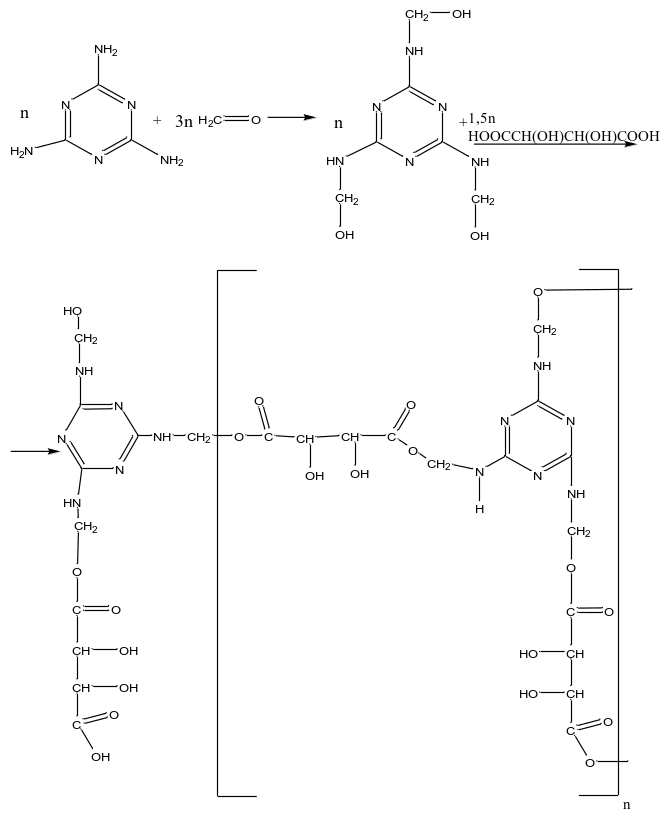
Synthesis of a cation exchanger based on urea, formaldehyde, and tartaric acid. A mixture of 2.52 g (0.02 mol) of melamine and 4.5 g (0.03 mol) of tartaric acid was melted at a temperature of 170°C. The temperature of the melt was lowered to 100°C; 5 ml (0.06 mol) of formaldehyde solution and 5 ml of NH4OH solution were added dropwise, and the mixture was heated until a viscous mass formed. The product was placed in a porcelain mortar and dried in a drying oven at 100°C for 24 hours. The analysis results of the dried sorbent were evaluated.
Results and Discussion
An optimal temperature of 125°C was established for the UFT cation exchanger reaction, with a reaction duration of 2.5–3 hours; the static exchange capacity of the cation exchanger for a 0.1 N sodium hydroxide solution was determined to be 3.6 mg-eq/g.
Table 1.
Dependence of the ion exchanger's sorption properties on the reagent ratio.
| Molar ratio of urea, formaldehyde, and tartaric acid | Reaction yield, % | Static exchange capacity, mg-eq/g, 0.1 N solutions: | ||
|---|---|---|---|---|
| Cu2+ | Zn2+ | Ni2+ | ||
| 2:5:0,5 | 89 | 4,03 | 5,32 | 5,15 |
| 2:5:1,0 | 90 | 6,80 | 6,0 | 6,40 |
| 2:5:1,5 | 88 | 4,55 | 4,65 | 4,54 |
The synthesized cation exchanger demonstrated good ion-exchange properties toward metal ions, which can be attributed to the presence of nitrogen- and oxygen-containing functional groups in its polymer matrix. These results indicate that the obtained material has potential for the selective sorption and removal of metal ions from aqueous solutions.
Table 2.
Effect of temperature and time on the polycondensation process during the formation of a cation exchanger based on urea, formaldehyde, and tartaric acid.
| № | Reaction temperature, t,℃ | Reaction time, τ, hours | Specific volume of a cation exchanger swollen in water in the H+ form, ml/g | SEC, in mg-eq/g of 0.1 N NaOH solution |
|---|---|---|---|---|
| 1 | 95 | 5-6,5 | 1,4 | 2,5 |
| 2 | 110 | 4,5-5 | 1,2 | 2,9 |
| 3 | 125 | 2,5-3 | 0,9 | 3,6 |
| 4 | 130 | 1,5-2 | 0,6 | 3,1 |
A high-performance cation exchanger was obtained from urea, formaldehyde, and tartaric acid. Experiments were conducted using various initial mass ratios, and a sorbent with the highest static exchange capacity was synthesized using a (urea:formaldehyde:tartaric acid) ratio of 2:5:1 (table 1).
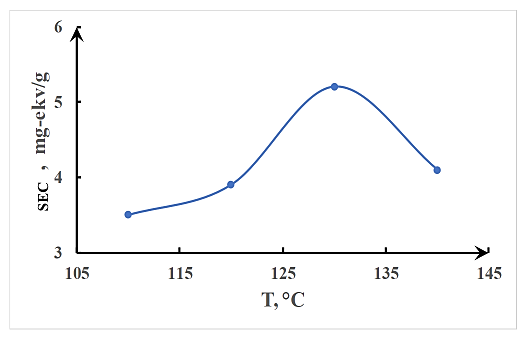
Table 3.
FTIR spectroscopic analysis of the cation exchanger based on urea, formaldehyde, and tartaric acid
| Classifications | UFT | UFT +Cu(II) | UFT +Zn(II) | UFT +Ni(II) | sm-1 |
|---|---|---|---|---|---|
| ν(OH) | 3128,42 | 542,70 | 552,76 | 551,33 | |
| ν(NH) | 3055,95 | 3095,93 | 3065,96 | 3067,81 | |
| ν(C=O) | |||||
| δ(NH) | 1568,20 | 1560,00 | 1538,20 | 1549,93 | |
| νas(-COO-) | 1725,93 | 1765,11 | 1745,94 | 1738,83 | |
| νas(-C-O-C-) | 1176,01 | 1188,11 | 1182,,50 | 1196,91 |
The FTIR analysis confirmed the presence of characteristic hydroxyl, amino, carbonyl, and carboxylate functional groups in the synthesized cation exchanger. The shifts in the characteristic absorption bands after interaction with Cu(II), Zn(II), and Ni(II) ions indicate the involvement of oxygen- and nitrogen-containing functional groups in metal-ion binding. Thus, the FTIR results confirm the formation of coordination interactions between the functional groups of the polymer matrix and the investigated metal ions.
The following conclusion can be drawn from the analysis of the differential thermal analysis and thermogravimetric curves obtained for the cation exchanger based on urea, formaldehyde, and tartaric acid.
Thermal gravimetric analysis revealed decomposition occurring in three stages; the first stage took place within the 25–120°C range.
We attribute the mass loss during this stage primarily to the release of physically adsorbed moisture and surface-bound water present in the sorbent. The desorption of water from the sorbent also contributes to this process, owing to the material's porous structure.
The third stage of mass loss occurred within the temperature range of 200–300°C. The most significant portion of the mass reduction is observed in this interval. This may be attributed to the thermal decomposition of organic structures, chain scission, and the detachment of certain functional groups within the urea-formaldehyde-tartaric acid-based polymer sorbent. Sharp changes in the DTA curve also indicate that thermal processes are proceeding rapidly at these temperatures.
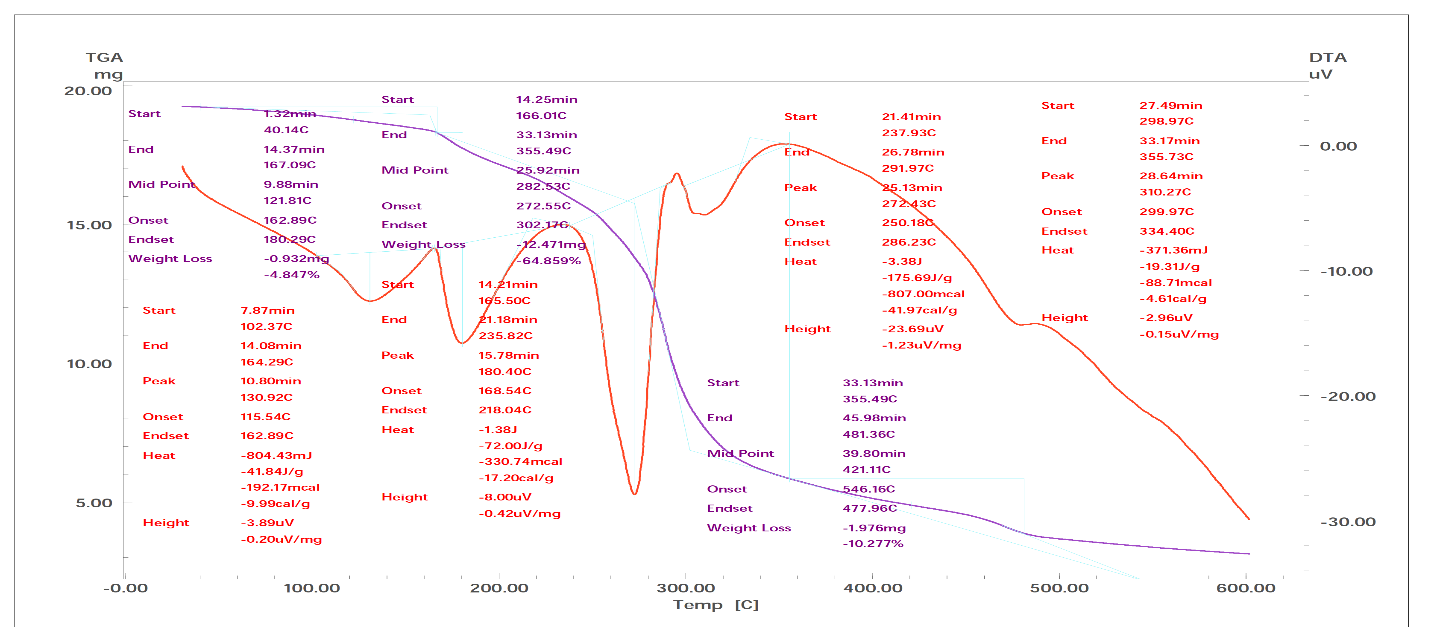
The red curve represents the thermal effects (DTA) occurring during the heating of the sample. Significant changes are observed on the graph in the ranges of approximately 100–160°C, 170–200°C, 220–300°C, and 330–370°C. Changes in the thermal signal continue at higher temperatures as well.
- Low-temperature effects may be associated with moisture desorption and physicochemical changes.
- Effects in the 170–300°C range may correspond to structural changes in the organic matrix and thermal decomposition processes.
- Effects in the 300–370°C range may reflect further decomposition of the polymer structure and the formation of a thermal residue.
- Changes in the 400–600°C range may be related to further thermal transformations of the residual material.
Conclusion
During the study, a polymeric cation exchanger containing functional groups was synthesized based on urea, formaldehyde, and tartaric acid. The effect of the temperature and duration of the polycondensation process on the ion-exchange properties of the cation exchanger was investigated. Based on the results obtained, synthesis conditions involving a temperature of 120°C and a duration of 2.5–3 hours were determined to be optimal. The static exchange capacity of the cation exchanger obtained under these conditions was 3.6 mg-eq/g with respect to a 0.1 N NaOH solution. The obtained results demonstrate that temperature is a key factor affecting the formation and ion-exchange properties of the synthesized cation exchanger. The synthesized material exhibited stable ion-exchange characteristics and can be considered a promising polymeric sorbent for the removal of metal ions from aqueous solutions. The obtained results provide a basis for further studies aimed at investigating the sorption selectivity and complex-forming properties of the cation exchanger toward various metal ions.
References