Synthesis and properties of agricultural hydrogels based on carboxymethylcellulose, urea, bentonite, and kaolin
УДК 678.7+549.6+547.495
Abstract
In this study, a highly swellable composite hydrogel based on carboxymethyl cellulose, methacrylic acid, bentonite, kaolin, and urea was synthesized for agricultural application. The hydrogel was prepared in an aqueous medium using radical grafting and cross-linking techniques. During synthesis, carboxymethyl cellulose served as the polymer matrix, methacrylic acid as the monomer, ammonium persulfate as the initiator, and N,N′-methylenebisacrylamide as the cross-linking agent. The structure and physicochemical properties of the resulting hydrogel were investigated using IR spectroscopy, thermogravimetric and differential thermal analysis, and X-ray diffraction methods. The results indicated the formation of a three-dimensional polymer-mineral network within the hydrogel. The water absorption capacity of the hydrogel was significantly dependent on the pH of the medium, reaching a maximum value of 420 g/g at pH 7. It was observed that water absorption capacity decreased as the salt concentration increased in NaCl, CaCl2, and AlCl3 solutions. During repeated swelling-drying cycles, the hydrogel retained its effective properties for the first 4–5 cycles. Furthermore, the release of urea incorporated into the composite was significantly slower compared to ordinary urea, reaching 89.5 % over a period of 30 days. The results indicate that this hydrogel is a promising material for retaining soil moisture and ensuring the controlled release of nitrogen fertilizers.
Аннотация
В данном исследовании был синтезирован высокоабсорбирующий композитный гидрогель на основе карбоксиметилцеллюлозы, метакриловой кислоты, бентонита, каолина и мочевины для сельскохозяйственного применения. Гидрогель был получен методом радикальной прививки и сшивания в водной среде. В процессе синтеза в качестве полимерной матрицы использовалась карбоксиметилцеллюлоза, в качестве инициатора — мономер метакриловой кислоты, в качестве сшивающего агента — персульфат аммония, а в качестве сшивающего агента — N,N′-метиленбисакриламид. Структура и физико-химические свойства полученного гидрогеля были изучены с помощью ИК-спектроскопии, термогравиметрического и дифференциального термического анализа, а также рентгенодифракционного анализа. Результаты исследования показали, что в гидрогеле сформировалась трехмерная полимерно-минеральная сетка. Водопоглощающая способность гидрогеля значительно зависела от значения pH среды, достигая максимального значения 420 г/г при pH 7. Было установлено, что водопоглощающая способность снижается с увеличением концентрации соли в растворах NaCl, CaCl2 и AlCl3. В ходе многократных процессов замачивания-сушки гидрогель сохранял свои эффективные свойства в течение первых 4–5 циклов. Кроме того, высвобождение мочевины, входящей в состав композита, значительно замедлилось по сравнению с простой мочевиной, достигнув 89,5 % в течение 30 дней. Полученные результаты указывают на то, что этот гидрогель является перспективным материалом для поддержания влажности почвы и обеспечения контролируемого высвобождения азотных удобрений.
Keywords: carboxymethyl cellulose; methacrylic acid; urea; natural minerals; bentonite; kaolin.
Ключевые слова: карбоксиметилцеллюлоза; метакриловая кислота; мочевина; природные минералы; бентонит; каолин.
Introduction
In recent years, global climate change, water resource scarcity, and the need to improve water use efficiency in agriculture have sharply increased interest in hydrogels. Therefore, they are viewed as promising materials for stabilizing soil moisture, conserving irrigation water, reducing nutrient leaching, and enhancing crop resilience in arid regions. Traditional synthetic hydrogels are primarily prepared based on polyacrylate and polyacrylamide [3, p. 1222]. Although they possess high water-absorbing properties, their low rate of biodegradation and relatively high production cost limit their widespread use [13, p. 85]. For this reason, in recent years, special attention has been focused on creating environmentally safe composite hydrogels based on renewable natural polysaccharides—specifically starch and its derivatives, cellulose and its derivatives, chitosan, alginate and guar gum[3-419]. One of the most pressing challenges facing the modern agrochemical industry and agriculture is maintaining the soil's nutrient balance and reducing fertilizer consumption. Urea, one of the main sources of nitrogen for plants, is relatively low in agrotechnical conditions [15; p. 348; 12, p. 1236]. The optimal way to overcome these shortcomings is to create intelligent systems with controlled release by incorporating active substances into polymer matrices [16, p. 14; 9, p. 320]. In this context, highly swellable hydrogels with a three-dimensional network structure—capable of absorbing and retaining water many times their own mass—play a particularly important role in the soil environment. In addition to retaining soil moisture, these hydrogels enable the efficient and effective utilization of minerals [7, p. 357; 1, p. 19]. In recent years, the incorporation of natural mineral fillers into hydrogel compositions has been developing as a distinct scientific direction. Bentonite creates an additional capillary structure, improving water diffusion and enhancing the hydrogel's resistance to mechanical deformation. Furthermore, bentonite and kaolin reduce the production cost of the hydrogel [17, p. 1376; 5, p. 16].
Due to its low swelling property, kaolin imparts strength to the polymer chain. When minerals are incorporated into the polymer matrix, complex network-like channels are formed within it; this enhances the absorption of water molecules and slows down the capillary diffusion of urea molecules [8, p. 1196; 14, p. 11]. The aim of this work is to synthesize a new urea-containing, highly swellable hydrogel via a radical polymerization reaction involving CMC, partially neutralized methacrylic acid, bentonite, and kaolin [4, p. 263]. The structural properties, thermal stability, and phase state of the obtained hydrogel were analyzed using IR, XRD, and TGA/DTA techniques, and its urea release process was investigated using various mathematical models.
Materials and methods
Materials and reagents. Carboxymethyl cellulose was used as a natural polymer derivative, methacrylic acid as a monomer, and urea as a nitrogen fertilizer. Ammonium persulfate was used to initiate the reaction, and N,N′-methylenebisacrylamide was used for cross-linking the chains. A 25 % potassium hydroxide (KOH) solution was used to neutralize the acidic medium. Purified bentonite and kaolin minerals were also used. Synthesis of a polymer-mineral composite hydrogel. Karboksimetilsellyuloza, metakril kislota, bentonit, kaolin va karbamid asosidagi yuqori bo‘kuvchan gidrogel suvli muhitda radikal payvandlanish usulida sintez qilish. For the optimally formulated composition, the following proportions were used relative to the total mass of structural components: 30.0 % carboxymethyl cellulose (CMC), 45.0 % methacrylic acid (MAA), 11.0 % urea, 9 % bentonite, 4 % kaolin, 0.3 % N,N'-methylenebisacrylamide (MBA), and 0.7 % ammonium persulfate (APS). Bentonite and kaolin were initially washed with distilled water, dried at 100°C for 6 hours, ground, and the fraction with a particle size of less than 100 µm was separated. In a separate vessel, 45 g of methacrylic acid was neutralized to a level of 60 % with a 25 % KOH solution under constant stirring and cooling in an ice bath. During neutralization, the temperature was monitored to ensure it did not exceed 30–35°C. In another reactor, 30 g of KMS was gradually added to 400 ml of distilled water and stirred at 50–55°C for 60 minutes to form a homogeneous solution. 0.30 g of MBA was added to the neutralized MAA solution and stirred until completely dissolved; this solution was then added dropwise to the CMS solution. In the next step, 9 g of bentonite and 4 g of kaolin were dispersed in 100 ml of distilled water for 30 minutes and gradually added to the polymer-monomer mixture. To ensure the uniform distribution of mineral particles in the reaction medium, the mixture was stirred for 30 minutes at a speed of 400–500 rpm. To reduce the inhibitory effect of dissolved oxygen on radical polymerization, nitrogen gas was bubbled through the mixture for 20 minutes. Once the reaction temperature reached 65 °C, 1.0 g of APS was dissolved in 10 ml of distilled water and added dropwise to the mixture. The graft polymerization and cross-linking process was carried out under a nitrogen atmosphere at a temperature of 60–65 °C for 4 hours. After the reaction was complete, the resulting gel was cooled to room temperature, cut into pieces measuring 8–10 mm, and washed several times with distilled water to remove unreacted monomers and soluble residues. The purified hydrogel was dried at a temperature of 55–60 °C until a constant mass was reached. To minimize urea loss due to leaching and ensure precise loading, the dried hydrogel was saturated in an 11 % urea solution for 24 hours.
Results and Discussion
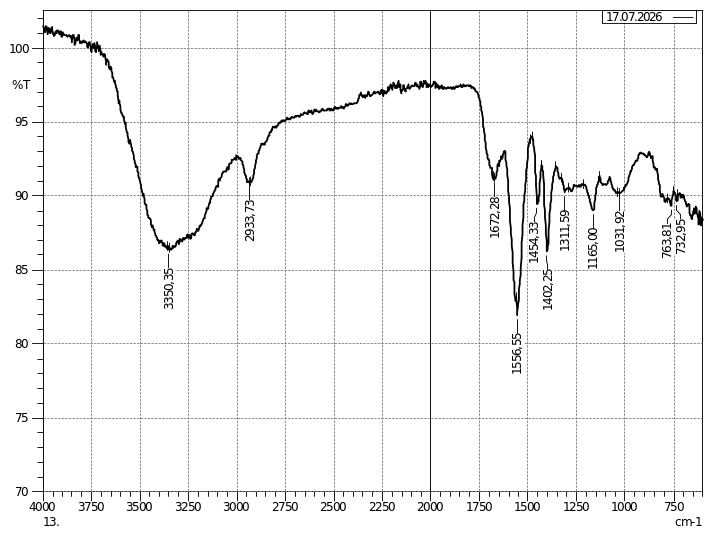
IR spectroscopy analysis. In the IR spectrum of the CMC-g-PMAA/bentonite-kaolin/urea composite hydrogel, the broad absorption band at 3360.33 cm-¹ corresponds to the –OH groups of carboxymethyl cellulose and the minerals, as well as the –NH2 groups of urea, indicating the formation of hydrogen bonds between them. The absorption at 2933.73 cm-¹ corresponds to the stretching vibrations of aliphatic –CH2– and –CH3 groups in the KMS and polymethacrylic acid chains. The absorption region at 1672.28 cm-¹ is associated with the hydrogen-bonded C=O stretching of polyacrylic acid and the stretching vibrations of the amide carbonyl group within the urea moiety. The absorption bands at 1566.53 and 1402.25 cm-¹ correspond to the asymmetric and symmetric vibrations of the partially neutralized carboxylate (–COO-) groups, confirming the partial neutralization of MAK with KOH. The difference of approximately 164 cm-¹ between these absorption bands indicates that the carboxylate groups have entered into ion-dipole interactions with K+ ions and with active sites on the surfaces of bentonite and kaolin. The region at 1454.33 cm-¹ corresponds to the deformation vibrations of –CH2– and –CH3 groups, while the absorption at 1311.59 cm-¹ corresponds to the vibrations of C–N, C–O, and –OH groups. The region at 1166.00 cm-¹ is attributed to the vibrations of the C–O–C glycosidic bonds in CMC and the Si–O–Si bonds in the mineral phase. The absorption at 1031.92 cm-¹ corresponds to the stretching vibrations of Si–O–Si and Si–O–Al bonds in bentonite and kaolin, as well as the C–O groups of CMC. The regions at 763.81 and 732.95 cm-¹ represent the bending vibrations of Si–O and Al–O bonds within the aluminosilicate structure. The absence of distinct, intense regions in the spectrum characteristic of the vinyl C=C bond indicates that the double bonds of methacrylic acid have been consumed during radical polymerization[15-371]. The shifting, broadening, and overlapping of the main absorption bands confirm the grafting of polymethacrylic acid chains onto the CMC backbone, the formation of a three-dimensional network cross-linked with MBA, and the bonding of bentonite, kaolin, and urea to the polymer matrix via hydrogen bonds and ion-dipole interactions.
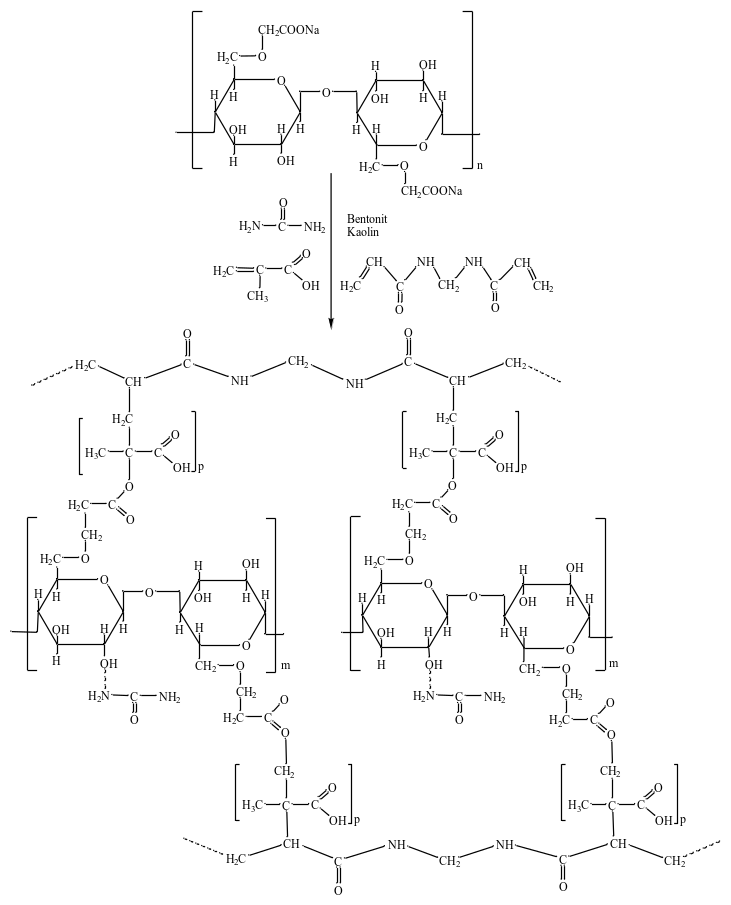
Based on the results of IR spectroscopic analysis, it can be concluded that a highly swellable hydrogel composed of CMC-g-PMAA/bentonite-kaolin/urea was successfully synthesized, and its structural formula (Formula 1) was represented as follows.
TGA/DTA analysis of the hydrogel. In the first stage, the sample lost 24.708 % of its mass in the temperature range of 38.71–337.27 °C. At the lower end of this wide temperature range, the evaporation of water that was physically adsorbed and held within the polymer network by hydrogen bonds took place. The thermal effect with a maximum at 71.51 °C on the DTA curve corresponds to this process. With the rise in temperature, the decomposition of urea, the dehydration of hydroxyl and carboxymethyl groups in CMC, and the decarboxylation of –COOH groups in partially neutralized polymethacrylic acid began.
TGA/DTA analysis of the hydrogel. In the first stage, the sample lost 24.708 % of its mass in the temperature range of 38.71–337.27 °C. At the lower end of this wide temperature range, the evaporation of water that was physically adsorbed and held within the polymer network by hydrogen bonds took place. The thermal effect with a maximum at 71.51 °C on the DTA curve corresponds to this process. With the rise in temperature, the decomposition of urea, the dehydration of hydroxyl and carboxymethyl groups in CMC, and the decarboxylation of –COOH groups in partially neutralized polymethacrylic acid began. The thermal effect at 235.27 °C, occurring within the 212.90–268.19 °C range, is primarily attributed to the thermal transformation of urea and the decomposition of relatively weakly bonded functional groups within the polymer matrix [11, p. 294]. The second stage of thermal decomposition was observed in the 335.82–416.45 °C range, during which the sample mass decreased by 16.955 %. Bentonite and kaolin particles hinder the movement of polymer chains and form hydrogen and ion-dipole bonds with them; as a result, the primary degradation process of the hydrogel occurs at high temperatures. The third stage corresponds to the temperature range of 419.72–777.85°C, with a mass loss of 30.185 %. At this stage, the stable carbon chain residues of the polymer decompose, and carboxylate groups, as well as hydroxyl groups from the bentonite and kaolin, are released. It is associated with the processes of organic matrix destruction and mineral phase dehydroxylation at 443.07°C.
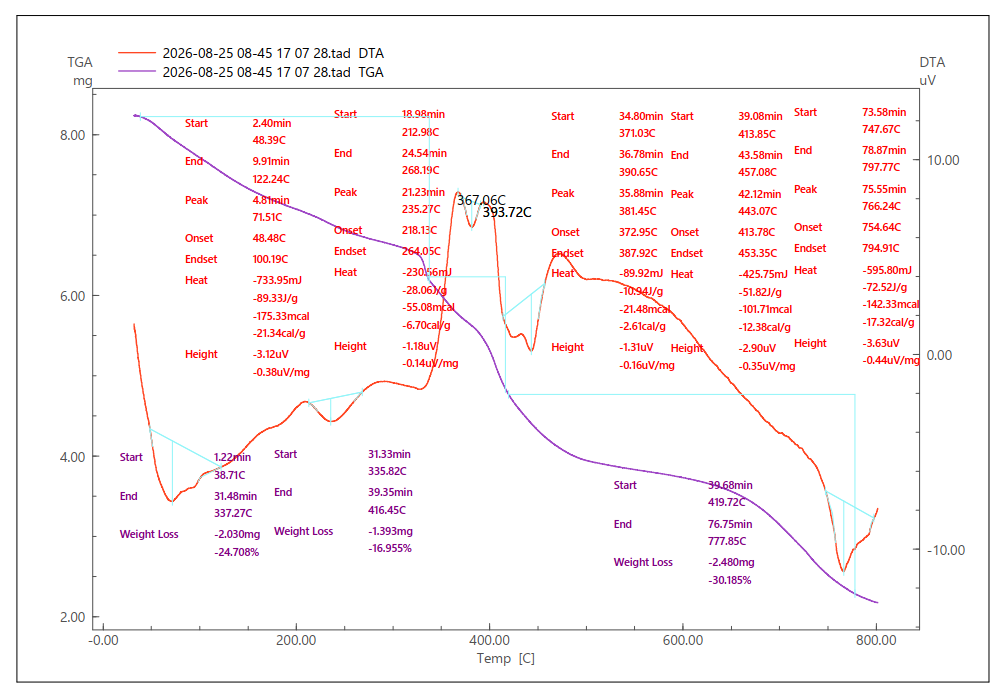
The subsequent decomposition at 766.24°C is associated with changes in the mineral lattice, the completion of dehydroxylation of bentonite and kaolin, and the decomposition of the carbonized residue.
During the analysis, the total mass loss amounted to 71.848 %, while the solid residue remaining after 777.85°C constituted approximately 28.152 % of the initial mass. The relatively high residue content is attributed to the presence of thermally stable aluminosilicate phases—derived from the bentonite and kaolin within the hydrogel—as well as inorganic potassium compounds formed during neutralization with KOH.
X-ray diffraction (XRD) analysis of the hydrogel. This is explained by the fact that the irregular polysaccharide chains and grafted polymethacrylic acid branches are cross-linked using MBA to form a three-dimensional polymer network. Sharp reflections characteristic of the distinct crystalline phase of urea are also not clearly visible.
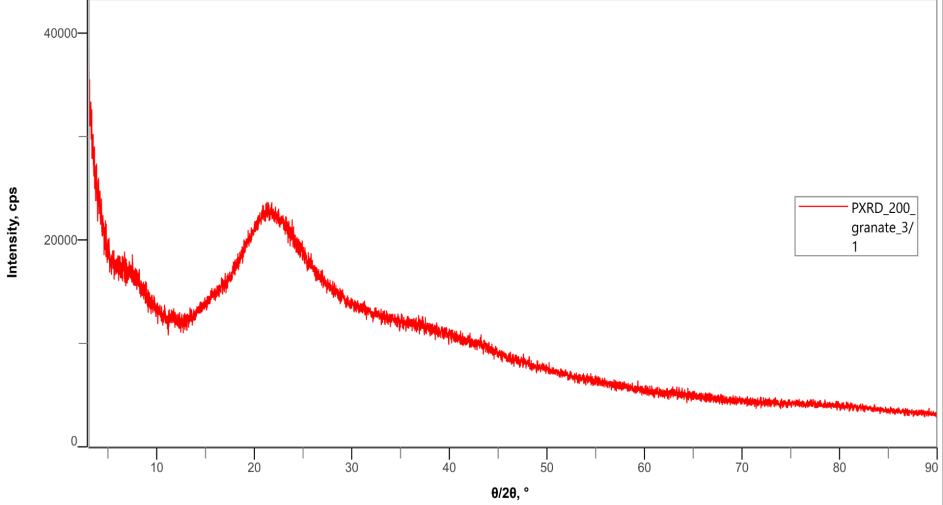
This indicates that the degree of crystallization has decreased because the urea is distributed within the hydrogel pores and polymer network in a molecular or finely dispersed state, and its –NH2 groups form hydrogen bonds with the active sites of CMC, polymethacrylic acid, bentonite, and kaolin. However, the broad maximum around 21–22° may encompass the overlapping reflections of the mineral and urea, in addition to the amorphous halo of the polymer.
Analysis of the water-absorbing property of the hydrogel. The water-swelling property of the synthesized hydrogel was determined using the gravimetric method. For this purpose, 1 g of the hydrogel was placed in an excess of distilled water at room temperature. After the specified time interval, the swollen hydrogel samples were removed from the water, excess surface moisture was carefully removed using filter paper, and the samples were weighed. The water absorbency of the hydrogel at a given time t (Qt, g/g) and the water absorbency at equilibrium (Qe, g/g) were calculated using the following equation:
Here, Wt is the mass of the swollen hydrogel at a given time t (g), and Wd is the initial mass of the dry hydrogel (g).
Studying the effect of various pH values. It was determined that the water absorbency of the KMS-g-PMAK/bentonite-kaolin/urea composite hydrogel depends significantly on the pH value of the medium. In an acidic medium—specifically at pH 3 and 4—the swelling capacity of the hydrogel was 73 g/g and 109 g/g, respectively. The reason for this is the protonation of the –COO- groups in polymethacrylic acid and carboxymethylcellulose, converting them into the –COOH form. As a result, electrostatic repulsion between polymer chains decreases, hydrogen bonds between –COOH and –OH groups strengthen, and the polymer network becomes denser. As the medium pH was increased from 5 to 7, the swelling capacity rose from 201 g/g to 420 g/g. The maximum water absorption was 420 g/g at pH 7. Under conditions approaching a neutral medium, the majority of carboxyl groups convert to the –COO- state, leading to increased electrostatic repulsion between polymer chains and higher Donnan osmotic pressure. As a result, the three-dimensional polymer network expands, allowing more water to enter. As the medium becomes more alkaline, the swelling capacity decreases again, reaching 333, 208, 111, 73, and 48 g/g at pH levels of 8, 9, 10, 11, and 12, respectively. Although carboxylate groups are fully ionized in a strongly alkaline medium, an increase in the concentration of K+ or other counter-ions in the solution screens the charge of the –COO- groups.
This resulted in a reduction of both the electrostatic repulsion between chains and the osmotic pressure difference between the hydrogel interior and the external solution. Furthermore, the alkaline environment—by altering the ionization state of active sites on the bentonite and kaolin surfaces and thereby strengthening polymer-mineral interactions—may also restrict the expansion of the polymer network.
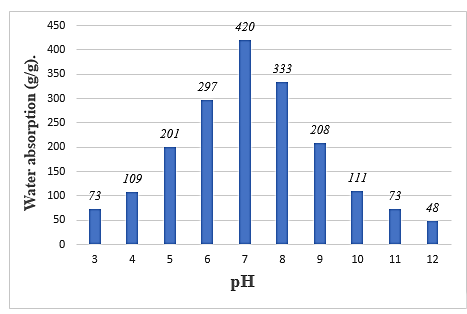
The results indicate that the CMC-g-PMAA/bentonite-kaolin/urea hydrogel exhibits distinct pH-sensitive properties and that its optimal swelling medium is around pH 7.
To model soil salinization, the swelling stability of the material was investigated at room temperature in solutions of mono- and multivalent salts at various concentrations. The swelling behavior of the CMC-g-PMAA/bentonite-kaolin/urea composite hydrogel was examined in 1–4 % NaCl, CaCl2, and AlCl3 solutions. The swelling capacity in NaCl solution was 138 g/g at 1 %, 103 g/g at 2 %, 77 g/g at 3 %, and 59 g/g at 4 %. In CaCl2 solution, these values were 117, 96, 63, and 48 g/g, respectively, while in AlCl3 solution, they were 109, 82, 51, and 43 g/g. As the salt concentration increased from 1 % to 4 %, the hydrogel's swelling capacity decreased by 57.2 % in NaCl solution, 59.0 % in CaCl2 solution, and 60.6 % in AlCl3 solution. An increase in salt concentration raises the osmotic pressure and ionic strength of the external solution, thereby reducing the osmotic pressure difference between the hydrogel's interior and the external environment. At the same time, cations in the solution screen the negatively charged –COO- groups within CMC and PMAK, thereby weakening the electrostatic repulsion between the polymer chains [6, p. 5]. As a result, the polymer network contracts, and its water-absorbing capacity decreases. The effect of multivalent Ca²+ and Al³+ ions was stronger than that of Na+ ions. While Na+ primarily screens the charge of carboxylate groups, Ca²+ and—especially—Al³+ bind simultaneously to multiple –COO- groups, forming additional ionic bridges between polymer chains. Such secondary cross-links increase the density of the hydrogel network and limit swelling.
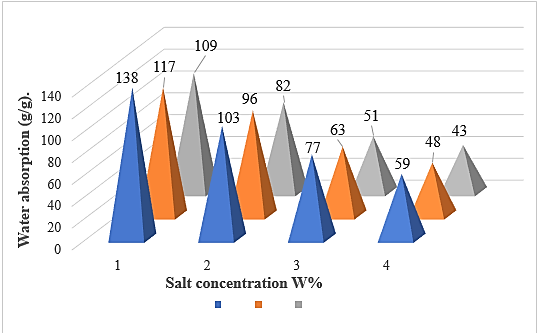
The lowest values observed in the AlCl3 solution are attributed to the high charge density of the Al³+ ion and its strong complex-forming ability. Furthermore, the hydrolysis of Al³+ ions can lower the solution pH, thereby promoting the protonation of –COO- groups to the –COOH form. Overall, the results indicate that the hydrogel retains relatively high swelling capacity in a medium containing monovalent Na+ ions, whereas its water absorption decreases significantly in the presence of divalent Ca²+ and trivalent Al³+ ions.
Repeated water absorbency of the hydrogel. Repeated swelling–drying experiments were conducted to evaluate the economic efficiency and mechanical properties of the hydrogel. Fully swollen hydrogel samples were dried at 60°C until a constant mass was reached, then re-immersed in distilled water and kept there until maximum water absorption was attained. This process was repeated eight times, and the water absorption capacity was recorded after each cycle. While the water absorbency of the hydrogel was 420 g/g in the first cycle, it decreased to 381, 324, 277, 239, 168, 102, and 77 g/g, respectively, in the subsequent cycles. The results indicate a steady decline in water absorbency after each swelling–drying cycle. By the fifth cycle, the composite retained 56.9 % of its initial water absorption capacity. From the sixth cycle onwards, the decline accelerated, and by the eighth cycle, water absorption had dropped to 77 g/g. This represents an 81.7 % decrease compared to the initial value.
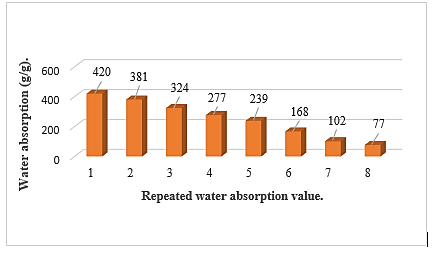
The decrease in water absorption is attributed to the densification of polymer chains during repeated drying, the partial closure of pores, the reformation of hydrogen bonds, and the restriction of the ability of certain hydrophilic groups to interact with water. Nevertheless, the hydrogel's water absorption of 77 g/g in the eighth cycle indicates that its three-dimensional network structure has not completely collapsed and that it possesses a certain degree of reusability. The obtained results indicate that the period of highly efficient reuse of the composite is primarily limited to the initial 4–5 cycles.
Slow-release characteristics of urea fertilizer. The practical significance of the synthesized CMC-g-PMAA/bentonite–kaolin/urea composite in agriculture was evaluated based on its ability to release nutrients into the soil steadily over an extended period.
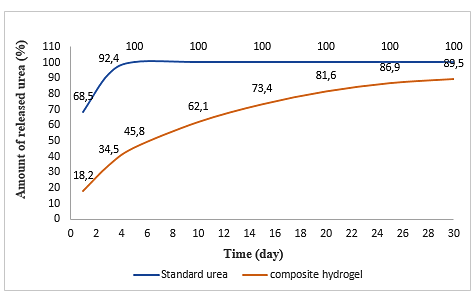
The fertilizer release process was studied under soil conditions at room temperature and compared with ordinary crystalline urea.
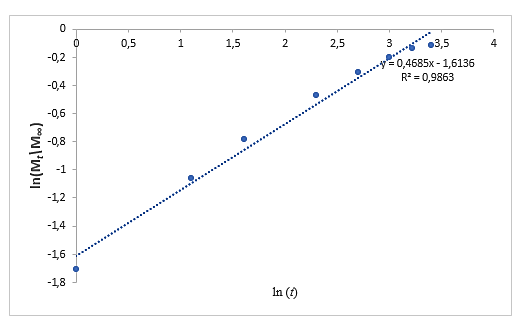
Ordinary urea, used as a control sample, lost 68.5 % of its mass within the first day and 100 % by the fifth day due to its high water solubility. Such rapid leaching from the soil can prevent plants from fully absorbing the nutrient and lead to groundwater contamination. In contrast, the release of urea incorporated into the composite hydrogel matrix via an *in situ* method was significantly slowed down. While an initial «burst» effect was partially observed—with 34.5 % of the fertilizer released during the first three days—the process proceeded at a steady rate thereafter. Specifically, 73.4 % of the total urea was released by the 15th day, and 89.5 % by the end of the 30th day. This deceleration in fertilizer release is attributed to two factors: first, hydrogen bonding between the carboxylate (–COO-) groups of the polymer network and the amide (–NH2) groups of the urea; and second, the presence of bentonite and kaolin, which reduce the size of the voids between polymer chains, thereby restricting water ingress and lengthening the diffusion path for urea molecules. To gain a more comprehensive understanding of the urea release mechanism, the initial stages of the process (total release ≤60 %) were modeled using the empirical Ritger–Peppas equation (Figure 8). The synthesized composite is considered a promising material that serves to reduce fertilizer waste while retaining moisture in the soil.
Conclusion
In this study, a composite hydrogel with versatile properties was synthesized for agricultural applications, and its key characteristics were investigated. IR spectroscopy results demonstrated that polymethacrylic acid chains were grafted onto the CMC backbone, a cross-linked polymer network was formed with the aid of a cross-linking agent, and intermolecular interactions existed between the hydrogel and urea as well as minerals. TGA/DTA analyses revealed the presence of organic polymer chains and thermally stable mineral phases within the hydrogel. XRD analysis indicated the predominance of an amorphous phase and a weakening of the characteristic features of kaolin, bentonite, and urea within the polymer matrix. The hydrogel exhibited high water absorbency at pH 7, while its swelling capacity decreased as salt concentration and cation valence increased. Repeated swelling–drying tests demonstrated that the hydrogel remained effective for the first 4–5 cyclesThe release of urea was slowed down compared to ordinary crystalline urea. Therefore, the developed composite hydrogel can be considered a promising agricultural material designed to retain soil moisture and ensure the controlled release of nitrogen fertilizers.
References