Synthesis of SBA-15 mesoporous silica from rice husk ash: colloidal dispersion and hydrodynamic size characterization via nanoparticle tracking analysis
УДК 544.77+546.284
Abstract
SBA-15 mesoporous silica is a promising material for adsorption, catalysis, separation, and environmental remediation owing to its ordered mesoporous structure and tunable surface properties. In the present study, the colloidal dispersion behavior and particle-size distribution of SBA-15 synthesized from biogenic rice husk ash were investigated in aqueous suspension using Nanoparticle Tracking Analysis (NTA). NTA measurements were performed using a NanoSight NS300 system across three combined video captures. The stably suspended colloidal fraction exhibited a mean hydrodynamic particle size of 186.0 pm 1.6 nm, a median diameter (D50) of approximately 176 nm, and a modal diameter of 169.8 pm 4.1 nm. Percentile values (D10 = 124.3 nm, D90 = 252.7 nm) indicated a moderately broad sub-micron size distribution. SEM revealed that the dry bulk powder consists of larger multi-micron agglomerates, demonstrating that NTA selectively captures the stably suspended sub-micron aggregate fraction in liquid media. These findings highlight the necessity of evaluating colloidal hydrodynamic behavior alongside solid-state morphology when applying mesoporous silica to dynamic aqueous systems.
Аннотация
Мезопористый диоксид кремния SBA-15 является перспективным материалом для адсорбции, катализа, разделения и очистки окружающей среды благодаря своей упорядоченной мезопористой структуре и регулируемым свойствам поверхности. В настоящей работе исследован характер коллоидной дисперсии и распределение частиц по размерам SBA-15, синтезированного из золы рисовой шелухи, в водной суспензии с использованием анализа трекинга наночастиц (NTA). Измерения NTA проводились на приборе NanoSight NS300 путем объединения трех видеозаписей. Взвешенная коллоидная фракция продемонстрировала средний гидродинамический размер частиц 186.0 pm 1.6 нм, медианный диаметр (D50) около 176 нм и модальный диаметр 169.8 pm 4.1 нм. Значения перцентилей (D10 = 124.3 нм, D90 = 252.7 нм) указывают на относительно широкое распределение субмикронных частиц. Сканирующая электронная микроскопия (SEM) показала, что исходный сухой порошок состоит из более крупных многомикронных агломератов. Это подтверждает, что метод NTA селективно регистрирует устойчиво взвешенную субмикронную фракцию агрегатов в жидкой среде. Полученные результаты подчеркивают важность оценки коллоидного гидродинамического поведения наряду с морфологией твердой фазы при использовании мезопористого диоксида кремния в динамических водных системах.
Keywords: SBA-15; Rice husk ash; Nanoparticle Tracking Analysis (NTA); Colloidal dispersion; Hydrodynamic particle size; Aggregation.
Ключевые слова: SBA-15; золь рисовой шелухи; анализ траекторий движения наночастиц (NTA); коллоидная дисперсия; гидродинамический размер частиц; агрегация.
Introduction
Mesoporous silica materials, particularly SBA-15, have gained widespread scientific interest due to their highly ordered two-dimensional hexagonal pore networks, uniform pore diameters, large surface areas, and tunable surface chemistry. These structural properties make SBA-15 an outstanding candidate across various applications, including aqueous adsorption, heterogeneous catalysis, separation processes, and environmental remediation [9; 6]. To optimize manufacturing costs and promote sustainable synthesis, recent developments have increasingly focused on using biogenic waste silica, such as rice husk ash as a high-purity precursor for SBA-15 fabrication [3–5; 7].
While the internal textural properties (e.g., surface area, pore volume, and pore size) of SBA-15 are extensively characterized using nitrogen physisorption, X-ray diffraction, and electron microscopy, its macro-behavior in liquid media is strongly dictated by its colloidal dispersion state. In aqueous applications, SBA-15 particles frequently aggregate due to strong interparticle forces, such as van der Waals interactions and hydrogen bonding between surface silanol groups, Si-OH [9]. This colloidal aggregation can significantly alter the accessible external surface area, liquid transport, sedimentation rates, and effective mass transfer of active species or adsorbates. Consequently, evaluating the dynamic hydrodynamic particle size distribution in suspension is crucial for understanding its performance in aqueous media.
Nanoparticle tracking analysis (NTA) provides a unique, real-time method to assess hydrodynamic size distributions by tracking the Brownian motion of individual particles in light-scattering suspensions. Unlike ensemble light-scattering techniques, NTA enables accurate visualization and quantification of primary particles and light aggregates in polydisperse systems [2]. In this study, SBA-15 was synthesized using high-purity silica extracted from rice husk ash. The primary objective is to investigate the hydrodynamic particle-size distribution and colloidal dispersion behavior of this bio-derived SBA-15 in aqueous suspension using NTA, contrasting the hydrodynamic measurements with surface morphology obtained via SEM. By bridging the gap between intrinsic mesoporous structures, bulk morphology, and aqueous dispersion behavior, this work provides critical insights into optimizing bio-derived SBA-15 for dynamic liquid-phase applications.
Materials and Methods
Synthesis of SBA-15
SBA-15 was synthesized using a standard hydrothermal method [10], with silica obtained from rice husk ash (purity >99 %) as the silica source. The synthesis was performed using the following molar composition: P123/SiO2 = 0.017, HCl/SiO2 = 5.8, and H2O/SiO2 = 206.3. Specifically, 2 g of rice husk ash-derived SiO2, 4 g of Pluronic P123, 120 mL of hydrochloric acid (2 M) were used. The reagents were mixed under continuous stirring until a homogeneous solution was obtained. The resulting mixture was transferred to a Teflon-lined PTFE vessel designed for microwave-assisted COD digestion and subjected to hydrothermal treatment for 24 h at 105 °C. After hydrothermal treatment, the resulting white precipitate was collected and thoroughly washed with deionized water until the filtrate reached a constant conductivity. The washed precipitate was then dried in a drying oven (Memmert UN55, Memmert GmbH + Co. KG, Germany) at 105 °C for 18 h. Finally, the dried sample was calcined at 550 °C for 6 h [1].
Preparation of SBA-15 aqueous suspension
For particle-size analysis, the calcined SBA-15 powder was dispersed in deionized water to prepare a dilute aqueous suspension suitable for nanoparticle tracking analysis (NTA). The suspension was gently homogenized and subjected to ultrasonic treatment prior to measurement to promote dispersion of the particles and reduce the presence of large agglomerates. The prepared suspension was immediately transferred to the NTA measurement cell to minimize changes in the dispersion state during analysis.
Nanoparticle tracking analysis
The particle-size distribution of SBA-15 in aqueous suspension was determined using a NanoSight nanoparticle tracking analysis system [3]. NTA measurements were performed by recording the Brownian motion of individual particles dispersed in the aqueous phase. The instrument tracks the movement of individual scattering objects and estimates their hydrodynamic particle size from their Brownian motion using the Stokes–Einstein relationship.
Three independent measurement captures were recorded for the same suspension under identical instrumental conditions. The resulting captures were combined to obtain a representative particle-size distribution. The analysis was performed at room temperature under controlled measurement conditions. Instrument settings, including camera level, detection threshold, and measurement duration, were maintained constant for all captures.
The particle-size distribution was expressed in terms of the mean particle size, standard deviation, mode, median diameter (D50), and percentile diameters D10 and D90. Here, D10 represents the particle diameter below which 10 % of the detected particles occur, D50 corresponds to the median particle diameter, and D90 represents the diameter below which 90 % of the detected particles occur.
Surface Morphology Characterization
The bulk morphology and dry aggregate size of the calcined SBA-15 were examined using scanning electron microscopy (SEM, JEOL JSM-IT200, JEOL Ltd., Japan). The samples were mounted onto aluminum stubs using conductive carbon adhesive tape and sputter-coated with a thin gold layer prior to imaging. SEM images were recorded at an accelerating voltage of 3.0 kV, with a working distance of approximately 15.1 mm, at magnifications of ×1,000 and ×1,500 [8].
Results and Discussion
Particle-Size Distribution and Hydrodynamic Behavior
The hydrodynamic particle-size distribution of SBA-15 in aqueous suspension was evaluated via NTA. Three combined measurement captures yielded a consistent size profile with a dominant population spanning 100 – 300 nm and a low-intensity tail extending toward 500 nm (Figure 1).
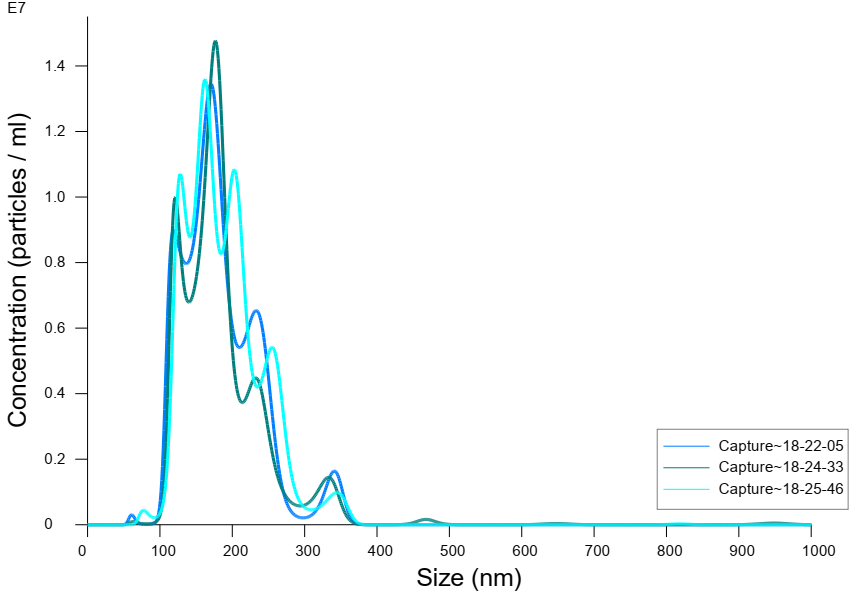
The mean particle size was 186.0 ± 1.6 nm, whereas the modal particle size was 169.8 ± 4.1 nm. The median particle size (D50) was approximately 176 nm, indicating that half of the detected particles or scattering objects were smaller than this value. The D10 and D90 values were 124.3 ± 1.9 and 252.7 ± 3.4 nm, respectively. The difference between the D10 and D90 values indicates a relatively broad particle-size distribution.
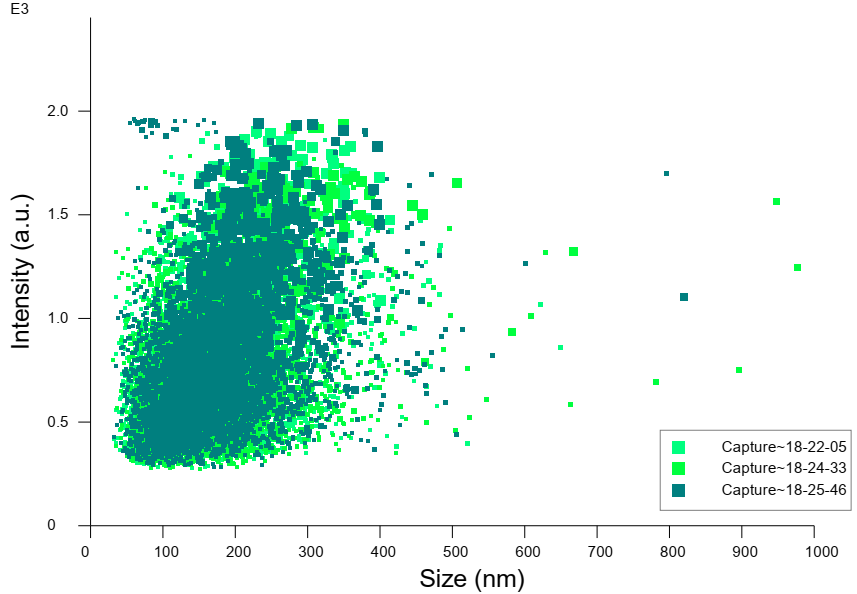
The observed hydrodynamic size distribution reflects the dispersion state and colloidal aggregation of SBA-15 in aqueous media. Although individual SBA-15 primary domains possess internal mesoporosity, surface silanol groups (Si-OH) and attractive van der Waals forces drive interparticle association, forming secondary sub-micron clusters in water. The degree of this aggregation is sensitive to suspension parameters, including concentration, pH, ionic strength, surface charge, and ultrasonic energy input.
Crucially, the hydrodynamic diameter determined by NTA (186.0 pm + 1.6 nm) characterizes the ensemble size of these suspended colloidal aggregates and primary fragments rather than the intrinsic mesopore dimensions (6 – 10 nm). While internal mesoporosity is typically quantified via nitrogen physisorption, powder XRD, or electron microscopy, NTA captures the dynamic physical boundary of the material when suspended in a liquid matrix.
The moderately broad size dispersion (D10 = 124.3 nm, D90 = 252.7 nm) highlights the coexistence of individual sub-micron domains and small clusters. In practical aqueous systems—such as adsorption, heterogeneous catalysis, and membrane separation—this hydrodynamic aggregate size directly governs liquid mass transport, sedimentation kinetics, and effective external surface accessibility. Consequently, NTA serves as a necessary complementary tool to solid-state textural analysis for predicting liquid-phase performance.
Morphological Analysis and Comparison Between SEM and NTA
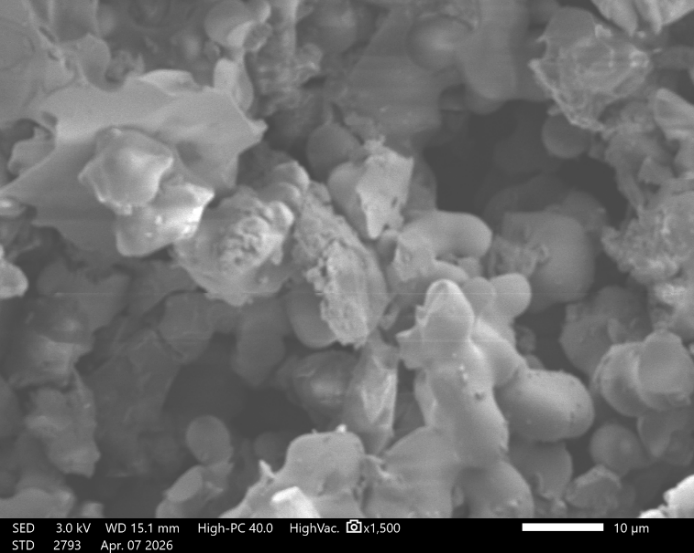 | 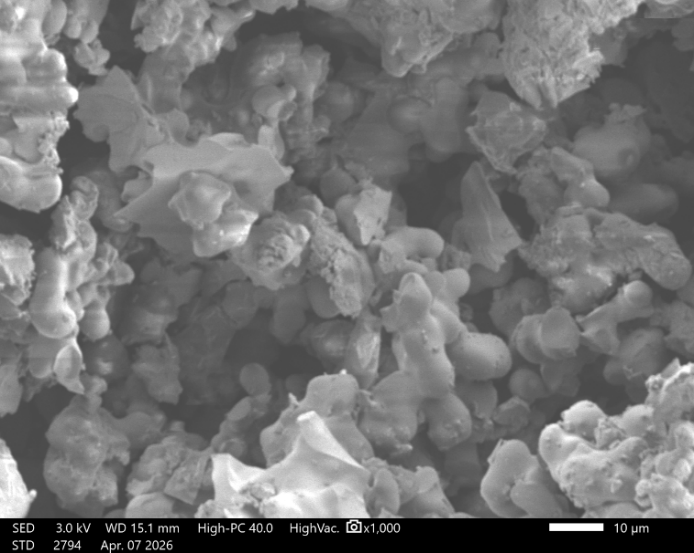 |
SEM micrographs of the dry SBA-15 powder (Figure 3) reveal irregular, quasi-spherical, and platy aggregates on the scale of several micrometers up to >10 µm.
Comparing the SEM micrographs with the NTA data highlights an important methodological distinction:
– Bulk Powder vs. Suspended Fraction: SEM images reflect the dry, strongly agglomerated state of the synthesized powder where primary domains are bound into multi-micron clusters.
– NTA Optical Boundaries: NTA measures the Brownian motion of light-scattering objects in liquid suspension. Multi-micron aggregates shown in SEM settle rapidly due to gravity and scatter light beyond the optimal sCMOS tracking threshold. Consequently, NTA selectively quantifies the stably suspended sub-micron fraction (mean 186 nm) and fine fragments dispersed following ultrasonic treatment.
Distinguishing between intrinsic mesopore diameter (6–10 nm), primary domain size, and hydrodynamic aggregate size (186 nm) is crucial. In dynamic liquid applications such as aqueous adsorption or flow-through catalysis, the hydrodynamic size determines liquid mass transfer rates, effective diffusion paths, and particle sedimentation stability.
Conclusions
SBA-15 mesoporous silica was successfully synthesized using silica derived from biogenic rice husk ash. Nanoparticle Tracking Analysis (NTA) was utilized to evaluate its hydrodynamic particle size distribution in aqueous media. The suspended colloidal fraction exhibited a mean hydrodynamic size of 186.0 pm 1.6 nm, a median size (D50) of 176 nm, and a mode of 169.8 pm 4.1 nm. SEM imaging showed that the dry state consists of larger multi-micron agglomerates, proving that NTA characterization selectively probes the sub-micron fraction that remains stable in liquid suspension. Combining NTA colloidal analysis with solid-state electron microscopy provides a clear understanding of how bio-derived SBA-15 behaves in liquid environments, offering essential insights for optimizing its use in aqueous adsorption, catalysis, and environmental separation processes
References