Resource-saving utilization of carbonate industrial waste in local quartz-based cement composites
УДК 666.9
Abstract
This study investigates carbonate-containing solid waste generated at Ferganaazot JSC as a secondary mineral raw material for dry construction mixtures based on local quartz and cement binder. The objective was to substantiate the rational use of the carbonate technogenic product as a microfiller by considering its physicochemical and particle-size characteristics and its influence on the structure and strength of cement-quartz composites. The chemical composition of the waste was examined by energy-dispersive X-ray fluorescence spectroscopy using a Rigaku NEX CG EDXRF instrument, while structural and chemical features were evaluated by FTIR spectroscopy using a SHIMADZU IRSpirit spectrometer. Local quartz sand fractions of 1.25–2.50 and 0.16–0.31 mm were combined at a 70:30 ratio. Experimental results showed that a 10 % carbonate addition provides rational filling of intergranular voids, with a measured void content of 31.8 %. When carbonate flour obtained from the solid waste was introduced at 10 % of binder mass, the compressive strength of mixtures with binder-to-filler ratios from 1:5 to 1:3 increased by 6–12 % relative to the corresponding control specimens. These results substantiate the use of carbonate industrial waste as a functional microfiller in cement-based dry construction mixtures and provide a resource-saving approach that can reduce the demand for primary mineral raw materials while maintaining or improving the performance of the composite.
Аннотация
В работе исследована возможность ресурсосберегающего использования карбонатсодержащих твёрдых отходов АО «Ферганаазот» в качестве функционального микронаполнителя цементно-кварцевых сухих строительных смесей на основе местного кварцевого сырья. Цель исследования заключалась в установлении рационального содержания карбонатного продукта с учётом его физико-химических и дисперсных характеристик, а также влияния на плотность упаковки и прочность цементно-кварцевых композиций. Химический состав отхода исследовали методом энергодисперсионной рентгенофлуоресцентной спектрометрии на приборе Rigaku NEX CG EDXRF, структурно-химические особенности — методом ИК-Фурье-спектроскопии на приборе SHIMADZU IRSpirit, а гранулометрический состав — методом ситового анализа. В смесях использовали местный кварцевый песок фракций 1,25–2,50 и 0,16–0,31 мм в соотношении 70:30. Установлено, что при содержании карбонатного продукта 10 % показатель пустотности составил 31,8 %. При введении карбонатной муки в количестве 10 % от массы вяжущего прочность при сжатии композиций с отношением вяжущее:заполнитель от 1:5 до 1:3 повысилась на 6–12 % относительно соответствующих контрольных составов. Полученные результаты показывают, что исследованный техногенный карбонатный продукт может применяться как микронаполнитель в изученной системе сухих строительных смесей и позволяет частично вовлекать промышленный отход во вторичный материальный цикл.
Keywords: green chemistry; resource-saving technology; secondary raw material; waste valorization; carbonate microfiller; local quartz; cement composite.
Ключевые слова: зелёная химия; ресурсосберегающая технология; вторичное сырьё; утилизация отходов; карбонатный микронаполнитель; местный кварц.
Introduction
Resource-saving technologies for inorganic construction materials require both a reduction in the consumption of primary mineral resources and the technically justified utilization of industrial by-products. In dry construction mixtures, finely dispersed mineral additions can modify particle packing, intergranular voids and the formation of the hardened structure. Therefore, the use of chemically compatible secondary mineral products as fillers or microfillers is of practical interest, provided that their composition, dispersion and influence on performance are experimentally verified [1–4].
The present study considers carbonate-containing solid waste generated in the technological processes of Ferganaazot JSC. The research focuses on its physicochemical characterization and on determining a rational dosage for cement-quartz dry mixtures prepared with local quartz raw material. Particular attention is given to particle packing and compressive-strength changes because these parameters directly characterize the functional role of the carbonate microfiller.
Materials and Methods
The experimental program consisted of four stages: physicochemical characterization of the carbonate-containing industrial waste, determination of its particle-size distribution, evaluation of the packing characteristics of the quartz–carbonate system, and comparative determination of compressive strength. Local quartz sand fractions of 1.25–2.50 mm and 0.16–0.31 mm were combined at a mass ratio of 70:30. Portland cement was used as the binder, while C-3 plasticizer and hydroxyethyl cellulose were used as modifying additives. The carbonate-containing solid waste from Ferganaazot JSC was characterized by energy-dispersive X-ray fluorescence spectroscopy using a Rigaku NEX CG EDXRF spectrometer and by FTIR spectroscopy using a SHIMADZU IRSpirit instrument. Particle-size distribution was evaluated by sieve analysis.
In the particle-packing study, the carbonate product was investigated at addition levels up to 30 %, and the dosage corresponding to the lowest measured void content was selected for subsequent strength tests. A 10 % carbonate microfiller dosage relative to binder mass was used in the modified compositions. Control mixtures of the same binder-to-filler ratios contained no carbonate microfiller. Binder-to-filler ratios ranging from 1:5 to 1:3 were investigated, while the quartz fraction ratio was maintained at 70:30 in all comparative compositions. All control and carbonate-containing specimens were prepared and tested under identical conditions.
Compressive strength was determined on 20×20×20 mm cubic specimens after 28 days of curing in accordance with GOST 5802 – 86. The specimens were kept under normal conditions for the first 24 h and subsequently cured under the prescribed conditions for 27 days. Compressive-strength tests were performed using an AlfaX-050 testing machine.
Results and Discussion
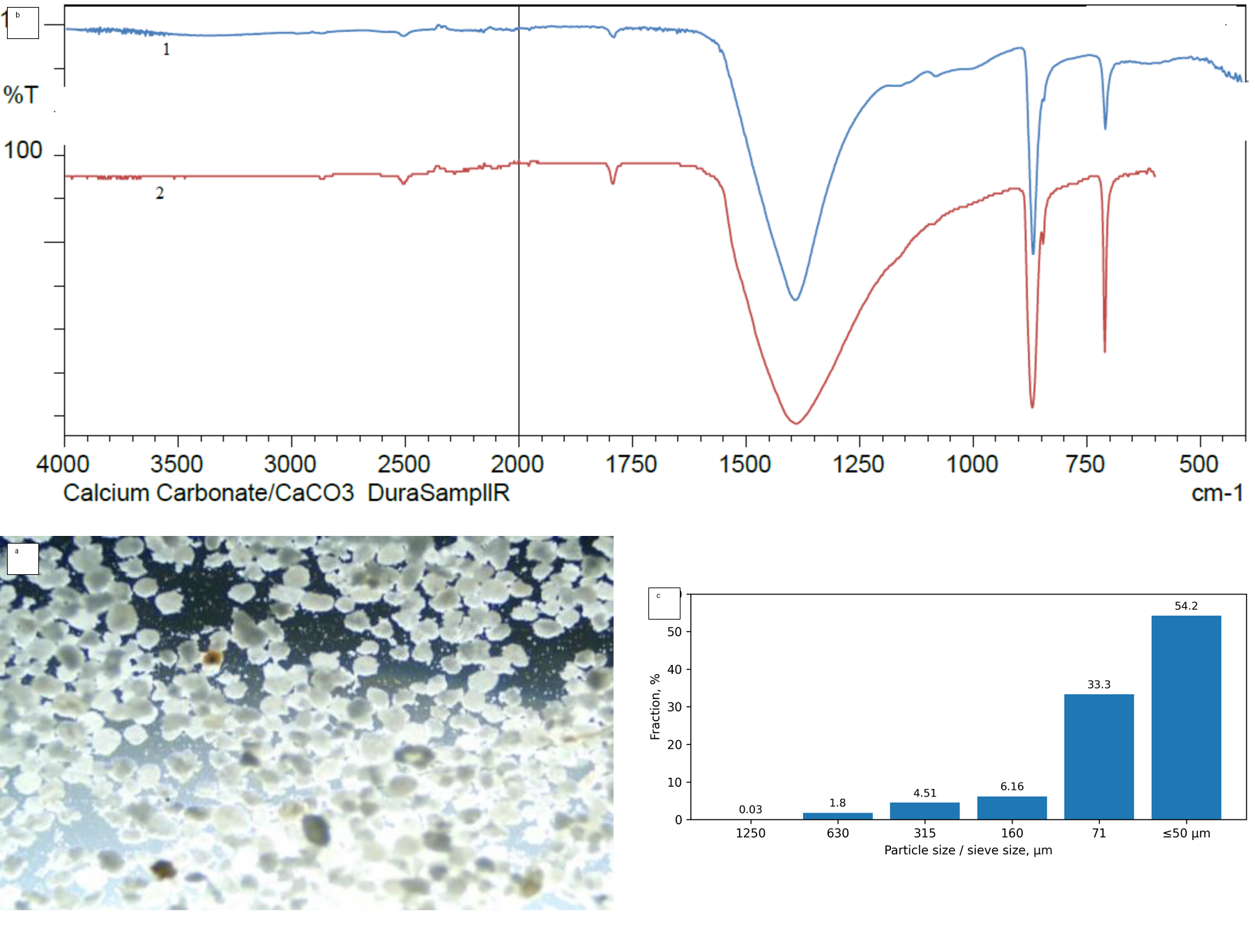
The FTIR spectrum of the investigated waste shows absorption bands characteristic of carbonate groups, including intensive bands in the regions around 1400–1500, 875 and 710 cm-¹, which correspond well with the CaCO3 reference spectrum shown in Figure 1a. The sieve analysis demonstrates the predominantly fine character of the material: 54.2 % of the particles belong to the ≤50 μm fraction and 33.3 % to the 71 μm fraction. Thus, approximately 87.5 % of the investigated material is concentrated in the finest particle-size classes up to 71 μm. Such a dispersed composition is favourable for the physical filling of voids between the larger quartz grains and provides a basis for considering the waste as a mineral microfiller rather than only as an inert secondary raw material.
The physicochemical analyses confirmed that the investigated industrial by-product is a carbonate-containing finely dispersed mineral material suitable for evaluation as a filler or microfiller. The combined EDXRF and FTIR investigations were used to characterize its chemical and structural features, while particle-size analysis established its dispersed state. In the packing experiments, the carbonate product was introduced as an additional fine fraction into a quartz system composed of the 1.25 – 2.50 and 0.16-0.31 mm fractions at a 70:30 ratio. The lowest experimentally established void content for the carbonate-containing system was 31.8 % at a 10 % addition. This dosage was therefore considered rational for further evaluation in cement-based compositions.
The packing results indicate that the effect of the carbonate addition is governed not only by its chemical nature but also by its role as a fine fraction in the granular system. A 10 % addition produced a void content of 31.8 %, supporting its selection as the rational level for the investigated system. This result is consistent with the use of finely dispersed mineral material to occupy part of the intergranular space between the coarser quartz particles[2,8].
Table 1.
Summary of the main experimental results obtained at the rational carbonate microfiller dosage.
| Property | Control composition | Composition with carbonate microfiller | Observed effect |
|---|---|---|---|
| Carbonate microfiller dosage | 0% | 10% of binder mass | Rational investigated dosage |
| Void content in packing study | — | 31.8% | Lowest measured value at the selected dosage |
| Binder-to-filler ratio | 1:5–1:3 | 1:5–1:3 | Identical comparative range |
| Compressive strength | Reference level | 106–112% of control | Increase by 6–12% |
The mechanical tests showed that introducing carbonate flour obtained from the solid waste at 10 % of binder mass increased compressive strength by 6-12 % relative to the corresponding control specimens when the binder-to-filler ratio varied from 1:5 to 1:3.
The effect observed at a 10 % carbonate dosage can be explained primarily by the particle-packing mechanism. Fine carbonate particles occupy part of the intergranular space between the two quartz fractions, producing a denser granular skeleton. This interpretation is supported by the experimentally measured void content of 31.8 % at the selected dosage. The increase in compressive strength by 6–12 % is therefore consistent with a reduction in ineffective void space and improved contact between the solid particles. Recent studies on finely dispersed limestone and calcium-carbonate additions also describe filling and nucleation effects as important mechanisms influencing the microstructure and mechanical behaviour of cementitious systems[11-14]. Fine carbonate particles can provide additional nucleation surfaces for cement hydration products and may promote the formation of a denser C–S–H-containing structure. Depending on particle size and cement composition, interaction of carbonate ions with aluminate phases may also lead to carboaluminate formation. However, the latter mechanisms were not directly verified in the present study by analysis of hydrated phases; therefore, they are considered possible contributing mechanisms rather than experimentally confirmed processes.
From a resource-saving perspective, the principal result is the experimentally substantiated possibility of returning a carbonate industrial by-product to material use as a functional microfiller. The proposed approach combines utilization of a secondary mineral resource with improved packing and a measurable increase in compressive strength. The conclusions are limited to the investigated raw materials, dosage range and mixture compositions; broader environmental benefits require a separate life-cycle assessment. [1, 2, 4]
Conclusion
The physicochemical and technological results substantiate the use of carbonate-containing solid waste from Ferganaazot JSC as a functional microfiller in cement-based dry construction mixtures containing local quartz. For the quartz fractions of 1.25–2.50 and 0.16–0.31 mm combined at a 70:30 ratio, a 10 % carbonate addition produced a void content of 31.8 %. When the carbonate microfiller was introduced at 10 % of binder mass, compressive strength increased by 6–12 % compared with the corresponding controls for binder-to-filler ratios from 1:5 to 1:3. These findings provide an experimentally supported basis for incorporating the carbonate by-product into resource-saving cement-quartz compositions.