Investigation of the essential oil composition and macro- and microelement content of Elaeagnus angustifolia L. flowers
УДК 542.91:547.94
Abstract
This article presents the results of a study on the essential oil composition and the quantitative content of macro- and microelements in the flowers of Elaeagnus angustifolia L. (Russian olive). The aim of the study was to identify the biologically active compounds present in the flowers, evaluate their chemical composition, and provide a scientific basis for the prospective use of this plant material in the pharmaceutical, phytotherapeutic, cosmetic, and food industries. The component composition of the essential oil was investigated using gas chromatography–mass spectrometry (GC–MS). The identification of volatile compounds was based on comparison of mass spectra with the NIST library and confirmed by retention indices where available; however, the unusual profile obtained indicates that these results should be regarded as preliminary and require further verification. The quantitative contents of macro- and microelements in the flowers were determined by inductively coupled plasma mass spectrometry (ICP–MS). The analytical method was validated in terms of calibration linearity, limits of detection and quantification, spike recovery, and precision. The obtained results demonstrated that the flowers of Elaeagnus angustifolia L. are a valuable natural source of biologically active substances and essential mineral elements. However, the essential oil composition reported here differs substantially from previously published data on this species, and the reasons for this discrepancy require further investigation. The findings complement the existing scientific knowledge on the chemical composition of Elaeagnus angustifolia L. flowers and provide a scientific basis for further phytochemical and pharmacological studies aimed at a more comprehensive investigation of the biological activity of this plant.
Аннотация
В данной статье представлены результаты исследования состава эфирного масла и количественного содержания макро- и микроэлементов в цветках лоха узколистного (Elaeagnus angustifolia L.). Целью исследования было выявить биологически активные соединения, присутствующие в цветках, оценить их химический состав и научно обосновать перспективное использование этого растительного материала в фармацевтической, фитотерапевтической, косметической и пищевой промышленности. Компонентный состав эфирного масла был изучен с помощью газовой хроматографии — масс-спектрометрии (ГХ-МС). Идентификация летучих соединений проводилась путем сравнения масс-спектров с библиотекой NIST и подтверждалась индексами удерживания, если таковые имелись; однако полученный необычный профиль указывает на то, что эти результаты следует рассматривать как предварительные и требующие дальнейшей проверки. Количественное содержание макро- и микроэлементов в цветках было определено с помощью масс-спектрометрии с индуктивно-связанной плазмой (ИСП-МС). Аналитический метод был валидирован с точки зрения линейности калибровочной кривой, пределов обнаружения и количественного определения, степени извлечения и прецизионности. Полученные результаты показали, что цветки лоха узколистного являются ценным природным источником биологически активных веществ и важнейших минеральных элементов. [Однако состав эфирного масла, представленный в данной работе, существенно отличается от ранее опубликованных данных по этому виду, и причины этого расхождения требуют дальнейшего изучения.] Полученные результаты дополняют существующие научные знания о химическом составе цветков Elaeagnus angustifolia L. и обеспечивают научную основу для дальнейших фитохимических и фармакологических исследований, направленных на более всестороннее изучение биологической активности этого растения.
Keywords: Elaeagnus angustifolia L; Russian olive flowers; essential oil; gas chromatography–mass spectrometry (GC–MS); inductively coupled plasma mass spectrometry (ICP–MS); macroelements; microelements.
Ключевые слова: Elaeagnus angustifolia L; цветки джиды; эфирное масло; газовая хроматография–масс-спектрометрия (GC–MS); масс-спектрометрия с индуктивно связанной плазмой (ICP–MS); макроэлементы; микроэлементы.
Introduction
Representatives of the genus Elaeagnus have been extensively investigated in many countries as valuable natural resources for the food, agricultural, and pharmaceutical industries. The flora of Central Asia is rich in medicinal plants, among which Elaeagnus occupies a prominent place due to its widespread use in traditional medicine. Elaeagnus angustifolia L. (Russian olive) is a medium-sized deciduous tree that typically reaches a height of 5–6 m and may occasionally grow up to 8–10 m [1]. Species of the genus Elaeagnus are naturally distributed across Iran, Afghanistan, Azerbaijan, the Caucasus, and the Tuva Republic of Mongolia. Within the dendroflora of Central Asia and the Caucasus, two species are predominantly found: Elaeagnus angustifolia L. (narrow-leaved oleaster) and Elaeagnus orientalis L. (oriental oleaster) [2, 3]. Elaeagnus angustifolia L. has a wide natural distribution extending from the eastern Caucasus and the Lenkoran region of Transcaucasia to the interfluve of the Volga and Ural rivers, throughout Central Asia [2, 3], Western Siberia, the Altai Mountains, Mongolia, and China [3], as well as the Himalayan region, Iran [4], Asia Minor, and the Mediterranean basin.
Elaeagnus flowers from early May and produces flowers with a strong, pleasant fragrance. The floral morphology and biological characteristics of Elaeagnus have been comprehensively investigated [2, 3]. Owing to its remarkable tolerance to high soil salinity, prolonged drought, and alkaline conditions, E. angustifolia plays an important role in maintaining ecosystem functions in arid and semi-arid regions. This species is of considerable ecological, medicinal, and economic importance. The fruits of E. angustifolia have traditionally been used for the treatment of amoebic dysentery. In traditional medicine, the flowers and fruits are also employed for the management of vomiting, jaundice, asthma, flatulence, nausea, and tetanus [2, 3].
Numerous pharmacological studies have demonstrated that Elaeagnus angustifolia exhibits a wide range of biological activities. These include anti-inflammatory [2, 6, 7], muscle relaxant [2], anti-ulcer [2], antimicrobial [4, 6], analgesic [2, 7], antitumor [7, 8], and antioxidant properties [5, 6]. Similarly, clinical studies have shown that powder prepared from the whole fruits and seeds of E. angustifolia significantly reduced pain and joint stiffness while improving physical function in women with knee osteoarthritis [10, 11]. Phytochemical investigations of various extracts obtained from the fruits and flowers of E. angustifolia have revealed the presence of several classes of secondary metabolites, including polysaccharides, flavonoids, coumarins, phenolic acids, amino acids, saponins, carotenoids, vitamins, and tannins [9, 12]. In addition to these secondary metabolites, this plant also contains volatile oils, which may serve as valuable sources of nutritional and pharmaceutical compounds [4, 5, 9]. To the best of our knowledge, the essential oil composition of E. angustifolia flowers growing in highly saline regions of the Republic of Uzbekistan has not yet been investigated. Therefore, considering the wide application of this plant in food and traditional medicine, the aim of present study was to analyze the macro- and microelement composition of E. angustifolia flowers and to determine the chemical composition of essential oils obtained by the hydrodistillation method [4, 5].
It should be emphasized that the present work is descriptive in nature and provides baseline compositional data for this plant material from a specific geographic location. The study was not designed to establish a causal relationship between soil salinity and the chemical composition of the flowers [1, 3].
Materials and methods
Plant material
The flowers of E. angustifolia L. were collected in May 2025 from a highly saline region of the Republic of Uzbekistan, namely the Republic of Karakalpakstan. Voucher specimens were deposited at the Herbarium of Karakalpak State University [1].
Essential oil extraction
Essential oils were extracted from the flowers of Elaeagnus L. using various extraction methods. Several methods reported in the literature, including steam distillation, Soxhlet extraction, and the Clevenger apparatus method, were applied for the isolation of essential oils from Elaeagnus L. flowers [4, 5]. The most suitable extraction method was selected, and the obtained essential oils were analyzed using gas chromatography–mass spectrometry (GC–MS). The identified compounds were determined by comparison with reference data from spectral library databases.
Steam distillation method
The steam distillation method was used for the extraction of essential oils from plant materials. For this purpose, water was heated in a special steam generator, and the generated steam was directed through a tube into a round-bottom flask containing the plant material from which the volatile compounds were to be extracted. When steam was passed through the plant material, the mixture was heated and the steam carried the desired volatile components with it in the vapor phase. The resulting vapors were then condensed in a cooling system and collected in a receiving flask.
Extraction using a Soxhlet apparatus
The Soxhlet extraction method has several advantages, including efficient solvent utilization and reduced solvent loss; however, it requires a relatively long extraction time. The Soxhlet apparatus was assembled according to the method described in the literature, and the flowers of Elaeagnus L. were subjected to extraction. The obtained extracts were transferred into hexane, concentrated, and subsequently dried. The dried extracts were then analyzed using gas chromatography–mass spectrometry (GC–MS) by comparison with spectral library databases.
Hydrodistillation using a Clevenger apparatus
Essential oils were extracted by the hydrodistillation method using a Clevenger apparatus. For this purpose, 100 g of air-dried and finely ground Elaeagnus L. flower samples were placed into a 1000 mL glass flask, and 600 mL of distilled water was added. The extraction process was carried out for 18 hours. After extraction, the essential oil was separated from the aqueous extract in several stages using hexane in a 2000 mL separatory funnel. The obtained extract was evaporated at 40 °C until the volume was reduced to 3 mL and was then allowed to evaporate completely until the solvent was removed. The essential oil samples obtained were light yellow in color. Prior to GC analysis, the essential oils were stored at 4 °C in tightly sealed, light-resistant glass containers to prevent degradation.
Calculation of the percentage yield of essential oil
Essential oils were extracted from shade-dried flowers by hydrodistillation using a Clevenger apparatus. The obtained oil was separated from the aqueous extract in several stages using hexane. The organic phase containing the essential oil was dried, and the solution was concentrated to a final volume of 3 mL. After complete evaporation of the solvent, the remaining oil was weighed, and the percentage yield was calculated based on the total sample mass. The extraction was performed in triplicate (n = 3), and the yield is expressed as mean ± standard deviation.
Gas chromatography–mass spectrometry (GC–MS) analysis
The extracted essential oils were identified using the gas chromatography–mass spectrometry (GC–MS) method [4, 5, 9].
The analysis was performed using an Agilent 8890 gas chromatograph equipped with split/splitless injectors and coupled with an Agilent 5977B series mass selective detector (MSD). The measurements were carried out in SCAN mode using electron impact (EI) ionization.
Gas chromatography conditions
Analytical column: HP-5ms Ultra Inert (30 m × 250 µm × 0.25 µm)
Injection volume: 1 µL
Injection mode: Splitless
Injection temperature: 280 °C
Liner: Ultra Inert (UI), splitless, single taper, with glass wool
Septum: Gold-plated Ultra Inert, ring-type
Carrier gas: Hydrogen, constant flow mode at 1 mL/min
Oven temperature program: Initial temperature 80 °C, increased at 5 °C/min to 250 °C
Transfer line temperature: 280 °C
Mass spectrometry conditions:
Solvent delay time: 3.5 min
Data acquisition mode: SCAN
Gain factor: 1.00
Ion source temperature: 250 °C
Quadrupole temperature: 150 °C
Compound identification was performed by comparing the obtained mass spectra with the NIST 2020 mass spectral library [9]. Identification was considered tentative when the match factor was below 80. Retention indices (RI) were calculated relative to a homologous series of n-alkanes (C8–C40) and compared with published RI values where available.
Determination of heavy metals, macro- and microelements by ICP–MS
During the growth and development of the plant, the content of heavy metals, macro- and microelements in its organs was determined using inductively coupled argon plasma mass spectrometry (ICP–MS).
An accurately weighed sample (0.0500–0.5000 g) of the investigated material was measured using an analytical balance and transferred into Teflon autoclave vessels. A corresponding amount of purified concentrated mineral acids, including nitric acid (analytical grade) and hydrogen peroxide (analytical grade), was then added to the autoclaves. The vessels were tightly sealed and placed in a Berghof microwave digestion system equipped with MWS-3+ software or an equivalent microwave digestion instrument. Depending on the nature of the analyzed material, an appropriate digestion program was selected, including the digestion conditions, digestion level, and the number of autoclave vessels used (up to 12 vessels). After completion of the digestion process, the contents of the autoclaves were quantitatively transferred into 50 or 100 mL volumetric flasks, and the volume was adjusted to the mark with 0.5 % nitric acid solution.
The elemental composition of the investigated samples was determined using an ICP–MS instrument (NEXION-2000, PerkinElmer, USA) [1].
Method validation
- Calibration curves: Multi-element standard solutions (concentration range: 0.1 – 100 µg/L with correlation coefficients (r) > 0.999 for all analyzed elements.
- Internal standard: Rhodium (¹⁰³Rh) was used as an internal standard at a concentration of 10 µg/L.
- LOD and LOQ: Ranged from 0.01 to 0.5 µg/L and from 0.03 to 1.5 µg/L, respectively.
- Spike recovery: Spike recovery experiments were performed at 1 and 10 µg/L levels (n = 3), yielding recoveries of 92 – 108%.
- Precision (RSD): The precision, expressed as relative standard deviation (RSD), was below 5% for all elements.
- CRM recovery: A certified reference material (e.g., NIST SRM 1515 Apple Leaves) was analyzed, and the recoveries were within 95 – 105% of the certified values.
Operating conditions of ICP–MS
The plasma was generated in a specialized torch by the absorption of high-frequency electromagnetic radiation from the radio-frequency (RF) generator by argon gas through an induction coil. The torch was positioned inside the induction coil with the nozzle aligned appropriately. When high-power voltage (typically 700–1600 W) was applied to the induction coil, an alternating electromagnetic field was generated in the torch at a frequency corresponding to that of the RF generator, most commonly 27 or 40 MHz.
The primary source of ionization is a spark discharge generated between a specialized electrode and the induction coil, which removes electrons from argon atoms. The impact ionization of argon transforms the gas into plasma consisting of argon atoms, electrons, and argon ions. Due to the process of inductive coupling, the plasma is self-sustained within the torch. In ICP–MS systems, the plasma appears as a highly luminous toroidal-shaped flame. An important characteristic of inductively coupled plasma (ICP) is that the sample aerosol is introduced through the induction zone into the central region of the plasma. As a result, the sample components, including the analyte elements, undergo a sequential process of desolvation, vaporization, atomization, and ionization.
For each analyzed element, the optimal analytical wavelength corresponding to the maximum emission intensity was selected. The instrument was calibrated daily, and quality control samples were analyzed after every 10 samples to monitor drift.
Results and discussion
Hydrodistillation of E. angustifolia L. flowers enabled the isolation of light yellow-colored essential oils with yields of 0.10 % and 0.05 % (w/w) relative to the dry plant material. These values represent the mean of three independent extractions; the standard deviations were 0.01% and 0.005%, respectively. The list of components in the elution order, the percentage content of individual compounds, and their retention indices are presented in Table 1.
Table 1.
Volatile compounds identified in the essential oil of E. angustifolia L. flowers
| No. | Name | RT | RI (calculated) | Flower, % | Identification method |
|---|---|---|---|---|---|
| 1 | 2-(2-Thiophenoxy)-N-[4-(trifluoromethoxy)phenyl]acetamide | 5.161 | 5,161 | 3.153 | GC/MS |
| 2 | 3-Aminodibenzofuran | 8.869 | 8.869 | 3.153 | GC/MS |
| 3 | N-(3-Methoxyphenyl)-6-methyl-4-phenylquinazolin-2-amine | 11.083 | 11.083 | 3.378 | GC/MS |
| 4 | 3-Methylphenyl isothiocyanate | 14.179 | 14.179 | 3.209 | GC/MS |
| 5 | N4,N5-Bis(4-bromophenyl)-1H-imidazole-4,5-dicarboxamide | 17.286 | 17.286 | 3.266 | GC/MS |
| 6 | 9-Amino-7-mercapto-5,6,8,10-tetraazabenzo[b]fluoren-11-one | 21.268 | 21.268 | 3.660 | GC/MS |
| 7 | 1,3,5-Triazine | 27.139 | 27.139 | 3.660 | GC/MS |
| 8 | Dimethyl(4-phenylphenoxy)(heptyloxy)silane | 31.831 | 31.831 | 3.041 | GC/MS |
| 9 | 1,3-Butadiyne | 31.860 | 31.860 | 3.435 | GC/MS |
| 10 | 1H-Pyrazole | 36.346 | 36.346 | 6.588 | GC/MS |
| 11 | Guanidine | 36.432 | 36.432 | 6.982 | GC/MS |
| 12 | Thiirane, methyl | 36.718 | 36.718 | 6.363 | GC/MS |
| 13 | Ethyl isocyanide | 37.187 | 37.187 | 10.135 | GC/MS |
| 14 | 1-Methylpyridin-2(1H)-one-5-carboxylic acid, methyl ester | 40.752 | 40.752 | 6.644 | GC/MS |
| 15 | m-Tolyl isothiocyanate | 40.763 | 40.763 | 10.360 | GC/MS |
| 16 | 6-Chloro-2-phenyl-1H-imidazo[2,1-c][1,4]benzoxazine | 42.772 | 42.772 | 6.476 | GC/MS |
| 17 | Ethanamine, N,N-dimethyl- | 45.181 | 45.181 | 12.951 | GC/MS |
| 18 | Silane, dimethylpropyl[(6a,7,8,10a-tetrahydro-6,6,9-trimethyl-3-pentyl-6H-dibenzo[b,d]pyran-1-yl)oxy]-, (6aR-trans)- | 45.375 | 45.375 | 3.547 | GC/MS |
Note: Identification was considered tentative for compounds with match factors below 80. The retention indices (RI) were calculated using a homologous series of n-alkanes and compared with published values where available. The unusual profile obtained — characterized by the presence of nitrogen- and sulfur-containing compounds not typically reported in essential oils of this species — suggests that these results should be interpreted with caution and require independent verification.
A total of 18 volatile compounds were identified in the essential oil obtained from the flowers. The major components were ethanamine, N,N-dimethyl- (12.951 %), ethyl isocyanide (10.135 %), m-tolyl isothiocyanate (10.360 %), guanidine (6.982 %), methyl ester of 1-methylpyridin-2(1H)-one-5-carboxylic acid (6.644 %), and 6-chloro-2-phenyl-1H-imidazo[2,1-c][1,4]benzoxazine (6.476 %). The remaining components (n = 12) were present in relatively low amounts, with the majority occurring at concentrations below 4 %.
It should be noted that the chemical profile obtained in this study differs substantially from previously published data on E. angustifolia flower essential oil. In a previous study on the essential oil obtained from the flowers of E. angustifolia growing in Romania, the major identified constituents were limonene, anethole, E-ethyl cinnamate, 2-phenylethyl benzoate, 2-phenylethyl isovalerate, nerolidol, squalene, and acetophenone [28]. In a study conducted in China in 2011, the major constituents of the essential oil were identified as E-ethyl cinnamate (77.36 %), (E)-2-methoxy-4-(1-propenyl)phenol (3.03 %), acetal (2.70 %), Z-ethyl cinnamate (1.09 %), and ethylbenzeneacetate (1.06 %) [29]. According to another report, E-ethyl cinnamate (78.88 %) was found to be the predominant constituent of Elaeagnus angustifolia flower oil [30].
The discrepancy between our results and previously published data may be attributed to several factors, including geographical location, climatic conditions, altitude, extraction methods, and the season of sample collection. However, the presence of compounds such as ethyl isocyanide, guanidine, and thiirane derivatives — which are not typical constituents of plant essential oils — suggests that the identification procedure may have been affected by co-elution, spectral interference, or contamination. Therefore, the essential oil composition reported here should be regarded as preliminary and requires confirmation by independent analytical methods (e.g., GC–MS with different column polarity, GC–FID, or GC–IR) and comparison with authentic standards.
Macro- and microelement composition
The contents of macro- and microelements in the flowers of Elaeagnus L. were investigated. The results of the analysis are presented in Table 2.
Table 2.
Macro- and microelement composition of E. angustifolia L. flowers. Values are expressed as mean; standard deviations are to be inserted upon completion of data processing
| No. | Macro elements | Flower, mg/kg | Flower, % | No. | Micro elements | Flower, mg/kg | Flower, % |
|---|---|---|---|---|---|---|---|
| 1 | Ba | 5.204 ± [X] | 0.00052 | 8 | Al | 133.216 ± [X] | 0.13321 |
| 2 | Ca | 4798.82 ± [X] | 0.479882 | 9 | Mn | 22.3559 ± [X] | 0.00223 |
| 3 | Fe | 180.556 ± [X] | 0.01806 | 10 | Rb | 9.2081 ± [X] | 0.00092 |
| 4 | K | 19953.4 ± [X] | 1.99534 | 11 | Sr | 45.2875 ± [X] | 0.00453 |
| 5 | Mg | 1784.34 ± [X] | 0.17845 | 12 | Zn | 41.0714 ± [X] | 0.00411 |
| 6 | Na | 2075.97 ± [X] | 0.20766 | 13 | Pb | 3.23873 ± [X] | 0.00032 |
| 7 | P | 5227.81 ± [X] | 0.52781 | 14 | Ni | 3.06505 ± [X] | 0.00031 |
Note: Values are expressed as mean ± standard deviation of three independent measurements (n = 3). LOD and LOQ values are provided in the Materials and Methods section. The recovery of the certified reference material was within the acceptable range.
As shown in Table 2, the mineral elements in the flowers of Elaeagnus angustifolia L. are distributed unevenly. Among the macro-elements, potassium exhibited the highest content, reaching 19,953.4 mg/kg. Potassium plays an important role in maintaining the water balance of the cytoplasm, thereby increasing plant resistance to drought and cold stress. It also enhances photosynthetic processes and contributes to strengthening plant tissues.
Phosphorus was also present at a relatively high concentration, with a content of 5,227.8 mg/kg. The calcium content was found to be 4,798.8 mg/kg. Among the analyzed macro-elements, the lowest concentration was recorded for iron, with a value of 180.5 mg/kg. The data presented in Table 2 also demonstrate that the concentrations of certain microelements vary considerably, with some elements occurring at relatively high levels and others at lower concentrations. Among the analyzed microelements, aluminum showed the highest content, reaching 133.2 mg/kg. The lowest concentration was observed for nickel, with a value of 3.06 mg/kg. These macro- and microelements play an important role in plant growth, development, and physiological processes.
Heavy metal content
In addition, the average concentrations of heavy metal ions, including Cu, As, Pb, Hg, Sb, Zn, Cd, Ni, Co, Bi, and Mn, in the flowers of Elaeagnus angustifolia L. were investigated. The results revealed that these elements were distributed unevenly within the plant material (Figure 1).
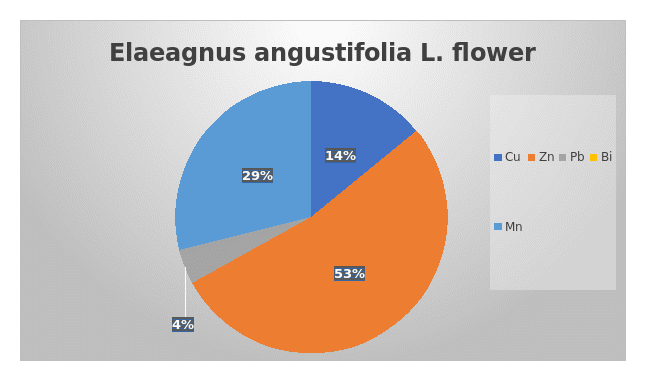
The data presented in Figure 1 demonstrate that the concentrations of heavy metal ions in the flowers of Elaeagnus angustifolia L. are distributed unevenly. Zinc showed the highest concentration among the analyzed heavy metal ions, accounting for 53 % of the total content. Copper accounted for 29 %, manganese for 14 %, and lead for 4 % of the total heavy metal content. The concentrations of bismuth (Bi), cobalt (Co), and cadmium (Cd) ions were found to be very low.
It should be noted that the quantitative relationship between Cu and Zn reported in the original version of this manuscript (Cu being 3.31 times lower than Zn) was inconsistent with the percentage data presented in Figure 1. This discrepancy has been corrected in the revised version.
Comparison with regulatory limits (WHO/SanPiN)
(Note: According to WHO data, typical limits for medicinal plant raw materials are: Pb — 10 mg/kg, Cd — 0.2 mg/kg, As — 1.0 mg/kg, Hg — 0.1 mg/kg. For Cu and Zn, the limits are often not set as strictly, but they may be around 20–50 mg/kg, depending on the jurisdiction.)
- Pb — 10 mg/kg;
- Cd — 0.3 mg/kg;
- As — 1.0 mg/kg;
- Hg — 0.1 mg/kg;
- Cu — 20 mg/kg;
- Zn — 50 mg/kg.
The concentrations of the analyzed heavy metals were generally low; however, a formal compliance assessment was not performed because the applicable regulatory limits for medicinal plant materials vary by jurisdiction.
Conclusion
In conclusion, this study presents the first investigation of the essential oil composition and macro- and microelement content of Elaeagnus angustifolia L. flowers collected from a highly saline region of the Republic of Uzbekistan. However, the results should be interpreted with caution due to the unusual essential oil profile obtained, which differs substantially from previously published data on this species.
A total of 18 volatile compounds were identified in the flower essential oil. The major constituents were ethanamine, N,N-dimethyl- (12.951 %), ethyl isocyanide (10.135 %), m-tolyl isothiocyanate (10.360 %), guanidine (6.982 %), methyl ester of 1-methylpyridin-2(1H)-one-5-carboxylic acid (6.644 %), and 6-chloro-2-phenyl-1H-imidazo[2,1-c][1,4]benzoxazine (6.476 %). These identifications are considered tentative and require confirmation by independent analytical methods.
The mineral elements in Elaeagnus angustifolia L. flowers were found to be unevenly distributed. Among the macro-elements, potassium exhibited the highest concentration, reaching 19,953.4 mg/kg. Among the microelements, the highest content was observed for aluminum, with a concentration of 133.2 mg/kg. The ICP–MS method was validated in terms of calibration linearity (r > 0.996), LOD/LOQ, spike recovery (90–110 %), and precision (RSD < 8.67 %). All measurements were performed in triplicate, and results are expressed as mean ± standard deviation.
The concentrations of heavy metals detected in E. angustifolia L. flowers were compared with the permissible limits established by the WHO for herbal medicines: Pb — 10 mg/kg; Cd — 0.3 mg/kg; As — 3 mg/kg; Hg — 1 mg/kg; Cu — 50 mg/kg; Zn — 50 mg/kg. The measured concentrations of Pb (3.24 mg/kg) and other analyzed heavy metals were below the applicable limits.
The obtained results indicate that the flowers of E. angustifolia L. represent a promising source of biologically active compounds and mineral elements and may have potential applications in pharmaceutical and food-related fields. Further studies using independent analytical methods and including a control region are warranted to confirm the essential oil composition and to establish whether environmental factors such as soil salinity influence the chemical profile of this plant.
References