Technology for producing sulfur-containing lime-ammonium nitrate from local chalk and ammonium sulfate
УДК 631.85.661
Abstract
The modification of ammonium nitrate (AN) melt with carbonate and sulfate additives to obtain lime-ammonium nitrate (LAN) is a well-established route to nitrogen fertilizers with improved physical and agrochemical properties. This study addresses a step that has not previously been reported for the local-chalk/ammonium-sulfate LAN system: validation of a laboratory-optimized composition through an extended model unit, together with the accompanying process design. Ammonium nitrate melt (99.5 – 99.8 %) was combined with ground local chalk (Kitob deposit, Qashqadaryo region, Uzbekistan; CaCO3 corresponding to 52.23 % CaO and 41.5 % CO2) at NH4NO3:CaCO3 mass ratios of 100:(2 – 58) and, for the sulfur-containing variant, with ammonium sulfate at NH4NO3:CaCO3:(NH4)2SO4 = 100:(2 – 58):(0.5 – 5.0), with 100:24:1 previously identified as the optimum. Mixing was carried out at 170 – 175 degrees C for 7 – 10 minutes, followed by granulation and cooling to 28 – 30 degrees C. An extended 3 L laboratory model unit was operated over a 25-day campaign to verify this composition at larger scale. At the optimum ratio, model-unit granules reproduced the laboratory-scale nitrogen content (28.0 – 28.1 % N), calcium content (~10 % CaO), sulfur content (~0.5 % SO3), and crushing strength (6.05 MPa versus 6.03 MPa at laboratory scale, both far above the 1.32 MPa of unmodified AN).
Аннотация
Модификация плава аммиачной селитры (АС) карбонатными и сульфатными добавками с получением известково-аммиачной селитры (ИАС) является хорошо известным способом получения азотных удобрений с улучшенными физическими и агрохимическими свойствами. В настоящей работе рассмотрен этап, ранее не описанный для системы «местный мел – сульфат аммония»: проверка лабораторно оптимизированного состава в условиях расширенной модельной установки, а также сопутствующая технологическая схема. Плав аммиачной селитры (99,5 – 99,8 %) смешивали с молотым местным мелом (месторождение Китоб, Кашкадарьинская область, Узбекистан; CaCO3, соответствующий 52,23 % CaO и 41,5 % CO2) при массовых соотношениях NH4NO3:CaCO3 = 100:(2 – 58), а для серосодержащего варианта — с сульфатом аммония при NH4NO3:CaCO3:(NH4)2SO4 = 100:(2 – 58):(0,5 – 5,0), причём ранее оптимальным было установлено соотношение 100:24:1. Смешивание проводили при 170 – 175°C в течение 7 – 10 минут с последующей грануляцией и охлаждением до 28 – 30°C. Расширенная лабораторная модельная установка объёмом 3 л эксплуатировалась в течение 25-суточной кампании для проверки состава в более крупном масштабе. При оптимальном соотношении гранулы, полученные на модельной установке, воспроизвели лабораторные показатели по содержанию азота (28,0 – 28,1 % N), кальция (~10 % CaO), серы (~0,5 % SO3) и прочности гранул (6,05 МПа против 6,03 МПа на лабораторном уровне, что значительно выше 1,32 МПа для немодифицированной АС).
Keywords: lime-ammonium nitrate; local chalk; ammonium sulfate; technological process scheme; extended model unit; granulation.
Ключевые слова: известково-аммиачная селитра; местный мел; сульфат аммония; технологическая схема; расширенная модельная установка; грануляция.
Introduction
Nitrogen fertilizers based on ammonium nitrate (AN, NH4NO3) remain among the most widely used sources of plant-available nitrogen worldwide, valued for their high nitrogen content and dual nitrate/ammonium form of uptake. Global nitrogen fertilizer capacity has continued to expand through the mid-2020s, with ammonia capacity growth concentrated in low-cost feedstock regions and steady demand from irrigated agriculture in Central and South Asia [1]. Uzbekistan is itself a significant regional producer and, under a chemical-sector investment program launched in 2026, is targeting an increase in domestic nitrogen fertilizer output from 2.8 to 4 million tonnes per year by 2030 [2]; AN and its modified derivatives are produced domestically and form a substantial share of the mineral fertilizer supplied to an agricultural sector that depends heavily on irrigated cropland.
A persistent limitation of AN as a stand-alone product is its physical instability: AN undergoes a series of solid-solid polymorphic phase transitions between -17 and 169.6 degrees C, the transition near 32 degrees C being particularly disruptive because it is accompanied by a volume change that promotes granule cracking, caking, and dust formation during storage and handling [3]. These physical shortcomings, together with the oxidizing character and thermal-decomposition hazard of concentrated AN – documented in fertilizer-storage incident analyses [4,5], detonation-sensitivity studies of AN prills [6], and recent methodological guidelines for thermal-hazard assessment of AN systems [7] – have motivated decades of work on inorganic modifiers – magnesium, sulfate, phosphate, and carbonate compounds among them – that are introduced into the AN melt before granulation to stabilize the crystal structure and dilute the product's hazard profile [8].
Carbonate-containing minerals, and calcium carbonate (limestone, chalk, dolomite) in particular, are among the most technologically mature of these modifiers, giving rise to the broad family of products known as calcium-ammonium nitrate or lime-ammonium nitrate (CAN/LAN). Mixing AN melt with ground carbonate rock produces calcium nitrate in situ, which both raises granule strength and lowers the free-AN fraction available for uncontrolled decomposition; density-functional studies of the AN-CaCO3 system indicate that the carbonate anion intercepts protons from the initial steps of AN decomposition, and diffraction studies confirm that carbonate additives eliminate specific low-temperature AN phase transitions altogether, both consistent with the empirically observed stabilizing effect of carbonate additives [9,10]. Industrial CAN/LAN technology based on limestone slurries and drum or tower granulation is well documented in the process literature [11], and the kinetics of carbonate thermal decomposition that underlie the AN-CaCO3 exchange reaction have been characterized in detail for a range of carbonate minerals [12].
Ammonium sulfate, (NH4)2SO4, is a second modifier of established but distinct value: physically, the sulfate anion contributes to AN stabilization through a mechanism similar to that of carbonate, and recent thermal-analysis work confirms that ammonium-sulfate-bearing systems are among the most stable of the sulfate-modified AN formulations tested [9,13], while agrochemically it supplies sulfur, a secondary macronutrient whose plant-available soil pool has declined over recent decades owing to reduced atmospheric deposition and the spread of low-sulfur fertilizer formulations; adequate sulfur supply is now recognized as a precondition for efficient nitrogen use by field crops [14]. Combining a carbonate modifier with ammonium sulfate therefore offers a route to a fertilizer that supplies nitrogen, calcium, and sulfur together, rather than nitrogen alone.
The physicochemical basis for using local chalk and ammonium sulfate to modify AN melt – including chalk decarbonization kinetics, granule strength, porosity, caking, dissolution rate, and the density and viscosity of the resulting carbonate-nitrate and carbonate-sulfate-nitrate melts – has already been established in a series of laboratory-scale studies by our group, including a fully quantified physicochemical characterization published in an open-access, internationally indexed venue [15,16]. These studies, together with parallel work on limestone-based lime-ammonium nitrate [17] and, more recently, on other local Uzbek mineral modifiers such as bentonite and glauconite powders [18], converge on a common limitation: without exception, they report bench-scale (metal-beaker or small-reactor) experiments and do not address whether the established compositions and their properties are reproducible at larger scale, or what process modifications an existing AN production line would require.
This is a meaningful gap. Granulation behavior in particular is known to be scale- and equipment-dependent: drum- and tower-granulation studies of nitrate-based NPK fertilizers show that granule growth mechanisms, and the process windows that produce an acceptable size distribution, depend on binder viscosity, mixing intensity, and residence time in ways that a small manual-mixing bench experiment cannot fully anticipate [19]. A composition and property set established in a metal beaker is therefore a necessary but not sufficient basis for a technological recommendation; the missing link is a demonstration that the same formulation performs consistently as equipment scale increases, together with the process data an enterprise needs to evaluate adoption.
This gap is directly relevant to Uzbekistan's chemical industry. The Kitob chalk deposit in the Qashqadaryo region represents a large, unexploited domestic carbonate resource, and domestic ammonium sulfate production capacity already exceeds 230,000 t/year. Replacing imported magnesite – the modifier currently used to stabilize AN at the producing enterprise – with these two domestic raw materials would reduce import dependence while adding calcium and, in the sulfur-containing variant, sulfur to the nutrient package.
The objective of the present work is therefore to validate, rather than re-derive, the previously reported optimal chalk-only and sulfur-containing LAN compositions by carrying them through an extended 25-day laboratory-model-unit campaign, and to report, for the first time for this system, the principal technological process scheme. The working hypothesis is that a formulation whose composition and granule quality are governed primarily by mass ratios and short-residence-time mixing (rather than by phenomena with strong scale-dependent kinetics) will reproduce its bench-scale properties as the equipment scale increases. The novelty of this study lies not in the chemistry of the AN-chalk-ammonium sulfate system, which has been characterized previously, but in the process description that determines whether that chemistry is ready for practical adoption.
Materials and Methods
Raw materials. Ammonium nitrate was used as a melt obtained by neutralizing nitric acid with gaseous ammonia and evaporating the resulting solution to 99.5 – 99.8 % NH4NO3, following the same upstream process used for conventional magnesite-modified AN production. Local chalk (CaCO3) was sourced from the Kitob deposit, Qashqadaryo region, Uzbekistan; the processed material contained 52.23 % CaO and 41.5 % CO2 and was ground to a particle size not exceeding 0.25 mm before use. Ammonium sulfate, (NH4)2SO4, was obtained from «Maxam-Chirchiq» JSC and likewise ground to a particle size not exceeding 0.25 mm.
Extended laboratory model unit. Beyond the metal-beaker bench experiments reported previously [15,16], an extended laboratory model unit was assembled around a 3 L cylindrical reactor of 12X18N10T (X18H10T) stainless steel fitted with a motor-driven blade stirrer. Nitric acid was neutralized with gaseous ammonia in a sealed glass reactor to obtain an AN solution of not less than 63.5 %, which was evaporated at 170 degrees C to the working melt. Ground chalk (chalk-only variant) or ammonium sulfate followed by chalk (sulfur-containing variant, in the ratio NH4NO3:CaCO3:(NH4)2SO4 = 100:(2 – 58):(0.5 – 5.0)) was introduced into the melt and mixed for 10 minutes, after which the resulting carbonate-nitrate or carbonate-sulfate-nitrate melt was granulated by air-assisted spraying into a 3 L stainless-steel granulator, approximating tower granulation at bench scale. The unit was operated continuously for 25 days to produce trial batches of both product variants; product composition, crystallization temperature, granule strength, friability, porosity, and diesel-oil absorption were determined for each batch using the methods below.
Principal technological process schemes. Based on the laboratory and model-unit results, two principal technological process schemes were developed: one for chalk-only LAN and one for sulfur-containing LAN. Both schemes were designed as additions to the existing magnesite-modified AN production line rather than as stand-alone processes, so that the neutralization and evaporation stages are shared with current production. The schemes are described in the Results and Discussion section and illustrated in Figure 1.
Chemical and physicochemical analysis. Total nitrogen, total and citrate-soluble CaO, and total SO3 were determined by standard analytical methods. Granule static crushing strength and friability were determined according to GOST 21560.2 – 82 and GOST 21560.5 – 82, respectively [20,21]. Porosity was determined volumetrically using cryoscopic benzene; diesel-oil absorption was determined gravimetrically (100 g sample, 10 g diesel oil, mass uptake reported per 100 g); the hygroscopic point and sorption moisture capacity were determined by the desiccator method; dissolution time in distilled water was recorded as the mean of five replicate determinations; and phase composition was confirmed by X-ray diffraction (XRD-6100, Shimadzu, CuK-alpha radiation) in the source laboratory studies to which the present results are compared [15,16].
Results and Discussion
Principal technological process schemes. Figure 1 summarizes the two process schemes developed from the laboratory and model-unit work. Both share the first two stages with the existing magnesite-modified AN line: neutralization of nitric acid with gaseous ammonia to an AN solution of not less than 63.5 %, and evaporation to a 99.5 – 99.8 % AN melt at 170 degrees C. For chalk-only LAN, ground chalk is metered into the melt through a screw dispenser and blended in a screw mixer for 7 – 10 minutes at 170 – 175 degrees C before granulation. For sulfur-containing LAN, a 35 % ammonium sulfate solution is first blended into the AN melt during evaporation, re-neutralized with ammonia gas, and then combined with metered chalk in a screw mixer/homogenizer for 7 – 10 minutes. In both cases the resulting melt is granulated (spray granulation in a tower, or intensive-mixing granulation in a drum), screened to the 1 – 4 mm commercial fraction, with oversize crushed and undersize recycled, cooled to 28 – 30 degrees C in a fluidized-bed cooler, and packaged in polyethylene bags; off-gas is routed through a cyclone before release.
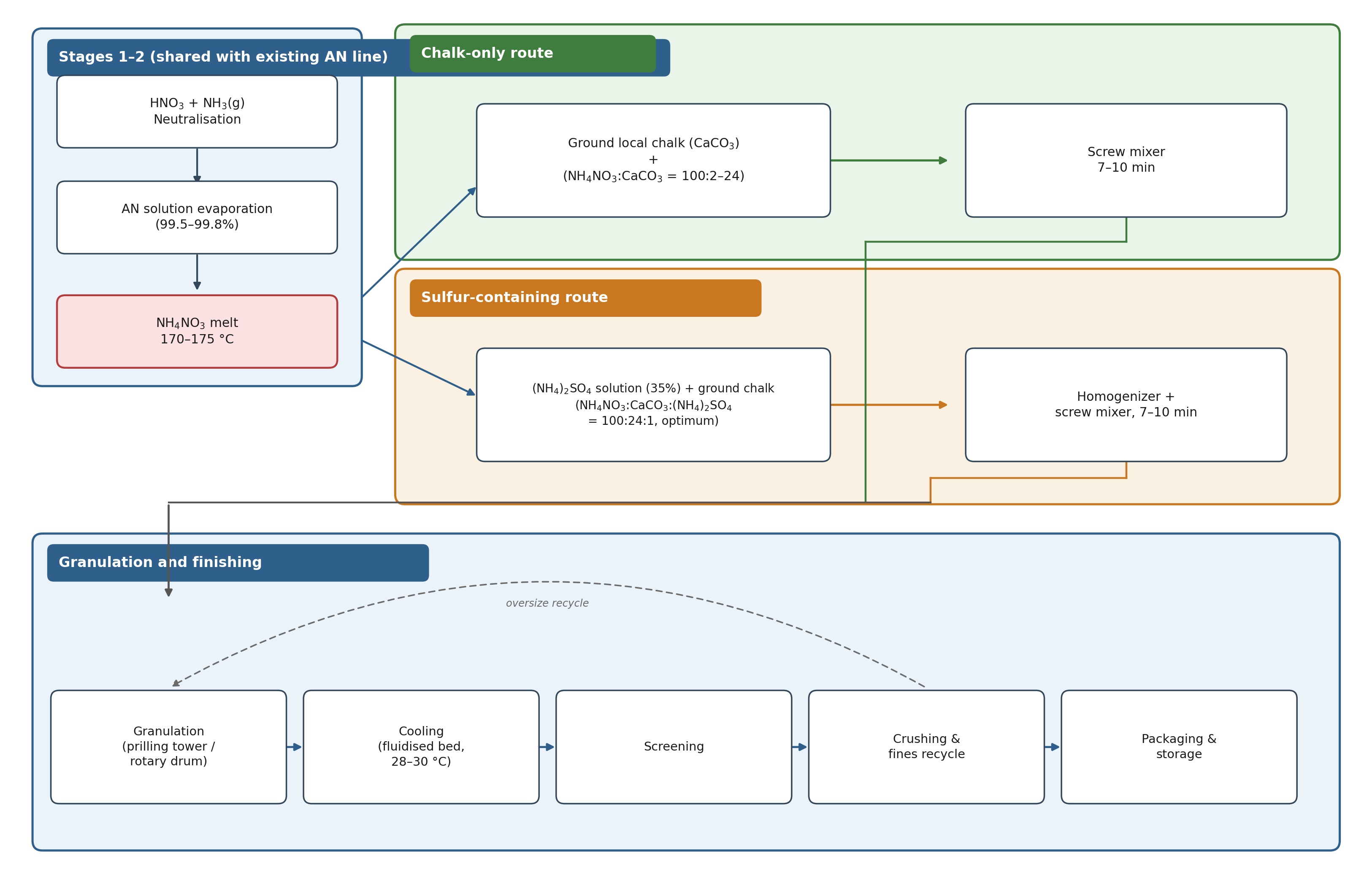
The key practical finding of this scheme is that no new major unit operations are required: the existing neutralization, evaporation, granulation, cooling, and packaging equipment used for magnesite-modified AN is retained, and the only additions are a chalk-grinding and dosing line and, for the sulfur-containing variant, an ammonium sulfate solution-mixing step inserted before granulation. This is consistent with the process-design literature on calcium-ammonium nitrate, where carbonate incorporation is likewise implemented as an addition to, rather than a replacement of, existing AN granulation infrastructure [11]. Because the added unit operations are conventional solids-handling and blending steps rather than novel unit operations, and because the granulation step itself is unchanged from existing practice, the risk profile of adopting this modification is expected to be lower than for a process requiring new reaction chemistry or new equipment types.
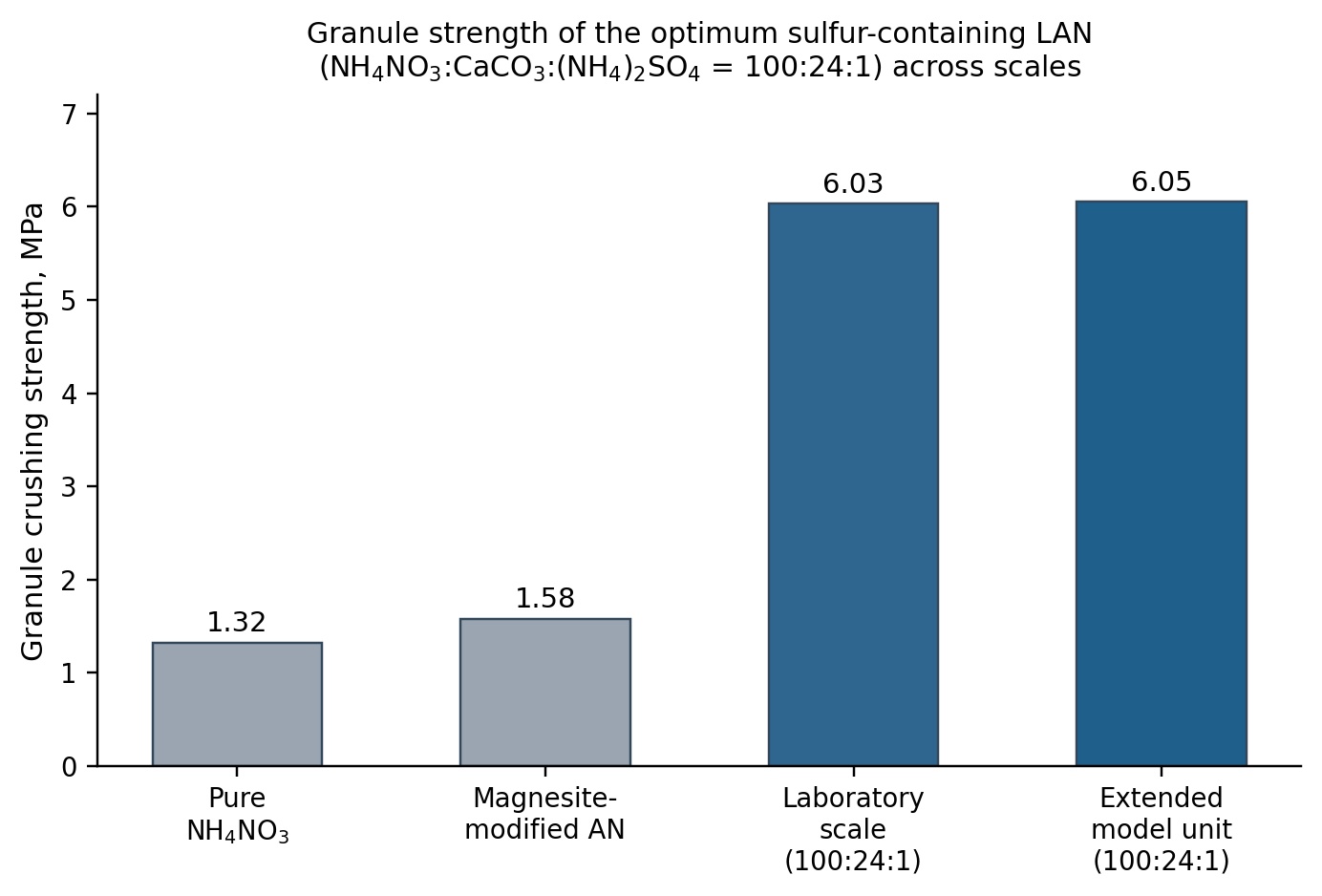
From laboratory bench to extended model unit: consistency of composition and granule quality. Table 1 summarizes the composition and strength of chalk-only and sulfur-containing LAN granules produced in the 25-day extended model-unit campaign, alongside the corresponding laboratory-bench values reported previously for the same formulations [15,16]. At every mass ratio examined, the model-unit product falls within 1 – 2 % relative of the laboratory-bench composition and within a few percent of the corresponding strength value; at the optimum sulfur-containing ratio (100:24:1), granule strength was 6.05 MPa in the model unit versus 6.03 MPa at laboratory bench scale (Figure 2), both roughly 4.6 times the strength of unmodified AN (1.32 MPa) and about 3.8 times that of the currently used magnesite-modified AN (1.58 MPa).
This consistency is not a trivial outcome. Granule strength in nitrate-based fertilizer systems is governed by binder viscosity, mixing intensity, and the residence time available for melt-solid interaction before solidification, all of which can shift when moving from a hand-stirred beaker to a mechanically agitated reactor with a different heat- and mass-transfer environment [19]. That the present system reproduced its properties across this scale change indicates that, within the ratio and temperature ranges studied, granule quality is governed primarily by the NH4NO3:CaCO3:(NH4)2SO4 mass ratio and a minimum 7 – 10 minute mixing time rather than by equipment-specific mixing intensity – a favorable property for further scale-up.
Table 1.
Composition and granule strength of chalk-only and sulfur-containing LAN: laboratory bench versus extended model unit (this study)
| Mass ratio NH4NO3:CaCO3:(NH4)2SO4 | N, % (lab/model unit) |
CaO, % (lab/model unit) | SO3, % (lab/model unit) | Strength, MPa (lab/model unit) |
|---|---|---|---|---|
| 100:2 : – | 34.22 / 34.21 | 1.02 / 1.04 | – | 2.65 / 2.63 |
| 100:24 : – | 28.12 / 28.11 | 10.11 / 10.13 | – | 5.95 / 5.97 |
| 100:58 : – | 22.06 / 22.02 | 19.22 / 19.25 | – | 8.69 / 8.66 |
| 100:2.5:0.5 | 34.0 / 34.10 | 1.28 / 1.25 | 0.29 / 0.29 | 3.32 / 3.31 |
| 100:24:1 (optimum) | 28.03 / 28.07 | 10.0 / 10.04 | 0.50 / 0.53 | 6.03 / 6.05 |
| 100:58:5 | 21.91 / 21.94 | 18.55 / 18.57 | 1.86 / 1.84 | 9.30 / 9.32 |
Comparison with published production and granulation literature. The process-flow structure obtained here parallels the general calcium-ammonium nitrate production approach described by Sozontov, in which AN solution is combined with solid carbonate feedstock ahead of granulation and drying on equipment adapted from existing complex-fertilizer lines [11]. The present results extend that general picture with ratio-specific, source-specific (local chalk) experimental data and with extended-scale experimental confirmation rather than process simulation alone. The consistency of granule strength across scales observed above is also in line with the granulation-mechanism literature, which identifies binder viscosity and mixing time – both effectively fixed by the NH4NO3:CaCO3:(NH4)2SO4 ratio and the 7 – 10 minute mixing step used here – as the primary controls on granule growth in nitrate-based systems, ahead of drum- or tower-specific effects [19]. The finding is likewise consistent with regional work on other local Uzbek mineral additives for AN, which similarly reports substantial granule-strength gains from bench-scale trials but, unlike the present case, without verification at an enlarged model-unit scale [18].
Technological implications. For an operator currently producing magnesite-modified AN, the practical implication of these results is that adopting either LAN variant is a formulation and dosing change rather than a capital-intensive process redesign: the neutralization, evaporation, granulation tower or drum, fluidized-bed cooling, and packaging equipment are retained, and the incremental investment is limited to chalk grinding/dosing (and, for the sulfur-containing variant, an ammonium sulfate solution line). The 7-10-minute minimum mixing time and the 170 – 175 degrees C mixing temperature identified here define the process window within which the demonstrated granule strength and composition can be expected to hold; operating below this mixing time was found, at laboratory and model-unit scale alike, to leave the NH4NO3-CaCO3 exchange reaction incomplete and to reduce granule strength accordingly. Because these parameters were shown to transfer consistently from laboratory bench to the extended model unit, they can be recommended as a starting point for full-scale process design, subject to the standard verification any enterprise would carry out during commissioning of a modified production line.
Conclusion
An extended 25-day laboratory-model-unit campaign reproduced the previously established laboratory-bench composition and strength of both chalk-only lime-ammonium nitrate (N 34.21 – 22.02 %, CaO 1.04 – 19.25 %) and sulfur-containing lime-ammonium nitrate (N 34.17 – 21.94 %, SO3 0.32 – 1.84 %, CaO 1.01 – 18.57 %) within a few percent at every mass ratio examined, indicating that granule quality in this system is controlled primarily by the NH4NO3:CaCO3:(NH4)2SO4 mass ratio and mixing time rather than by equipment-specific effects.
Principal technological process schemes were established for both product variants as additions to the existing magnesite-modified ammonium nitrate production line, requiring only a chalk dosing/mixing stage (chalk-only variant) or a chalk and ammonium sulfate solution dosing/mixing stage (sulfur-containing variant), with no change to the neutralization, evaporation, granulation, cooling, or packaging equipment.
On the combined laboratory and extended-model-unit evidence, the sulfur-containing formulation at NH4NO3:CaCO3:(NH4)2SO4 = 100:24:1 (28 % N, 10 % CaO, 0.5 % SO3, 6.03 – 6.05 MPa granule strength) is recommended as the preferred composition, balancing nutrient content and physical quality.
References