
Development of a catalyst for the catalytic oxychlorination synthesis of vinyl chloride from ethylene
УДК 547.314.2:54 – 44
Abstract
This study describes the composition, preparation procedure, and catalytic performance of a multicomponent KCl·ZnCl2·CuCl2·CeCl3/HZS catalyst designed for the production of vinyl chloride through catalytic oxychlorination of ethylene. The catalyst contained 5 % KCl, 5 % ZnCl2, 10 % CuCl2, 3 % CeCl3, and 77 % high-silica zeolite. Component quantities were calculated on the basis of 100 g of nominal dry catalyst. When hydrated laboratory precursors were employed, 12.68 g of CuCl2·2H2O and 4.53 g of CeCl3·7H2O were used to provide the required amounts of anhydrous CuCl2 and CeCl3, respectively. The catalyst was prepared by incipient-wetness impregnation using a solution volume corresponding to the pore volume of the support, followed by staged drying and mild chlorinating activation. Catalytic tests were performed at 230–240 °C, and a vinyl chloride selectivity of 94.7 % was achieved. Since the conversion value was not reported, the product yield could not be determined separately. The observed catalytic performance is attributed to the synergistic interaction between the redox chlorination centers of CuCl2, the acidic sites of the high-silica zeolite, and the promotional effects of KCl, ZnCl2, and CeCl3. The proposed catalytic system demonstrates promising potential for selective vinyl chloride production.
Аннотация
В данной работе представлены состав, способ приготовления и каталитические свойства многокомпонентного катализатора KCl·ZnCl2·CuCl2·CeCl3/HZS, предназначенного для получения винилхлорида методом каталитического оксихлорирования этилена. Состав катализатора включал 5 % KCl, 5 % ZnCl2, 10 % CuCl2, 3 % CeCl3 и 77 % высококремнезёмного цеолита. Количества компонентов рассчитывали на 100 г номинально сухого катализатора. При использовании гидратированных лабораторных прекурсоров применяли 12,68 г CuCl2·2H2O и 4,53 г CeCl3·7H2O, что соответствовало требуемому содержанию безводных CuCl2 и CeCl3. Катализатор получали методом пропитки по влагоёмкости с использованием объёма раствора, соответствующего объёму пор носителя, с последующей ступенчатой сушкой и мягкой хлорирующей активацией. Каталитические испытания проводили при температуре 230–240 °C. Селективность по винилхлориду достигала 94,7 %. В связи с отсутствием данных о степени конверсии выход целевого продукта отдельно не рассчитывали. Высокая селективность катализатора объясняется синергетическим взаимодействием окислительно-восстановительных хлорирующих центров CuCl2, кислотных центров высококремнезёмного цеолита, а также промотирующим действием KCl, ZnCl2 и CeCl3. Полученная каталитическая система представляет интерес для селективного синтеза винилхлорида.
Keywords: ethylene; vinyl chloride; catalytic oxychlorination; high-silica zeolite; copper(II) chloride; potassium chloride; zinc chloride; cerium(III) chloride; selectivity.
Ключевые слова: этилен; винилхлорид; каталитическое оксихлорирование; высококремнезёмный цеолит; хлорид меди(II); хлорид калия; хлорид цинка; хлорид церия(III); селективность.
Introduction
Vinyl chloride is the main monomer for the production of polyvinyl chloride and is one of the large-volume products of the organochlorine synthesis industry. A technology based on ethylene feedstock is distinguished by efficient utilization of hydrocarbon resources and the possibility of recycling hydrogen chloride into the reaction. In industrial practice, oxychlorination of ethylene often proceeds through the formation of 1,2-dichloroethane; vinyl chloride is then obtained by dehydrochlorination or thermal cracking [4]. If a bifunctional catalyst combines oxychlorination and dehydrochlorination functions in one system, it becomes possible to lower the process temperature and reduce the number of process stages [11].
Copper(II) chloride is known as an active chlorine carrier in ethylene oxychlorination. Dynamic transitions between copper(II) and copper(I) states in the working catalyst link chlorination of ethylene, oxidation of copper(I) chloride by oxygen, and rechlorination by hydrogen chloride [4; 6; 14; 15]. Potassium chloride forms mixed surface phases with copper chloride and affects reduction kinetics, acidity, and the mobility of copper(I) chloride. Cerium(III) chloride is considered a promoter that modifies the redox balance and thermal stability, while zinc chloride modifies the chloride surface environment and active-phase dispersion [6; 12; 14; 15].
C2H4 + 2HCl + 1/2 O2 → C2H4Cl2 + H2O
C2H4Cl2 → C2H3Cl + HCl
Overall: C2H4 + HCl + 1/2 O2 → C2H3Cl + H2O
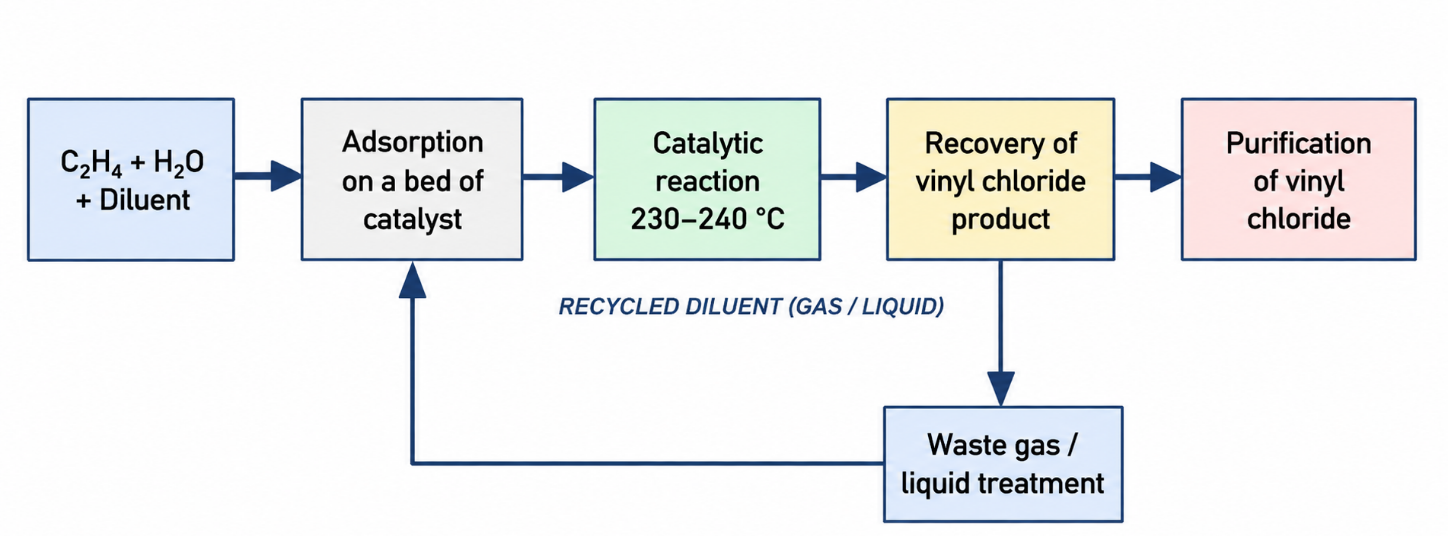
Table 1.
Catalytic functions and control parameters
| Function | Process role | Main control parameter |
|---|---|---|
| Oxychlorination | Formation of a chlorinated C2 intermediate from ethylene and hydrogen chloride | Copper oxidation state, oxygen consumption |
| Dehydrochlorination | Formation of vinyl chloride from the chlorinated intermediate | HZS acidity, contact time |
| Promotion | Control of selectivity, dispersion, and stability | Amounts of KCl, ZnCl2, and CeCl3 |
| Heat management | Limitation of hot spots and deep oxidation | Bed temperature in the 230–240 °C range |
The aim of the work is to calculate a catalyst with the mass ratio KCl:ZnCl2:CuCl2:CeCl3:HZS = 5:5:10:3:77, describe the laboratory preparation algorithm, and scientifically discuss the 94.7 % selectivity recorded at 230–240 °C in terms of interactions among the active phases.
Materials and Methods
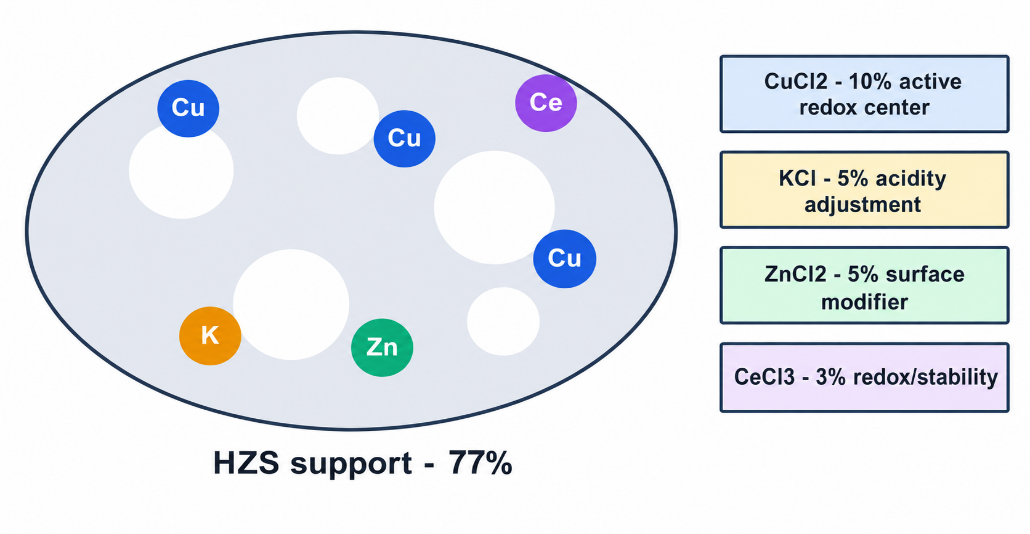
The catalyst composition was specified on the basis of the final dry mass. Since 5+5+10+3+77 equals 100, the mass percentages are numerically equal to the component masses for 100 g of catalyst. HZS denotes high-silica zeolite. The support is used in a hierarchical porous form with a Si/Al ratio of at least 25 and is dried at 120 °C to constant mass before impregnation.
Table 2.
Catalyst composition and calculated amounts of laboratory precursors.
| Component | Mass fraction, % | Dry substance for 100 g | Laboratory precursor for 100 g | For 10 g catalyst |
|---|---|---|---|---|
| KCl | 5 | 5.00 g | 5.00 g KCl | 0.500 g KCl |
| ZnCl2 | 5 | 5.00 g | 5.00 g ZnCl2 | 0.500 g ZnCl2 |
| CuCl2 | 10 | 10.00 g | 12.68 g CuCl2·2H2O | 1.268 g CuCl2·2H2O |
| CeCl3 | 3 | 3.00 g | 4.53 g CeCl3·7H2O | 0.453 g CeCl3·7H2O |
| HZS | 77 | 77.00 g | 77.00 g dry HZS | 7.700 g dry HZS |
| Total | 100 | 100.00 g | 104.21 g weighed material | 10.421 g weighed material |
The mass of hydrated salt was determined from m(hydrate) = m(anhydrous salt)·M(hydrate)/M(anhydrous salt). For copper(II) chloride, 10.00·170.48/134.45 = 12.68 g; for cerium(III) chloride, 3.00·372.58/246.48 = 4.53 g. During drying, the water of crystallization is removed, so 104.21 g of the initial weighed material yields a nominal 100 g of dry catalyst. If anhydrous CuCl2 and CeCl3 are used, exactly 10.00 g and 3.00 g, respectively, are required.
The molar amounts of the salts are KCl = 0.0671 mol, ZnCl2 = 0.0367 mol, CuCl2 = 0.0744 mol, and CeCl3 = 0.0122 mol. Relative to CuCl2, the nominal molar ratio KCl:ZnCl2:CuCl2:CeCl3 is 0.90:0.49:1.00:0.16. This notation does not represent a separate crystalline compound formula; it denotes the calculated composition of the multicomponent phase loaded onto the HZS surface.
The catalyst is prepared by incipient-wetness impregnation. First, HZS is dried at 120 °C for 4 h, cooled in a desiccator, and its water capacity is determined by dropwise wetting. The volume of the impregnation solution should equal the experimentally determined pore volume of the support. For example, if the water capacity is 0.45 mL/g, 34.65 mL of solution is used for 77 g of support. If all salts do not dissolve in this volume, two consecutive impregnation cycles are applied.

Table 3.
Catalyst preparation stages and control criteria
| Stage | Operation | Regime | Control criterion |
|---|---|---|---|
| 1 | Drying and fractionation of HZS | 120 °C, 4 h; 100–300 μm |
Constant mass, no dust fraction |
| 2 | Preparation of salt solution | Deionized water, 50–60 °C, 30 min |
Clear solution; no hydrolysis precipitate |
| 3 | Incipient-wetness impregnation | Dropwise addition for 20–30 min | Uniform wetting, no free liquid |
| 4 | Aging | 2 h in a closed vessel | Diffusion of salts into the pores |
| 5 | Staged drying | 80 °C for 2 h; 120 °C for 6–12 h | Constant mass, no large crystals |
| 6 | Activation | 180 °C in N2; diluted HCl/N2 at 200–220 °C | Retention of chloride phase and safe off-gas |
Strong calcination is not recommended because high temperatures may cause volatilization of chlorides, agglomeration of the copper phase, or changes in the acid sites of HZS. Since ZnCl2 and CeCl3 are hygroscopic, weighing should be performed rapidly in a dry atmosphere. Each sample should be prepared at least three times, and the actual mass, solution volume, drying time, and activation time should be recorded for each batch.
Catalytic testing is carried out in a corrosion-resistant fixed-bed microreactor. A 0.5–1.0 g portion of catalyst is diluted with quartz to improve heat transfer. The reactor is first purged with nitrogen, followed by hydrogen chloride and ethylene, and finally oxygen. The test temperature is directly controlled in the catalyst bed using a thermocouple at 230–240 °C. For the direct overall reaction, an initial C2H4:HCl:O2 molar ratio of 1:1.0:0.55 is recommended; if the exact flow rates of the experiment yielding 94.7 % selectivity are available, those values should take precedence in the main protocol.
Table 4.
Catalytic test conditions and analytical methods
| Parameter | Test condition or method | Comment |
|---|---|---|
| Temperature | 230–240 °C | Actual temperature inside the bed |
| Catalyst mass | 0.5–1.0 g | Diluted with quartz at approximately 1:5 |
| Initial gas ratio | C2H4:HCl:O2 = 1:1:0.5 | 10% oxygen excess relative to the overall equation |
| Space velocity | 1000–3000 h−1 | Recommended range for screening |
| Product analysis | Gas chromatography | Gas and condensate streams analyzed separately |
| Stability | At least 24 h; target 100 h | Time dependence of selectivity and conversion |
Vinyl chloride is a carcinogenic and highly flammable gas; experiments must be performed only on a hermetically sealed, remotely controlled test rig equipped with continuous gas monitoring. Oxygen is introduced last and, in an emergency, is shut off first. Materials resistant to hydrogen chloride and wet chloride environments, as well as an absorber and neutralization system, are mandatory [7].
Results and Discussion
Table 5.
Main experimental results and their scientific interpretation
| Result | Value | Scientific interpretation |
|---|---|---|
| Temperature | 230–240 °C | Reported catalytic test range |
| Vinyl chloride selectivity | 94.7% | Based on converted ethylene |
| Fraction of other products | 5.3% | Calculated as 100 − 94.7; composition requires clarification |
| Ethylene conversion | Not provided | Required to calculate product yield |
| Vinyl chloride yield | Not calculated | Cannot be determined from selectivity without conversion |
The calculation showed that the active salts account for 23 mass% of the catalyst, while HZS accounts for 77 mass%. The 10 % CuCl2 content provides the principal reservoir of redox chlorination centers. KCl and ZnCl2, each at 5 %, are expected to have a significant effect on the acid–base properties of the surface and the mobility of the chloride phase. The 3 % CeCl3 content serves as an additional modifier of copper reoxidation and active-phase stability.
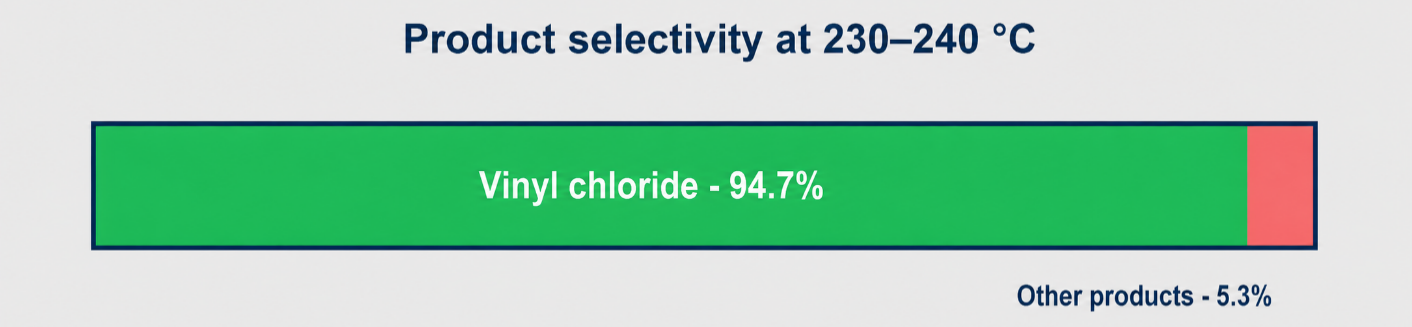
Table 6.
Functions and potential risks of catalyst components.
| Component | Mass fraction | Expected catalytic function | Main risk discussed |
|---|---|---|---|
| CuCl2 | 10% | Cu(II)/Cu(I) redox center for ethylene chlorination | Agglomeration and CuCl volatility |
| KCl | 5% | Adjustment of acidity and reduction of copper chloride | Blocking of active sites at excessive amounts |
| ZnCl2 | 5% | Modification of chloride environment and surface dispersion | Hygroscopicity and pore-mouth blockage |
| CeCl3 | 3% | Redox balance and structural stability | Hydrolysis and phase change in moisture |
| HZS | 77% | Dispersed support and acid sites for dehydrochlorination | Side products if acidity is too high |
The 94.7 % selectivity indicates that most of the converted ethylene was transformed into vinyl chloride. The remaining 5.3 % was calculated as the difference in product selectivity, but its distribution among ethyl chloride, 1,2-dichloroethane, carbon dioxide, or heavy organochlorine compounds was not reported. Therefore, the composition of the side products should be confirmed by gas chromatography and mass spectrometry. Although selectivity itself is high, catalyst productivity cannot be fully evaluated until ethylene conversion is known.
Literature results for high-silica zeolites are not uniform: some CuCl2/zeolite systems have been less active than alumina-supported samples [13]. The high selectivity observed with the present composition may be associated with the combined promoter effect of KCl, ZnCl2, and CeCl3 and the dehydrochlorination function of HZS. This is a mechanistic hypothesis and should be tested using promoter-free and alumina-supported control samples.
The catalytic cycle at copper chloride centers can be represented by three elementary stages. In the first stage, copper(II) chloride chlorinates ethylene and is reduced to copper(I) chloride. In the second stage, copper(I) chloride is converted into copper oxychloride by oxygen. In the third stage, copper oxychloride is rechlorinated by hydrogen chloride, regenerating active copper(II) chloride [4; 6; 14; 15]. The acid sites of HZS may accelerate hydrogen chloride elimination from the formed 1,2-dichloroethane, facilitating vinyl chloride formation at 230–240 °C.
2CuCl2 + C2H4 → C2H4Cl2 + 2CuCl
2CuCl + 1/2 O2 → Cu2OCl2
Cu2OCl2 + 2HCl → 2CuCl2 + H2O
C2H4Cl2 → C2H3Cl + HCl
Table 7.
Recommended investigations to verify the selectivity result.
| Investigation | Measured parameter | Purpose in confirming the 94.7% result |
|---|---|---|
| Gas chromatography | Vinyl chloride and all C2 products | Recalculate selectivity using a carbon balance |
| Inductively coupled plasma analysis | Cu, K, Zn, and Ce loading | Verify that the 5:5:10:3:77 composition is retained |
| X-ray diffraction | HZS crystallinity and large chloride phases | Determine the phase state after impregnation |
| X-ray photoelectron spectroscopy | Cu(I)/Cu(II), Ce(III)/Ce(IV), surface Cl | Substantiate the redox mechanism |
| Electron microscopy and elemental mapping | Distribution of active components | Determine salt islands and pore blockage |
| Time-on-stream testing | Conversion and selectivity over 24–100 h | Demonstrate activity stability |
At the lower end of the temperature range, the dehydrochlorination rate may be insufficient, whereas at the upper end deep oxidation and heavy organochlorine products may increase. The exact temperature at which the 94.7 % selectivity was obtained was not reported; therefore, at least three parallel experiments should be conducted at 230, 235, and 240 °C, with the mean value and standard deviation reported. If conversion is X, vinyl chloride yield equals 0.947X. This formula illustrates the calculation method, but because conversion is unknown, no numerical yield is reported in this article.
As a control series, 10 % CuCl2/HZS, 5 % KCl–10 % CuCl2/HZS, 5 % KCl–5 % ZnCl2–10 % CuCl2/HZS, and the complete composition should be tested. This sequence separates the individual and combined effects of the promoters. The corresponding formulation supported on γ-Al2O3 would also make it possible to determine the actual contribution of HZS.
Conclusion
A catalyst with the mass composition KCl:ZnCl2:CuCl2:CeCl3:HZS = 5:5:10:3:77 was calculated for the catalytic oxychlorination of ethylene to vinyl chloride. For 100 g of dry catalyst, 5.00 g KCl, 5.00 g ZnCl2, 10.00 g CuCl2, 3.00 g CeCl3, and 77.00 g HZS are required. When hydrated laboratory salts are used, 12.68 g CuCl2·2H2O and 4.53 g CeCl3·7H2O should be taken. Impregnation with a solution equal to the pore volume, staged drying at 80 and 120 °C, and mild chlorinating activation at 180–220 °C are recommended. In catalytic testing at 230–240 °C, vinyl chloride selectivity was 94.7 %. The result was explained by the combined effect of CuCl2 redox centers, HZS acid sites, and the promoters KCl, ZnCl2, and CeCl3. The remaining product fraction was calculated as 5.3 %. Because ethylene conversion was not provided, vinyl chloride yield was not calculated; future work should report conversion, carbon and chlorine balances, side-product composition, reproducibility, and long-term stability. Thus, the 5:5:10:3:77 composition represents a promising starting formulation, whose scientific validation should be strengthened by control catalysts and comprehensive instrumental characterization.
References
