
Treatment of silk fibroin with ammonia solution and its application in bleaching cottonseed oil
УДК +547.962.94
Abstract
In recent years, various methods for utilizing silk fibroin waste have been developed. In this study, fibroin fiber obtained from silk fiber waste was swollen in 25 % ammonia solution and treated with microwave irradiation. The obtained hydrolyzed fibroin macromolecule was characterized by ultraviolet-visible (UV-Vis) spectroscopy and molecular weight analysis. The results showed that alkaline and microwave treatment had a significant effect on the structural composition of silk fibroin. The molecular weight was 388.3 kDa. The sorption properties of the obtained fiber were studied during bleaching with cottonseed oil: the acid value decreased to 0.15 mmol/L and the peroxide value to 6.22 mmol/L. IR spectroscopy analysis of cottonseed oil showed that cottonseed oil and hydrolyzed fibroin did not undergo a chemical reaction, and the basic chemical structure was preserved after bleaching of cottonseed oil. By purifying vegetable oils through the sorbent obtained in this way, not only is the oil purified, but it can also be another way to utilize waste from the silk industry.
Аннотация
В последние годы были разработаны различные методы утилизации отходов фиброина шелка. В данном исследовании фиброиновое волокно, полученное из отходов шелкового волокна, набухало в 25 %-ном растворе аммиака и обрабатывалось микроволновым излучением. Полученная гидролизованная макромолекула фиброина была охарактеризована с помощью ультрафиолетово-видимой (УФ-Вид) спектроскопии и анализа молекулярной массы. Результаты показали, что щелочная и микроволновая обработка оказали значительное влияние на структурный состав шелкового фиброина. Молекулярная масса составила 388,3 кДа. Сорбционные свойства полученного волокна изучались в процессе отбеливания хлопковым маслом: было установлено, что кислотное число снизилось до 0,15 ммоль/л, а перекисное число — до 6,22 ммоль/л. ИК-спектроскопический анализ хлопкового масла показал, что хлопковое масло и гидролизованный фиброин не вступали в химическую реакцию, и основная химическая структура сохранялась после отбеливания хлопкового масла. Очистка растительных масел с помощью полученного таким образом сорбента позволяет не только очистить само масло, но и использовать отходы шелковой промышленности в качестве еще одного способа утилизации.
Keywords: Silk fibroin; microwave irradiation; molecular mass; peroxide value; acid number.
Ключевые слова: фиброин шелка; микроволновое облучение; молекулярная масса; перекисное число; кислотное число.
Introduction
Today, the increasing demand for sustainable materials-free technologies has increased the interest in the evaluation of protein-based industrial waste. Among natural biopolymers, silk fibroin has attracted great attention due to its biodegradability, biocompatibility, excellent mechanical properties, and abundance of reactive amino acid functional groups. Silk fibroin (SF) is a natural polymer derived from silk fibroin and accounts for 70 %–75 % of the total mass of silk fibers. In the textile industry, a portion of silk fiber is separated as fiber waste, and today it is important to make rational use of this fiber silk waste. In recent years, silk waste has been recognized as an important renewable resource for the production of high-value adsorbents and functional biomaterials, instead of being disposed of as textile waste [1,2,3]. Silk fibroin is a protein with a hierarchical structure composed of highly ordered β-sheet crystalline domains and amorphous regions. The interplay between these structural phases governs its physicochemical properties, including molecular stability, swelling properties, and adsorption capacity [3,4]. As a result, controlled chemical modification has become an effective strategy to tailor the structure of fibroin-based materials and improve their adsorption properties. Previous studies have shown that structural modification significantly affects crystallinity, surface activity, and adsorption efficiency [3–5].
Among the various modification methods, alkaline treatment is widely used because it partially hydrolyzes peptide bonds, weakens intermolecular hydrogen bonds, and exposes additional amino, hydroxyl, and carboxyl functional groups.[2,6] Compared with strong alkaline reagents, aqueous ammonia provides a relatively mild chemical environment that can induce structural rearrangement while preventing excessive degradation of the protein backbone. However, little is known about the structural evolution of hydrolyzed silk fibroin prepared from silk waste after ammonia treatment, especially in terms of molecular weight changes and crystallinity [2,6]. In addition, silk fibroin molecules have been well studied in alkaline medium[7]. Characterizing molecular and crystallinity changes is crucial for understanding the structure-property relationships of fibroin. UV-visible spectroscopy has been widely used to observe structural changes in protein materials and assess molecular fragmentation after chemical modification, while X-ray diffraction (XRD) remains one of the most reliable methods to study the crystalline and amorphous structure of silk fibroin and determine its crystallinity [4,8].
Recently, biobased adsorbents have attracted increasing attention in vegetable oil processing, as traditional bleaching earths and mineral adsorbents generate large amounts of secondary solid waste and require energy-intensive production processes [8]. Hydrolyzed silk fibroin has multipolar functional groups that can interact with phospholipids, pigments, oxidation products, soaps, and other polar compounds present in vegetable oils. However, there are still few studies on ammonia-modified hydrolyzed silk fibroin obtained from silk waste as an adsorbent for cottonseed oil purification [1,5,9]. This study investigated the preparation of hydrolyzed silk fibroin from silk processing waste and its adsorption performance in cottonseed oil purification.
Materials and methods
Materials and instruments. Fibrous waste of silk (Cleaned of additives, Urganch Bahmal, LLC, Urgench, Uzbekistan), Sodium bicarbonate (purity 99,9 %) was purchased from Chimreaktivinvest (Uzbekistan), Ammonia solution (pure for analysis) supplied by ESER KIMYA(Turkey). Calcium chloride and ethyl alcohol (98 %) were purchased from Fortek company (Uzbekistan). Unrefined oil obtained from cotton seeds. Bidistilled water is obtained from the “GFL 2104 Double distillation water still” device (Germany). Microwave radiation was performed on an ME81ARW (Samsung) device at a frequency of 2450 MHz. The experiments used a UV-1800 Shimadzu spectrometer. Thermostat spare parts (Assistant cat. № 3180) (Hamburg, Germany), Lovibond® Tintometer Model F.
Extraction of fibroin fiber from natural silk waste. This study aims to use silk fibroin as a fiber sorbent by effectively utilizing silk waste in bleaching vegetable oils. The conditions for extracting fibroin from silk waste were selected: sericin was heated in NaHCO3 solution at 90-100ºC for 40 minutes. The obtained fibroin fibers were washed with distilled water [10].
Extraction of “HF” from silk fibroin. Further studies were conducted on the hydrolysis of fibroin fibers from silk fibers and their sorbent properties. Silk fibroin(SF) was hydrolyzed under alkaline conditions and microwave irradiation (800 W) to obtain hydrolyzed fibroin (“HF”) in the form of fibers [11]. Extraction of “HF” in an alkaline medium was carried out by swelling in 25 % ammonia solution. In this case, it took 1 hour to obtain “HF” in 25 % ammonia solution. The ampholytic properties of “HF” and the presence of polyfunctional groups allow it to be used in a variety of conditions. To further increase the cracks and porosity in the “HF” particles, the “HF”fiber was immersed in an alkaline medium in a wet state and then exposed to 800 W microwave radiation for 5 minutes. After the procedure, the sample was washed with hot distilled water to a neutral medium. As the cracks and pores in “HF” increase, its sorption properties also increase.
Determination of the molecular weight of the HF sample obtained in an alkaline (ammonia) medium using UV spectrophotometry. The measured mass of “HF” fiber was dissolved in a solution of CaCl2:C2H5OH:H2O (1:2:8 mol) at 65 oC [12]. To determine the molecular mass of “HF” obtained under laboratory conditions, solutions with concentrations of 0.008, 0.017, 0.056 and 0.12 g/L were prepared. The UV-1800 Shimadzu spectrophotometer showed that the maximum absorption wavelength of the prepared “HF” solution was 280 nm. The light absorption was determined in a 1 cm thick (l) cuvette [13].
Purification of cottonseed oil with “HF”. Cottonseed oil was purified to test the sorption properties of the obtained «HF» samples. 100 g of purified vegetable oil was poured into numbered flasks and immersed in a water bath. When the temperature reached 70ºC, 1.0 g of the «HF» sample was added to the flask and mixed at a speed of 250 rpm. Continue mixing for 30 minutes, bringing the oil temperature to 90ºC. At the end of the process, the oil was filtered. The color level of the filtered oil was measured on a Lovibond device. The peroxide value and acid content were measured by the method of [14].
Results and discussion
Considering the better swelling of silk fibroin in an alkaline environment, we treated it with ammonia solution[15]. When treated with ammonia solution, 93.7 % of the original fiber mass is retained. Then, microwave irradiation was applied to increase the porosity and cracks in the macromolecule. The practical application of HF was evaluated in the bleaching of cottonseed oil. The results obtained show that the combined treatment affected the molecular structure of silk fibroin without causing complete decomposition of protein chains. These structural changes are expected to affect the physicochemical properties of the material, in particular its adsorption properties. Therefore, spectroscopic properties, molecular weight distribution, and sorption indices were analyzed together to determine the relationship between structural modification and functional efficiency.
Comparison of UV-Vis spectra shows that ammonia digestion and microwave treatment significantly affected the optical properties of silk fibroin. The UV spectra of silk fibroin and ammonia-treated HF sample solutions showed maximum absorption peaks at 280 nm in both samples, suggesting that the protein structure of fibroin remained largely preserved after ammonia treatment.
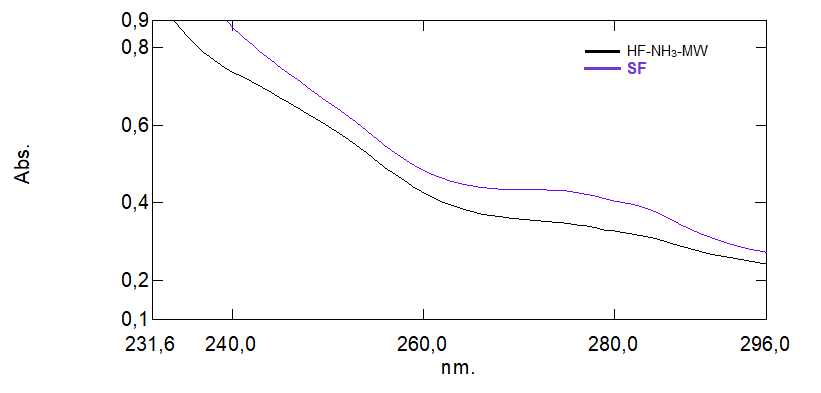
The light absorption values of “HF” solutions at 280 nm were determined and the A/l and C correlation graphs were plotted (Figure 2). To determine the molecular mass of “HF”, it is necessary to determine the angular length (α) of the graph line A/l—C concerning the C axis. Molecular mass is determined by the following formula.
| (1) |
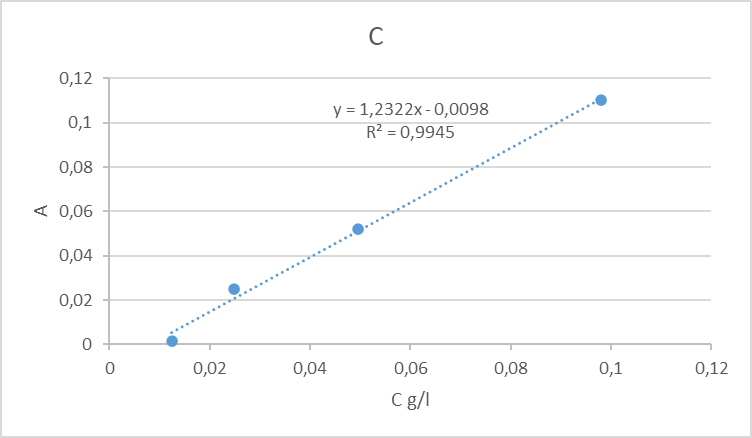
Based on the results obtained by spectrophotometry, it was determined that the molecular mass of «HF» obtained under the influence of MW rays in an alkaline medium (equation 1) is 388.3 kDa. The decrease in molecular weight can be explained by the hydrolysis process.
Results of using HF sorbent in oil bleaching. Hydrolyzed fibroin («HF» – obtained under alkaline conditions by microwave radiation) sample are used in the purification of cottonseed oil. As a result of the cleaning process, the red color unit of the fat was reduced from 12 to 9. The acid number decreased from 0.33 mmol /L to 0.15 mmol L. There was also a significant decrease in the peroxide number, which decreased from 10.58 mmol/L to 6.22 mmol/L. The table below shows the cottonseed oil purification performance of the sample.
Table 1.
Parameters of cottonseed oil
| Parameters | Unrefined oil Indicators |
Oil refined with sample HF |
|---|---|---|
| Color level | Yellow unit:35 Red: 12 |
Yellow unit:35 Red: 9 |
The amount of Acid (mmol/L) |
0.33 | 0.15 |
| Peroxide value (mmol/L) | 10,58 | 6.22 |
According to the bleaching results, the HF sorbent significantly reduced the acid number of cottonseed oil, and the decrease in peroxide value affects the increase in the shelf life of the oil.
FTIR spectra analysis of oil samples. FTIR analysis of unbleached crude cottonseed oil and cottonseed oil bleached with HF sorbent ATR-IR Fourier spectroscopy analyses were performed on a “FTIR 4600 JASCO” spectrophotometer and studied in the range of 4000 – 400 cm-1 [16].
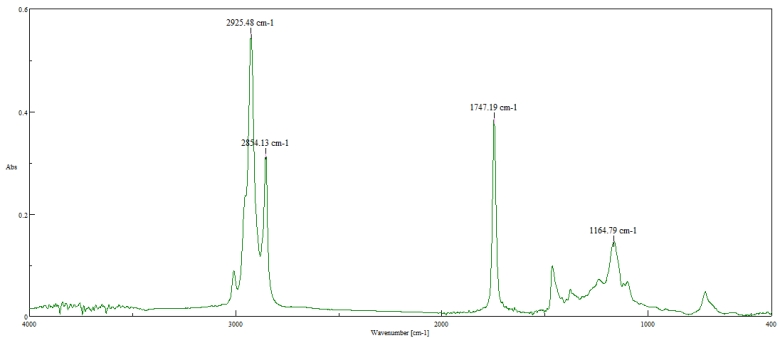
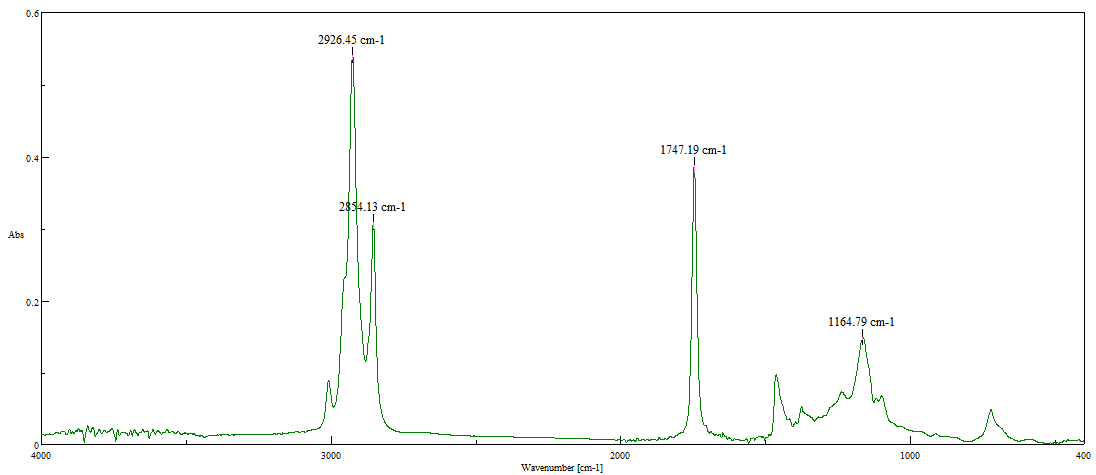
The FTIR spectra of the crude and bleached cottonseed oils demonstrate that adsorption bleaching using the silk fibroin sorbent does not affect the molecular structure of triglycerides. The characteristic absorption bands at 2926, 2854, 1747, and 1165 cm-¹ remain unchanged after treatment, while slight intensity changes in the fingerprint region indicate the effective removal of pigments and other minor impurities. These results confirm the high selectivity of the silk fibroin sorbent for oil purification without causing chemical degradation of the oil.
Conclusion
Silk fibroin treated with 25 % aqueous ammonia solution and then microwave irradiation underwent significant structural modification, as confirmed by UV-Vis spectroscopy and molecular weight analysis. The processed fibroin showed a molecular weight of 388.3 kDa. These structural changes increased the adsorption capacity of the material towards impurities in cottonseed oil. Hydrolyzed silk fibroin showed effective sorption performance during bleaching, reducing the acid value to 0.15 mmol/L and the peroxide value to 6.2mmol/L. FTIR analysis confirmed that no new chemical bonds were formed between the sorbent and the purified oil.
Overall, the results indicate that ammonia- and microwave-treated silk fibroin is a promising, environmentally friendly, and sustainable biobased sorbent for the purification of vegetable oil. The proposed modification method is simple, efficient, and suitable for value-added utilization of silk fibroin waste.
References
